
Chemical protective clothing levels range from A to D: Level A provides the highest respiratory and skin protection, Level B combines the highest respiratory protection with chemical splash protection, Level C uses suitable air-purifying respiratory protection under verified conditions, and Level D provides basic work-uniform protection. These categories help employers select personal protective equipment (PPE) for chemical exposure while matching protective clothing to the work being performed.
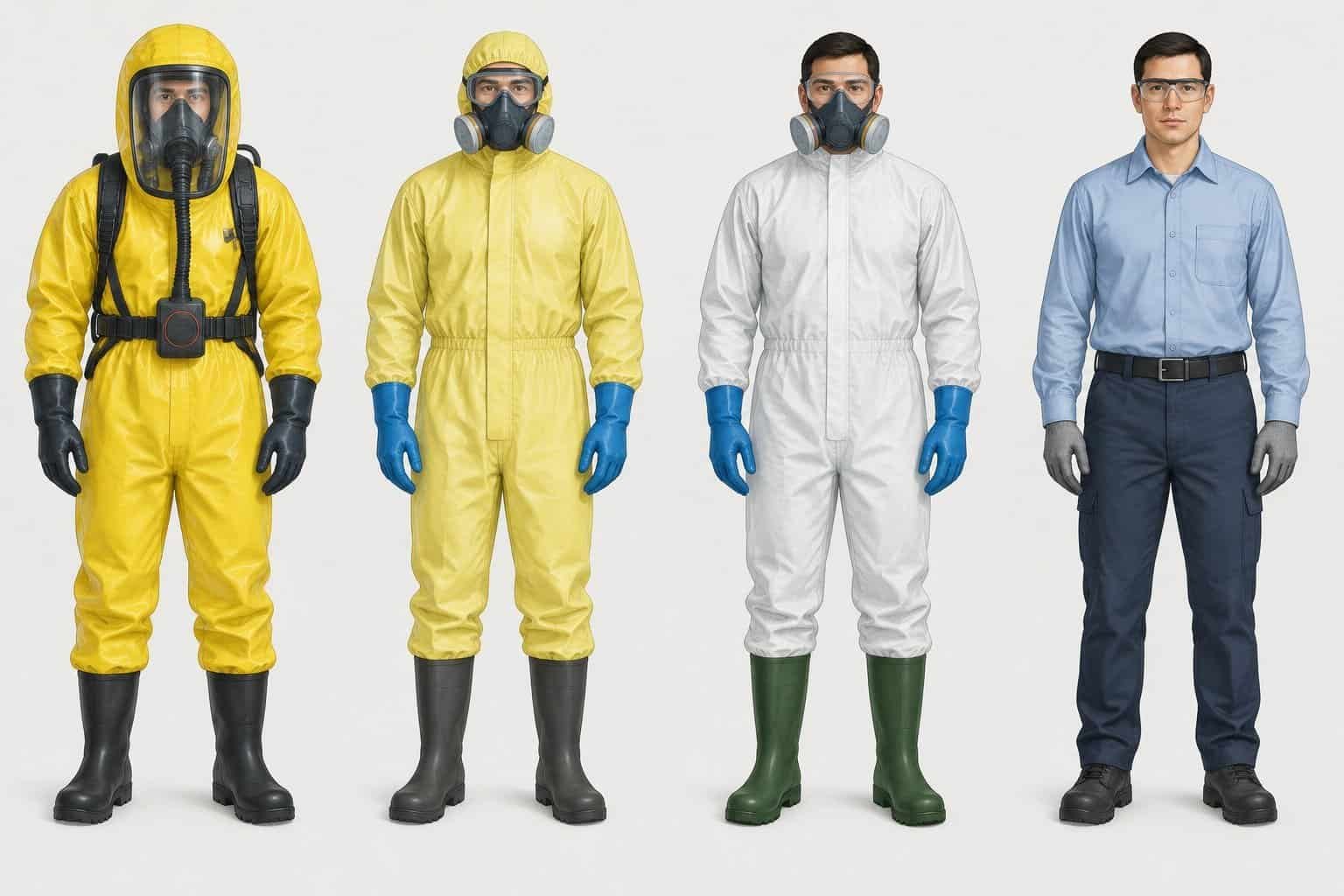
For workwear buyers, the critical distinction is between an ensemble’s protection category and a textile’s documented performance. A garment’s appearance or repellent finish does not establish its suitability for a hazardous chemical. Effective protection requires compatible clothing and respiratory equipment supported by exposure-specific evidence.
How Do Levels A–D Compare?
Levels A–D describe combinations of respiratory equipment and protective clothing selected for particular workplace hazards. OSHA’s 29 CFR 1910.120 Appendix B identifies four PPE categories based on the degree of protection afforded, while EPA guidance uses the same A–D framework.
At-a-Glance Comparison of Respiratory and Skin Protection
The comparison below summarizes the principal differences between the four PPE levels. Each category still requires chemical-specific material selection and assessment of the complete ensemble.
| Selection criterion | Level A | Level B | Level C | Level D |
|---|---|---|---|---|
| Respiratory equipment | Positive-pressure SCBA or SAR with escape SCBA | Positive-pressure SCBA or SAR with escape SCBA | Suitable APR under verified conditions | No working respiratory protection |
| Body protection | Totally encapsulating vapor-protective suit | Hooded chemical splash clothing | Chemical-resistant clothing matched to exposure | Work uniform |
| Skin protection | Highest category | Chemical splash protection | Exposure-specific chemical protection | Minimal protection |
| Atmospheric conditions | Severe respiratory and skin hazards | Severe inhalation hazards; lesser skin hazard | Known contaminants; adequate oxygen; non-IDLH | No known atmospheric hazard |
| Key limitation | Chemical-specific suit compatibility | Clothing lacks Level A vapor protection | All APR-use criteria must be met | Unsuitable for hazardous chemical exposure |
SCBA means self-contained breathing apparatus; SAR means supplied-air respirator. Hazmat suits alone do not establish the protection level because the breathing equipment and component interfaces also determine ensemble performance.
Why PPE Levels Describe Ensembles, Not Fabric Grades
An ensemble includes the suit and respiratory equipment together with compatible gloves, footwear, and other necessary protection. Its performance depends on how those components function together during the assigned task.
A fabric sold as chemically resistant still needs evidence for the substance and exposure involved. The A–D designation does not establish universal chemical resistance, and a fabric test cannot establish the protection of a completed ensemble.
When Is Level A Protection Needed?
Level A protection is selected when the greatest degree of respiratory, skin, and eye protection is required. Severe skin hazards and chemicals capable of harmful skin absorption are important triggers.
Highest Respiratory, Skin, and Eye Protection
Level A PPE addresses situations involving highly hazardous vapor or liquid contact, including suspected substances that present serious skin hazards. High concentrations alone do not settle the clothing decision; the assessment must also establish the consequences of skin and eye exposure.
Uncertainty requires conservative decisions by qualified personnel. Confined or poorly ventilated conditions warrant Level A consideration when conditions requiring that protection have not been ruled out, alongside any applicable confined-space controls.
Fully Encapsulating Suits and Positive-Pressure Air Supplies
Fully encapsulating suits provide vapor protection through a tested garment system with compatible closures and interfaces. A hooded coverall’s appearance provides no evidence of vapor-tight performance.
The respiratory component uses positive-pressure, full-face SCBA or a positive-pressure supplied-air respirator with escape SCBA. EPA identifies both breathing-air configurations for Level A protection. Suit compatibility must cover the actual chemical, including gloves and visor materials.
What Does Level B Protect Against?
Level B protection combines the highest respiratory protection with chemical-resistant clothing selected for liquid splash exposure. Its suitability rests on evidence that the skin hazard requires less protection than Level A.
Highest Respiratory Protection with Chemical Splash Protection
Level B PPE includes hooded chemical-resistant clothing with chemical-resistant gloves and boots. The clothing provides meaningful splash protection when its materials and construction match the chemicals present.
An immediately dangerous to life or health (IDLH) inhalation hazard does not automatically require a vapor-protective suit. Level B is appropriate only when the assessment also establishes that the substance presents no skin hazard requiring Level A protection.
Why Level B Requires Supplied Breathing Air, Not an APR
Level B uses breathing air delivered independently of the contaminated atmosphere. Its respiratory equipment is positive-pressure, full-face SCBA or an appropriate positive-pressure SAR with escape SCBA.
An air-purifying respirator cannot supply oxygen and does not satisfy Level B respiratory requirements. An oxygen-deficient atmosphere requires suitable atmosphere-supplying respiratory equipment; additional skin hazards determine whether Level A clothing is necessary.
When Can Level C Be Used?
Level C PPE is appropriate only after identified contaminants and measured concentrations establish that suitable air-purifying respiratory protection is permitted. Adequate oxygen and chemical-resistant clothing matched to the exposure remain essential.
Known Contaminants, Measured Concentrations, and Adequate Oxygen
Air monitoring must establish the airborne substances and their concentrations before an air-purifying respirator (APR) is selected. Atmospheric monitoring must also address changing conditions throughout the work.
OSHA’s technical guidance specifies at least 19.5% oxygen and concentrations below IDLH levels for Level C. Those conditions alone are insufficient: concentrations must also remain within the selected respirator’s maximum use limits, and exposed skin must remain protected from harmful contact or absorption.
Respirator Approval, Cartridge Selection, and Change Schedules
Air-purifying respirators require NIOSH approval and a configuration suitable for the identified hazard. A particulate filter captures specified particles; gas or vapor exposure requires an appropriate cartridge or canister.
For gas and vapor cartridges, the respiratory protection program must establish a suitable end-of-service-life indicator or a documented change schedule. Odor provides an unreliable replacement signal because warning properties and individual sensitivity vary.
Facepiece selection also affects eye protection. A half-mask APR requires separate protection wherever chemical exposure threatens the eyes.
What Are the Limits of Level D?
Level D protection is a work uniform with task-specific basic PPE for conditions that preclude hazardous chemical exposure. It provides minimal skin protection and no working respiratory protection.
Work Uniforms and Task-Specific Basic Protection
Level D PPE includes coveralls or other suitable work clothing, with safety footwear and eye protection selected for the task. Additional equipment addresses assessed physical hazards.
The choice of workwear fabric affects comfort and durability during routine work. Those properties support daily use but establish no chemical barrier performance.
Why Level D Is Not Chemical-Exposure Protection
Level D is unsuitable where work creates hazardous chemical splash, immersion, or unexpected inhalation or contact. A cold zone supports Level D use only while assessment and monitoring confirm appropriate conditions.
Zone boundaries require reassessment when releases or work activities change. The presence of chemical-resistant boots or gloves within an otherwise basic uniform does not authorize entry into an area requiring higher protection.
How Should Employers Select Ensembles and Materials?
Employers should base PPE selection on a documented hazard assessment supported by chemical-specific performance evidence. Site characterization establishes the exposure conditions, while material and ensemble testing establishes whether the proposed equipment provides sufficient protection.
Assess Chemical Identity, Concentration, Contact Routes, and Tasks
The assessment identifies hazardous materials and their physical form, concentration, and potential routes of exposure. Safety data sheets provide a starting point, supplemented by workplace measurements and task observations.
Relevant operating conditions include contact duration, temperature, pressure, and the likelihood of repeated splashes. Kneeling in contaminated liquid requires different garment coverage and seam performance from handling closed containers.
Chemical families also require distinct compatibility checks. Evidence for acid-resistant fabrics does not establish performance against every acid concentration, while alkali resistance requires separate verification for the substance and conditions involved.
Evaluate Chemical Penetration, Permeation, and Degradation Data
Protective materials fail through different mechanisms, each requiring attention:
- Chemical penetration: bulk movement through openings, pores, damaged areas, or construction features.
- Chemical permeation: molecular movement through a material, including material that appears intact.
- Degradation: a harmful change in material properties after chemical contact, such as swelling, softening, or embrittlement.
An evaluation of chemical-resistant fabrics should identify the exact tested material and chemical concentration. Manufacturer documentation should also specify test conditions and relevant seam or closure performance.
Laboratory breakthrough time does not establish a universal safe wearing period. Workplace temperature, mixtures, abrasion, and prior contamination affect protection; a suit’s service limit requires a conservative, task-specific decision.
Compare Material Compatibility and Whole-Ensemble Interfaces
Nitrile, butyl rubber, neoprene, Viton, polyvinyl chloride (PVC), and polyvinyl alcohol (PVA) have different compatibility profiles. Material names alone are insufficient because thickness and formulation affect performance.
PVA illustrates the importance of exposure conditions: its water sensitivity limits suitability for aqueous environments. Mixture-specific evidence is necessary when individual chemical results fail to represent the actual exposure.
A chemical protective suit also requires compatible glove connections and footwear interfaces. Overboots need adequate fit and traction, while sleeves, closures, and respiratory equipment must maintain coverage during reaching or bending.
How Do PPE Levels Differ from Garment Types and Fabric Finishes?
PPE levels classify the selected protective ensemble, garment types describe specified garment performance, and fabric finishes modify textile properties. Each addresses a different part of the protection decision.
European Garment Types Are Not Direct Equivalents to A–D
European chemical protective garment types identify performance against defined exposure forms. Examples include Type 1 gas-tight clothing, Type 3 liquid-tight clothing, Type 4 spray-tight clothing, Type 5 airborne-particle protection, and Type 6 limited liquid protection.
Those designations do not establish the respiratory protection used with the garment. A Type 3 label therefore does not independently establish a Level B or Level C ensemble.
Selection requires examination of the applicable standard and the garment’s chemical test results. The respiratory equipment and remaining components must then meet the assessed workplace hazards.
Chemical Repellency Is Different from Barrier Chemical Resistance
Chemical-repellent fabrics reduce wetting or liquid uptake under specified conditions. Barrier chemical resistance requires evidence that the material and garment resist the relevant penetration and permeation hazards.
Levitex produces chemical-repellent fabrics through post-treatment finishing on cotton, cotton/nylon (C/N), and cotton/polyester (CVC) base fabrics. These products provide chemical liquid repellency; their protection levels, use cases, and test results differ from barrier-based chemical-resistant fabrics.
The distinction between waterproofing, water resistance, and repellency helps explain why surface beading alone establishes limited information about a textile’s barrier performance. Chemical exposure requires its own substance-specific assessment.
Protective claims also require attention to the treatment involved. Fabric finishes alter particular properties, and flame-retardant finishing addresses a separate hazard from chemical permeation.
Verify Current Standards Rather Than Relying on Historical References
Historical standard numbers require a current-status check before procurement specifications are finalized. OSHA Appendix B names NFPA 1991, NFPA 1992, and NFPA 1993, but those references do not establish that each document remains a current standalone standard.
Purchasing specifications should identify the applicable current standard and edition, together with the certification scope. Product documentation must support the claimed protection for the supplied garment configuration.
Chemical protection also requires separate consideration from thermal and electrical protection. Flame-resistant clothing addresses ignition and burning behavior, while arc-flash clothing materials require performance evidence relevant to electrical arc exposure.
What Makes Protective Clothing Safe to Use?
Protective clothing requires trained personnel, a functioning respiratory protection program, and controlled work procedures. Safe use also depends on managing the burdens introduced by the equipment itself.
Qualified Training and Respiratory Protection Programs
HAZWOPER training must match employees’ assigned roles in hazardous waste operations or hazardous materials response. A protection-level label provides no authorization or competence to perform hazmat response.
Training covers equipment limitations and practical use, including donning, doffing, and emergency actions. HHS guidance identifies proper fit and PPE-use training as requirements for effective protection.
Required respirator use also needs an appropriate program covering medical evaluation, equipment selection, maintenance, and training. Tight-fitting facepieces require fit testing and a seal check each time they are donned.
Heat Stress, Mobility, and Work-Duration Planning
Chemical protective clothing restricts heat loss, and encapsulating equipment adds substantial physiological strain. Planning must account for workload and environmental conditions alongside individual medical suitability.
Work periods need allowances for travel and decontamination before breathing-air reserves become critical. Cooling and recovery arrangements should be established before entry.
Mobility checks should confirm that personnel perform assigned movements without opening gaps or disrupting equipment. Restricted vision, reduced dexterity, and communication difficulties also affect safe task completion.
Inspection, Decontamination, and Reassessment as Conditions Change
Inspection must confirm serviceable materials and functioning components before use. Damage around closures or glove attachments deserves particular attention because small defects compromise coverage.
Decontamination planning must address the chemicals involved and prevent secondary exposure during removal. Reusable equipment requires a validated cleaning method and confirmation that continued service remains permitted.
Hot zone conditions and atmospheric results require continuing review. Changes in contaminants or work scope trigger reassessment by responsible safety personnel before the ensemble’s protection level is changed.
Match the Entire Ensemble to Verified Workplace Hazards
Effective chemical protection combines exposure-specific clothing with suitable respiratory protection and compatible accessories. Levels A–D provide a selection framework; chemical resistance remains specific to the material and workplace conditions.
Employers should document the selected ensemble, supporting test evidence, respiratory requirements, and operating limits. Chemical-repellent workwear belongs within that assessment according to its demonstrated performance, with inspection and reassessment continuing throughout use.
Frequently Asked Questions
Chemical protective clothing decisions require both a suitable protection category and verified equipment performance. The following answers address common classification and use questions.
What is the highest level of chemical protective clothing?
Level A provides the highest combined respiratory, skin, and eye protection within the A–D framework. A Level A hazmat suit still requires chemical-specific compatibility evidence and suitable positive-pressure breathing equipment.
How are Level A and Level B PPE the same?
Level A and Level B use the same category of highest respiratory protection: positive-pressure, full-face SCBA or an appropriate positive-pressure SAR with escape SCBA. Both require compatible chemical-resistant accessories; their principal difference is the degree of skin protection.
Can an air-purifying respirator be used with Level B PPE?
An air-purifying respirator does not satisfy Level B respiratory requirements. APR use belongs within Level C selection when identified contaminants, measured concentrations, adequate oxygen, and all other respirator-use criteria permit it.
Is there a Level E in OSHA’s chemical protection framework?
OSHA’s 29 CFR 1910.120 Appendix B uses Levels A, B, C, and D. It contains no Level E category for chemical protective clothing or PPE ensembles.
Does chemical-repellent workwear qualify as Level C PPE?
Chemical-repellent workwear alone does not qualify as Level C PPE. Level C requires suitable air-purifying respiratory protection and clothing supported by evidence for the assessed exposure; a repellent finish establishes neither complete ensemble protection nor automatic barrier chemical resistance.
How long can a chemical protective suit be worn safely?
A chemical protective suit has no universal safe wearing duration. The permitted work period must account for chemical-specific material limits, breathing-air availability, heat stress, task demands, and the time required for exit and decontamination.