
To wash flame-resistant fabric clothing safely, follow your garment’s current care label and employer-approved laundry program, use approved cleaning products, and inspect the garment before wearing it again. Your wash settings and drying method must match the specific fabric and finished garment to preserve protective performance and usable fit.
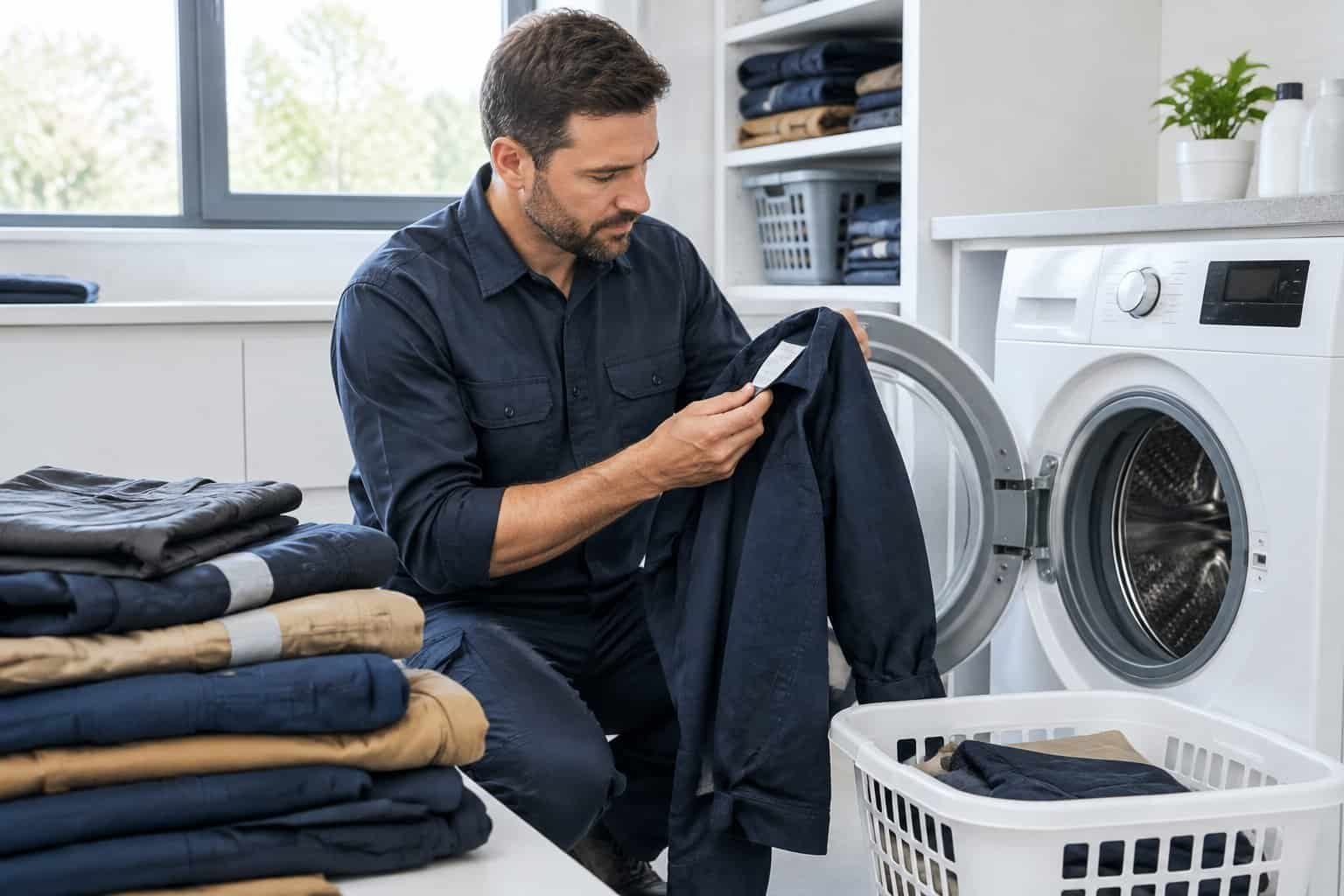
When you work around heat or ignition hazards, keeping your flame-resistant clothing clean is part of maintaining your personal protective equipment (PPE). Oil and other flammable residues require particular attention because they introduce fuel onto the garment.
Knowing how to wash flame resistant clothing also means recognizing when to stop and request professional assessment. A completed wash cycle gives you no assurance that heavy contamination has been safely removed.
Which Care Instructions Apply to Your FR Garment?
Use the instructions for your exact garment together with your employer’s PPE requirements. Check the fabric specification and permitted laundering route before choosing a cleaning process.
Identify the Fabric, Garment Label, and Employer Requirements
Read the sewn-in care label and identify your garment’s manufacturer, product code, and fiber composition. Keep any supplied technical instructions with your uniform records, especially when you manage several garment styles.
Check your employer’s requirements for contamination handling and return-to-service approval. If instructions conflict or your label is unreadable, hold the garment out of use while your safety manager obtains clarification.
Understand Inherent and Treated FR Care Requirements
Identify whether your garment uses inherently flame-resistant fibers, an FR treatment, or a combination. Inherent flame resistance comes from the fiber’s properties; treated fabrics obtain their FR characteristics through a manufacturing treatment.
When you compare flame-retardant fabrics, request care instructions for the specific construction. Neither category gives you permission to ignore laundering limits, and a treated fabric designation alone tells you nothing about its validated wash life.
Confirm Whether Home or Industrial Laundering Is Permitted
Confirm that both your garment instructions and workplace policy permit home washing before taking workwear home. Use the designated industrial laundry when your employer requires controlled processing or contamination handling.
If you need to clean an arc flash suit, check each component’s instructions separately. Your hood, face shield, and multilayer garments require their own maintenance procedures; a shirt’s care label does not authorize the same process for the entire ensemble.
Check Contamination and Sort Before Washing
Inspect your workwear before it enters the laundry so you select a process suited to its contamination. Keep suspect garments separate while you establish safe handling requirements.
Inspect for Oil, Grease, and Other Flammable Contaminants
Check cuffs and pocket openings, then examine knees and other areas that contact equipment. Look for oily patches, embedded grease, fuel exposure, and residues from workplace chemicals.
Treat known contamination as significant even when your garment looks presentable. Your laundry process needs to remove potentially flammable contaminants because retained contamination compromises the protection your FR garment provides.
When Does Contamination Require Specialist Assessment?
Arrange specialist assessment when your clothing has heavy oil or fuel contamination, unknown chemical exposure, or contamination that remains after approved cleaning. Keep the garment out of service until your safety manager or qualified laundry provider determines the next step.
Use your workplace’s designated collection procedure for these items. Avoid experimenting with solvents, concentrated degreasers, or repeated household washing, and keep fuel-contaminated clothing out of a household dryer.
Separate Loads According to the Approved Laundry Program
Sort your garments by compatible care instructions and contamination category. Follow your approved program’s requirements for separating FR workwear from household laundry or other work clothing.
Keep heavily contaminated items apart from lightly soiled garments to limit cross-contamination. Give your laundry provider the identity of known contaminants and any relevant safety data sheet information before processing begins.
Follow a Label-Specific Washing and Drying Workflow
Match every stage of your laundry cycle to the approved instructions for your garment. When washing flame-retardant fabrics, temperature alone is insufficient: your process also needs suitable chemistry, loading, rinsing, and drying conditions.
Prepare Garments and Select the Specified Wash Settings
Use this preparation sequence once your garment has passed the contamination check:
- Empty pockets and remove detachable items as instructed.
- Prepare closures and turn garments inside out if the manufacturer specifies.
- Check the machine for residues from previous loads.
- Select the prescribed cycle, water temperature, and load size.
- Use only an approved pretreatment for localized soiling.
Leave enough room for the movement and rinsing required by your laundry program. Avoid substituting a delicate cycle or higher temperature on the assumption that either provides better care.
Check Approval for Detergents, Bleach, Softeners, Starch, and Additives
Choose a detergent that your garment manufacturer or laundry program approves, and check the complete formulation. A familiar brand name does not establish suitability for every product sold under that brand.
Before adding anything beyond the approved detergent, verify its status:
- Bleach: Check restrictions covering chlorine bleach, oxygen bleach, and peroxide-containing products.
- Softeners and dryer sheets: Check whether residue-forming products are prohibited.
- Starch: Use only with explicit approval.
- Soap-based cleaners: Check restrictions intended to prevent deposits.
- Other additives: Obtain approval for sanitizers, stain removers, scent products, and water-treatment chemicals.
Measure the approved dose for your machine and soil level. If you cannot establish compatibility, leave the product out and request guidance.
Rinse and Dry According to the Garment Instructions
Complete the prescribed rinsing stages so your garment leaves the wash with acceptable detergent removal. In an industrial program, follow the specified checks for wash chemistry and final rinsing.
When you dry flame-retardant clothing, use the permitted method and heat setting. Follow any instructions for load size and removal timing, and avoid overdrying; excessive drying contributes to shrinkage and unnecessary wear.
Inspect Clean Garments Before Returning Them to Service
Return your clothing to service only after it passes the required condition check. Inspect the cleaned garment under good lighting and assess whether you still have the coverage and functioning closures your task requires.
Check for Residual Contamination, Damage, and Shrinkage
Examine your garment for remaining oily areas, chemical residues, or unusual stiffness. A stain alone does not tell you whether hazardous contamination remains, so refer uncertain areas for assessment.
Check fabric thinning, holes, damaged seams, burns, and failed fasteners. Also assess FR clothing shrinkage: sleeves that expose your wrists or restricted movement require attention even when the fabric appears sound.
Use Approved Repairs and Compatible Components
Arrange repairs through the service your employer or garment manufacturer approves. Your repair materials need to match the garment’s protective requirements, including suitable thread and replacement fabric.
Check approval before adding patches, logos, reflective trim, or replacement closures. Keep the garment out of use until the repair and any required inspection are complete.
Remove Garments From Service When Their Condition Is Unacceptable
Remove your garment from service when contamination remains unresolved, damage exceeds approved repair limits, or fit no longer provides the required coverage. Report accidental exposure to prohibited laundry chemicals so your safety manager can assess it.
Base your FR clothing service-life decision on documented limits and garment condition. Follow your employer’s retirement procedure, including identification that prevents rejected garments from returning to the uniform supply.
What Evidence Supports Industrial Laundering Durability?
Support your durability decisions with product-specific test results and records of the laundry process used. Match any claimed performance to the exact fabric, test conditions, and protective properties evaluated.
Follow Employer and Industrial Laundry Instructions
Give your laundry provider the current garment instructions and details of workplace soiling. Confirm how the provider controls processing and handles garments that fail inspection.
For your industrial program, ASTM F1449 addresses care and maintenance of flame-resistant or arc-rated clothing, including compatibility of laundry processes and materials. Its scope separates industrial laundering from home laundering and dry cleaning, so use the applicable instructions for your chosen route.
Understand the Scope of ISO 15797
When you receive an ISO 15797 claim, read it as a reference to industrial washing and finishing procedures used for testing workwear. Ask which procedure was used and which properties were measured afterward.
To substantiate FR durability, request the associated protective-performance results for your specific fabric or garment. An ISO 15797 reference alone does not establish retained flame resistance, an arc rating, or a guaranteed service life.
Keep Product-Specific Test Reports and Laundry Records
When you check whether fabrics meet quality standards, connect each report to an identifiable product specification. Request the tested laundering conditions and cycle count alongside the relevant post-laundering results.
Your records should identify:
- Fabric or garment product code and construction.
- Test methods, laundering procedures, and tested cycle count.
- Results for the protective properties being claimed.
- Applicable dimensional-change or strength results.
- Laundry history, repairs, contamination events, and retirement decisions.
Keep these documents available to your safety team. A result for a different blend or finish does not substantiate the performance of your selected workwear.
Preserve Protection With Verified Care Instructions
Preserve your FR workwear by following verified care instructions and resolving contamination before reuse. Use your approved laundry process, inspect the cleaned garment, and follow documented repair or retirement decisions.
For your specific LEVITEX fabric, ask Charlie@levitex.com for care guidance and available supporting documentation. Include your fabric reference and intended laundering process so you can request information relevant to your application.
Frequently Asked Questions
Use these answers to resolve common product questions while keeping your garment label and employer’s program as the operating instructions.
Can you wash flame-resistant clothing at home?
You can wash your FR clothing at home when your garment manufacturer and employer permit it. Heavy flammable contamination or hazardous chemical exposure requires assessment before you choose a cleaning route.
What laundry detergent should you use for FR clothing?
Use the detergent approved for your specific garment and laundry program. Check the full formulation for restricted ingredients, including bleach or softening additives, and follow the prescribed dosing instructions.
Can you use OxiClean on flame-resistant clothing?
Use an OxiClean product on your FR clothing only with explicit approval for that formulation and garment. Check restrictions on oxygen bleach and peroxide-containing ingredients before applying it, including as a spot treatment.
Can you use dryer sheets on FR clothing?
Use dryer sheets only when your garment instructions explicitly permit them. If approval is absent, dry your garment without them and ask the manufacturer about an approved approach to static control.
How should you dry flame-resistant clothing?
Dry your FR clothing using the method and heat setting stated in its care instructions. Follow any removal-timing requirements and check the finished garment for shrinkage before returning it to use.
How many times can flame-resistant clothing be washed?
Determine your garment’s permitted wash life from product-specific documentation and your employer’s retirement criteria. Ask for the tested laundering conditions and retained-performance results; a tested cycle count does not authorize continued use of damaged or contaminated clothing.