LEVITEX manufactures workwear and flame-retardant fabrics, including cotton, cotton/nylon, and cotton/polyester options, for garment manufacturers and industrial uniform suppliers serving petroleum, smelting, and machinery manufacturing. We support wholesale sourcing and custom fabric development with dyeing, printing, and application-specific functional finishing, with specifications and testing requirements agreed for each order.
How to Choose Workwear Fabric for Prioritizing Comfort?
Comfortable workwear comes from matching fabric structure to how long a shift runs, how much a worker moves, and how hot or humid the job site gets. A fabric that feels soft initially may trap heat or cling to skin during eight hours of labor. Choosing the right material requires evaluating real-work performance rather than just swatch feel. Moisture absorption, drying speed, and airflow are three distinct properties; strength in one does not guarantee performance in another. For example, heavy cotton absorbs sweat well but dries slowly, whereas dense synthetics may dry quickly but trap heat. Always request separate data for each property instead of assuming they correlate.
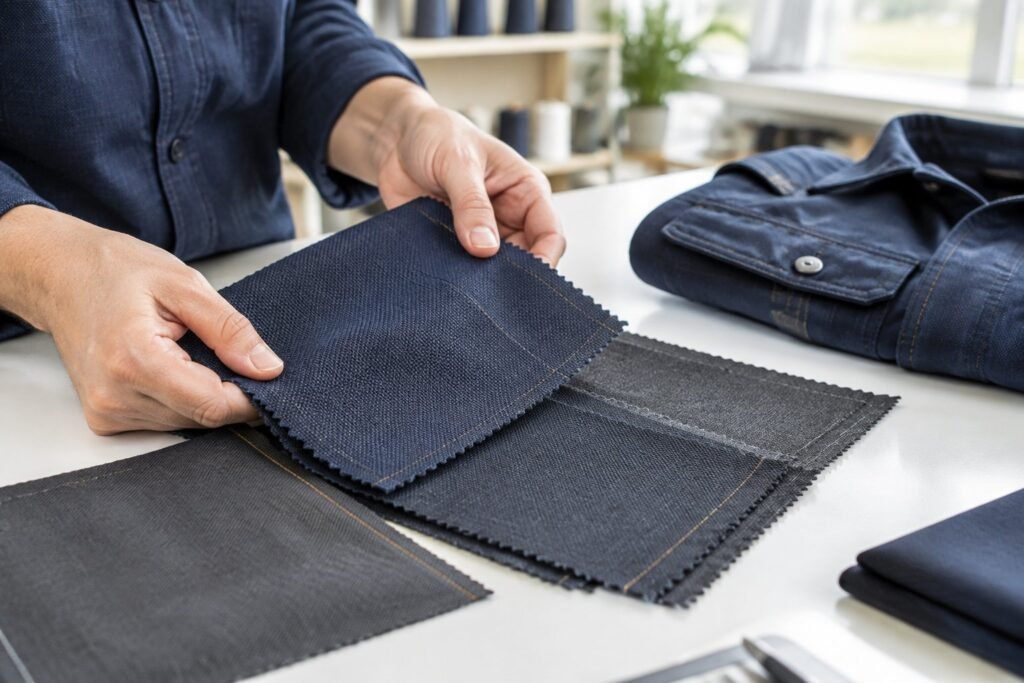
Composition, weave, and weight each change how a fabric wears on the body, and none of them should be judged in isolation. A detailed breakdown of fiber options appears in our guide to cotton workwear fabric selection, which covers how cotton, cotton/nylon, and cotton/polyester substrates compare for daily wear. Request finished, cut-and-sewn samples in your garment style before committing to volume, since loose yardage does not show how a fabric drapes or moves on a body.
How to Choose Workwear Fabric for Demanding Wear?
Durable fabric for work jackets, trousers, and coveralls has to hold up against tool contact, rough surfaces, and repeated flexing at the knees and elbows, not just resist a single snag test. Fabric weight alone does not tell you how a construction performs against a sharp edge or a gritty wall, and a ripstop grid does not by itself prove abrasion resistance across the whole garment.
Abrasion resistance measures rubbing resistance, tear strength prevents cuts from spreading, and tensile strength measures breaking force under pulling. Because a fabric can score differently on each test, request separate data for the exact construction you plan to order rather than relying on general product families. A full comparison of fiber and blend options for demanding jobs is available in our guide to compare workwear fabric materials.
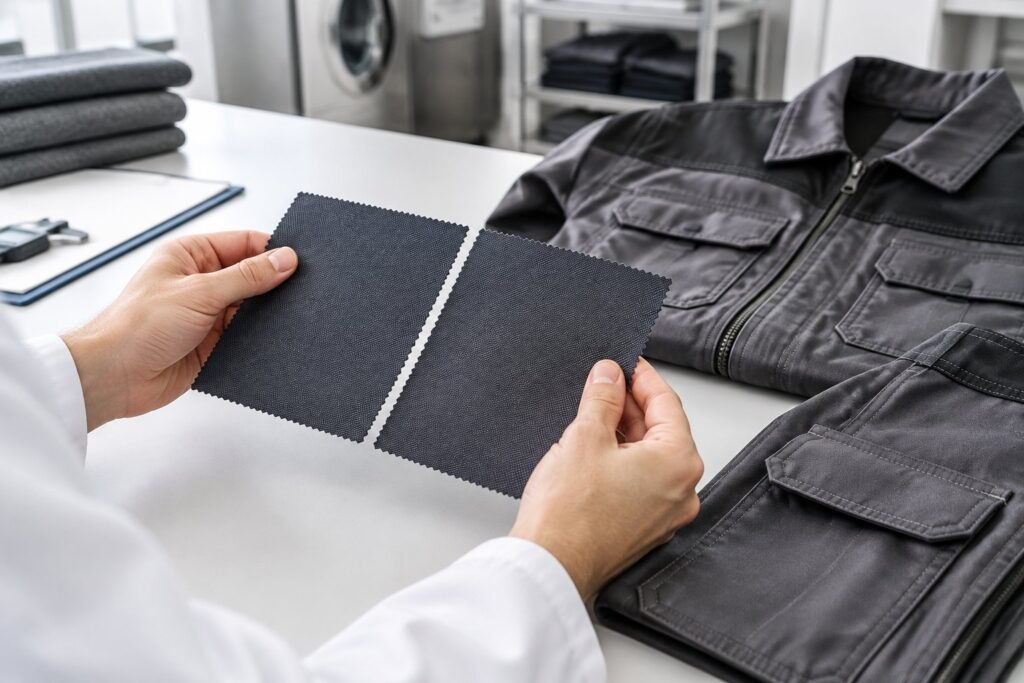
Lab test numbers only tell part of the story. Ask for sewn sample garments in the finished weight and finish, then check wear points at the knees, seat, and forearms after simulated rough use. This confirms the fabric performs in the places where tools, ladders, and equipment actually make contact.
Checking Stability After Repeated Washing
Work uniforms need to hold their size, color, and seam shape through the specific laundry and drying process they will actually go through, whether that’s a home washing machine or an industrial laundry line. Preshrunk fabric reduces shrinkage; it does not eliminate it, so acceptance criteria should state a maximum percentage rather than assume zero change.
Home and industrial laundering differ in temperature, detergents, and friction; passing one test doesn’t guarantee passing the other. Always specify the exact wash and dry cycle before requesting data, as wrong test conditions yield irrelevant results. Additionally, measure dimensional change in both length and width, while evaluating colorfastness across repeated washes and checking for post-wash seam skew.
Our guide to fabric shrinkage and dimensional stability explains how these measurements are taken and reported. Agree on acceptance thresholds for each property before bulk production starts.
Matching Protective Performance to the Hazard
Protective workwear fabrics need hazard-specific evidence for the exact fabric and garment construction, since general comfort or durability claims do not establish protection against a named risk. A job hazard assessment should identify the specific exposure (thermal, chemical, or physical) before a fabric gets selected, not after.
Everyday workwear and protective fabric are not interchangeable. Jobs involving flame, arc, or chemical exposure require documented test results under applicable standards rather than general comfort or durability claims.
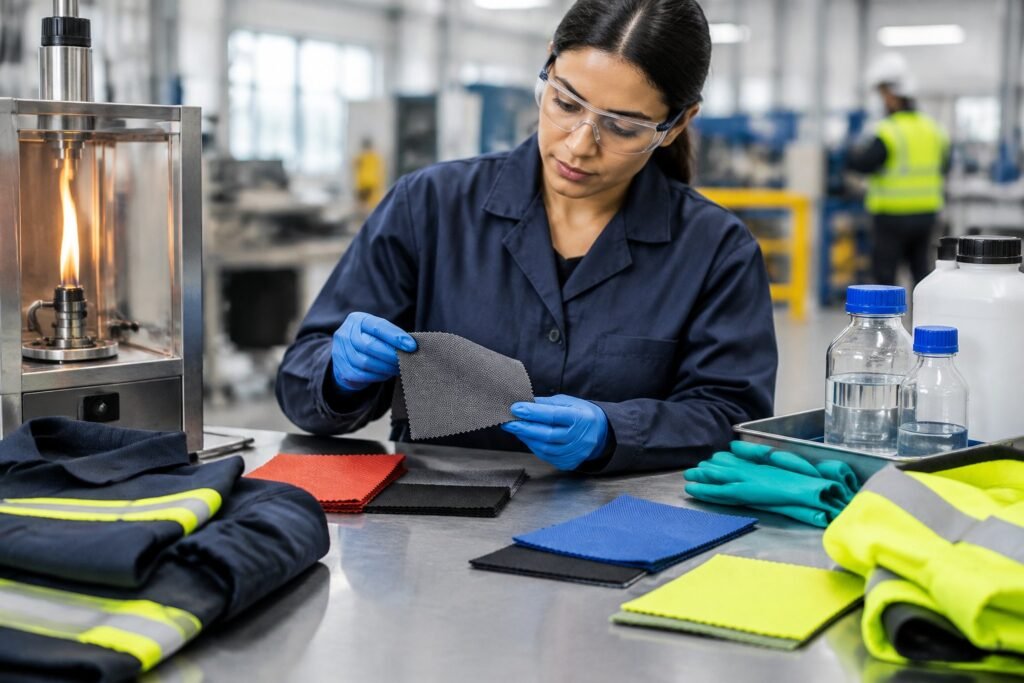
LEVITEX produces chemical-repellent fabrics via post-treatment finishing on cotton, cotton/nylon, and cotton/polyester blends, making liquids bead and roll off. This differs from barrier-based chemical-resistant fabrics designed to block permeation. Because each category uses different test methods, always request data matching the specific hazard rather than relying on a general label. Our page on functional finishes for workwear outlines how post-treatment finishes are applied and what they change about a base fabric.
What Should You Include in a Fabric Sourcing Request?
Defining the Application, Construction, and Finishing Requirements
State the garment type, the work environment, and whether the fabric needs a specific weave, knit, or coating. Give a target composition and weight range rather than a vague description, and name any functional finish the job requires, such as water repellency or chemical repellency. The clearer this is upfront, the fewer rounds of back-and-forth your order needs before sampling starts.
Agreeing on Samples, Test Evidence, and Acceptance Criteria
Request a swatch or cut sample first, then a finished garment sample before bulk production. Agree on which test methods apply, what pre-treatment or wash cycle precedes testing, and what minimum or maximum values count as a pass. Lock these details in writing against the exact fabric code before placing a production order.
Send your garment application, composition preference, fabric weight, laundering process, and any required performance tests to Charlie@levitex.com, and we will work from those specifics to recommend a fabric and sampling path suited to your order.