
A strip test measures fabric tensile strength by gripping the specimen’s full width; a grab test grips its central portion, allowing adjacent yarns to help carry the load. That difference changes the measured breaking force and makes the test method essential when buyers compare workwear fabrics.
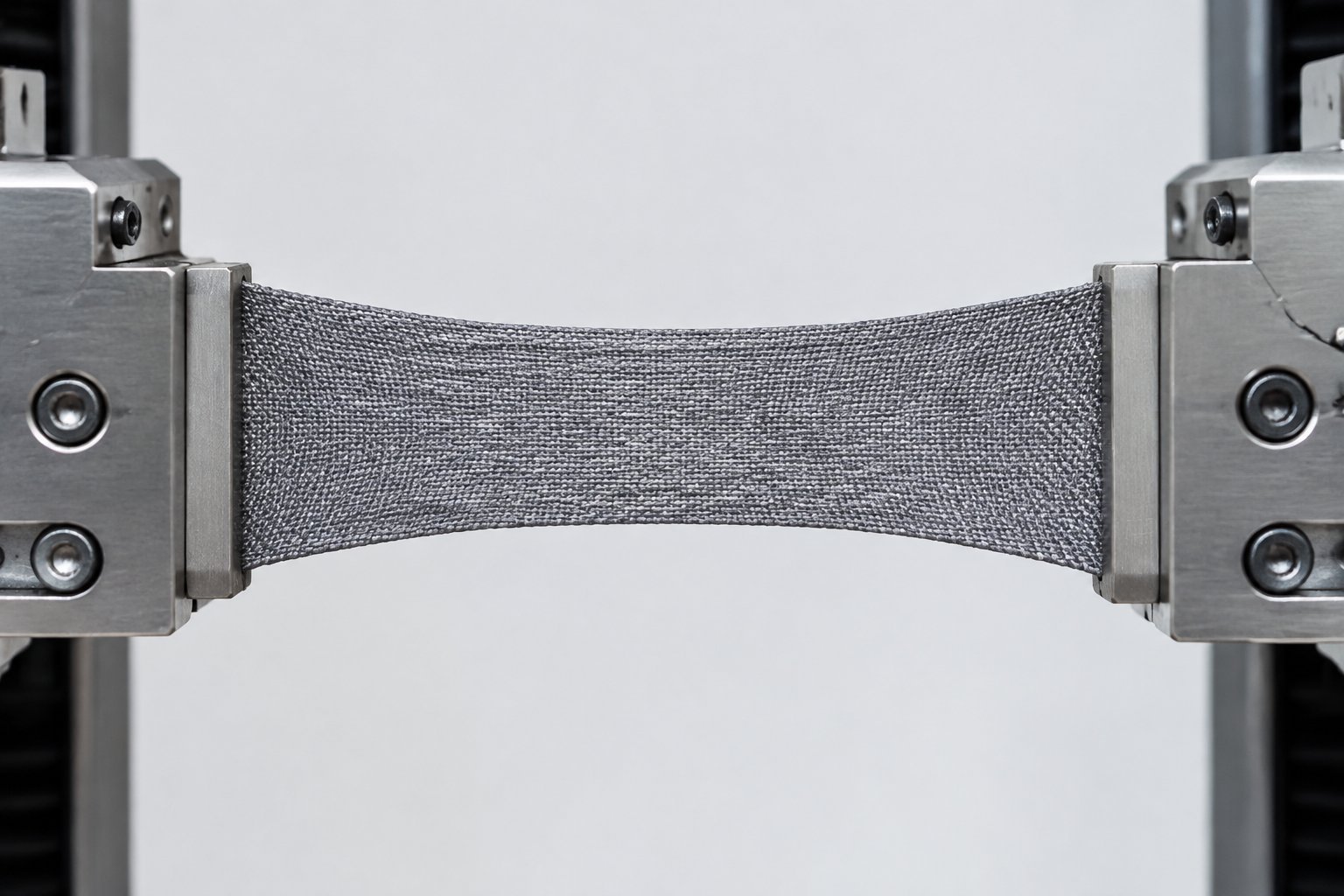
A fabric tensile strength test records resistance to pulling under specified laboratory conditions. Two reports describing the tensile strength of fabric become comparable only when their methods and specimen conditions align.
Levitex manufactures protective-workwear textiles in 100% cotton, cotton/nylon, and cotton-rich cotton/polyester families. For these materials, meaningful FR fabric quality control connects each strength result to an identified finished fabric and an agreed acceptance requirement.
How Do Grab and Strip Tests Differ?
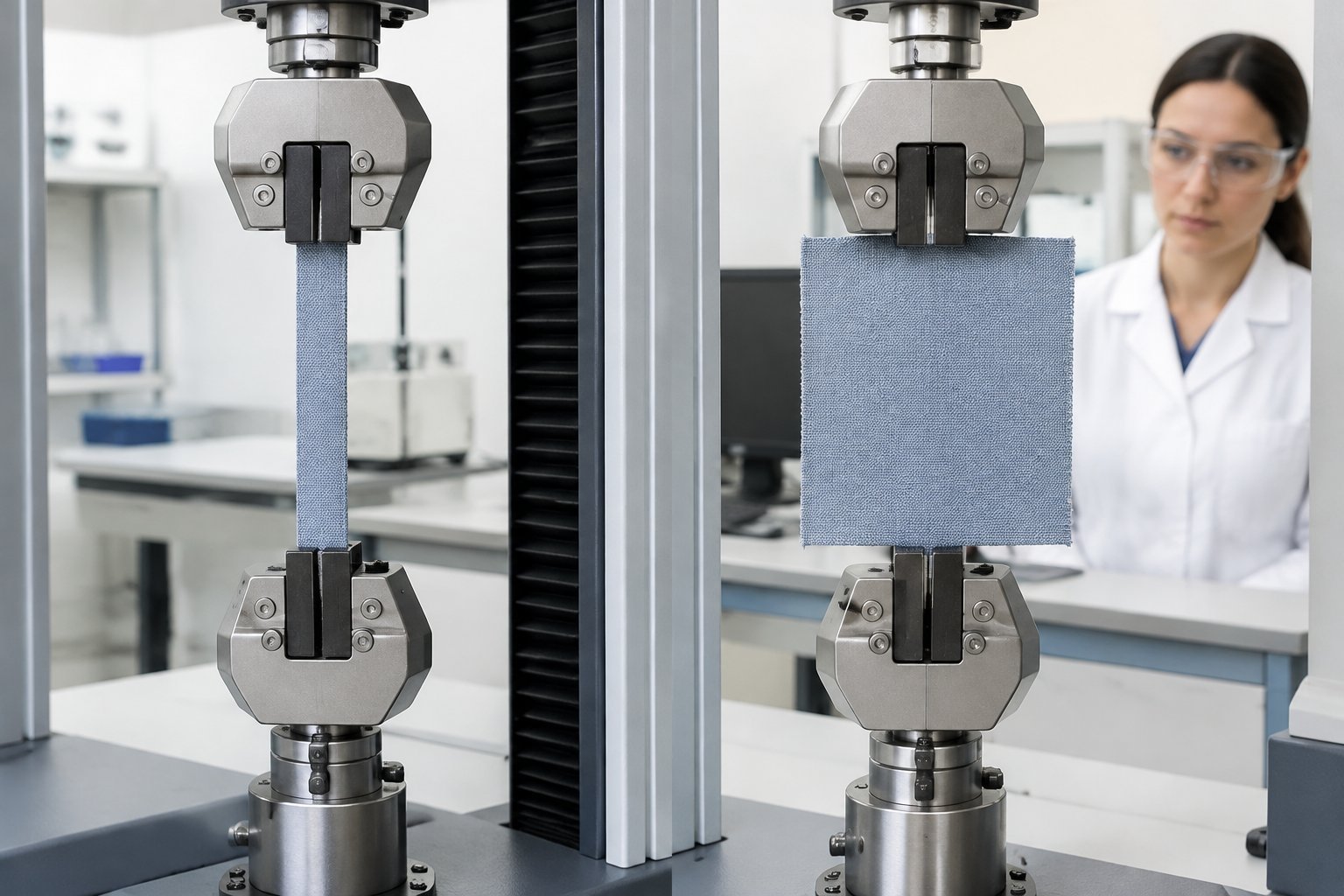
Grab and strip tests differ in how the clamps introduce tension into the fabric. Their specimen geometry changes the contribution of neighboring yarns, so each method produces its own measurement.
| Comparison criterion | Strip test | Grab test |
|---|---|---|
| Gripped width | Entire specimen width | Central portion |
| Adjacent-yarn assistance | Limited by prepared edges | Contributes to measured force |
| Specimen preparation | Raveled or cut strip | Wider specimen; central gripping |
| ASTM method | ASTM D5035 | ASTM D5034 |
| ISO method | ISO 13934-1 | ISO 13934-2 |
| Measurement basis | Defined-width strip loading | Effective fabric strength |
Strip Testing: Full-Width Loading and Raveled vs. Cut Specimens
The strip test method applies tension across the full prepared width. The specimen’s width therefore defines the set of lengthwise yarns directly loaded between the clamps.
For suitable woven fabrics, a technician prepares a raveled strip by removing edge yarns until the specified width remains. This preparation helps establish a controlled width with continuous load-bearing yarns.
A cut strip test uses specimens cut directly to the required width. It serves constructions whose edges resist raveling, subject to the selected method’s scope. Edge preparation deserves attention because progressive unraveling during loading changes the effective specimen width.
Grab Testing: Central Gripping and Adjacent-Yarn Assistance
The grab test method uses a specimen wider than the gripping faces. Only its center is held directly, while the surrounding fabric transfers load through yarn interlacings.
ASTM D5034 describes this as effective fabric strength. The result includes assistance from adjacent yarns, and that contribution changes with construction and yarn mobility.
The modified grab test changes specimen preparation for constructions that unravel further during raveled-strip loading. Its use should be identified explicitly on the report, especially when high-strength woven fabrics are involved.
Which ASTM or ISO Method Fits the Fabric?
ASTM D5034 covers grab and modified grab procedures; ASTM D5035 covers strip procedures. ISO 13934-1 addresses strip testing, while ISO 13934-2 addresses grab testing. The contract should identify the standard and edition.
For US commercial acceptance testing, ASTM D5034 is established for many woven fabrics and includes provisions for nonwoven and felted fabrics. ASTM and ISO counterparts have distinct procedural requirements, so an ASTM result requires review before comparison with an ISO result.
Technical textiles and geotextiles require particular attention to application-specific methods, including wide-width procedures where specified. The distinction between FR knitted and woven fabrics also affects method selection: ASTM D5034 discourages grab testing of knits because of their high stretch.
How Are Specimens Tested and Results Reported?

Reliable textile testing requires controlled specimen preparation and a documented machine setup. A useful report preserves those conditions alongside separate directional results.
Conditioning, Specimen Preparation and Machine Setup
Conditioning brings specimens toward moisture equilibrium in a specified atmosphere. ASTM D1776 and ISO 139 provide conditioning frameworks; the selected tensile procedure determines the applicable requirements.
A reproducible test sequence includes:
- Identifying the fabric lot and sampling locations.
- Conditioning the material under the specified atmosphere.
- Preparing specimens to the required dimensions and orientation.
- Setting grip faces, gauge length, and loading rate.
- Recording force and extension during loading.
- Evaluating slippage, jaw breaks, and other abnormal failures under the method’s rules.
A universal testing machine needs an appropriate load cell and grips that hold the specimen securely without causing premature damage. A single speed or gauge length should never be assumed to apply across all four standards.
The report should identify conditioned-dry or wet testing. Laundered specimens also need a stated washing and drying procedure before reconditioning.
Why Warp and Weft Results Must Be Reported Separately
Warp direction and weft direction load different yarn systems. Differences in yarn count, density, and crimp produce different responses, even within one roll.
A warp-direction specimen places warp yarns along the pulling axis; a weft-direction specimen places filling yarns along that axis. Warp strength should never be presumed higher without the results.
The report should show each direction’s mean and specimen count, with variability where required. Recording fabric shrinkage separately also helps explain changes in construction after laundering.
Reading Breaking Force, Elongation and Units Without False Conversions
Breaking force is reported in force units such as newtons (N) or pounds-force (lbf). ISO reports specify maximum force; a detailed force-extension curve also reveals whether the peak occurs before complete rupture.
Elongation describes the specimen’s extension relative to its initial gauge length. Elongation at maximum force and elongation at break refer to different points on that curve, so the report’s terminology needs to remain intact.
For unit conversion, 1 lbf equals approximately 4.448 N. This changes the force unit while preserving the method. A grab result remains a grab result after conversion.
An entry such as “N/50 mm” identifies a width basis that needs clarification. Dividing a grab force by jaw width does not establish a valid strip-strength value because adjacent yarns contribute to the load.
Tensile Failure vs. Tear Propagation and Bursting
Tensile strength describes resistance to increasing tension in an initially intact specimen. Tear strength describes resistance to an existing cut or tear advancing through the structure.
A fabric tearing strength test concentrates load near the tear tip. Yarn movement and grouping influence propagation, which explains why tensile and fabric tearing strength rankings sometimes differ.
Bursting strength measures resistance to multidirectional loading through a diaphragm or ball procedure. This loading mode suits many knit fabrics, whose loops extend and redistribute force differently from woven yarn systems. The specified application determines which combination of mechanical tests is required.
What Should Buyers Check in Finished Workwear Fabrics?
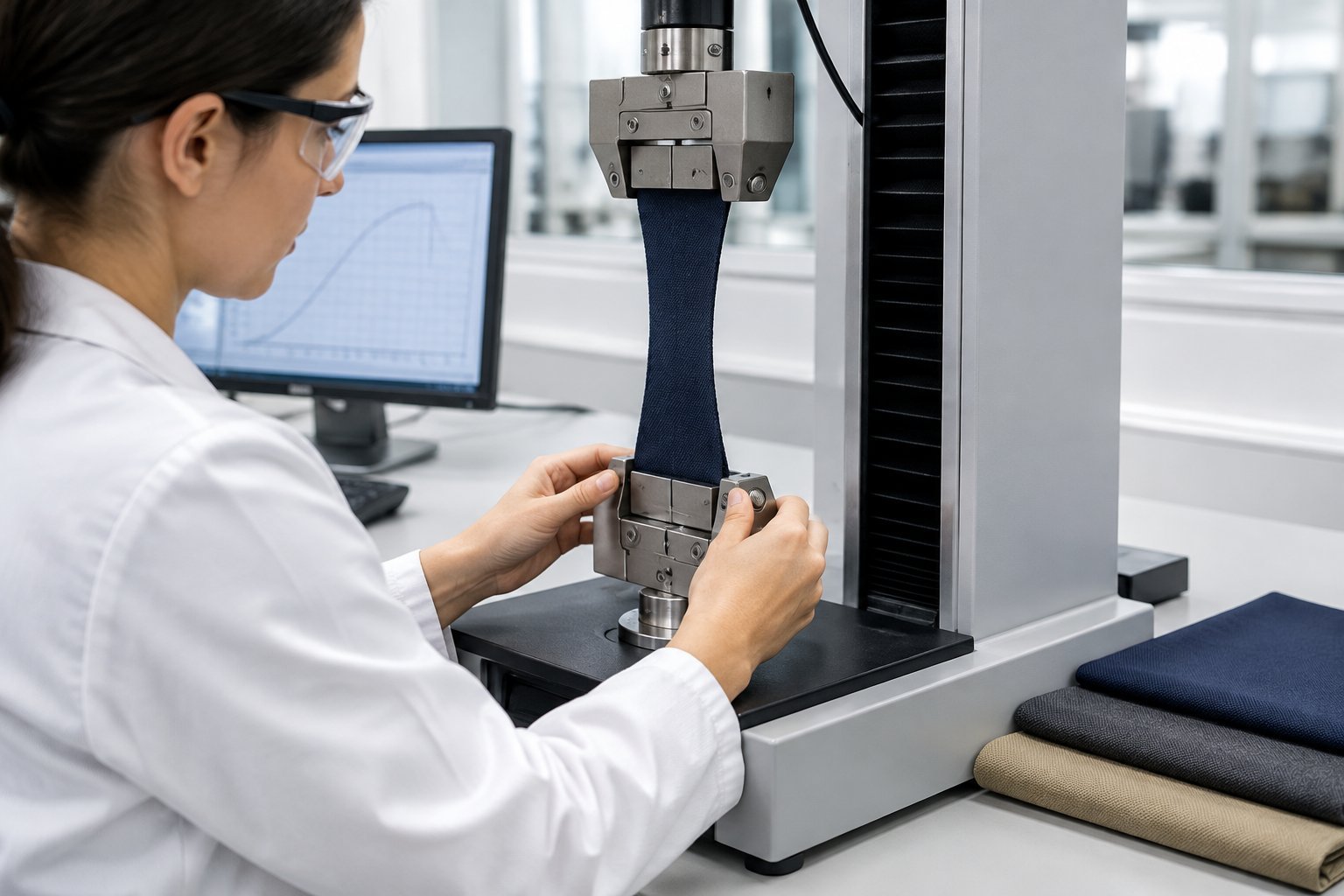
Buyers should compare results for the finished fabric against a method-specific requirement. Composition and GSM help describe the material, while the report establishes its measured strength under stated conditions.
How Fiber, Yarn and Construction Affect Strength Beyond GSM
Fiber type contributes to tensile behavior through strength and elongation characteristics. Yarn quality adds the effects of fiber alignment, twist, and evenness.
Fabric construction determines how many yarns share the load and how their crimp straightens during extension. Two fabrics with equal GSM can have different yarn sizes, densities, and breaking forces.
For example, cotton/nylon blend properties provide useful material-selection context, but the finished construction still needs its own report. Neither a blend name nor a weight establishes an acceptance value.
Why Finishing and Laundering Conditions Matter
Finishing changes the fabric presented to the tensile machine. Chemical exposure and curing conditions affect fiber strength; changes in yarn friction affect how the structure redistributes load.
For multifunctional textiles, FR finishing compatibility belongs alongside mechanical testing. Approval of one finish does not establish the strength of every subsequent formulation.
Laundering adds mechanical action and chemical exposure. A useful assessment identifies detergent, wash temperature, drying conditions, and the agreed number of cycles. Industrial laundering of FR fabrics also requires attention to each protective function being assessed.
Dimensional stability should be reviewed alongside strength. Shrinkage changes yarn spacing, so a retained breaking-force value alone gives an incomplete account of the fabric’s condition.
Comparing Levitex Fabric Reports Against Agreed Requirements
Levitex provides a test report for each product. Buyers should match the relevant report to the ordered fabric and confirm which properties and conditions it covers.
A tensile-strength comparison should establish:
- Fabric identification, composition, and finished weight.
- Test standard, edition, and procedure.
- Warp and weft acceptance limits.
- Specimen width and gauge length.
- Conditioning and any laundering pretreatment.
- Results, specimen counts, and relevant test observations.
Fabric-level results support textile purchasing decisions. External garment-level requirements also involve seams and components beyond Levitex’s textile-manufacturing offering.
For a fabric inquiry, buyers can send the required method and directional limits to Sale Manager Charlie Luo at Charlie@levitex.com. Including the intended finish combination helps align the quotation with the required testing scope.
Compare Methods and Conditions Before Comparing Strength

A valid fabric tensile strength comparison starts with matching test methods and specimen conditions. Strip testing measures full-width loading; grab testing includes adjacent-yarn assistance.
Buyers should compare breaking force separately for warp and weft, preserving the reported force units and elongation definitions. Finished-fabric identity and laundering history belong in the same review.
When reports use different methods, testing representative specimens under one agreed procedure provides a defensible comparison. The purchase specification should record that procedure alongside separate directional acceptance limits.
Frequently Asked Questions
The following answers address practical specification questions that arise when buyers review strength reports.
What is a good tensile strength for workwear fabric?
A good result meets the application’s specified minimum in both tested directions after the required pretreatment. Selection of workwear fabric materials should connect those limits to the intended duty and applicable EN workwear requirements.
Can grab test results be converted to strip test results?
A reliable universal conversion is unavailable because adjacent-yarn assistance varies with fabric construction. A buyer needing strip data should request a strip test on representative material.
What formula is used to report fabric tensile strength?
For force-based reporting, mean breaking force is calculated as ΣFᵢ ÷ n, where Fᵢ represents each valid specimen result. Engineering stress uses σ = F/A, but applying that formula to fabric requires a defined cross-sectional-area procedure.
Does high tensile strength also mean high tear strength?
High tensile strength provides insufficient evidence of tear strength. A separate tear test evaluates how an existing cut propagates under the selected loading procedure.
Which tensile test is suitable for knitted workwear fabrics?
Knitted workwear fabrics need a procedure validated for their stretch and construction. ASTM D5034 discourages grab testing of high-stretch knits; specifications frequently use bursting tests, with directional tensile testing added where required.