You can use 100% FR-treated cotton for welding tasks with assessed heat and spatter exposure within the garment’s documented protection level, because the treatment limits continued burning. For a welding shirt purchase, choose purpose-designed protective workwear with suitable coverage and supporting test documentation.
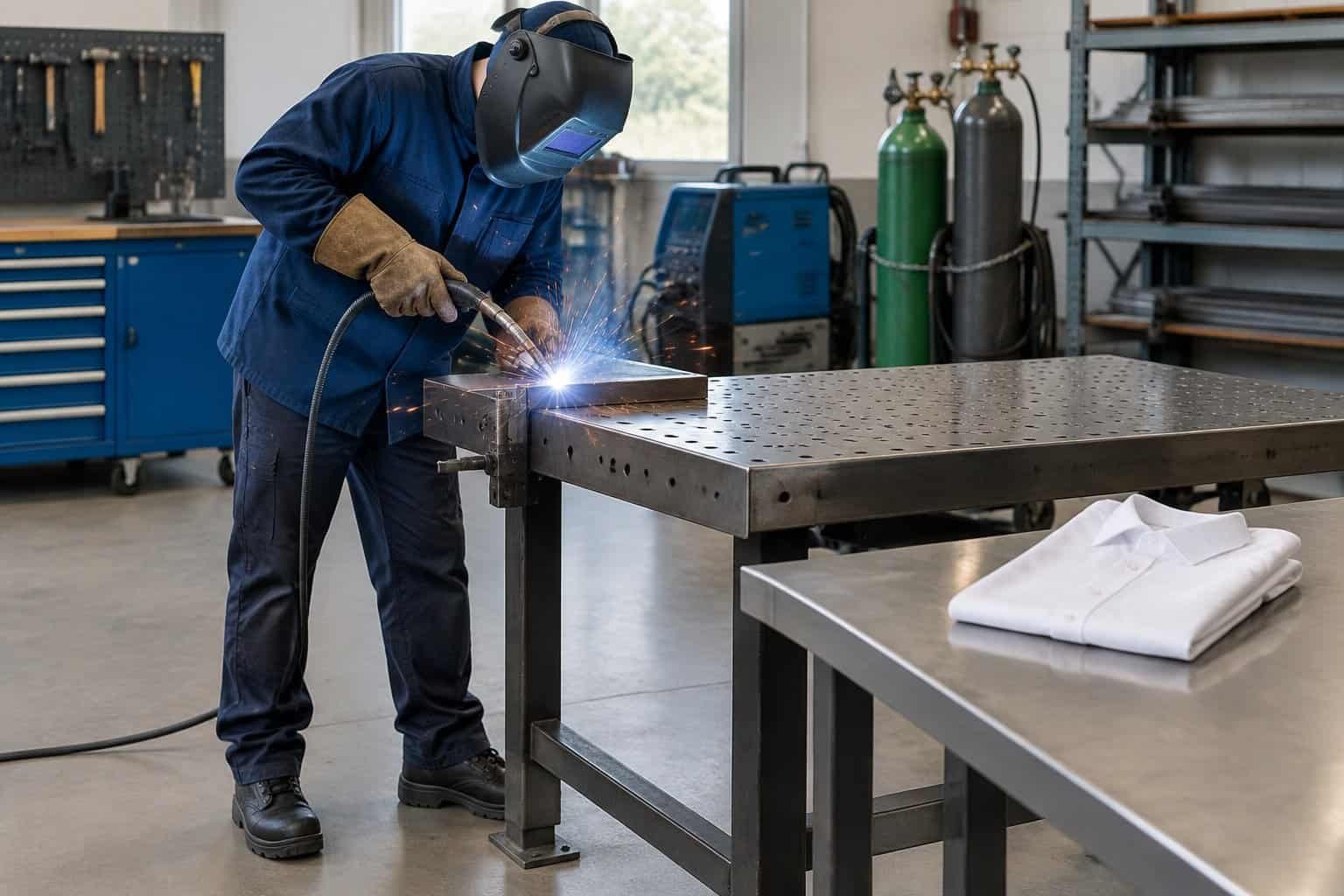
“Is 100% Cotton Good for Welding?” is a useful starting question when you want comfortable clothing that protects your arms and torso. Your purchasing decision also needs to distinguish ordinary cotton from tested flame-resistant cotton: the same fiber-content label can describe garments with substantially different burning behavior.
You gain cotton’s soft feel and moisture absorption with a suitable FR fabric, while your employer’s hazard assessment determines the required protection. A shirt’s sleeves, pocket openings, and seams also influence how well your clothing handles sparks during work.
Non-Melting Does Not Mean Flame-Resistant
You need separate evidence for resistance to continued burning and suitability for welding exposure. Cotton’s non-melting behavior addresses only one part of your thermal protection.
Why Can Untreated Cotton Still Ignite and Burn?
You are wearing a natural cellulose fiber when you wear cotton. With sufficient heat, untreated cotton ignites and continues burning after the initial ignition source disappears.
Your cotton shirt also transfers heat through the fabric, even where it chars without developing sustained flames. A hot particle lodged against your sleeve creates a different exposure from a spark that falls away immediately.
You should therefore treat “100% cotton” as a composition statement. A dense weave or heavy feel alone gives you no verified flame-resistance classification.
When Does Safety Guidance Allow Ordinary Dense Cotton?
You will encounter context-specific welding guidance that permits heavyweight, tightly woven cotton for certain exposures. That allowance requires attention to the actual work, fabric condition, and protective clothing specified for the task.
For your U.S. workplace, OSHA’s welding requirements connect protective clothing selection to the size, nature, and location of the work. Your employer must assess the hazards and select appropriate protection under the applicable PPE requirements.
You should confirm whether any ordinary-cotton allowance applies to your precise task and clothing arrangement. A recommendation for dense work clothing does not establish that your casual cotton T-shirt provides adequate welding protection.
Ordinary Cotton vs. Tested FR Cotton
You receive a different level of evidence when your cotton fabric has documented FR performance. Your comparison should address burning behavior, welding-related testing, and care requirements.
How Do Ignition Behavior, Protection, and Care Requirements Compare?
You can use the following comparison to separate fiber composition from protective performance. For either option, your garment’s condition and construction remain part of the assessment.
| Selection criterion | Ordinary cotton | Tested FR-treated cotton |
|---|---|---|
| Continued burning | Supports burning after ignition | Limits continued burning under specified tests |
| Melting behavior | Non-melting cellulose fiber | Non-melting cotton base |
| Welding suitability | Task-specific assessment required | Relevant performance evidence required |
| Care requirements | Ordinary textile instructions | Specified protective-fabric instructions |
| Evidence to request | Composition and construction details | Relevant test reports and care conditions |
You should check the test method and laundering preparation behind any FR claim. A flame-retardant treatment for 100% cotton changes its burning behavior, but welding suitability also requires evidence relevant to heat and spatter exposure.
Why Is a Casual Cotton Shirt Not Equivalent to Protective Workwear?
Your casual shirt’s label tells you little about protection against molten droplets or heat transfer. Its open neckline, thin panels, or uncovered pockets also create potential exposure points.
With purpose-designed workwear, you should receive specifications addressing the fabric and the assembled garment. That includes closures, compatible components, and instructions explaining the intended use.
You should also examine the difference between a work shirt and a dedicated welding outer layer. A comfortable shirt beneath a jacket has a different protective role from a shirt used as your outermost garment.
Where Does FR-Treated Cotton Fit the Welding Task?
You should evaluate FR-treated cotton for tasks whose documented exposure falls within the selected garment’s performance. Welding position and accumulated spatter determine whether you need additional protection.
How Do Welding Process, Spatter, and Heat Affect Selection?
You should record the welding process alongside its operating conditions. TIG welding with limited spatter presents a different clothing challenge from flux-cored or stick welding that deposits repeated hot particles.
Your settings, consumables, work position, and exposure duration also affect selection. A process name alone does not establish the required shirt or jacket.
When assessing FR clothing for welding, identify where sparks travel and where they remain against your clothing. Include shoulders and the waist when evaluating overhead or awkward-position work.
When Are Additional Layers or More Robust Materials Needed?
You need to reassess a shirt-only arrangement when exposure includes heavy spatter, falling slag, concentrated radiant heat, or repeated burn-through. Under those conditions, evaluate a dedicated jacket or task-specific reinforcement.
Your options include leather sleeves, an apron, or a reinforced garment covering the exposed zones. Select each item for the identified hazard and confirm how it overlaps adjacent clothing.
A welding jacket adds torso and arm coverage, but you still need suitable protection at the neck and lower body. Keep the complete arrangement wearable throughout the task, including during reaching and crouching.
Why Must Protective Blends Be Judged by Testing Rather Than Fiber Content Alone?
You should judge an engineered protective blend through its relevant test results and intended use. The presence of synthetic fibers alone does not establish that a tested protective textile is unsuitable.
Ordinary polyester-containing fashion clothing presents melting and burning concerns under welding heat. A purpose-designed FR blend requires its own evaluation of flame spread, thermal behavior, and welding-related performance.
When reviewing materials unsuitable for welding clothing, distinguish everyday apparel from documented protective formulations. Request evidence for the exact blend and finish you intend to purchase.
What Should a Welding Shirt Buyer Check?
You should inspect the complete shirt for continuous coverage and features that shed hot particles. Fabric performance loses practical value when your garment leaves openings or collects spatter.
Coverage, Collar, Cuffs, and Secure Closures
Choose full-length sleeves that cover your wrists throughout your working movements. Check whether the collar closes appropriately around your neck and whether the front fastening stays secured when you bend.
Your cuffs should coordinate with your welding gloves without leaving exposed skin. Keep sleeves unrolled, because folds collect debris and remove coverage.
When evaluating long-sleeved cotton protective clothing, test coverage while reaching forward and overhead. Reject a size or cut that pulls the hem clear of the waistband.
Pocket Design and Other Places That Can Trap Sparks
Inspect your chest pockets for protective flaps or another suitable closure arrangement. Open upward-facing pockets provide a place for hot particles to remain against the fabric.
Check your shirt’s front placket and sleeve details for ledges or folds that collect debris. Decorative attachments also deserve attention if they create openings or use unsuitable materials.
Keep combustible items out of exposed pockets during welding. Confirm that pocket closures remain effective in your normal working posture, including when you lean over a bench.
Comfort, Fit, and Compatibility with Other Protective Clothing
Your shirt should permit movement while maintaining its intended coverage. Excessively tight fabric restricts reach, while excessive loose material creates folds and snagging points.
Cotton absorbs moisture, so assess how your selected fabric feels through a full shift in the expected environment. Avoid assuming every cotton construction provides the same drying performance or heat comfort.
Try your shirt with the rest of your welding protective equipment. Check glove overlap, jacket fit, and the coverage between your collar and helmet accessories.
Seams, Thread, and Complete Garment Construction
You should verify that the thread and other components suit the garment’s claimed protective performance. A particular thread brand alone gives you no assurance about the complete assembly.
Inspect shoulder seams, underarms, and cuff attachments for skipped stitches or separation. Check whether stress points remain intact during movement without distorting the closure.
Your specification should also address labels, fasteners, and any reflective trim. Exposed metal hardware requires appropriate design because it conducts heat, while unsuitable plastic components introduce their own thermal limitations.
How Can Buyers Verify Protection and Maintain It?
You should verify documentation for the exact product and preserve its condition through the specified care process. Your purchasing records should connect the tested material to the garment you receive.
Check Applicable ISO 11611 Documentation and Protection Class
Request the applicable ISO 11611 or EN ISO 11611 documentation when your purchasing specification requires welding protective clothing to meet that standard. Confirm the standard’s edition and the product identification covered by the claim.
You should distinguish Class 1 from Class 2. Class 1 addresses lower levels of spatter and radiant heat within the standard’s scope; Class 2 addresses higher levels of those exposures.
Match the class to your assessed task, including work position and process conditions. For your U.S. application, also verify employer requirements and applicable OSHA obligations, because an ISO marking alone does not settle workplace compliance.
Distinguish Fabric Test Results from Complete Garment Claims
You need to establish whether each report covers a fabric sample, a component, or the complete garment. A fabric flame-spread result supports that tested characteristic under the stated conditions.
Your finished shirt introduces seams, pockets, closures, and other construction details. Those features require evaluation within the applicable garment requirements before you make a complete-garment compliance claim.
When reviewing flame-retardant fabric testing, check the sample identity, pretreatment, and reported results. Separate welding protection claims from electrical arc-flash or flash-fire claims, which address different hazards and testing requirements.
Follow Laundering Instructions and Inspect for Damage or Contamination
Follow your garment manufacturer’s washing and drying instructions, including restrictions on bleach or other laundry products. Durable FR-treated cotton has a defined care regime that you need to preserve throughout use.
Your FR fabric laundering procedure should remove combustible contamination without damaging the textile. Oil, grease, or solvent residue adds a separate hazard even when the underlying fabric retains its FR properties.
Before each use, inspect your clothing for holes, thinning areas, failed seams, and persistent contamination. Remove damaged garments from service and follow the manufacturer’s repair or replacement instructions; ordinary patches and thread require compatibility checks.
Choose Verified Protection, Not Cotton Content Alone
You should select your welding shirt through documented protective performance, suitable construction, and your employer’s hazard assessment. FR-treated cotton offers a practical option when the specified garment matches your heat and spatter exposure.
Keep the care instructions and relevant reports with your purchasing specification. Reassess the clothing arrangement when your welding process or work position changes.
If you manufacture welding garments, send your process, exposure conditions, and required fabric tests to Charlie@levitex.com for a cotton FR fabric discussion with Levitex. Include the intended garment design so your fabric requirements support the assembly you plan to evaluate.
Frequently Asked Questions
Your welding-shirt purchase should resolve the following practical questions before you approve a garment for use.
Can I weld in an untreated 100% cotton shirt?
You should use an untreated cotton shirt only where your employer’s task-specific assessment and applicable guidance permit that exact clothing arrangement. Untreated cotton burns, so its fiber-content label provides no FR assurance.
Why do welders wear 100% cotton?
You get a soft, moisture-absorbing natural fiber that does not melt like ordinary thermoplastic apparel fibers. For protective welding workwear, you should distinguish those comfort characteristics from the documented performance provided by FR treatment and suitable garment construction.
Are polyester-cotton blends always unsafe for welding?
You cannot classify every polyester-cotton blend as unsafe solely from its fiber percentages. Choose a purpose-designed protective blend only when relevant testing and garment documentation support your assessed welding exposure; ordinary fashion blends provide no equivalent assurance.
What should I look for when choosing a welding shirt?
You should check relevant protection documentation, full sleeve coverage, secure closures, protected pocket openings, and compatible seams. Confirm that your selected size maintains coverage during movement and that you can follow its care instructions.
Can cotton welding pants replace a welding jacket?
Your cotton welding pants protect different body areas from a welding jacket, so they cannot replace its torso and arm coverage. Select your upper- and lower-body garments together, with adequate overlap and protection suited to the task.