
ISO 11612 addresses multiple industrial heat and flame hazards through hazard-specific performance codes; NFPA 2112 addresses short-duration thermal exposure from fire, including flash-fire protection. For buyers comparing iso 11612 vs nfpa 2112, the practical distinction is the evidence each standard requires for the workplace exposure.
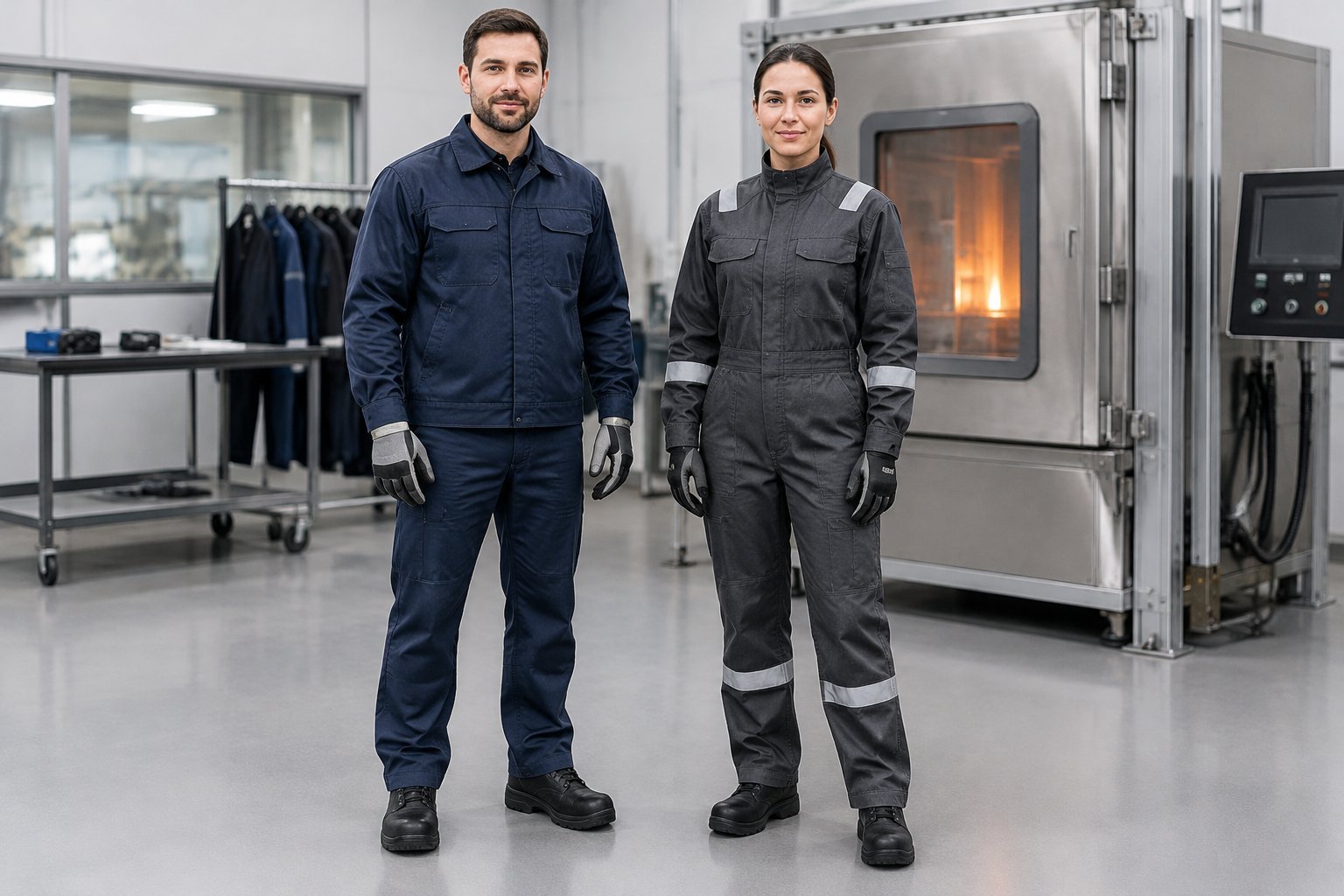
A foundry specification needs evidence for the relevant molten metal and heat exposure. A US industrial flash-fire program needs the applicable NFPA 2112 product certification. A garment carrying both claims needs independent support for each.
Levitex manufactures FR fabric for industrial protective-workwear applications. Its textile-production perspective helps buyers separate material performance from the finished-product evidence required for FR workwear.
How Do the Standards Differ in Scope?
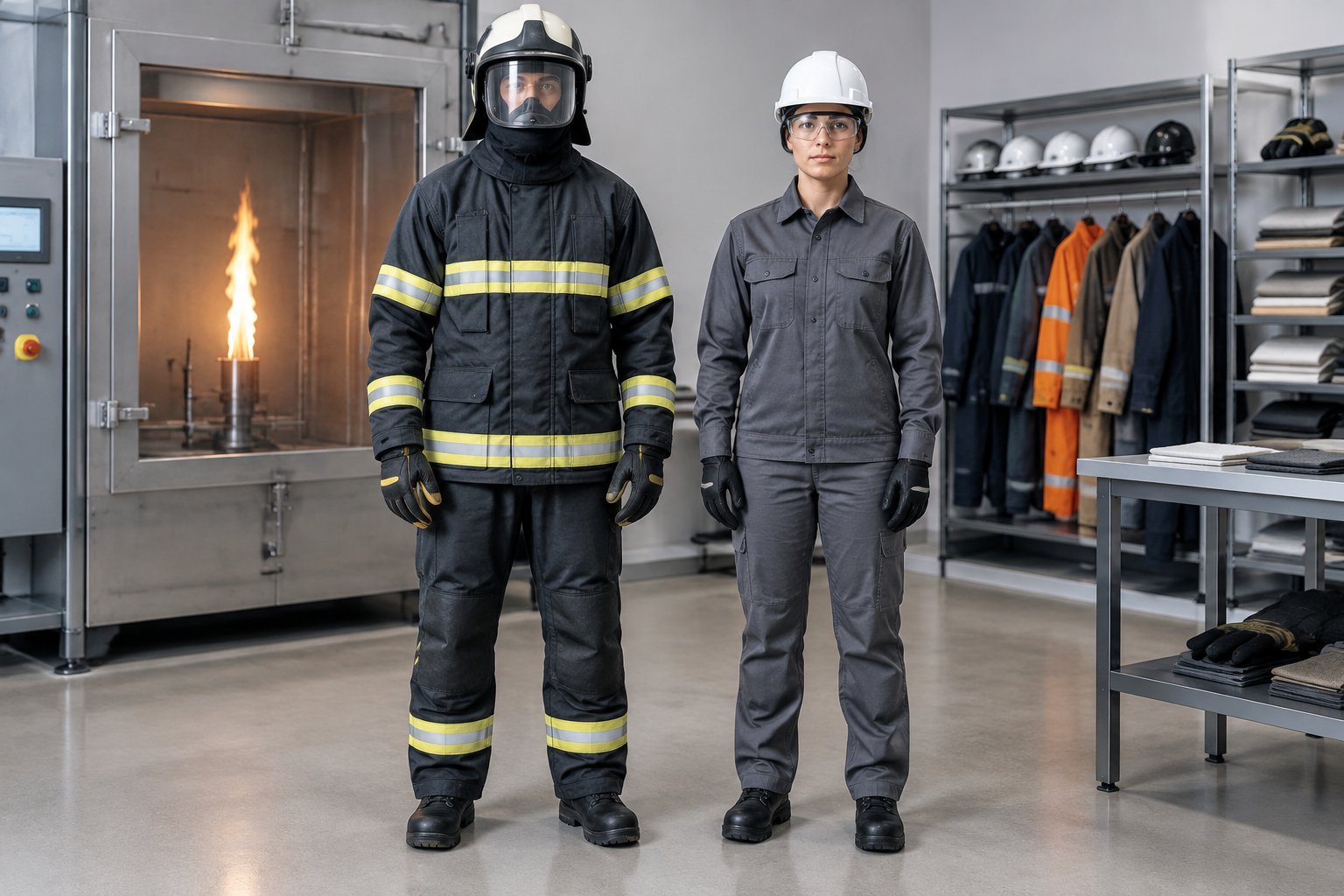
ISO 11612 covers several forms of heat exposure, while NFPA 2112 concentrates on industrial short-duration fire exposure. Both establish requirements beyond a fabric’s ability to stop flaming.
Multiple Heat Hazards vs. Short-Duration Flash Fire
ISO 11612 specifies requirements for protective clothing against heat and flame. Its performance framework distinguishes convective heat from radiant heat, and separately addresses molten-metal splash and contact heat. EN ISO 11612 is the European adoption of that international standard.
NFPA 2112 specifies requirements for flame-resistant clothing protecting industrial personnel against short-duration thermal exposures from fire. Flash-fire hazards occur where an ignitable atmosphere develops, including locations handling flammable gases or vapors.
Neither standard gives unlimited exposure protection. The workplace assessment must establish the required coverage and the thermal hazards that the clothing must address.
Scope, Test, and Evidence Comparison Table
The comparison below uses ISO 11612:2015, including its EN adoption, and NFPA 2112:2023. Purchasing documents should identify the accepted edition and account for applicable amendments or certification-transition requirements.
| Criterion | ISO 11612 / EN ISO 11612 | NFPA 2112 |
|---|---|---|
| Primary scope | Multiple heat and flame hazards | Short-duration industrial fire exposure |
| Flame-test method | ISO 15025 | ASTM D6413 |
| Thermal evidence | Hazard-specific B–F classifications | Heat-transfer and flash-fire requirements |
| Manikin evidence | Outside the basic A–F code sequence | ASTM F1930 assessment required |
| Molten-metal classification | D: aluminum; E: iron | No D/E splash classification |
| Purchasing evidence | Claimed codes and applicable conformity documents | Third-party product certification and listing |
A higher number within an ISO performance code describes a higher classification for that particular test. NFPA 2112 uses compliance requirements without an equivalent A–F marking system.
Material Requirements vs. Finished-Product Requirements
Both frameworks address materials and finished-product requirements. Fabric performance supplies part of the technical evidence; garment construction adds questions about coverage, seams, closures, and exposed components.
For example, a qualifying outer fabric does not establish the performance of an added pocket material or reflective trim. The garment manufacturer must control the complete construction covered by its conformity assessment.
The distinction also applies to flame-resistant and flame-retardant fabric terminology. A material description identifies a property or treatment approach; the applicable test and product documentation establish the supported protection claim.
What Do the Tests and Performance Codes Demonstrate?
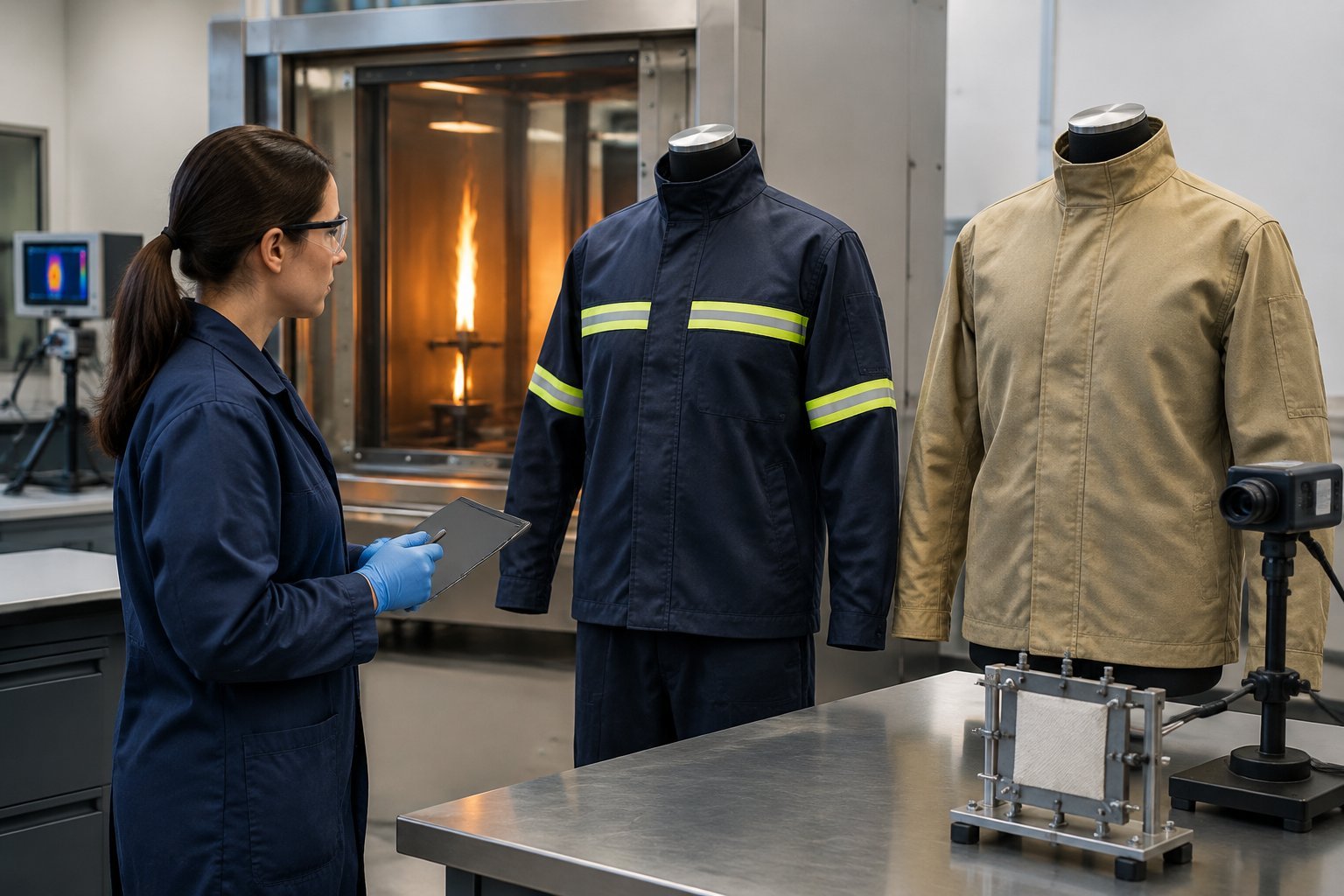
Each test demonstrates performance under defined exposure conditions, and each result has a specific interpretation. Flame-spread results, heat-transfer classifications, and predicted burn injury describe different aspects of protection.
ISO 15025 and ASTM D6413 Address Different Flame-Test Requirements
ISO 15025 evaluates limited flame spread using defined surface-ignition or bottom-edge-ignition procedures. The applicable product standard establishes acceptance requirements for observations such as flame spread, afterflame, afterglow, and flaming debris.
ASTM D6413 measures vertical flame resistance, including afterflame time and char length. NFPA 2112 supplies the applicable acceptance criteria and conditioning requirements for its use.
The methods differ in specimen exposure and evaluation. A passing result under one method does not establish a passing result under the other, and longer burner exposure alone does not establish that one standard provides universally greater protection.
Reports for flame-retardant fabric testing should identify the method edition, specimen preparation, and conditioning. A result without those details provides an incomplete basis for comparison.
Reading A1/A2 and B–F Without Confusing the Hazards
Under ISO 11612:2015, A1 identifies limited flame spread assessed using surface ignition, and A2 identifies bottom-edge ignition. These markings identify procedures; they do not form a rising protection scale.
The remaining performance codes identify separate heat hazards:
- B1–B3: Convective heat.
- C1–C4: Radiant heat.
- D1–D3: Molten aluminum splash.
- E1–E3: Molten iron splash.
- F1–F3: Contact heat.
ISO 9185 provides the molten-metal splash test associated with D and E classifications. D3 identifies the highest listed aluminum-splash classification, while E3 identifies the highest listed iron-splash classification.
D3 and E3 remain laboratory classifications with defined limits. Neither represents unlimited splash protection, and evidence for one metal does not automatically establish suitability for every alloy or pouring condition.
A bare EN ISO 11612 claim leaves the relevant exposure scope unclear. Buyers need the actual claimed code sequence, supported by documentation for the supplied construction.
What the ASTM F1930 Manikin Test Adds
The ASTM F1930 manikin flash fire test evaluates heat transfer through a clothing system during a controlled exposure. Instrumented sensors support a prediction of second- and third-degree burn injury over the assessed body area.
NFPA 2112 uses a three-second exposure and a maximum 50% predicted body-burn criterion under its specified test conditions. The relevant standard test configuration and certification scope govern how that evidence applies to a product.
The result is a controlled injury prediction, with defined clothing configuration and calculation rules. It provides no guarantee of a particular outcome in an incident involving different fuel conditions, exposure duration, or garment fit.
Which Standard Matches the Workplace Hazard?
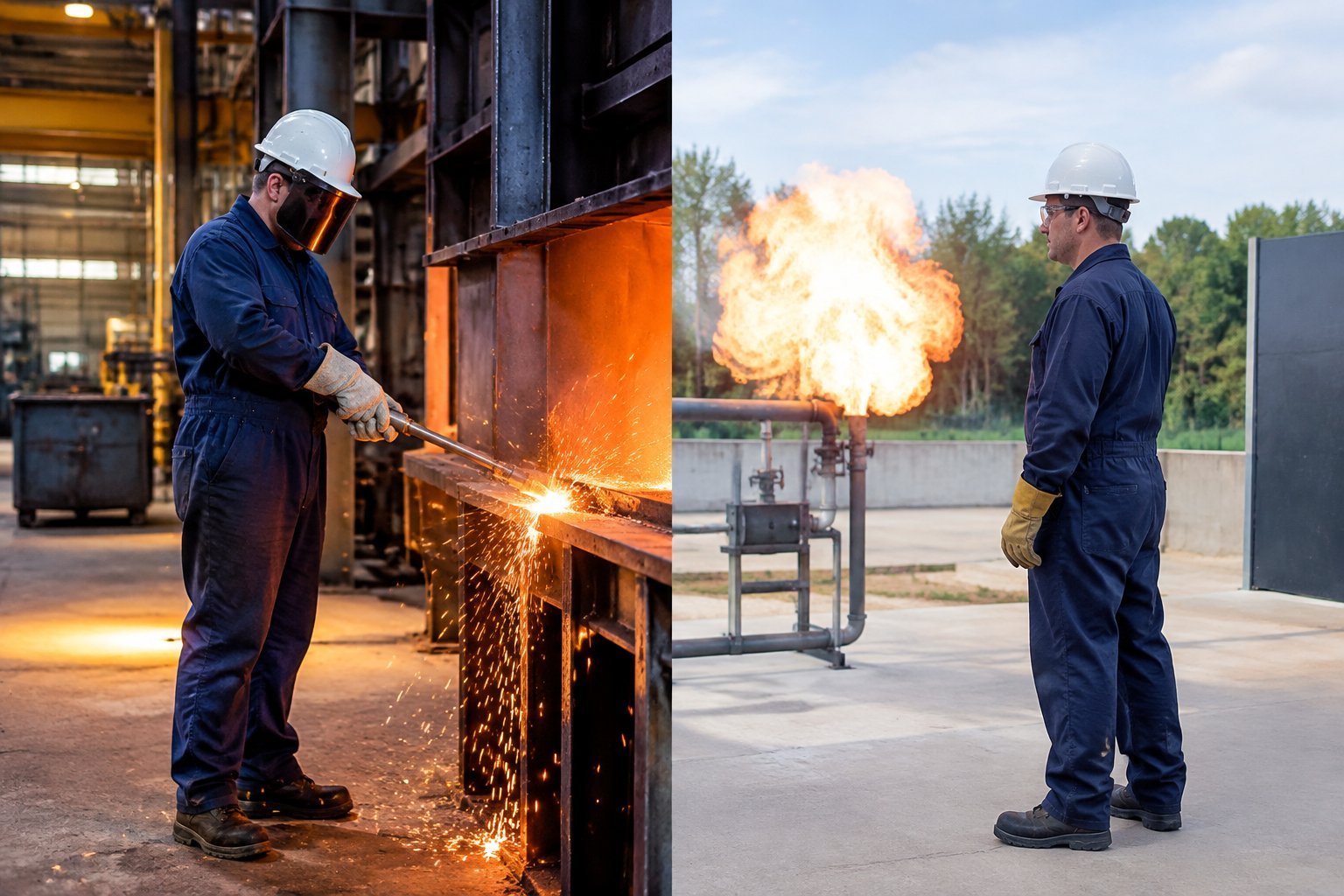
The assessed exposure determines the required standard and supporting performance evidence. Industry labels alone leave important differences between tasks unresolved.
Flash Fire, Furnace Heat, and Foundry Splash Require Different Evidence
An industrial flash-fire program calls for evidence addressing short-duration fire exposure. NFPA 2112 provides that product framework for specifications that adopt it, including many US industrial programs.
Furnace work requires assessment of radiant heat and any other applicable exposure. ISO 11612 C classifications provide relevant radiant-heat evidence, with additional codes selected for the remaining hazards.
Foundry splash requires metal-specific documentation. A flash-fire certificate alone does not substantiate molten aluminum splash or molten iron splash performance, and fabric composition provides no substitute for ISO 9185 evidence.
Why Welding Calls for EN ISO 11611 Context
EN ISO 11611 addresses protective clothing for welding and allied processes. Its assessment includes welding-related hazards and garment requirements that a general heat-and-flame claim does not fully describe.
The welding process and working position affect the required protection. Heavy spatter exposure and overhead work create different demands from lower-spatter operations, including opportunities for hot material to collect in folds or openings.
A buyer specifying EN ISO 11611 welding protection should establish the required class and flame-spread marking. An ISO 11612 code sequence supplies additional information when the task includes relevant heat hazards.
Why Arc, Visibility, Static, and Firefighting Need Separate Assessment
Electrical arc exposure requires arc-specific evidence. ASTM F1959 determines material arc ratings through an open-arc test, while the IEC/EN 61482 framework addresses protection against the thermal hazards of an electric arc.
The distinction between arc-rated and FR clothing is essential in mixed-hazard workplaces. Neither ISO 11612 nor NFPA 2112 alone establishes an arc rating.
Other hazards introduce additional requirements:
- Visibility: EN ISO 20471 addresses conspicuity, including material performance and garment-area requirements.
- Electrostatic ignition: EN 1149 assessments address electrostatic properties and relevant clothing-system requirements.
- Firefighting: EN 469 addresses protective clothing for firefighting activities within its scope.
Combining EN ISO 20471 with flame-resistant workwear requires assessment of the complete assembly. Fluorescent fabric alone does not establish the finished garment’s visibility class.
What Evidence Supports a Purchasing Decision?

A purchasing decision needs documents that identify the supplied product and substantiate every claimed protection requirement. Traceable evidence connects the label to the tested material and approved garment construction.
Check the Edition, Product Identity, and Claimed Performance Scope
The specification should name the standard edition and the required classifications or certification scope. “FR certified” leaves the relevant hazard and acceptance basis undefined.
Product identity deserves equal attention. A useful document set connects the fabric reference to its composition, construction, finish, and applicable color range, then connects the finished garment to its model designation.
For NFPA 2112, the certification body’s listing should cover the product being ordered. For EN ISO 11612, applicable conformity documents should state the claimed performance codes and identify the covered models.
Separate Fabric Reports from Garment Certification
A laboratory fabric report establishes results for its identified specimens. It does not independently certify the finished flame-resistant garments manufactured from that fabric.
Garment construction introduces variables including seam performance, closure arrangements, and coverage during movement. The responsible garment supplier must demonstrate that the assembled product falls within its assessment or certification scope.
Flame-retardant certification documents also serve different purposes. Management-system certification supports organizational controls; product-specific documents support defined protective-performance claims.
Confirm Dual Compliance and Tender Acceptance Independently
Dual compliance requires evidence for both standards. An ISO 11612 certificate does not transfer into NFPA 2112 certification, and NFPA 2112 certification does not generate ISO performance codes.
The purchasing team should also distinguish technical conformity from contractual acceptance. A technically supported alternative still requires approval when the tender names a particular standard or certification scheme.
For international orders, written acceptance should resolve the standard edition and required documents before production approval. This prevents a completed shipment from reaching inspection with an unresolved substitution request.
How Can Levitex Support the Fabric Specification?
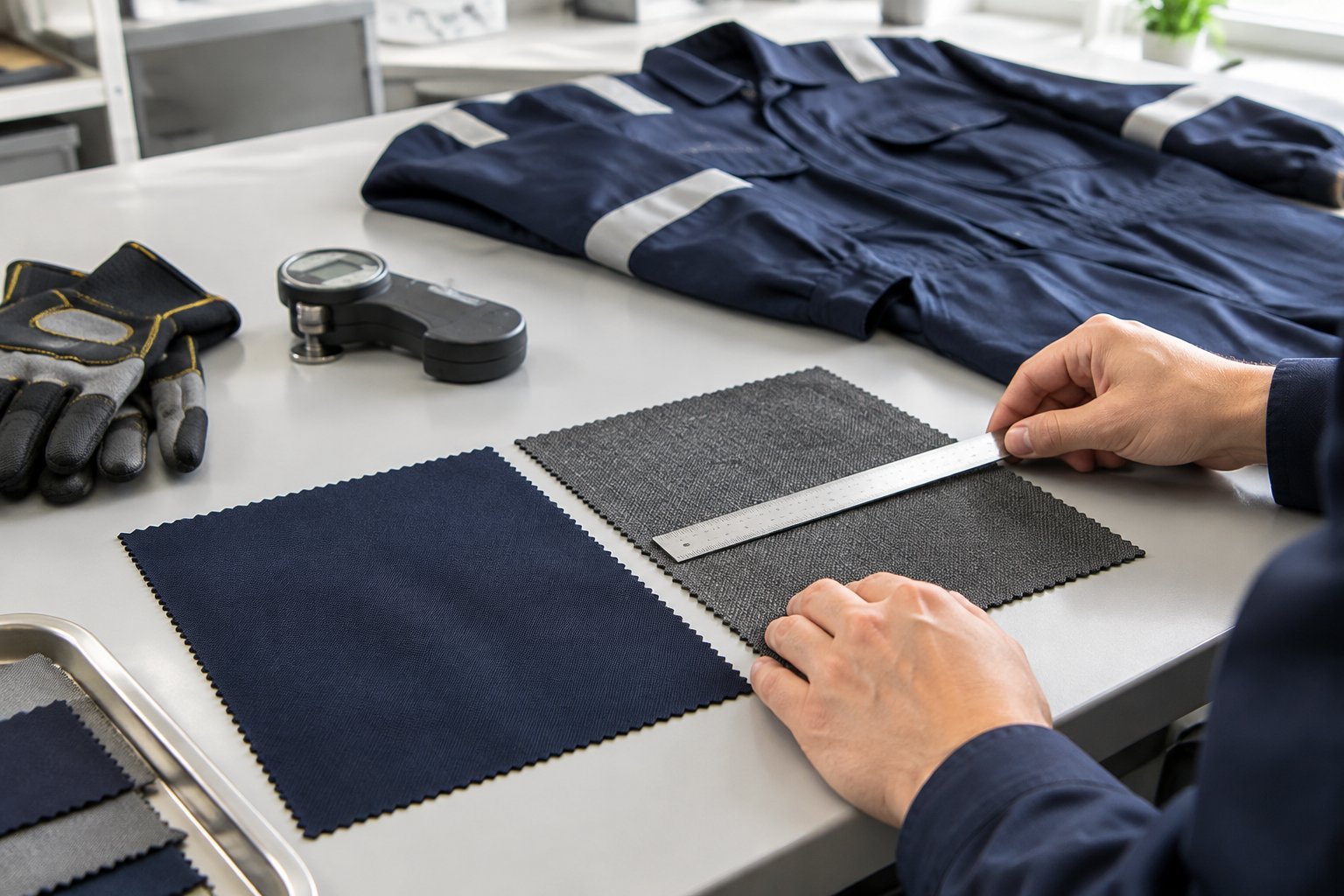
Levitex supports textile selection and customized FR fabric production for industrial workwear manufacturers. Established in 1951, it reports monthly production capacity of 5 million meters, with 1.5 million meters dedicated to flame-retardant fabrics.
Compare Cotton, C/N, and CVC Without Assuming Tested Protection
Levitex manufactures three principal fabric families: 100% cotton, cotton/nylon (C/N), and cotton-rich cotton/polyester (CVC). These families support industrial woven fabrics and are also available in knitted constructions.
Selection involves comfort and mechanical-performance requirements alongside the intended finishing route. Cotton/nylon blend properties help explain material-selection considerations, but the blend name alone establishes no thermal classification.
Similarly, CVC versus 100% cotton comparisons help narrow suitable base fabrics. The exact finished fabric still needs evidence matching the required application.
Assess Custom Colours, Printing, and Repellent Finishes Against the Specification
Levitex provides custom dyeing and printing, including fluorescent dyeing. It also offers FR plus water-repellent and FR plus oil-repellent finishing on all three base-fabric families.
These options require review against the final performance specification. Changes in finishing chemistry or printed coverage require technical evaluation to establish whether existing evidence covers the revised material.
Multi-functional FR finishing compatibility is particularly relevant when several properties share one cloth. Repellency requirements need their own acceptance criteria alongside the specified heat-and-flame performance.
Request Product-Specific Evidence While Keeping Garment Compliance Separate
Levitex provides a test report for each product. Buyers should request the relevant report and check its methods and scope against the proposed fabric specification.
Levitex supplies textiles for FR workwear, including materials intended for FR jackets; it does not supply finished garments or garment-design and assembly solutions. Dedicated molten-metal or arc-performance claims require the relevant product-specific evidence.
Buyers seeking fabric options can send their target market, workplace hazards, and required standards to Charlie Luo at Charlie@levitex.com. The garment manufacturer retains responsibility for finished-product conformity and certification.
Match the Hazard to the Standard and Verify the Evidence

ISO 11612 provides a hazard-specific framework for industrial heat and flame protection, while NFPA 2112 provides requirements for short-duration industrial fire exposure. Their different tests support different protection claims.
A defensible specification identifies the required exposure protection and the accepted standard edition. Purchasing approval should then connect the fabric reports, garment identity, and applicable conformity documents, with separate evidence for any additional hazards.
Frequently Asked Questions

NFPA 2112 terminology requires particular care when flash-fire protection and electrical protection appear in the same purchasing specification.
Is NFPA 2112 the same as CAT 2?
NFPA 2112 and CAT 2 describe different protection requirements. CAT 2 refers to an NFPA 70E arc-flash PPE category with a minimum clothing-system arc rating of 8 cal/cm²; an NFPA 2112 claim alone establishes no arc rating.
What does NFPA 2112 compliant mean?
An NFPA 2112 compliance claim means the product satisfies the applicable requirements of the stated edition. Purchasing verification should establish third-party certification and confirm that the ordered flame-resistant garments fall within the certification listing.
What is the difference between NFPA 2112 and NFPA 2113?
NFPA 2112 sets product requirements for flame-resistant clothing protecting industrial personnel against short-duration thermal exposures from fire. NFPA 2113 addresses the selection, care, use, and maintenance of that clothing within an employer’s protective-clothing program.
How does NFPA 2112 differ from NFPA 70E?
NFPA 2112 addresses industrial short-duration fire exposure, while NFPA 70E addresses electrical safety-related work practices. NFPA 70E includes arc-flash risk assessment and PPE selection, so electrical tasks require appropriately selected arc-rated clothing.
Can the same garment meet both ISO 11612 and NFPA 2112?
The same garment qualifies for both when its materials and construction satisfy each standard’s requirements and the necessary conformity evidence supports both claims. Buyers should verify the ISO 11612 performance codes and the NFPA 2112 certification scope for the exact garment model.