
Acid proof lining is an engineered protective layer or multilayer system that shields industrial equipment and structures from acid attack, providing corrosion protection within defined service conditions. It protects assets such as tanks and pipes while supporting reliable chemical containment and safer plant operation.
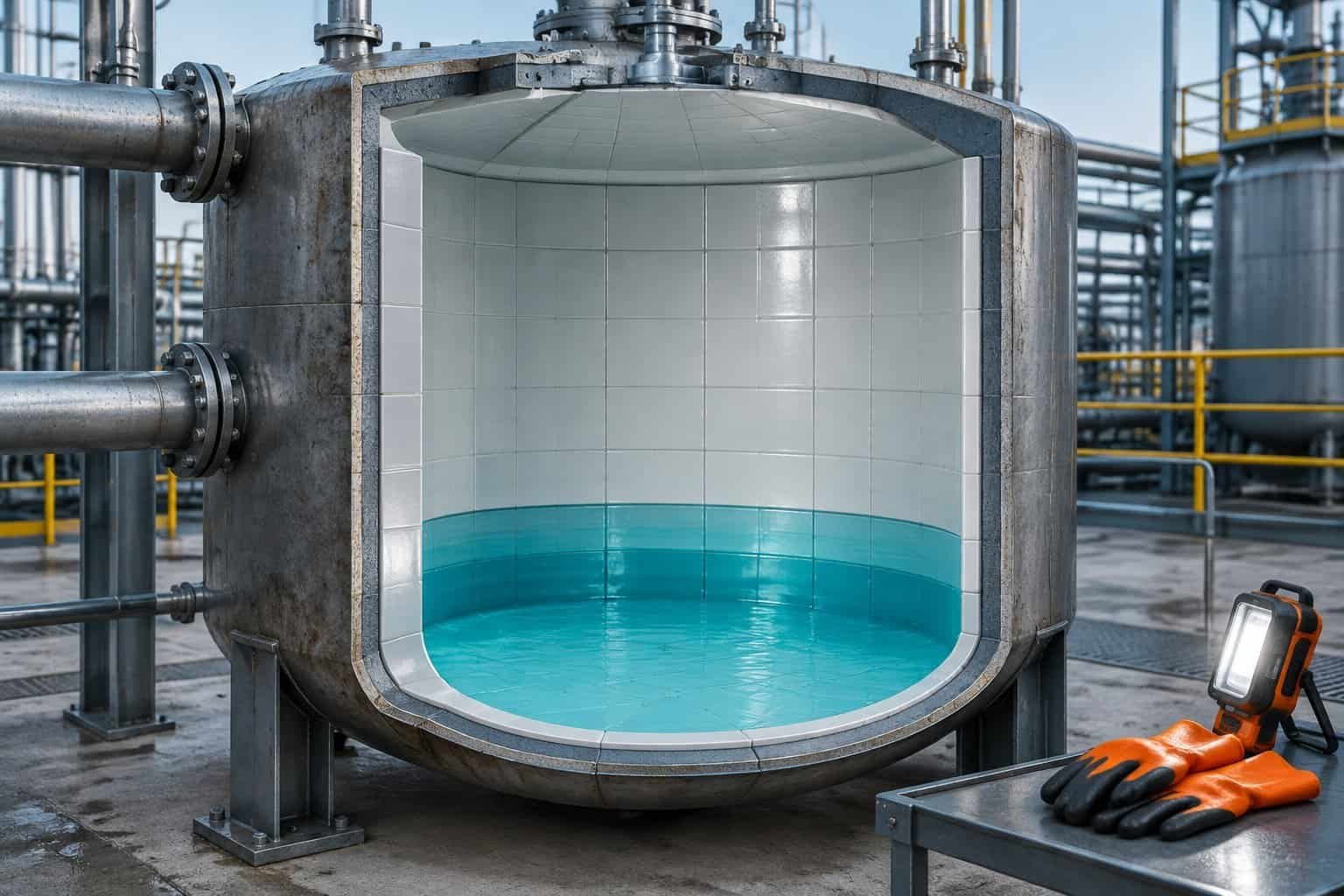
“Acid-proof” is a common industrial term; every material has chemical and operating limits. Effective chemical protection requires a lining matched to the actual process, including cleaning and shutdown conditions.
Equipment linings and garment linings serve separate purposes. An industrial lining protects a substrate from corrosive contents, while a garment lining contributes to the construction or comfort of protective clothing. Each requires its own performance assessment.
How Do Industrial Lining Systems Compare?
Industrial lining systems differ in their barrier construction, mechanical behavior, and installation requirements. Rubber, masonry, resins, and thermoplastics each suit specific duties when their complete assemblies have documented compatibility.
| Comparison criterion | Rubber lining | Brick or ceramic system | Resin-based lining | Thermoplastic lining |
|---|---|---|---|---|
| Construction | Bonded elastomer | Units, mortar, barrier | Applied resin system | Fabricated sheet |
| Mechanical emphasis | Flexibility; abrasion grades | Hard wearing face | Formulation-specific strength | Grade-specific toughness |
| Critical installation detail | Bonds and seams | Joints and membrane | Preparation and cure | Welds and attachments |
| Main selection limitation | Compound compatibility | Complete assembly limits | Resin chemistry | Temperature and movement |
Rubber Lining for Compatible Chemical and Abrasive Conditions
Rubber lining provides a bonded elastomeric barrier inside equipment such as tanks, piping, and slurry-handling vessels. Selected compounds combine chemical resistance with resilience under abrasive service.
The rubber formulation determines suitability. Natural rubber, butyl rubber, and other elastomers have different responses to oxidizing chemicals, solvents, and heat.
Seams and adhesion require particular attention. A chemically compatible sheet still needs suitable bonding materials and an approved curing procedure, with inspection around nozzles and changes in geometry.
Acid-Resistant Brick and Ceramic Systems
Brick lining uses acid-resistant brick or tile with chemically compatible bedding and jointing materials. Engineered ceramic materials also provide wearing surfaces in applications involving abrasive process streams.
Acid proof bricks require selection by composition and service conditions. Ordinary refractory brick offers no automatic assurance of acid resistance, and silica-containing materials require special scrutiny where hydrofluoric acid is present.
Many heavy-duty assemblies include an underlying membrane. A flexible sheet membrane serves as an impervious barrier between acid-resistant brick and corrosion-prone steel, alloy, or concrete. Brick strength alone does not establish the containment performance of the assembly.
Epoxy and Other Resin-Based Linings
Epoxy lining forms a continuous protective surface when the specified system is correctly applied and cured. Epoxy resin chemistry varies substantially, so a general-purpose floor coating and a specialized tank lining require separate evaluations.
Other options include vinyl ester systems and furan resin mortars or linings. Their suitability requires confirmation against the actual chemicals, including oxidizing agents and cleaning solutions.
Monolithic lining systems reduce masonry joints but introduce their own application controls. Film thickness, reinforcement, recoat timing, and cure conditions govern the finished barrier; exterior exposure also requires product-specific weathering guidance.
Thermoplastic Linings, Polymer Concrete, and Flooring Systems
Thermoplastic sheet linings include polyethylene and other polymers selected for particular chemical duties. Welded seams and attachment details require qualified fabrication, especially around penetrations and supports.
Thermal expansion and permeation influence their design. Pressure or vacuum conditions also require review because a sheet liner and its supporting structure respond differently to loading.
Polymer concrete combines a resin binder with aggregates for applications such as trenches, sumps, and industrial flooring. Stone flooring requires confirmation of the stone’s mineral composition and joint compatibility; carbonate-based stone is vulnerable to acid attack.
How Do You Select a Lining for Actual Service Conditions?
A defensible selection begins with a written service profile and confirmation that the complete chemical resistant lining system suits that exposure. Chemical processing and mining applications require assessment of normal operation alongside foreseeable upset conditions.
Chemical Identity, Concentration, and Mixed Exposures
The service profile should identify every chemical contacting the lining, including contaminants and cleaning agents. Chemical resistance tables provide screening information, while written manufacturer confirmation establishes the proposed product’s intended duty.
Sulfuric acid compatibility changes with concentration and temperature. Nitric acid introduces oxidizing conditions that require separate consideration, even when another acid has already been approved for the material.
Mixed exposures deserve their own assessment. Acid service followed by caustic cleaning requires documented alkali resistance, and mixtures require confirmation beyond separate ratings for their individual ingredients.
Operating Temperature and Thermal Cycling
Selection must account for the highest credible lining temperature and the rate of temperature change. Bulk liquid temperature alone leaves out hot filling, steam cleaning, and localized heating.
Thermal cycling creates differential movement between the substrate and lining layers. A rigid wearing surface over a flexible membrane requires engineered movement details and compatible bonding materials.
The lowest-rated component constrains the assembly. A brick’s temperature capability does not establish the allowable temperature of the mortar, adhesive, or membrane behind it.
Immersion, Splash, Abrasion, and Mechanical Loads
Continuous immersion requires explicit approval for sustained chemical contact. A splash-resistant floor finish has a different exposure duty from the lining of storage tanks.
Exposure duration should reflect drainage and cleanup practices. A spill area with standing liquid receives a more demanding exposure than a surface that drains promptly.
Mechanical assessment includes slurry abrasion, impact, vibration, and maintenance traffic. For industrial flooring, loading around equipment supports and vehicle routes requires attention alongside chemical performance.
Substrate Compatibility and Complete-System Design
The substrate must remain structurally suitable for the intended service. A lining provides corrosion protection, but it does not restore lost steel thickness or resolve an unstable concrete foundation.
Design review should address substrate movement and bond compatibility. For masonry assemblies, the brick, mortar, membrane, and primer require approval as a coordinated system.
An alloy such as Hastelloy warrants a separate engineering comparison where process conditions justify metallic construction. Alloy grade and fabrication details require the same chemistry-specific scrutiny as a nonmetallic lining.
What Determines Installation Quality?
Installation quality comes from verified substrate condition, controlled application, and documented acceptance testing. Acid proofing requires qualified contractors and inspectors working to a project-specific corrosion control specification.
Professional Substrate Assessment and Surface Preparation
Assessment begins with structural condition and contamination. Steel requires examination for corrosion and defective weld profiles; concrete requires evaluation of cracks, chemical damage, and moisture conditions.
Preparation must achieve the cleanliness and surface profile specified for the selected system. Residual salts, embedded chemicals, or weak concrete create failure risks even when the finished surface looks uniform.
Environmental controls also form part of the work plan. Application records should demonstrate compliance with the manufacturer’s temperature, humidity, and condensation restrictions.
Membranes, Mortars, Joints, and Penetration Details
Continuity deserves particular attention at corners and terminations. Pipe penetrations, drains, and support attachments create changes in geometry where application defects or movement concentrate.
In brick systems, mortar must suit both the process chemistry and adjacent materials. Technical system documentation describes combined brick build-ups matched to rubber or synthetic resin membranes, reinforcing the need for coordinated layer selection.
Movement joints require their own chemical and mechanical specification. Substituting a general construction sealant creates an unverified component within the protective assembly.
Curing, Qualified Inspection, and Handover Records
A lining must meet its specified cure requirements before chemical exposure. Surface dryness alone provides insufficient evidence that the material has developed its required properties.
Qualified inspection should verify the applicable acceptance criteria. Depending on the system, checks include thickness measurements, seam examination, cure assessment, or electrical discontinuity testing under an approved procedure.
Handover records should identify installed products and material batches. They should also retain application conditions, inspection results, repair locations, and the approved service envelope for future maintenance decisions.
How Should Linings Be Inspected and Maintained?
Inspection frequency should reflect failure consequences, operating severity, and observed lining condition. A chemical resistant lining needs a documented maintenance plan that preserves corrosion protection throughout service.
Risk-Based Inspection and Maintenance Planning
Planning starts with asset criticality and the consequences of leakage. Equipment handling hazardous contents requires inspection arrangements proportionate to its containment role.
Accessible external observations complement planned internal examinations. Changes in leakage indicators, unexplained process losses, or corrosion staining deserve investigation under site procedures.
Internal inspection requires isolation and controlled preparation. Confined-space entry and atmospheric hazards belong under the facility’s formal safety program, with qualified personnel determining when access is safe.
Warning Signs of Cracking, Blistering, and Joint Failure
Cracking and open joints create potential paths toward the substrate. Their location and pattern help distinguish movement-related damage from localized impact or chemical deterioration.
Blistering, swelling, softening, and edge lifting indicate changes requiring technical assessment. Discoloration becomes more significant when accompanied by loss of hardness or adhesion.
Inspection records should map defects and track their progression. Repeated damage around the same nozzle or transition calls for review of the underlying detail before another patch is applied.
Qualified Repair and Review After Process Changes
Repairs require confirmation of the defect’s cause and extent. Rubber repairs exposed to strong acid or alkali service require correct repair execution to justify the time and expense.
A qualified repair procedure should address contaminated substrate and compatibility with the existing lining. Repaired areas require suitable curing and acceptance inspection before return to service.
Process changes trigger a fresh compatibility review. Changes in concentration, temperature, feedstock impurities, or cleaning chemicals belong in the facility’s management-of-change process.
What Drives Installed and Lifecycle Costs?
Installed and lifecycle costs reflect the complete acid proofing project, including preparation and production interruption. Material price alone leaves substantial project requirements outside the comparison.
System Specification, Access, and Substrate Repairs
System construction determines labor intensity and specialist requirements. A masonry assembly involves different handling and detailing from a spray-applied resin or fabricated sheet liner.
Access conditions affect productivity. Restricted openings, internal equipment, and complex vessel geometry increase the work needed for preparation and inspection.
Existing substrate damage adds another cost category. Comparable proposals should state assumptions for lining removal, waste handling, structural repairs, and environmental control equipment.
Downtime, Inspection, and Future Repair Allowances
Shutdown planning must include cleaning and preparation before application begins. Curing and inspection also occupy time before the asset returns to service.
Lifecycle comparisons should include planned inspection access and likely repair methods. A lower initial installation cost offers limited value if the chosen assembly requires disruptive maintenance under the intended duty.
Budget allowances should reflect uncertainty in concealed substrate condition. Clearly stated exclusions and repair rates help an owner compare proposals without relying on unsupported service-life promises.
How Do Equipment Linings Differ from Protective Clothing?
Equipment linings protect fixed substrates, while protective clothing provides a wearable layer selected for assessed worker exposure. Chemical resistance evidence must match the intended use of each system.
Industrial Barriers vs. Garment Linings
Industrial barriers experience loads associated with their supporting equipment. Protective garments must also accommodate movement and maintain protection through closures, seams, and interfaces with other equipment.
A garment lining performs the role assigned by its construction, such as comfort or insulation. A flame-resistant lining fabric requires separate chemical-performance evidence before it is treated as a chemical barrier.
Material descriptions alone provide incomplete protection information. The finished garment’s design and relevant test results determine its suitability for a workplace hazard.
Chemical-Repellent Textiles vs. Chemical-Resistant Barriers
Chemical-repellent textiles limit wetting by specified liquids under defined test conditions. Barrier materials require evidence relevant to chemical penetration and permeation for the intended exposure.
Levitex produces chemical-repellent fabrics through post-treatment finishing on cotton, cotton/nylon (C/N), and cotton/polyester (CVC) base fabrics. These textiles occupy a different protection category from barrier-based chemical-resistant materials.
Published descriptions of chemical-resistant fabrics require careful interpretation against actual test results. A repellency result establishes performance only within that test’s conditions.
Matching Workwear Protection to Assessed Exposure
Workwear selection begins with a workplace hazard assessment covering the chemical and expected contact. Exposure duration and the possibility of pressurized release also influence garment selection.
Chemical protective clothing levels describe broader protective ensembles; fabric choice remains one part of that assessment. Gloves and footwear need compatible protection, with particular attention to interfaces where liquid could enter.
Where thermal or electrical hazards coexist, the clothing specification must address them separately. Flame resistance or an arc rating supplies no substitute for chemical exposure evidence.
Match the Complete System to the Exposure
Reliable corrosion control requires an approved assembly that matches actual operating conditions. The specification should connect chemistry and temperature to mechanical loading, substrate condition, and installation requirements.
The operating record should preserve that design basis throughout the asset’s life. Inspection findings and process changes provide the evidence needed to revise maintenance plans or reassess the lining before further exposure.
Frequently Asked Questions
The following answers clarify material limitations and common repair or protective-clothing decisions.
Is any lining material completely acid-proof?
Every lining material has a defined resistance range. Acid-resistant brick also requires compatible mortar and, where specified, an underlying barrier to deliver the intended system performance.
What material is most resistant to sulfuric acid?
A documented product approval for the exact sulfuric acid concentration and temperature provides the strongest basis for selection. Candidate systems include selected rubber compounds, specialized resins, and engineered brick assemblies, with immersion conditions evaluated separately from splash exposure.
Why does acid-resistant mortar matter in brick linings?
Acid-resistant mortar protects the joints between masonry units and maintains the specified bedding arrangement. Mortar deterioration creates pathways through an otherwise sound brick surface, exposing deeper layers to chemical contact.
Can an existing tank lining be repaired instead of replaced?
Localized repair is suitable when inspection establishes limited damage and sound surrounding material. Widespread adhesion loss or continuing chemical attack requires a broader assessment of the lining and storage tanks’ structural condition.
Can chemical-repellent clothing replace chemical-resistant protective clothing?
Chemical-repellent clothing is suitable only where the hazard assessment and relevant test evidence support that protection level. Exposure requiring resistance to penetration or permeation calls for a tested chemical-protective barrier and compatible garment construction.