
For US buyers seeking American-made chemical protective clothing, Kappler is a documented option because it produces its critical-protection chemical and biohazard suits in Guntersville, Alabama. DuPont and Respirex North America also offer chemical protective apparel, while CS Hyde supplies industrial PTFE-coated cloth for applications such as packaging and sealing.
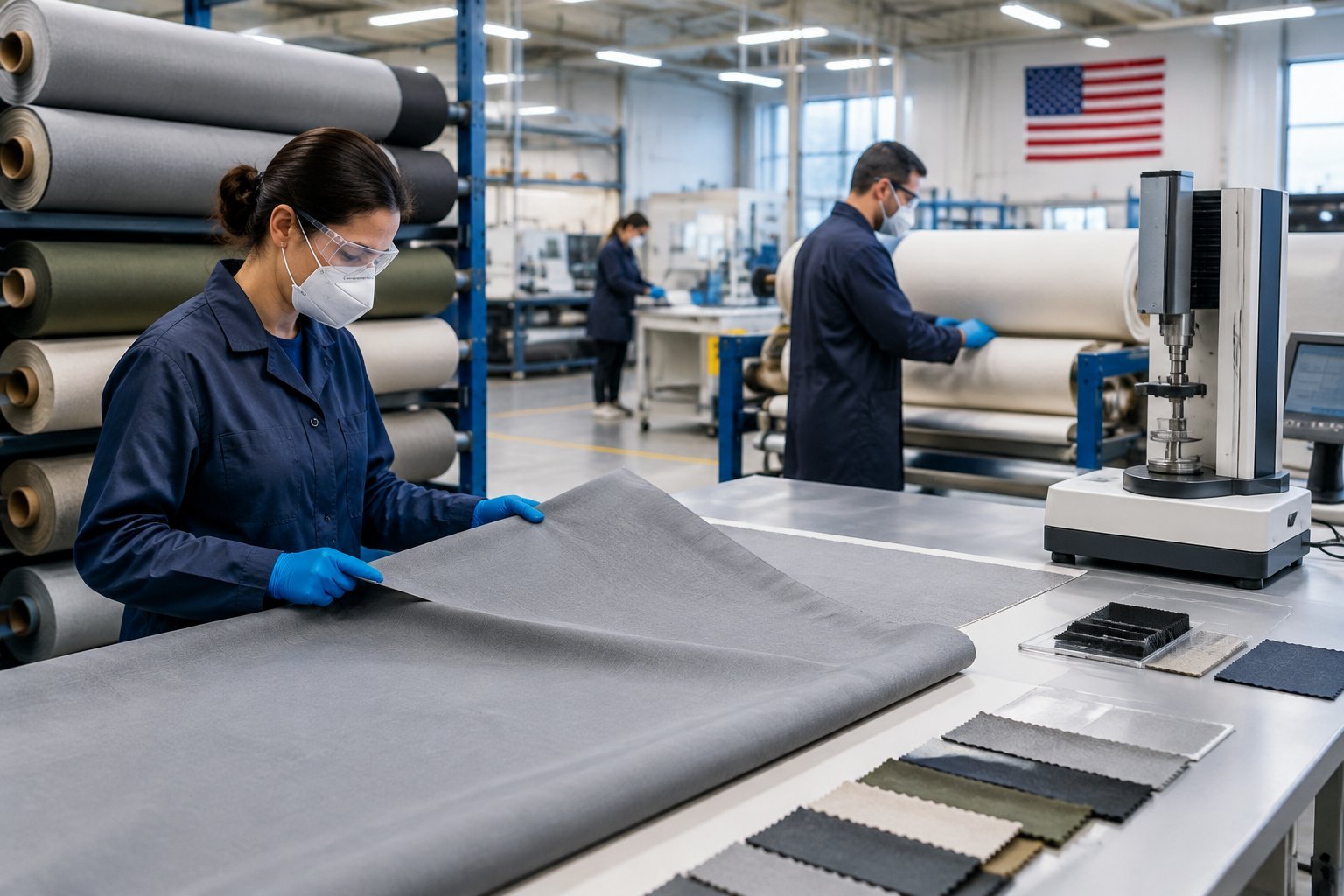
Successful sourcing starts with the intended purchase: fabric rolls for garment production, converted industrial materials, or finished protective clothing. Each route requires different evidence, especially when workers face hazardous liquids or vapors.
A useful supplier comparison connects the exact product to its tested chemicals and exposure conditions. US sales availability, domestic garment production, and US fabric manufacturing are separate purchasing attributes.
Which Supplier Category Matches Your Application?
The appropriate supplier category follows the intended end product and the protection required. Fabric construction and garment assembly create separate qualification responsibilities.
Coated and Laminated Fabric Manufacturers
These manufacturers apply coatings or bond layers to a supporting textile. Depending on the construction, the resulting material serves industrial equipment, protective apparel, or other technical applications.
For wearable protection, the specification should identify the exact coating or laminate and its chemical-performance evidence. Selecting chemical-resistant fabric requires chemical-specific results alongside the mechanical properties needed for garment construction.
Fabric Converters and Distributors
Converters process materials through operations such as slitting, sheeting, lamination, or die cutting. Distributors supply materials manufactured elsewhere and provide a purchasing channel for particular grades or dimensions.
Their value includes supplying usable formats for production. Buyers should establish who manufactures the underlying material and whether the offered grade carries evidence for the intended application.
Finished Chemical Protective Clothing Manufacturers
Finished chemical protective clothing manufacturers supply assembled products such as coveralls, aprons, splash suits, or encapsulating ensembles. Their product specifications address construction details beyond the fabric itself.
This category suits employers procuring wearable protection for an established hazard assessment. Selection should identify the garment model, seam construction, compatible accessories, and applicable use restrictions.
Why Filtration Textiles and Metal Wire Cloth Are Different
Filtration textiles separate particles or fluids within a process. Metal wire cloth consists of woven wire used for screening, filtration, and related industrial functions.
Chemical compatibility in those applications describes performance in process equipment. It establishes no wearable chemical-protection claim, so filtration and wire-cloth businesses require a separate evaluation before entering a protective-apparel shortlist.
US Supplier Options and Their Documented Product Scope
Kappler, DuPont, Respirex North America, and CS Hyde represent distinct purchasing routes in the US market. Their documented offerings support an application-based comparison without a ranked “best supplier” claim.
Supplier Comparison: Official Sources, US Operations, Applications, and Limitations
The comparison separates finished protective garments from industrial cloth. Domestic manufacturing claims apply only to the specifically documented products.
| Comparison criterion | DuPont | Kappler | Respirex North America | CS Hyde |
|---|---|---|---|---|
| Purchasing category | Finished chemical PPE | Finished chemical PPE | Finished chemical PPE | Industrial coated cloth |
| US operation or offering | US protective-apparel portfolio | Guntersville, Alabama production | North American PPE offering | Illinois industrial supplier |
| Documented product scope | Tychem chemical protective garments | US-made critical-protection suits | Chemical suits and reusable workwear | PTFE-coated fiberglass fabrics |
| Relevant applications | Chemical splash and hazmat | Hazard-specific chemical protection | Routine work and emergency response | Packaging, sealing, belting |
| Selection limitation | Grade and construction specific | Suit and hazard specific | Product and fabric specific | Wearable PPE suitability unverified |
DuPont: Distinguishing Tyvek From Tychem
DuPont’s Tychem range addresses chemical hazards through multiple garment families. Tyvek protective apparel also serves industrial protection and contamination-control applications, so the two names should remain distinct during specification.
For a concrete example, Tychem 4000 uses a chemical barrier film laminated to a Tyvek substrate. Its fabric provides at least 30 minutes of protection against >124 chemical challenges under the stated testing, which does not establish a universal safe wearing time.
Buyers should identify the exact Tychem family and garment configuration. A Tyvek substrate within a laminate does not transfer the laminate’s chemical-performance results to every Tyvek garment.
Kappler: Hazard-Specific Protective Garments
Kappler offers protective garments organized around specific hazards and fabric families. Its critical-protection chemical and biohazard suits are manufactured at its headquarters in Guntersville, Alabama.
The range includes ProVent products for general hazards and Zytron products for chemical exposure. ProVent Plus uses a patented microporous film composite for barrier protection against blood, body fluids, and viral threats.
Patented technology identifies a product characteristic; suitability still rests on the particular exposure and supporting test results. Procurement specifications should name the fabric family and garment style, including the required seam construction.
Respirex North America: Chemical Protective Suits and Workwear
Respirex North America supplies finished chemical protective clothing for routine industrial work and emergency response. Its chemical portfolio includes reusable jackets and bib pants, one-piece suits, supplied-air products, and gas-tight suits.
These product types serve different exposure scenarios. A reusable workwear ensemble and a gas-tight suit require different selection criteria, even when both fall within a chemical-protection catalog.
Purchasers should match the selected fabric and complete product configuration to the hazard assessment. Supplied-air products also require coordination with the employer’s respiratory-protection arrangements.
CS Hyde: Industrial PTFE Cloth With Wearable PPE Suitability Unverified
CS Hyde supplies PTFE-coated fabrics with documented industrial uses. Its standard-grade PTFE-coated fiberglass has a nominal thickness of .003″ to .028″ and is used extensively in packaging and sealing applications.
The catalog also includes porous materials and grades designed for release surfaces or conveyor equipment. Those characteristics help distinguish equipment materials from garment specifications.
Wearable chemical-PPE suitability remains unverified for these industrial PTFE cloth offerings. Their chemical-resistance descriptions should remain tied to the documented industrial applications unless a specific wearable construction has appropriate protective-clothing evidence.
Should You Buy Fabric or Finished Protective Garments?
Fabric procurement fits qualified garment-development projects; finished protective garments fit employers purchasing an established protective ensemble. The distinction determines who takes responsibility for validating the completed clothing.
When Fabric Procurement Fits a Workwear Manufacturing Project
Fabric sourcing suits manufacturers that control garment design and production qualification. The project team needs the capacity to assess material performance and validate the assembled garment.
Specifications should address workwear fabric selection alongside the chemical-exposure requirements. Weight and flexibility influence wearability, while seam design and closures require separate engineering decisions.
A successful fabric trial should include representative garment prototypes. Roll samples alone do not establish the performance of pockets, panel joins, or accessory interfaces.
When Finished Chemical PPE Is the Appropriate Purchase
Finished PPE is the appropriate route when an employer needs a defined protective garment for workplace use. Product selection should follow the exposure assessment and the manufacturer’s instructions.
OSHA requires employers to provide appropriate PPE when other controls do not provide sufficient protection and to train workers in its use and limitations. The purchasing decision therefore extends to donning, removal, maintenance, and disposal procedures.
Different chemical protective clothing levels describe different ensemble requirements. A purchasing team should specify the required protection and supporting evidence without treating a fabric description as an ensemble designation.
Why Seams, Closures, Fit, and Coverage Matter
The finished garment includes potential exposure pathways beyond the main fabric panels. Stitching, zipper assemblies, cuffs, and connections to other PPE require appropriate construction.
Fit affects coverage during kneeling, reaching, and other work movements. Excess tension also places stress on seams and closures.
Prototype reviews should include representative movements while the wearer uses the intended gloves, footwear, and respiratory equipment. The inspection should check whether interfaces remain covered throughout the task.
What Chemical Test Evidence Should Buyers Request?
Buyers need product-specific evidence that matches the chemical and exposure scenario. A broad “chemical-resistant” description leaves essential performance questions unanswered.
Match Chemical Identity, Concentration, Temperature, and Exposure
The test request should identify the chemical name and CAS number where applicable. Mixtures require their composition, because results for individual ingredients do not automatically establish mixture performance.
Concentration, temperature, contact duration, and exposure form belong in the same specification. Splash exposure and continuous contact represent different challenges.
For acid-protective fabric selection, the acid identity and concentration are essential starting points. A result for one acid does not establish suitability for another.
Distinguish Repellency, Penetration, Permeation, and Degradation
Each term describes a different performance mechanism:
- Repellency: Liquid shedding from the material surface.
- Penetration: Bulk liquid passage through openings, defects, or construction gaps.
- Permeation: Chemical movement through a material at the molecular level.
- Degradation: Physical or chemical deterioration following exposure.
Surface beading provides evidence of liquid shedding under the conditions observed. It supplies no molecular-barrier measurement.
The distinction between water resistance and repellency helps explain surface behavior, although chemical protection requires testing with the relevant challenge chemicals.
Understand ASTM F739, ASTM F903, and EN 13034 Scope
These standards address different aspects of protective-clothing performance. Their names should accompany the actual procedure and results.
ASTM F739 measures liquid and gas permeation under continuous contact. Its outputs include breakthrough time and permeation rate; ASTM states that the results cannot establish safe exposure levels.
ASTM F903 evaluates visible liquid penetration through materials and planar assemblies. It includes different pressure and exposure procedures, and a passing specimen still requires separate permeation assessment when that hazard applies.
EN 13034 covers limited-performance protection for light spray and low-pressure, low-volume splashes. It includes Type 6 suits and Type PB [6] partial-body protection, with different whole-garment testing scope.
The RFQ should state the required edition and procedure. The supplied ASTM F903-18 documentation identifies that edition as historical and lists F903-24 as active.
Check Laundering Durability and Combined Hazard Claims
Reusable protective clothing requires evidence after the intended care process. Reports should identify laundering pretreatment, drying conditions, and any required finish reactivation.
Chemical repellency, flame resistance, antistatic behavior, and arc protection each need applicable supporting evidence. The difference between arc-rated and flame-resistant clothing is particularly relevant when a specification combines electrical and chemical hazards.
A purchasing team should establish retirement criteria and approved cleaning instructions. Durability evidence for one protective function does not establish the wash durability of another.
How Do You Qualify Suppliers and Prepare an RFQ?
A useful RFQ connects a defined material or garment to measurable acceptance requirements. Protective clothing manufacturers should receive enough exposure information to propose a specific product configuration.
Specify Fabric Construction, Finish, Dimensions, and Intended Use
The RFQ should define the textile and the production format. A practical specification includes:
- Fiber composition and weave or supporting substrate.
- Fabric weight, thickness where relevant, and usable width.
- Coating, laminate, or finishing specification.
- Color or print requirements.
- Intended garment or industrial component.
- Chemical exposure and required performance.
- Order quantity and delivery destination.
The end use deserves a plain-language description alongside technical values. “Reusable workwear for assessed incidental splash exposure” communicates a different requirement from a continuously exposed equipment liner.
Request Product-Specific Test Reports and Representative Samples
Test reports should identify the offered product reference and tested construction. Relevant details include the challenge chemical, concentration, temperature, method, specimen conditioning, and results.
Samples should represent the proposed bulk specification. Approval records should connect the sample to its composition, finish, and product code.
For an assembled garment, specimen evidence and garment-level evidence serve separate purposes. The review should cover both wherever the required protection involves seams or interfaces.
Confirm the US Supplier Role, Manufacturing Origin, and Traceability
A US purchasing channel establishes where the transaction is supported. Fabric production, coating or finishing, and garment assembly are separate manufacturing stages.
The RFQ should request the supplier’s role and origin information for the proposed product. This is especially important where domestic-content requirements form part of the contract.
Traceability records should connect delivered rolls or garments with approved specifications and production lots. Substitutions require a defined approval process because a change in construction affects the relevance of existing test evidence.
Ask About Minimum Orders, Lead Times, and Quality Controls
Commercial questions should relate to the exact specification and order quantity. Minimum orders and schedules for stock goods differ from those for custom production.
The RFQ should request sample timing, bulk-production milestones, inspection arrangements, and procedures for nonconforming material. Acceptance criteria should cover dimensional tolerances and any performance characteristics critical to the application.
For multifunctional textiles, FR fabric quality controls belong alongside checks on the chemical-repellent finish. A general management-system certificate does not replace product-specific performance documentation.
When Is International Chemical-Repellent Fabric Sourcing Relevant?
International chemical-repellent fabric sourcing is relevant to workwear projects whose assessed exposure requirements fit liquid-shedding finishes. It represents a separate procurement route from purchasing chemical-barrier PPE.
Post-Treated Cotton, C/N, and CVC for Assessed Workwear Applications
LEVITEX is a China-based chemical-repellent fabric option for workwear manufacturers. Its offering uses post-treatment finishing on cotton, cotton/nylon (C/N), and cotton/polyester (CVC) base fabrics.
For example, its FCN240RR21 product lists 90% Cotton 10% Nylon, Weight: 240 GSM, and Width: 150cm / 59in. These values describe the fabric specification; suitability requires the relevant chemical-performance results.
Base-fabric selection should account for comfort and durability. The chemical properties of cotton fabric also require consideration when identifying exposure-related limitations.
Compare Custom Dyeing and Printing Requirements
LEVITEX offers custom dyeing and custom printing alongside customized fabric production. Buyers should define the final color or print specification together with the required finishing process.
The company was established in 1951 and has more than 500 professionals and employees. Its monthly production capacity is 5 million meters, with 1.5 million meters dedicated specifically to flame-retardant fabrics.
Those capacity figures describe the stated manufacturing operation, not a dedicated chemical-repellent production allocation. Buyers comparing fabric suppliers in China should qualify the proposed product and production schedule separately.
Keep Chemical Repellency Separate From Barrier Protection
LEVITEX’s chemical-repellent fabrics promote chemical-liquid shedding through a post-treatment finish. They are not equivalent to barrier-based chemical-resistant fabrics, and LEVITEX should not be classified as a US supplier or barrier-PPE maker.
Suitable workwear buyers are invited to email requirements to Charlie@levitex.com. The enquiry should include fabric composition, weight, quantity, required functions, chemical identities, exposure conditions, and laundering requirements.
Product approval should identify the precise finishing specification and supporting reports. Any finished protective-apparel claim also requires assessment of the completed garment.
Choose Suppliers by Application and Verified Protection
Supplier selection should connect the required purchase format with documented protection for the intended exposure. Kappler, DuPont, and Respirex North America provide finished chemical-PPE routes; CS Hyde’s documented PTFE cloth offering serves industrial applications.
For fabric-development projects, the next step is a product-specific RFQ supported by representative samples and relevant chemical testing. Employers buying finished protection should specify the garment configuration and review its use instructions, including accessory compatibility and care requirements.
International chemical-repellent fabrics belong in assessed workwear projects with suitable performance evidence. Approval should preserve the distinction between liquid shedding and chemical-barrier protection.
Frequently Asked Questions
The following answers address common purchasing distinctions for US chemical-protective textile projects.
Which US suppliers sell chemical-resistant fabric rather than finished suits?
CS Hyde sells industrial PTFE-coated fiberglass and related cloth products. Its documented packaging, sealing, and belting applications require separate qualification for any proposed wearable chemical-protection use.
Is industrial PTFE-coated cloth suitable for wearable chemical protection?
Industrial PTFE-coated cloth requires product-specific protective-clothing evidence before selection for wearable chemical protection. PTFE chemistry and industrial chemical-resistance claims alone do not establish garment suitability.
What is the difference between chemical-repellent and chemical-resistant fabric?
Chemical-repellent fabric promotes liquid shedding, while chemical-resistant fabric requires evidence of resistance to specified chemical exposure. Repellency results alone do not establish resistance to molecular permeation.
Does a US supplier necessarily manufacture its fabric in the USA?
A US supplier’s location does not establish the manufacturing origin of every fabric it sells. Buyers should document fabric production, finishing, and garment-assembly locations separately when origin requirements apply.
What test reports should I request before ordering chemical-protective fabric?
Buyers should request product-specific reports identifying the chemicals, concentrations, temperatures, test methods, and results relevant to the intended exposure. Reusable products also require appropriate laundering evidence, while garment projects need applicable seam and finished-clothing assessments.