For your workwear specification, waterproof fabric resists liquid-water penetration under defined conditions, water-resistant fabric provides limited penetration resistance, and water-repellent fabric makes droplets bead at the surface. You should specify breathability separately because water protection alone tells you little about how readily perspiration vapor escapes.
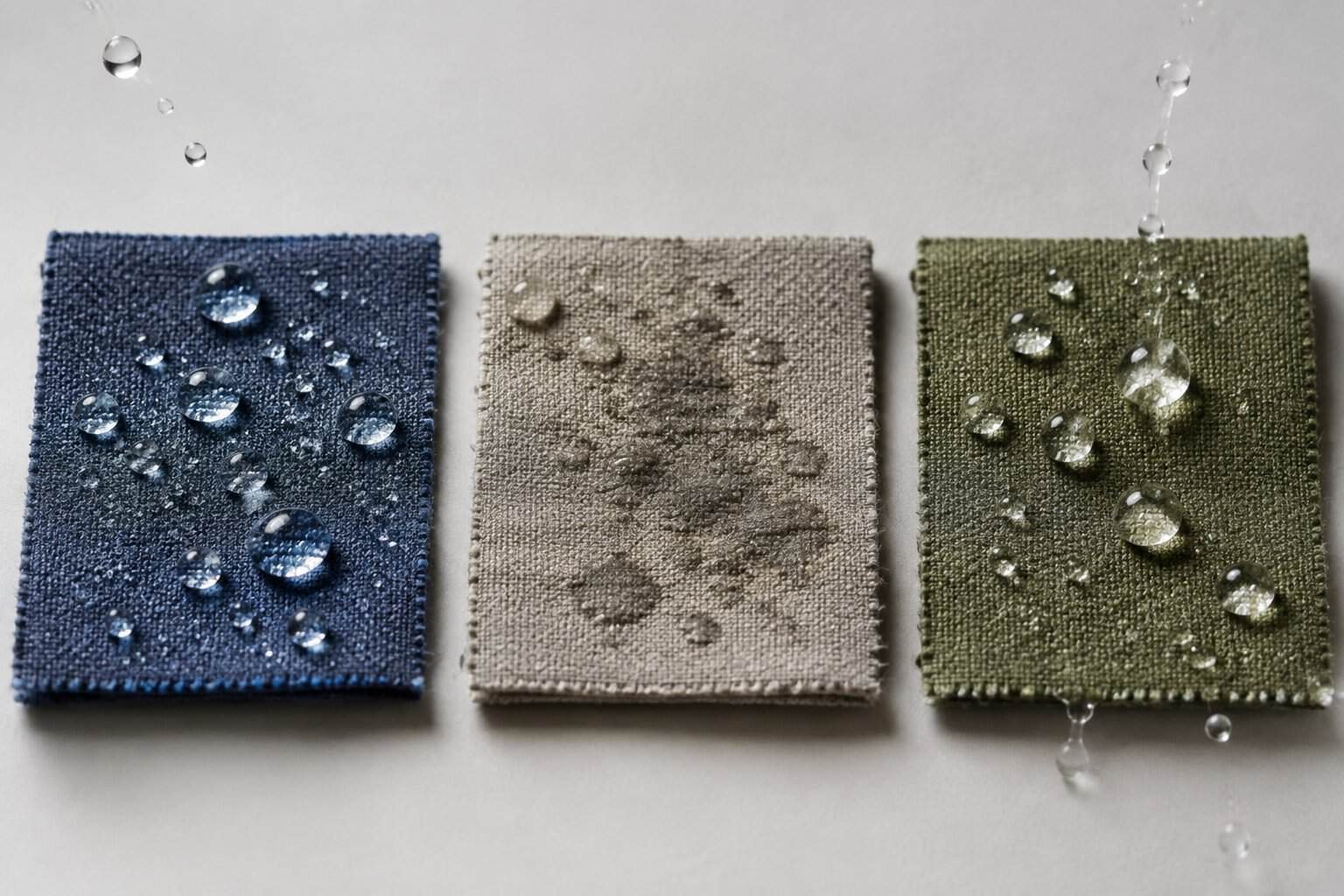
When you compare waterproof vs water resistant vs water repellent fabric, separate the surface finish from the fabric’s resistance to water pressure. A waterproof laminate also benefits from a repellent face, while a fabric that beads water still needs penetration testing before you specify it for sustained wet exposure.
For workwear purchasing, your goal is protection that survives the intended laundering process while supporting acceptable comfort. A useful specification connects each claim to a test method, an acceptance requirement, and the condition of the tested fabric.
What Do the Three Labels Actually Mean?
You should read waterproofness and water resistance as penetration-performance claims, while water repellency describes surface wetting. These properties overlap, and none establishes breathability by itself.
Waterproofness Describes Resistance to Water Penetration
When you specify waterproof fabrics, you are asking for resistance to liquid water under stated test conditions. A coating or membrane supplies a barrier, but the finished material still needs measured performance.
Your specification should identify the required pressure resistance and specimen condition. Treat “waterproof” as a claim with defined limits, including the effects of wear and garment construction.
Water Resistance Offers Protection Under Limited Exposure
You use water-resistant fabrics where a limited degree of penetration resistance meets the exposure requirement. A dense weave or a finishing treatment helps delay water entry during brief contact.
Your purchasing decision still needs evidence of how that fabric performs. The label alone supplies neither a duration of protection nor a dependable measure of resistance under pressure.
Water Repellency Describes Surface Beading, Not a Separate Protection Tier
With water-repellent fabric, you see droplets bead because the surface resists wetting. This behavior helps shed splashes and reduces water absorption into the face fabric.
You should treat repellency as a property that accompanies different levels of penetration resistance. Both a lightweight woven fabric and a waterproof laminate might have a repellent surface, despite substantially different barrier performance.
Comparison Table: Mechanisms, Limitations, and Suitable Exposure
You can use this comparison to separate the claims before requesting samples. Match the supplier’s evidence to your intended exposure, especially where pressure or prolonged contact is involved.
| Criterion | Waterproof fabric | Water-resistant fabric | Water-repellent fabric |
|---|---|---|---|
| Main claim | Defined penetration resistance | Limited penetration resistance | Surface wetting resistance |
| Common mechanism | Coating or membrane barrier | Dense weave or treatment | Hydrophobic surface finish |
| Main limitation | Damage and construction | Exposure duration and pressure | Beading proves no barrier |
| Suitable exposure | Sustained wet conditions, with verification | Brief, limited wet exposure | Splashes and surface shedding |
| Evidence to request | Hydrostatic-pressure results | Relevant penetration results | Spray-test results |
| Breathability | Separate measurement | Separate measurement | Separate measurement |
How Do Weaves, Finishes, and Barriers Control Water?
Your fabric’s water performance comes from its structure, surface chemistry, and any continuous barrier layer. Identifying which mechanism supplies the protection helps you request the right evidence.
What Can a Tight Weave Achieve?
A tight weave reduces the spaces through which water travels, helping your fabric delay penetration. Yarn construction and fiber wetting behavior also influence the result.
You still need testing to establish the protection supplied by a particular construction. When choosing materials for workwear, assess the complete fabric specification because fiber content alone gives you an incomplete performance description.
How Do Repellent Finishes Change Surface Wetting?
Repellent treatments lower the fabric surface’s tendency to wet, encouraging droplets to bead and roll away. You gain surface shedding without necessarily closing the spaces between yarns.
Your choice of fabric finishes also affects care requirements and compatibility with other protective functions. Ask which cleaning process preserves the finish and whether any restoration treatment is permitted.
How Do Coatings and Membrane Laminates Resist Penetration?
A continuous coating or membrane creates a barrier across the fabric structure. You encounter coatings applied to a textile substrate and laminates in which a separate membrane is bonded to supporting layers.
For a membrane laminate such as GORE-TEX, you should assess the particular construction and its documented performance. Microporous and hydrophilic systems transport moisture vapor through different mechanisms, so your breathability requirements need their own test results.
Which Tests Verify Water Protection and Breathability?
You need separate evidence for surface wetting, resistance to liquid-water penetration, and moisture-vapor performance. Each test answers a different purchasing question.
Surface-Wetting Tests: ISO 4920 and Equivalent Methods
Use a spray test when your question concerns how readily the fabric face wets. Your laboratory can assess surface repellency using ISO 4920 or AATCC 22, among other applicable methods.
The result describes the observed wetting pattern under the specified procedure. You should request the method, rating, tested face, and laundering condition; a favorable spray result alone does not establish resistance to pressurized water.
Hydrostatic-Pressure Tests: ISO 811 and Equivalent Methods
Request hydrostatic-pressure testing when you need evidence of resistance to water penetration. Available methods include ISO 811 and AATCC 127, with the selected procedure determining how pressure is applied and the endpoint recorded.
Your report should identify the test face and pressure-increase conditions. Hydrostatic head expresses pressure as an equivalent height of water, while other reports use pressure units directly.
For purchasing approval, connect these results to your fabric quality requirements. Agree on the acceptance criterion before bulk production and require reports that identify the submitted fabric.
Why Moisture-Vapor Performance Requires Separate Testing
Your resistance-to-water result does not predict how efficiently perspiration vapor moves through the material. Request a moisture-vapor transmission or evaporative-resistance method suited to the product.
With comparable test conditions, higher moisture-vapor transmission indicates greater vapor transfer, while lower evaporative resistance indicates easier transfer. You should compare results from the same procedure because temperature, humidity, and specimen arrangement affect the measurement.
Air permeability is another separate property. A fabric that blocks airflow still needs moisture-vapor testing to establish its breathable performance.
How Should Buyers Interpret a Waterproof Rating?
Read your waterproof rating as a laboratory result tied to a named method and specimen condition. A higher hydrostatic head indicates greater resistance to water pressure when the results are otherwise comparable.
Your approval should distinguish initial results from those obtained after laundering or abrasion. Ask whether the reported value represents an individual specimen, an average, or a guaranteed minimum.
Avoid assigning a universal waterproof threshold to every application. Your exposure assessment and applicable product requirements should determine the acceptance level.
Why Can a Finished Garment Still Let Water In?
Your garment’s protection depends on every route through which water enters, including construction details and damaged areas. Even when waterproof fabrics meet their specification, garment-level validation remains necessary.
Seams, Closures, and Garment Construction
Needle holes interrupt a continuous barrier, so your seam specification needs an appropriate sealing method. Seam tape must be compatible with the fabric and withstand the intended care process.
You should also evaluate openings at the neck and cuffs, along with pocket construction and front closures. For outdoor clothing, garment rain testing helps reveal entry paths that fabric testing leaves unexamined.
Wear, Contamination, and Laundering
Abrasion and repeated flexing change the condition of your fabric, while contamination interferes with surface shedding. Coatings and laminate bonds also need assessment after the expected service and cleaning conditions.
For multifunctional garments, follow an approved flame-retardant fabric laundering process alongside the water-performance care instructions. Unapproved detergent additives or restoration products risk changing the protective system.
Your post-care evaluation should include both surface repellency and penetration resistance where both are claimed. Restored beading supplies evidence about the face finish; barrier integrity requires its own assessment.
Surface Wet-Out vs. Leakage and Internal Condensation
You experience surface wet-out when the outer textile becomes saturated. The underlying barrier might remain intact, although the garment feels heavier and its moisture-vapor performance deteriorates.
Leakage involves outside water crossing the fabric system or entering through a construction detail. Condensation develops when moisture inside your clothing collects on cooler surfaces.
Before rejecting a material for leakage, document where and when dampness develops. A controlled evaluation of the garment helps separate these causes and identify the corrective action.
What Should Workwear Buyers Specify Before Ordering?
You should order against a written performance specification that connects exposure conditions with care durability and test evidence. Include garment construction requirements whenever your claim applies to the finished workwear.
Define Exposure, Activity, and Comfort Requirements
Describe whether your workers face intermittent splashes, prolonged rain, or contact with wet surfaces. Include pressure from kneeling or equipment straps because these conditions change the demands on the fabric.
Your checklist should cover:
- Expected exposure duration and frequency.
- Contact pressure and abrasion.
- Work intensity and environmental temperature.
- Required moisture-vapor performance.
- Other protective functions and garment layers.
- Approved care process and expected service life.
For hot-weather work pants, assess heat burden alongside water protection. For oil and mining workwear fabrics, document the full hazard assessment before selecting a multifunctional finish.
Request Relevant Test Methods and Results After Required Wash Cycles
Specify the laundering procedure and required number of cycles before requesting durability results. Include detergent, temperature, drying conditions, and any permitted finish-reactivation step.
Your approval package should identify:
- Fabric composition and construction.
- Finish or barrier-system identification.
- Test method and edition.
- Specimen preparation and conditioning.
- Initial and post-laundering results.
- Acceptance limits and sampling arrangements.
You should address fabric shrinkage in the same care specification because dimensional changes affect fit and seam behavior. For production control, require traceability between the approved sample, test report, and supplied fabric lot.
Separate Water Repellency, Chemical Repellency, and Chemical Barriers
Your water-repellency results establish performance against water under the selected test. Chemical-liquid repellency requires assessment against the specified chemical and exposure conditions.
Levitex produces chemical-repellent fabrics through post-treatment finishing on cotton, cotton/nylon (C/N), and cotton/polyester (CVC) base fabrics. When you assess these materials, classify them as chemical-repellent fabrics; permeation-resistant chemical barriers require different construction and evidence.
For your chemical protective clothing requirements, identify the chemical, concentration, contact duration, and exposure route. Keep liquid repellency, penetration resistance, and permeation resistance as separate approval criteria.
Match Fabric Performance to Exposure and Wash Requirements
Choose your water-protection claim by matching measured performance to the conditions your workwear must withstand. Waterproof fabric needs verified penetration resistance, water-resistant fabric needs a defined exposure limit, and water-repellent fabric needs documented surface-wetting performance.
Carry those requirements through the intended wash process and finished garment assessment. Your final approval should identify the accepted fabric, required test results, and construction details that preserve protection in service.
Frequently Asked Questions
You should treat fiber names and finish descriptions as starting points, with protection claims supported by testing.
Is water-resistant fabric the same as waterproof fabric?
You should specify them separately: water-resistant fabric describes limited penetration resistance, while waterproof fabric requires documented performance under defined conditions. Check the test method and post-care result behind either claim.
Which is better for workwear: waterproof or water-repellent fabric?
For sustained wet exposure, you should prioritize verified waterproof performance and suitable garment construction. For intermittent splashes, a tested water-repellent fabric offers surface shedding; assess comfort separately.
Can cotton fabric be waterproof?
You can obtain waterproof performance from a cotton-based fabric through a suitable coating or laminate. Cotton content alone establishes neither penetration resistance nor finished-garment protection.
Does waxing canvas make a garment waterproof?
Waxing improves your canvas’s water shedding, but a waterproof garment claim requires supporting performance evidence. Seams and closures still need evaluation.
Is polyester fabric waterproof on its own?
You should assess polyester fabric by construction and test results because polyester fiber alone does not establish waterproofness. A coating or membrane adds a barrier whose performance requires verification.
For your workwear order, discuss exposure conditions, laundering requirements, and required fabric-test documentation with Charlie@levitex.com.