
A fabric air permeability test measures the air flow passing perpendicularly through a defined fabric area at a controlled pressure differential. For protective clothing buyers, it provides a measurable basis for comparing airflow through candidate textiles and setting consistent purchasing specifications.
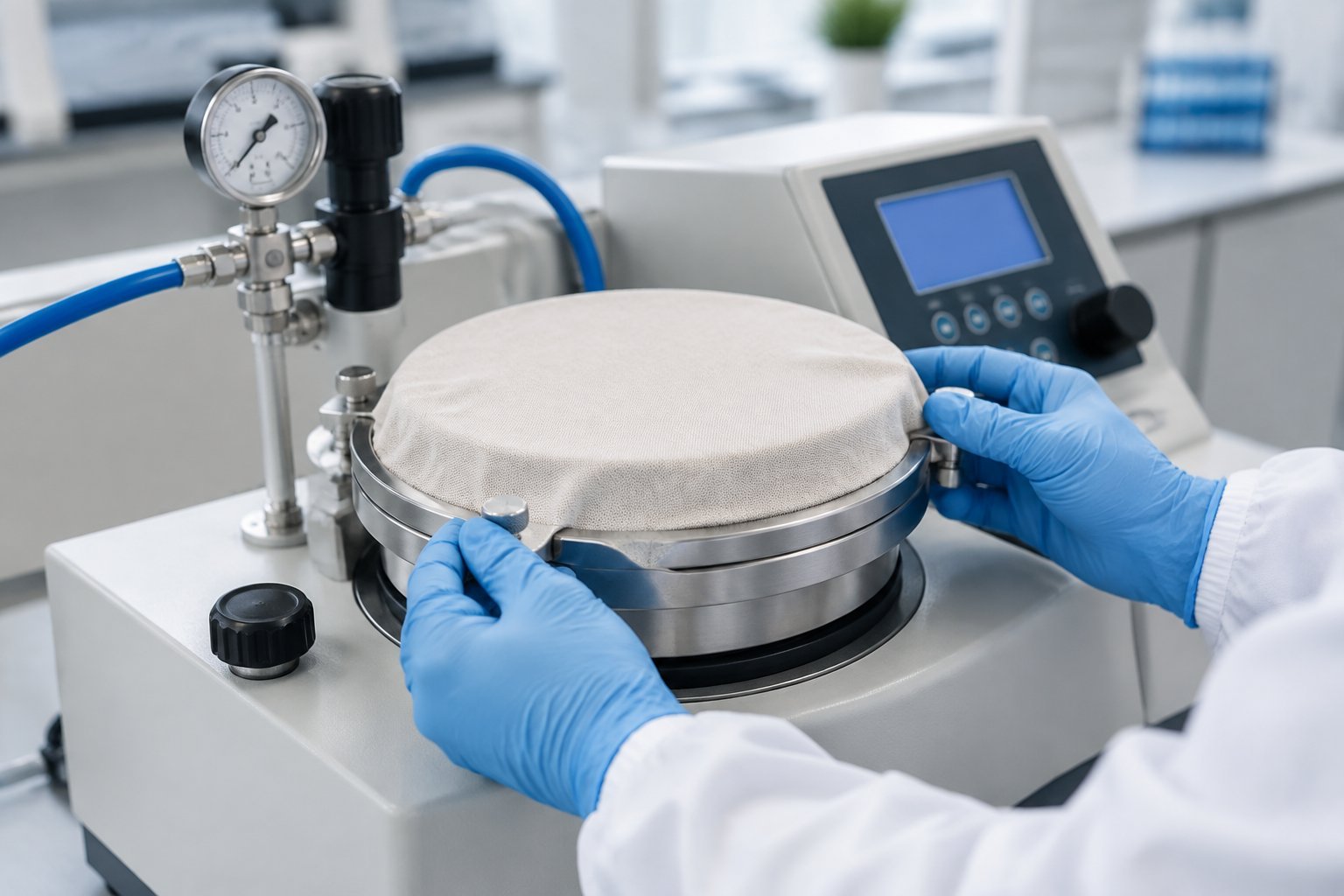
Levitex manufactures flame-resistant textiles for industrial applications, where fabric comfort must support the required protection. Air permeability adds useful evidence when selecting materials for workwear fabrics, provided textile testing reports identify the pressure differential and exposed test area.
How Is Airflow Through Fabric Measured?
An air permeability tester draws air through a clamped specimen and measures the flow required to maintain the specified pressure drop. Reliable airflow measurement requires representative sampling and a sealed test head.
Which Method Applies: ASTM D737, ISO 9237, or Regional Standards?
ASTM D737 is a common choice for US textile purchasing specifications. ISO 9237 serves international contracts, while EN ISO 9237 identifies its European adoption; ISO 9237:1995 is the dated designation encountered in many specifications.
Regional requirements include GB/T 5453 in China and applicable air-permeability procedures within JIS L1096 in Japan. The purchase contract should identify the method and edition before testing begins.
| Comparison point | ASTM D737 | ISO 9237 | Regional standards |
|---|---|---|---|
| Procurement context | US specifications | International specifications | Destination-market contracts |
| Common pressure examples | 125 Pa | 100 or 200 Pa | Method-specific |
| Common exposed-area example | 38 cm² | 20 cm² | Method-specific |
| Reporting units | SI or cfm/ft² | Commonly L/m²/s | Contract-defined |
These settings are examples, with the applicable method and agreed specification controlling the laboratory procedure. Air permeability methods also serve a different purpose from EN standards for FR workwear and GB standards for flame-retardant protective clothing, which address protective-performance requirements.
Sample Preparation, Conditioning, and Equipment Calibration
Sample preparation starts with fabric representative of the supplied lot. Test locations should cover different regions across the usable fabric, excluding creases, selvages, and accidental damage unless those features are under investigation.
Conditioning follows the atmosphere referenced by the selected method, such as ASTM D1776 or ISO 139. Moisture uptake changes fiber dimensions and pore geometry, so specimens need moisture equilibrium before measurement.
Equipment calibration covers the pressure sensor and airflow measurement system. Routine verification with the instrument’s reference device, inspection of seals, and recorded maintenance strengthen FR fabric quality control and help laboratories investigate unexpected readings.
Setting the Test Pressure and Exposed Area
The test pressure is the difference between the pressures on opposite faces of the specimen, expressed in pascals (Pa). The instrument adjusts suction until that pressure differential reaches the specified value.
The test area is the opening exposed inside the clamp. It differs from the total size of the cut specimen, which must extend far enough beyond the opening to form a secure seal.
The operator selects a test head and airflow range suited to the method and material. Any permitted adjustment to pressure or area belongs in the report, particularly when comparing dense industrial textiles with more open constructions.
Clamping the Specimen, Preventing Edge Leakage, and Recording Readings
The specimen should lie flat without stretching. Clamp tension that opens a knitted structure or distorts a woven fabric changes the measured airflow.
Edge leakage introduces air around the specimen boundary and inflates the result. Clean gaskets, appropriate clamping force, and method-approved sealing arrangements are especially important for fabrics with low airflow.
After pressure and flow stabilize, the operator records the reading and repeats the procedure at the required locations. The report should retain individual measurements and provide the required statistical summary, including variability where specified.
What Do the Results and Units Mean?

Air permeability test results express airflow rate per unit of exposed fabric area at a stated pressure differential. A higher number indicates greater airflow under those particular conditions.
Calculating Air Permeability From Airflow Rate and Area
The basic calculation is:
Air permeability = volumetric airflow rate ÷ exposed test area
For an illustrative measurement, an airflow rate of 0.4 L/s through 20 cm² gives:
- Exposed area: 20 cm² = 0.002 m²
- Calculation: 0.4 ÷ 0.002
- Air permeability: 200 L/m²/s
The pressure differential must accompany that result. The reported value describes flow at the selected pressure; the basic calculation does not divide the result by pressure.
Converting L/m²/s, cm³/cm²/s, and cfm/ft²
Air permeability units describe the same volume-per-area-per-time relationship:
- 1 cm³/cm²/s = 10 L/m²/s
- 1 cfm/ft² = 5.08 L/m²/s
- 1 L/m²/s ≈ 0.19685 cfm/ft²
- 1 L/m²/s = 1 mm/s of superficial air velocity
For example, 100 L/m²/s equals 10 cm³/cm²/s, or approximately 19.69 cfm/ft². In US reports, “cfm” alone is incomplete unless the document clearly identifies the area basis.
Unit conversion preserves the original test conditions. It changes the expression of the measurement without changing the pressure at which testing occurred.
Why Results at Different Pressures Are Not Directly Comparable
A larger pressure differential drives more air through the fabric. The relationship between pressure and airflow also changes with pore geometry and flow conditions.
Consequently, doubling a result obtained at 100 Pa does not reliably predict its value at 200 Pa. Even dividing airflow by pressure fails to establish a universal conversion between test settings.
A valid comparison requires retesting at the same pressure or a measured pressure-flow curve covering the relevant range. An assumed multiplier introduces uncertainty into supplier rankings.
Air Permeability vs. Water-Vapor Resistance and Garment Ventilation
Air permeability describes bulk air movement through fabric pores. Water-vapor resistance describes resistance to evaporative moisture transfer; moisture vapor transmission methods measure vapor transfer under their own specified conditions.
Some membranes permit water vapor diffusion while strongly restricting bulk airflow. This distinction also helps clarify waterproofness, water resistance, and repellency when evaluating protective layers.
Garment ventilation depends on openings and fit, as well as worker movement and external air speed. Fabric breathability, moisture management, and thermal comfort therefore require separate evidence, particularly for multilayer protective clothing.
How Should Buyers Evaluate FR Workwear Fabrics?
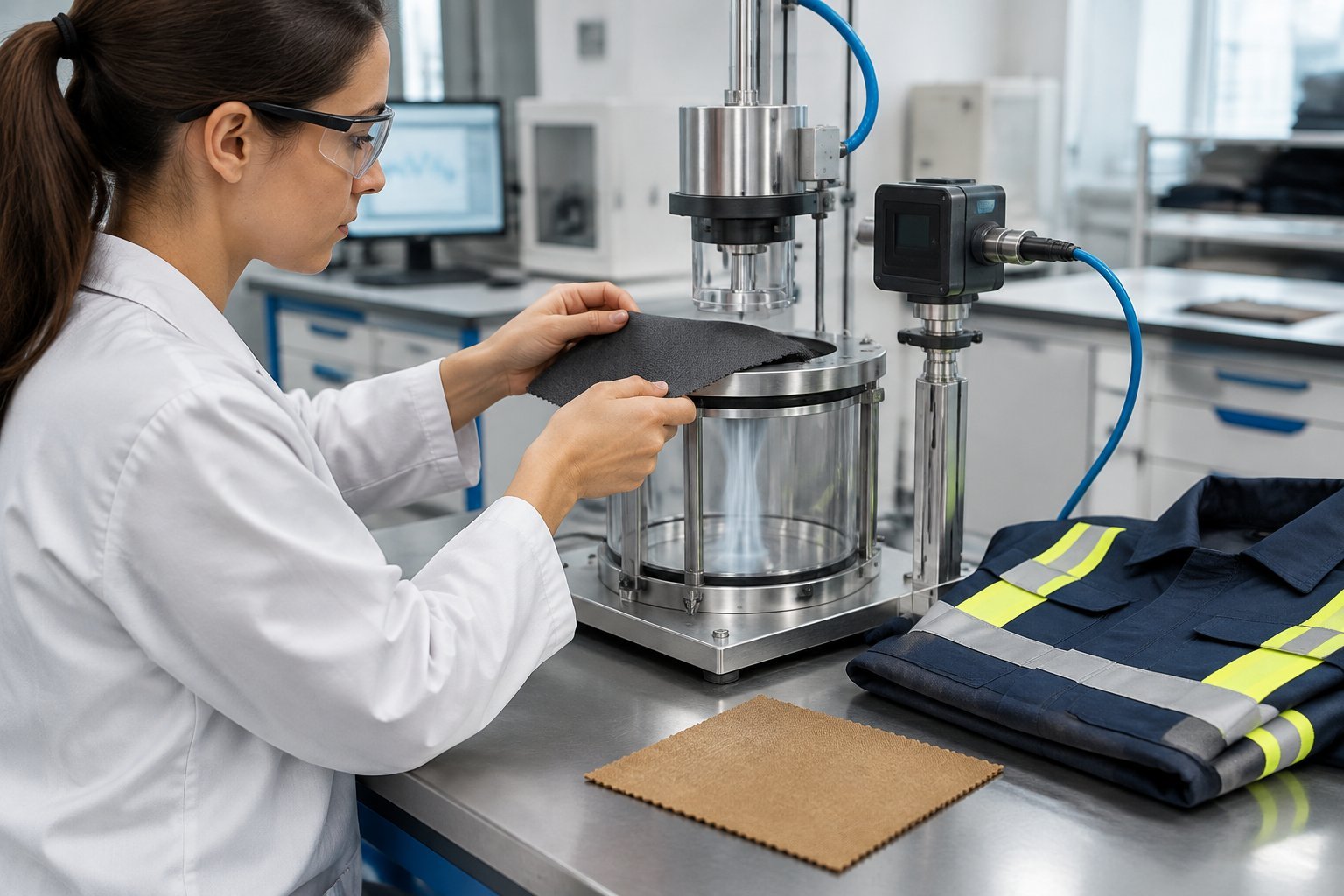
Buyers should compare airflow measurements from finished fabrics with equivalent test conditions and documented protective requirements. Composition and fabric weight provide useful identification, but product-specific reports establish measured performance.
How Construction, Porosity, Yarn, and Thickness Affect Airflow
Fabric construction controls the size and connectivity of the paths available to air. Woven fabrics with closely spaced yarns present different flow paths from knitted fabrics formed from interlocking loops.
Fabric porosity describes void space. Air permeability of textile fabrics also reflects how those voids connect through the material, so equal porosity does not guarantee equal airflow.
Fiber type and yarn structure influence pore geometry through swelling, hairiness, and packing. Yarn count and fabric weight help describe construction, although neither predicts textile air permeability independently.
Fabric thickness adds information about flow-path length. Thickness measurements under ISO 5084 should include the measurement pressure because compression changes the thickness of technical fabrics.
Comparing Cotton, C/N, and CVC Without Assuming Performance
Levitex’s three main fabric families are 100% cotton, cotton/nylon (C/N), and cotton-rich cotton/polyester (CVC). These families are available as woven constructions, and Levitex also manufactures flame-resistant knitted fabrics.
A useful comparison records the exact blend percentage alongside construction and finished weight. Cotton content alone provides insufficient evidence for ranking the air permeability of fabric.
Buyers comparing samples should identify whether differences arise from composition, yarn arrangement, finishing, or several variables together. Equivalent end-use requirements remain essential when assessing the practical value of a higher airflow result.
Checking the Effects of FR and Repellent Finishes
Finishing changes fabric permeability when it alters pore openings, yarn dimensions, or surface structure. A finish that leaves open pathways behaves differently from a continuous layer that covers them.
Levitex offers FR plus water-repellent and FR plus oil-repellent finishing on all three base-fabric families. The airflow consequences require testing of the final combined finish; water-repellent FR fabric finishing should be evaluated alongside the intended protective properties.
Comparisons should identify the fabric’s laundering or other pretreatment condition. Coated fabrics and repellent-finished fabrics also require clear identification because their structures and performance mechanisms differ.
What to Specify When Requesting Levitex Product Reports
Levitex provides a test report for each product. Buyers seeking air permeability evidence should request confirmation that the relevant product report includes the required method and settings.
A focused request should identify:
- Product reference, composition, construction, and finished weight.
- Final finish package and requested color.
- Air permeability method and edition.
- Pressure differential, exposed test area, and reporting units.
- Conditioning and pretreatment requirements.
- Number of locations, summary statistics, and acceptance range.
Separate flame-retardant fabric testing establishes the relevant combustion behavior. An airflow report establishes only the airflow characteristics covered by its method.
For a product-specific discussion, buyers can contact Sales Manager Charlie Luo at Charlie@levitex.com with the intended application and requested test conditions. Levitex supplies textiles; garment-level assessment remains part of the finished protective-clothing process.
Compare Airflow Under Matching Test Conditions

Matching test conditions make fabric air permeability results useful for purchasing decisions. Comparisons should use the same method, pressure differential, and test area, with conditioning and pretreatment aligned.
The fabric’s final finish and batch identity should accompany the result. These details allow buyers to distinguish a construction difference from a testing difference.
When selecting flame-retardant fabrics, the purchasing specification should retain separate requirements for airflow and protective performance. A practical next step is an agreed laboratory comparison of shortlisted finished fabrics under one documented procedure.
Frequently Asked Questions
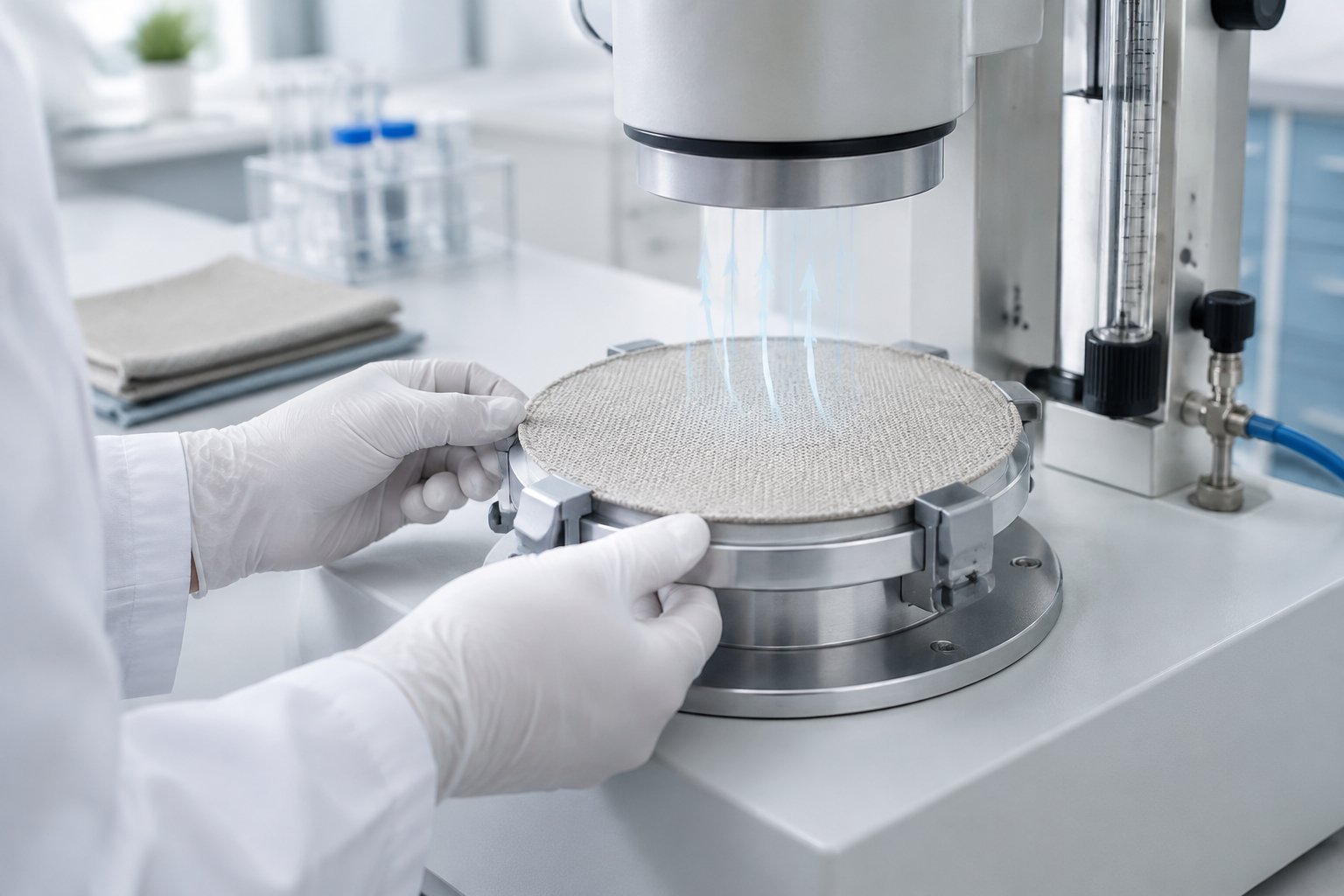
The following answers address acceptance criteria, report interpretation, and equipment purchasing for protective-clothing textiles.
What is a good air permeability value for protective-workwear fabric?
A good value meets the application’s agreed airflow range while preserving the required protection. Buyers should establish that range using an approved reference fabric and workplace comfort assessment, then specify the test pressure alongside it.
Can ASTM D737 and ISO 9237 results be compared?
ASTM D737 and ISO 9237 results support comparisons when the laboratory has aligned the relevant conditions and assessed procedural differences. Matching units alone leaves differences in pressure, exposed area, conditioning, and sampling unresolved.
What is the formula for fabric air permeability?
The formula is air permeability = volumetric airflow rate ÷ exposed test area. With airflow in L/s and area in m², the answer is L/m²/s, reported with the pressure differential.
Does higher air permeability mean better moisture-vapor performance?
Higher air permeability establishes greater bulk airflow at the stated pressure. Moisture-vapor performance requires a separate vapor-transfer or evaporative-resistance measurement, especially for membrane-containing protective clothing.
How much does an air permeability tester cost?
An air permeability tester price requires a supplier quotation tied to its configuration. A useful quotation request identifies the required ASTM D737 or ISO 9237 capability, pressure range, low-flow sensitivity, test heads, calibration service, and installation costs.