A higher English cotton count (Ne) means finer yarn and, at equal yarn length per square meter, lower fabric weight; finished GSM also reflects density, construction, ply, and finishing. For industrial textile buyers, specifying these variables together supports consistent fabric weight across quotations and production lots.

Levitex manufactures industrial fabrics in 100% cotton, cotton/nylon (C/N), and cotton-rich cotton/polyester (CVC), including woven and knitted constructions. Across these families, identical yarn counts produce different weights when fabric construction or finishing changes.
GSM means grams per square meter, a measure of fabric mass per unit area. Weight-band selection belongs alongside a fabric GSM chart; yarn count provides the separate information needed to describe the yarn entering that construction.
What Does Ne Tell You About Yarn Fineness?

English cotton count (Ne) expresses yarn fineness through length per unit mass. Its relationship to yarn thickness is useful, although fiber density and yarn packing also influence physical diameter.
Why Does a Higher Ne Mean a Finer Yarn?
Ne counts the number of 840-yard hanks weighing one pound. Ne 20 therefore represents 16,800 yards per pound, while Ne 40 represents 33,600 yards per pound.
Ne 40 provides twice the length at the same mass, so each yard weighs half as much. This establishes a precise linear-density relationship; physical diameter also reflects twist, fiber properties, and the yarn’s internal structure.
How Do Direct and Indirect Count Systems Differ?
Indirect yarn count systems express length per fixed mass. Both English count and metric count (Nm) increase as yarn becomes finer.
Direct yarn count systems express mass per fixed length. Tex measures grams per 1,000 meters; denier (D) measures grams per 9,000 meters; decitex (dtex) measures grams per 10,000 meters.
A higher direct-system value means greater mass per unit length. Every purchase specification therefore needs the count system beside the numerical value.
What Do Single and Plied Yarn Notations Mean?
A single yarn is one continuous yarn strand. Under the count/ply convention, Ne 20/1 identifies a single Ne 20 yarn, and Ne 40/2 identifies two Ne 40 singles twisted together.
Those two Ne 40 strands have a theoretical resultant count of Ne 20 before twist contraction. Their structure remains different from a Ne 20 single yarn, affecting surface character and processing behavior.
Some suppliers reverse the notation to 2/40s. Written confirmation of singles count, number of plies, and tested resultant count prevents ambiguity.
Why Can Fabrics With the Same Ne Have Different GSM?
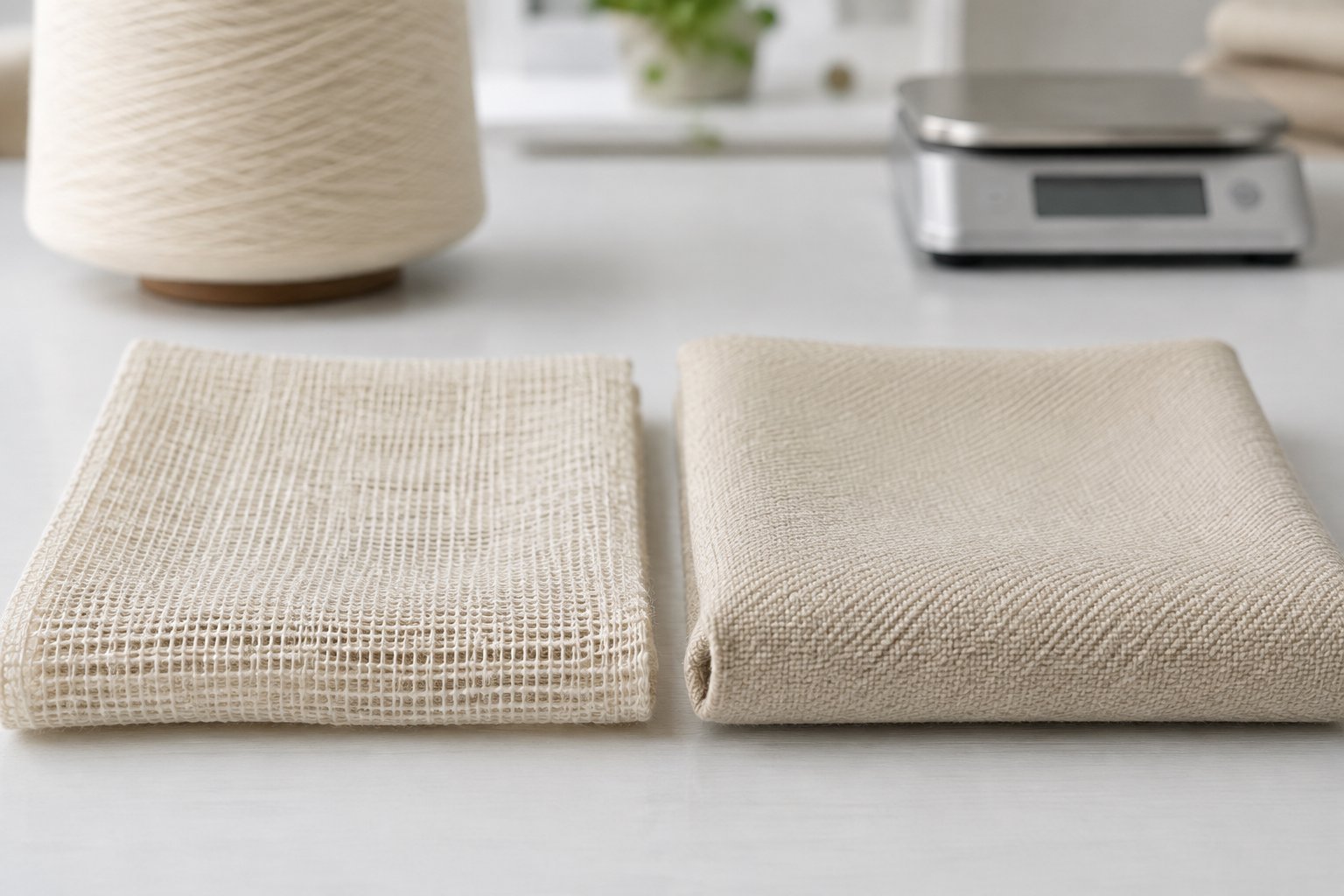
Fabrics with the same Ne have different GSM when they contain different yarn lengths per square meter or undergo different finishing changes. The relevant construction variables differ between woven fabric and knit fabric.
How Do Warp and Weft Density Affect Woven Weight?
Woven weight includes the mass of both warp and weft. Increasing ends per inch adds warp yarn; increasing picks per inch adds weft yarn.
A useful theoretical estimate is:
GSM ≈ 0.03937 × [EPI × warp tex × (1 + warp crimp) + PPI × weft tex × (1 + weft crimp)]
EPI means ends per inch, and PPI means picks per inch. Crimp is expressed as a decimal, so 8% becomes 0.08.
Separate warp yarn and weft yarn counts are essential when the directions use different yarns. A combined thread count hides that distinction, while weave interlacing changes crimp and hand feel.
How Does Knitted Construction Change Yarn Consumption?
Knitted fabric weight reflects yarn length within each loop and the number of loops per square meter. Rib, interlock, and single-jersey structures distribute yarn differently.
For a defined structure, fabric mass follows total yarn length per square meter multiplied by yarn mass per meter. Stitch length and relaxed stitch density interact, so changing a machine setting requires checking the resulting fabric dimensions.
Comparisons of FR knit and woven fabrics therefore require construction-specific specifications. Knitted fabrics need loop and relaxation information alongside count.
What Do Hypothetical 20s and 40s Comparisons Show?
The following examples are explicitly hypothetical. They assume identical warp and weft counts, single yarns, and zero crimp, with finishing and moisture effects excluded.
| Hypothetical construction | Yarn count, warp/weft | Ends × picks per inch | Calculated GSM |
|---|---|---|---|
| A | Ne 20/1 × Ne 20/1 | 80 × 60 | 163 |
| B | Ne 40/1 × Ne 40/1 | 80 × 60 | 81 |
| C | Ne 40/1 × Ne 40/1 | 160 × 120 | 163 |
At unchanged density, switching from Ne 20 to Ne 40 halves theoretical yarn mass per area. Doubling both directional densities restores that mass in the calculation.
Construction C is a mathematical illustration, not a production recommendation. Weaving feasibility and finished properties require separate assessment.
How Do Finishing and Shrinkage Change Finished Weight?
Finished GSM changes through both mass change and area change. Scouring removes material, while some fabric finishes add retained solids.
Fabric shrinkage raises GSM when the same fabric mass occupies less area. In a hypothetical example with unchanged mass, 5% shrinkage in each direction leaves 90.25% of the original area and increases GSM by approximately 10.8%.
Chemical processing also interacts with the chemical properties of cotton. Greige and finished specifications consequently need separate weight values, with the conditioning state identified.
How Do You Convert and Verify Yarn Counts?

Reliable yarn count conversion starts with a defined system and a consistent mass basis. Tex provides a convenient intermediate unit because it expresses yarn mass per kilometer.
Verified Formulas for Ne, Nm, Tex, Denier, and Dtex
The following formulas follow the standard unit definitions, with constants rounded for practical calculations:
- Tex = 590.54 ÷ Ne
- Ne = 590.54 ÷ tex
- Tex = 1,000 ÷ Nm
- Nm = 1,000 ÷ tex
- Nm ≈ 1.6934 × Ne
- Ne ≈ 0.59054 × Nm
- Denier = 9 × tex
- Dtex = 10 × tex
- Dtex = denier ÷ 0.9
Decitex and dtex identify the same unit. These conversions apply to cotton and blended yarns when their stated counts use the same conditioning or moisture basis.
Composition does not change the underlying unit arithmetic. Commercial regain conventions require separate attention when suppliers report counts on different mass bases.
A Worked Conversion Table for Common Ne Values
The table expresses equivalent linear densities for single yarns. Its values describe yarn mass per length and provide no standalone fabric GSM prediction.
| Ne | Nm | Tex | Denier | Dtex |
|---|---|---|---|---|
| 10 | 16.93 | 59.05 | 531.49 | 590.54 |
| 16 | 27.09 | 36.91 | 332.18 | 369.09 |
| 20 | 33.87 | 29.53 | 265.74 | 295.27 |
| 24 | 40.64 | 24.61 | 221.45 | 246.06 |
| 30 | 50.80 | 19.68 | 177.16 | 196.85 |
| 40 | 67.74 | 14.76 | 132.87 | 147.64 |
For Ne 20, dividing 590.54 by 20 gives 29.527 tex. Multiplying that unrounded result by nine gives 265.743 denier.
Keeping intermediate values unrounded avoids accumulated conversion error. Final purchase specifications should state the agreed reporting precision.
How Do You Calculate the Resultant Count of Plied Yarns?
For identical singles, theoretical resultant Ne equals the singles count divided by the number of plies. Two Ne 40 singles therefore produce approximately Ne 20 before contraction.
For unequal components, direct-system values add:
Resultant tex = tex₁ + tex₂ + …
Equivalently:
1 ÷ resultant Ne = (1 ÷ Ne₁) + (1 ÷ Ne₂) + …
A hypothetical combination of Ne 40 and Ne 30 gives approximately 34.45 tex, equivalent to Ne 17.14. Plying contraction increases mass per finished length, so an exact specification needs the measured resultant count.
How Is Yarn Count Measured From Length and Mass?
Yarn count measurement uses a known yarn length and its conditioned mass. A wrap reel prepares the skein, and a suitable precision balance measures its weight.
For length L in meters and mass m in grams:
- Tex = 1,000 × m ÷ L
- Nm = L ÷ m
- Ne = 0.59054 × L ÷ m
A hypothetical 100-meter sample weighing 2.00 grams equals 20 tex, Nm 50, or approximately Ne 29.53. The laboratory needs to record conditioning and measurement tension.
Spun yarn and filament yarn use the same mass-length principle. Polyester filament yarn specifications also need filament number distinguished from ply count: 150D/48F describes total denier and filament count.
Within FR fabric quality control, yarn extracted from finished cloth needs careful interpretation. Retained finish, extraction damage, and extension affect the measured result.
What Should Buyers Specify for Industrial Fabric Orders?

Industrial fabric orders need yarn details, construction parameters, and a finished-weight acceptance basis. Protective requirements belong in the same specification, supported by applicable product reports.
A Yarn, Construction, and Finished-Weight Checklist
A usable technical-textile inquiry includes the following information:
- Composition: Fiber percentages and any directional differences.
- Yarn: Warp/weft counts or each knitting-feed count, count system, ply, and agreed tolerances.
- Yarn structure: Spinning route, twist requirements, and carded yarn or other specified preparation.
- Woven construction: Weave, ends per inch, picks per inch, and measurement stage.
- Knitted construction: Structure, stitch length or agreed control parameters, and relaxed density.
- Finished dimensions: Usable width, target GSM, and acceptance tolerances.
- Processing: Dyeing or printing requirements and requested finishes.
- Verification: Conditioning basis, sampling method, and relevant test requirements.
For industrial workwear fabrics, this information connects the quotation to the intended application. An approved reference swatch adds a useful hand-feel reference while measured specifications define acceptance.
Applying the Checklist to Cotton, C/N, and CVC Fabrics
For 100% cotton, the specification should identify cotton yarn count and preparation. Changes in fiber selection or yarn twist alter processing behavior even when nominal Ne remains unchanged.
For cotton/nylon, blend percentage belongs alongside construction. Assessing cotton/nylon blend properties also requires distinguishing blended staple yarn from constructions that place different fibers in separate directions.
For CVC, the cotton-rich cotton/polyester ratio needs explicit percentages. A CVC versus 100% cotton comparison remains meaningful when count and finished GSM are matched, because composition still influences processing and moisture behavior.
Levitex manufactures these three base-fabric families in woven and knitted constructions. The inquiry should identify the required structure separately from composition.
Why Count Alone Cannot Establish Strength, Comfort, or Protection
Strength requires information about fiber quality and yarn structure, followed by testing of the finished fabric. A finer count alone establishes no reliable strength ranking.
Comfort also reflects air permeability, moisture handling, and surface finish. Carded yarn, compact-spun yarn, and core-spun yarn introduce structural differences that nominal count leaves undescribed.
Pilling resistance depends on fiber characteristics, synthetic fibers within the blend, yarn hairiness, and fabric construction. Protective performance requires relevant testing of the finished material; composition and GSM provide specification inputs without establishing a protection rating.
Confirming Specifications With Levitex Samples and Product Reports
Levitex supplies textiles for industrial applications and provides a test report for each product. Report review should match the exact product reference and identify the tested properties and sample condition.
Fabric construction analysis supports checks of directional density and yarn structure. Sample approval should distinguish a development swatch from a production-lot sample, with agreed finished GSM and tolerance recorded before bulk acceptance.
Garment-level requirements extend to assembly and components supplied by garment manufacturers. Levitex’s offering remains fabric manufacturing, including custom dyeing and printing.
Buyers seeking a fabric specification review are invited to send yarn, construction, weight, and protective requirements to Charlie@levitex.com.
Specify Yarn Count and Finished GSM Together

A complete fabric specification pairs yarn count with construction and measured finished GSM. Ne establishes yarn fineness; construction establishes yarn consumption per area, and finishing changes the delivered fabric’s mass and dimensions.
For woven orders, the specification needs separate warp and weft counts plus directional density. For knitted orders, it needs the structure and agreed stitch-control parameters.
The purchase order should record count system, ply, composition, finished width, and GSM tolerance. Acceptance checks should use the agreed conditioning state and product-specific protective requirements.
Frequently Asked Questions
Yarn count conversions describe equivalent linear density, while fabric GSM calculations require construction information. These distinctions resolve common specification questions.
Can you convert Ne directly into fabric GSM?
A fabric GSM calculation requires Ne plus yarn consumption per square meter. Woven calculations need directional density and crimp; knitted calculations need structure-specific yarn-length and stitch-density information.
How do you convert Nm to Ne?
Ne equals approximately 0.59054 multiplied by metric count (Nm). For example, Nm 50 converts to approximately Ne 29.53 on the same mass basis.
What does 20s mean in cotton yarn specifications?
“20s” denotes English cotton count Ne 20, equal to twenty 840-yard hanks per pound. It commonly identifies a single yarn, but an order should state Ne 20/1 explicitly to resolve ply ambiguity.
Is Ne 40/2 equivalent to Ne 20/1?
Ne 40/2 and Ne 20/1 have approximately equal theoretical linear density before plying contraction. The ply yarn has a different structure, and its measured resultant count reflects the contraction introduced during twisting.
Can cotton and CVC fabrics have the same Ne and GSM?
Cotton and CVC fabrics can share both nominal Ne and finished GSM. Their specifications still need separate composition and finishing details, with product testing establishing the required industrial performance.