
For arc welding, you need welding gear that includes a correctly shaded helmet, safety eyewear, flame-resistant clothing, task-matched welding gloves, and protective footwear, with hearing and respiratory protection selected through your workplace hazard assessment. Together, these items protect the body areas exposed to arc radiation, flying particles, sparks, and hot metal.
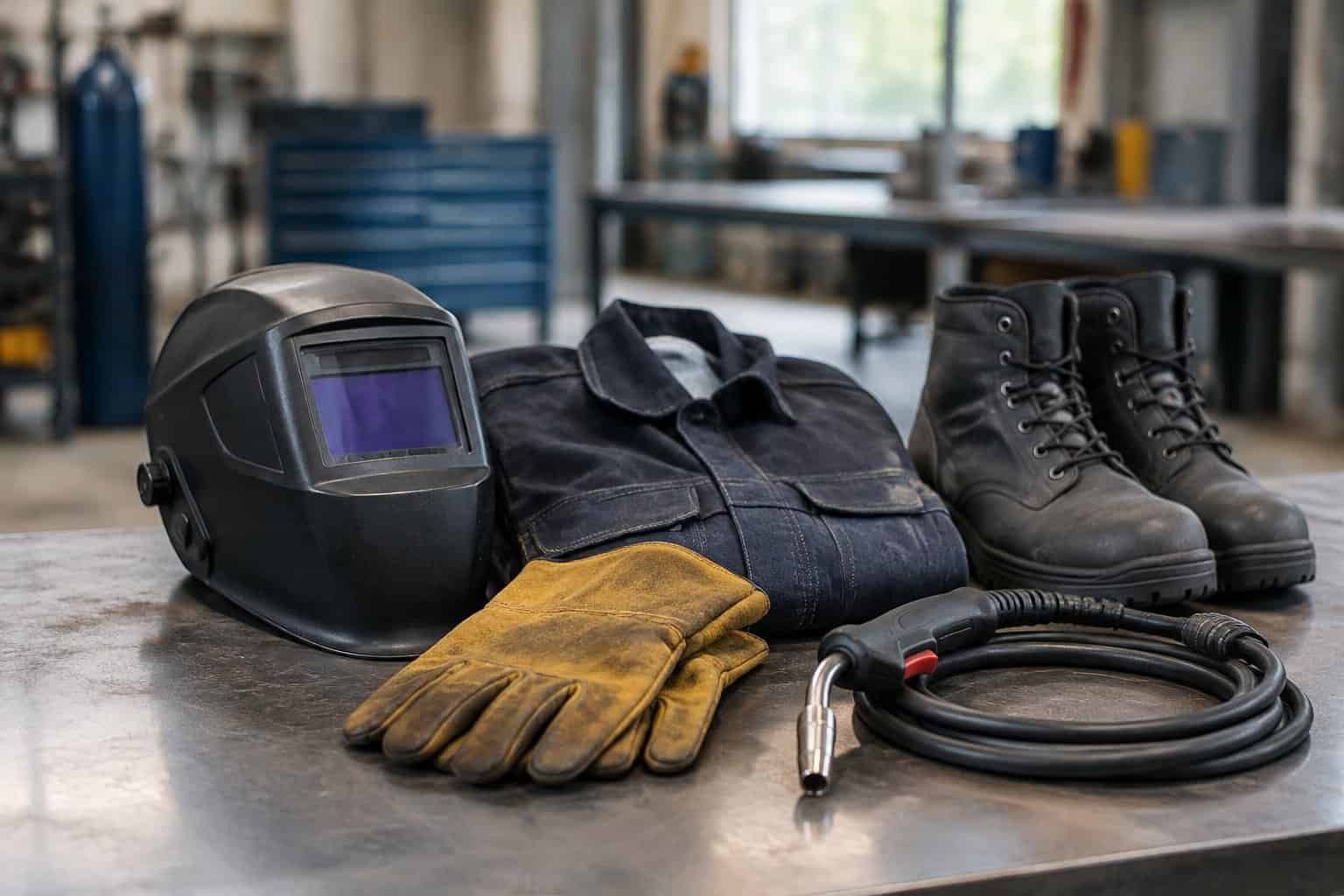
Whether you are selecting garments for your crew or specifying fabric for welding workwear, you need protection that stays in place throughout the job. Your welding machine and torch perform the work; your personal protective equipment (PPE) addresses the hazards that reach you.
Before work begins, your employer’s hazard assessment should account for the welding process, current, materials, position, and surrounding conditions. In the United States, your selection should follow applicable OSHA requirements, including welding-specific provisions, alongside manufacturer instructions and relevant ANSI/AWS safety guidance.
How Do You Choose Eye and Face Protection?
You need a welding helmet with a filter suited to your process, plus safety eyewear that protects your eyes when you lift the helmet. Your selection must address both optical radiation and flying debris.
Match the Helmet and Filter Shade to the Welding Task
Select your filter shade using the welding process and operating current, including electrode size where the applicable selection chart requires it. Follow the appropriate OSHA shade requirements and helmet instructions; improve task lighting if visibility is poor without reducing protection below the required level.
For an auto-darkening filter, verify its operating range, sensitivity, and delay settings before welding. Low-current TIG work requires a filter specified to detect that arc reliably, and you must return the helmet from grinding mode to welding mode before striking an arc.
Use full-face welding protection for arc welding. You must not substitute gas-welding goggles or ordinary sunglasses for an arc-welding helmet, and you should protect nearby personnel with suitable screens and task-appropriate eye protection.
Wear Appropriate Safety Eyewear Beneath the Helmet
Wear properly fitting safety glasses with side protection or suitable goggles beneath your helmet. You need secondary eye protection even when using other eye and face protection, because debris exposure continues during slag removal and between welds.
For your U.S. workplace, select eyewear meeting the applicable ANSI/ISEA Z87.1 requirements. Your everyday prescription glasses need appropriate protective over-eyewear unless they are themselves suitable safety eyewear.
When grinding or chipping, use the impact protection required for that operation. Confirm that any helmet grinding configuration is approved for the task and that your safety glasses remain in place.
What Protective Clothing Should Welders Wear?
Wear welding-appropriate flame-resistant clothing that provides continuous coverage in your working position. Choose the material and garment construction for the expected heat and spatter exposure.
Choose Tested Clothing and Adequate Body Coverage
Check the garment label and documentation for its intended welding use, applicable testing, and care requirements. You should evaluate FR clothing for welding against the actual exposure, including overhead work and prolonged radiant heat.
If your specification uses EN ISO 11611, confirm the applicable classification and the scope of the supporting documentation. A fabric test report supports material selection, while your finished garment also requires suitable seams, closures, and construction.
Cover your arms and legs, close your collar, and maintain overlap at your wrists and waist. Keep pockets closed, avoid trouser cuffs that collect sparks, and add appropriate head or neck coverage where the helmet leaves skin exposed.
Treated FR Cotton vs. Leather for Welding Jackets
Choose treated FR cotton for applications whose assessed heat and spatter exposure falls within the garment’s documented performance. You gain a lighter, more breathable option, but sparks and molten droplets still damage fabric.
Use leather garments or reinforcement where the task requires greater resistance to abrasion and concentrated spatter. Your choice of a suitable material for welding clothing should account for exposure duration as well as comfort.
| Selection factor | Treated FR cotton | Leather |
|---|---|---|
| Wearer comfort | Lighter, more breathable | Heavier, less breathable |
| Spatter exposure | Assessed lighter exposure | Demanding spatter exposure |
| Mobility | Flexible fabric construction | Varies with thickness |
| Care | Label-directed laundering | Leather-specific cleaning |
| Inspection focus | Holes, charring, thinning | Cracks, stiffness, damaged seams |
With either option, check the complete garment’s intended use. For overhead welding, review the paths that falling spatter takes around your shoulders, closures, and cuffs, and manage heat stress when heavier clothing increases your thermal burden.
Distinguish Protective Fibers and Blends From Ordinary Clothing
Choose purpose-designed protective materials using documented performance. Your options include treated cotton, inherently flame-resistant fibers, and engineered protective blends.
When assessing clothing materials to avoid during welding, pay particular attention to ordinary polyester or nylon garments that melt under heat. Specialized tested protective blends require their own evaluation; fiber names alone do not establish suitability.
Ordinary untreated cotton also requires caution because it burns. Select compatible base layers and check your full clothing system, including undergarments, against the garment instructions and workplace assessment.
How Should Gloves Match the Welding Process?
Select your gloves for the heat and spatter you face while preserving enough finger control to handle the equipment safely. Your welding process provides a starting point, followed by amperage and exposure duration.
Compare Dexterity and Heat Protection for TIG, MIG, and Stick Welding
Use these process distinctions when narrowing your selection of welding gloves:
- TIG (GTAW): Choose flexible welding gloves that support controlled filler-wire feeding. Increase thermal protection when higher current or sustained welding raises your hand exposure.
- MIG (GMAW): Look for a balance of insulation and grip, with reinforcement where your hand contacts the gun or work support.
- Stick (SMAW): Prioritize suitable insulation and coverage for sparks, slag, and radiant heat.
- Flux-cored welding (FCAW): Assess spatter and heat exposure directly, particularly during extended welding or work above shoulder level.
Try the gloves with your actual torch or electrode holder before starting the job. Check that you can operate controls without excess material bunching at your fingertips and that your cuffs maintain coverage as you move.
Understand the Limits of Welding Gloves
Treat your welding gloves as task-specific protection with defined limits. You must not assume they provide electrically insulating protection or a chemical barrier.
Keep your gloves dry and follow electrical-safety procedures for the welding system. For hot workpieces, use appropriate handling tools and allow cooling time; prolonged contact overwhelms glove insulation.
If your job includes sharp-edge handling or chemical exposure, assess those tasks separately. A cut-resistance rating alone does not establish protection against welding heat, flame, or spatter.
Which Additional Protection Does the Job Require?
Add footwear, hearing protection, and respiratory protection according to the hazards identified for your job. Address airborne contaminants through engineering controls and work practices before relying on a respirator.
Select Protective Footwear and Hearing Protection
Wear durable protective footwear suited to hot metal and the mechanical hazards around your work. Where falling objects or crushing hazards exist, select the required safety-toe and metatarsal protection.
Keep your trouser legs outside the boot tops so sparks shed away from the openings. Check exposed laces and tongue areas for places where spatter collects, and use task-appropriate guards when required.
Select hearing protection using your workplace noise assessment, including grinding, hammering, and gouging exposure. Where sparks threaten your ears, choose compatible flame-resistant protection and appropriate head coverage without disrupting the helmet fit.
Prioritize Ventilation and Fume Controls
Position local exhaust ventilation to capture welding fumes close to their point of generation. Keep your breathing zone out of the plume and check that extraction does not disrupt shielding gas.
Review the base metal and its coatings, along with filler materials and relevant safety data sheets. Welding stainless steel or coated metal requires attention to the contaminants produced under the specific working conditions.
Arrange exposure assessment when needed and verify that controls work throughout the task. Outdoor work still requires assessment, especially when wind directs fumes toward you or nearby workers.
Use Respiratory Protection Within a Formal Program
Use respiratory protection selected through your employer’s respiratory protection program whenever the assessment requires it. Your program should address medical evaluation, training, maintenance, and fit testing for tight-fitting respirators under applicable OSHA requirements.
Select the respirator and filters for the identified contaminants and exposure level. Particulate filters do not remove every welding gas, and air-purifying respirators do not supply oxygen.
Check compatibility with your helmet and eyewear, and keep facial hair away from a tight-fitting facepiece’s sealing surface. Confined-space work requires its own entry controls, atmospheric evaluation, and emergency arrangements before welding begins.
What Should You Check Before Each Use?
Before you weld, confirm that every PPE item fits, remains serviceable, and works with the rest of your protective system. Correct a failed check before striking an arc.
Check Fit, Coverage, and Compatibility Across PPE
Put on the complete system and move through the positions your task requires. Reach forward, bend, and raise your arms while checking for exposed skin at your waist and wrists.
Make sure your helmet clears your respirator and that eyewear temples do not interfere with a required face seal. Check hearing protection at the same time, including earmuff contact where applicable.
Verify your glove grip and boot stability. Secure excessive fabric through proper sizing or approved adjustment features, and avoid improvised alterations that change protective construction.
Inspect for Damage, Contamination, and Worn Components
Inspect your PPE in good lighting and follow each manufacturer’s pre-use checks:
- Helmet and eyewear: Look for cracks, damaged headgear, pitted filters, and scratched or hazy lenses. Test auto-darkening functions using the specified procedure.
- Clothing: Check for open seams, holes, thinning, damaged closures, and embedded spatter.
- Gloves: Examine fingertips, palms, cuffs, and seams for burns or wear.
- Footwear: Check damaged uppers, worn soles, and openings that admit sparks.
- Respirators: Inspect the facepiece, valves, connections, filters, and airflow indicators as applicable.
Remove contaminated clothing from service when oil, grease, or combustible deposits compromise safe use. When you clean welding gloves, follow the instructions for their leather, lining, and construction.
Follow Care Instructions and Replace Compromised Equipment
Follow the specified washing, drying, and storage instructions for each garment. Your method for laundering flame-retardant fabric must preserve its protective properties and remove hazardous contamination.
Use replacement parts approved for your helmet and respirator. Repair protective garments only through permitted methods using suitable materials.
Replace equipment when damage, contamination, or failed checks compromise its intended protection. Use the manufacturer’s retirement criteria and inspection results to make that decision; avoid assigning every welding jacket the same service life.
Match Welding Protection to the Task and Fabric Requirements
Build your welding protection around the assessed exposure, then verify fit and condition before each use. Keep ventilation and other workplace controls in place alongside your PPE.
If you manufacture welding garments, carry those same requirements into your fabric specification. Your process for verifying fabric quality standards should connect test documentation with the intended garment construction and care conditions.
For application-specific workwear fabrics, discuss your welding garment requirements with LEVITEX’s sales manager, Charlie Luo, at Charlie@levitex.com. Include your target protective performance, preferred fabric construction, and laundering requirements in your inquiry.
Frequently Asked Questions
You should resolve kit suitability, material substitutions, and fit questions against the requirements of your specific welding task.
What safety gear does a beginner welder need?
You need the same task-appropriate protection as an experienced welder, including eye and face protection, protective clothing, welding gloves, and suitable footwear. Complete your setup with the assessed hearing and respiratory protection, and obtain training before operating the equipment.
Is a welding gear kit enough for every welding job?
You should treat a welding gear kit as a starting package whose individual components require verification. Check its helmet operating range, garment suitability, glove protection, and sizing against each new task.
Can treated FR cotton replace a leather welding jacket?
You can select treated FR cotton when its documented performance meets your task’s heat and spatter requirements. Use leather or suitable reinforcement when your assessment identifies exposure beyond the fabric garment’s intended use.
Can cut-resistant gloves be used for welding?
You need gloves specifically suitable for welding; a cut-resistance rating alone is insufficient. If you need both forms of protection, verify that the exact glove provides the required cut protection and welding performance.
How should welding PPE fit women and smaller-framed workers?
You should select PPE using individual measurements and a movement check while wearing the complete system. Look for appropriate sleeve length, glove finger length, boot fit, and adjustable helmet headgear, then verify respirator fit separately where required.