
You use an arc flash suit for task-specific protection against assessed arc-flash thermal exposure during switchgear operations, justified electrical diagnostics or maintenance, and utility or industrial electrical work. As an electrician or another authorized person working on or near electrical installations, you need protective clothing matched to the task’s predicted exposure.
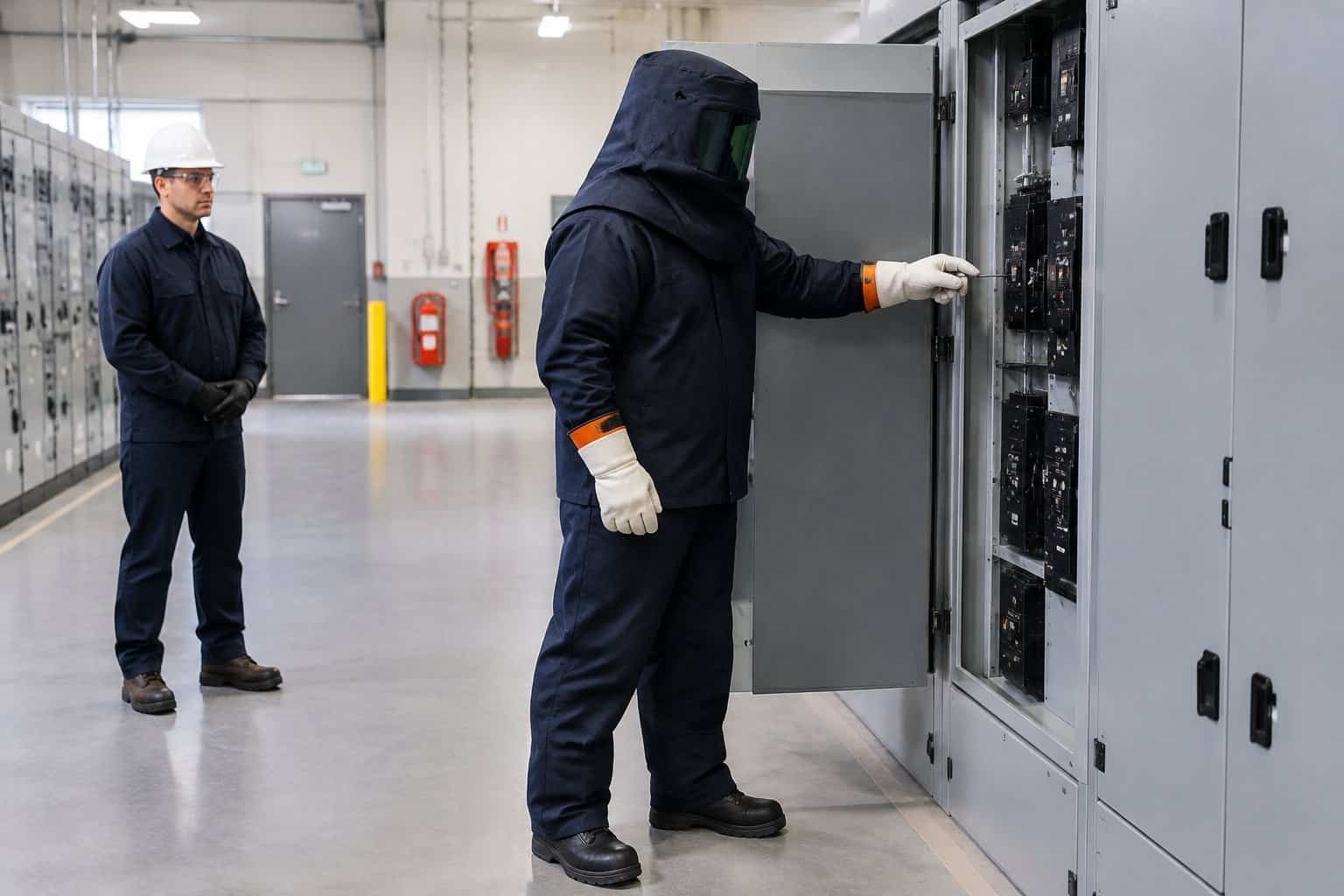
Your goal is to reduce burn injury if an electrical fault produces an arc flash. Specialized arc-rated clothing supports that goal within an electrical safety program that prioritizes eliminating exposure, establishing safe working conditions, and controlling remaining hazards.
Whether you specify protective garments or select workplace PPE, you need a clear connection between the assessed incident energy and the documented performance of the complete clothing system.
What Applications Are Arc Flash Suits Used For?
You use arc flash suits for electrical tasks where an assessment identifies thermal exposure requiring the suit’s protection. Your application is defined by the equipment condition and work activity, together with your position relative to the potential arc.
Switchgear Operation When an Arc-Flash Hazard Is Identified
Your switchgear tasks warrant close assessment when they involve breaker racking or interaction with equipment showing signs of impending failure. A closed enclosure alone does not establish that an operation is safe.
You should distinguish normal operation of properly installed and maintained equipment from servicing or abnormal operation. For work covered by its utility standard, OSHA identifies racking a circuit breaker as an electric-arc exposure, while distinguishing normal operation of enclosed equipment without evidence of impending failure.
Your authorization should reflect the actual operating condition. Evidence of overheating or damaged insulation calls for reassessment and additional controls before work proceeds.
Justified Electrical Diagnostics and Maintenance
You might need an arc flash suit during justified energized testing or fault diagnosis when the assessment identifies sufficient thermal exposure. Opening equipment and positioning test instruments changes the exposure from that associated with observing an intact enclosure.
Your employer must establish the justification for energized work and assign qualified personnel. Production convenience alone does not establish that justification.
You should also distinguish diagnostics that require electrical energy from repairs that follow diagnosis. Once energized measurements are complete, your work plan should return to de-energization wherever required.
Utility and Industrial Electrical Tasks Under Assessed Conditions
Your utility or industrial applications include assessed work around distribution equipment, motor control centers, substations, and generation systems. Your job title alone does not determine whether you need a suit.
When specifying what electric utility workers wear, you need to account for the task and applicable operating rules. Open-air equipment and enclosed switchgear present different exposure conditions.
Your assessment also needs to reflect system changes. Modified protection settings or a different operating configuration can alter incident energy without changing the equipment’s nominal voltage.
When Is an Arc Flash Suit Needed Instead of Other Arc-Rated Clothing?
You select an arc flash suit when the documented PPE requirements call for a clothing system and head protection that your other approved arc-rated garments do not provide. A tested layered ensemble is another option when its verified performance satisfies the assessed exposure.
How Does a Qualified-Person Risk Assessment Guide Selection?
Your employer’s assessment establishes whether an arc-flash hazard exists, evaluates the likelihood and severity of injury, and identifies protective measures. Qualified personnel need current equipment information and a clear description of the task.
To choose arc flash PPE, you use an applicable incident-energy analysis or the NFPA 70E PPE category method within its stated limits. Those methods require different inputs; you should not combine their outputs into an improvised selection.
Your incident-energy assessment considers factors including available fault current, protective-device clearing time, equipment configuration, and working distance. If the category tables do not cover your equipment or operating parameters, you need an appropriate analysis before selecting PPE.
Matching the Complete PPE Ensemble to Assessed Thermal Exposure
Your protective clothing needs an arc rating suitable for the assessed exposure at the specified working distance. Under the incident-energy method, your selected rating must meet or exceed the calculated incident energy.
You also need compatible protection for every exposed body area. Review the hood or face protection, garment overlap, hand protection, eye protection, hearing protection, and footwear required by your work plan.
When combining arc flash clothing materials, use documented performance for the exact layered system. Adding individual garment ratings does not establish a combined system rating, and a highly rated jacket does not compensate for inadequate protection elsewhere.
What Does an Arc Flash Suit Not Replace?
You still need exposure controls and separate protection for hazards outside the suit’s thermal-performance scope. Your suit provides no assurance against every injury associated with an electrical incident.
De-Energization, Safe Isolation, and Verification
Your first protective objective is an electrically safe work condition wherever required. That involves employer-controlled isolation and lockout/tagout, along with verification by qualified personnel under an approved procedure.
You must treat equipment as energized until the required verification is complete. PPE remains relevant during activities used to establish the safe condition because hazardous energy has not yet been confirmed absent.
Your suit never supplies the justification for leaving equipment energized. If your work plan relies on PPE while a feasible, required de-energization option remains available, the plan needs correction before authorization.
Separate Shock Protection and Electrical Safety Controls
Your arc flash suit addresses thermal exposure; electrical shock requires its own assessment and protective measures. Fabric thickness or a high arc rating does not establish dielectric insulation.
Where your shock assessment requires them, you need properly selected rubber insulating gloves and other voltage-rated protective equipment. Arc-rated gloves and electrical insulating gloves serve different functions, even when you wear them together as an approved combination.
Your work controls also include appropriate approach boundaries, access restrictions, and suitable tools. Keep shock-protection documentation separate from clothing arc-rating records so procurement and users do not confuse the two.
Hazard-Specific Welding, Firefighting, and Rescue Protection
You need PPE selected for welding hazards when performing welding work. A normal welding arc and an electrical fault arc present different exposure conditions, so an electrical arc rating alone does not establish suitability for welding.
If you intend to wear flame-resistant clothing while welding, verify its suitability for the process and expected spatter. Your eye and face protection must also match the welding task.
Your firefighting or rescue role requires separate training, authorization, and hazard-specific equipment. An arc flash suit does not provide respiratory protection or authorize you to approach an energized casualty.
What Should Employers Check Before Authorizing Use?
Before you authorize work, verify that the task justification, hazard information, and selected ensemble remain valid for current conditions. Your approval also needs to address the worker’s qualifications and the PPE’s serviceable condition.
Task Justification, Equipment Conditions, and Qualified Personnel
Your pre-job review should connect the written work scope with the equipment workers will encounter. A label is useful only when its information remains applicable to the present electrical system.
Check the following before approval:
- Your energized-work justification and any required permit or documented exception.
- Your workers’ qualifications for the specific equipment and activity.
- Your assessment’s applicability to current system settings and configuration.
- Your equipment’s maintenance status and evidence of abnormal operation.
- Your planned boundaries, access controls, and stop-work conditions.
If field conditions differ from the approved plan, stop and resolve the discrepancy. You should never ask workers to compensate for unknown exposure by choosing a heavier suit.
Verified Arc Ratings, Compatible Components, and Fit
Your procurement review should trace each protective component to its identification and supporting documentation. Confirm that the claimed performance applies to the supplied garment or ensemble configuration.
When checking whether a fabric is arc-rated, request the applicable test report and material identification. ASTM F1959/F1959M addresses arc-rating testing of clothing materials; ASTM F1506 addresses performance requirements for protective clothing used against flames and electric arcs.
Your fit check should include reaching and bending while maintaining coverage. Review closure engagement and garment overlap, and confirm that the hood works with the specified head protection.
If you manufacture garments, you can discuss fabric specifications and required supporting documentation with Levitex at Charlie@levitex.com. Your request should identify the intended garment construction and required performance evidence; fabric selection remains one part of the finished-PPE evaluation.
Inspection, Cleaning, Storage, and Removal From Service
Your maintenance program should follow the manufacturer’s instructions and keep damaged or contaminated equipment out of use. Include garments and head protection in your checks, along with closures and required labels.
When you clean an arc flash suit, follow its specified laundering method and restrictions on cleaning products. Oil or other combustible contamination requires attention before the garment returns to service.
Store your ensemble clean and dry, protected from damaging chemicals and physical abrasion. Establish clear criteria for when you replace your arc flash suit, including arc exposure, unrepairable damage, or loss of the documentation needed to verify its protection.
Frequently Asked Questions
Your practical PPE questions should be resolved through the employer’s electrical safety program and manufacturer documentation. Use equipment-specific information when confirming suitability for a task.
What arc flash suit is needed for 11 kV equipment?
You need a suit selected from an assessment of the specific 11 kV equipment and task; voltage alone cannot determine its arc rating. Your assessment must address fault current and clearing time, together with equipment configuration and working distance.
Does OSHA require an arc flash suit for every electrical task?
You do not need a full arc flash suit for every electrical task under OSHA requirements. Your employer must assess the hazards and provide appropriate protection; OSHA warns that electric arcs can ignite clothing and cause severe or fatal burn injuries.
Is flame-resistant fabric automatically arc-rated?
You need documented arc-test performance before treating flame-resistant fabric as arc-rated. When checking the difference between AR and FR clothing, verify the stated arc rating and applicable test documentation for your intended configuration.
How often should an arc flash suit be inspected?
You should inspect your arc flash suit before each use and follow any additional manufacturer or employer inspection requirements. Remove suspect components from service for evaluation, including garments with holes or damaged closures and face protection with impaired visibility.
Can an arc flash suit protect against electric shock?
You receive thermal protection from an arc flash suit, not electrical insulation against shock. Select any required voltage-rated insulating equipment through your employer’s separate shock risk assessment and verify its inspection and testing status before use.