
For buyers specifying chemical resistant fabric, coated textiles and multilayer barrier laminates with chemical-specific test results are the appropriate starting point for hazardous liquid contact because their barrier performance is evaluated against identified chemicals. For assessed incidental splash applications, tested liquid-repellent workwear offers another route, with protection limited to its documented exposure conditions.
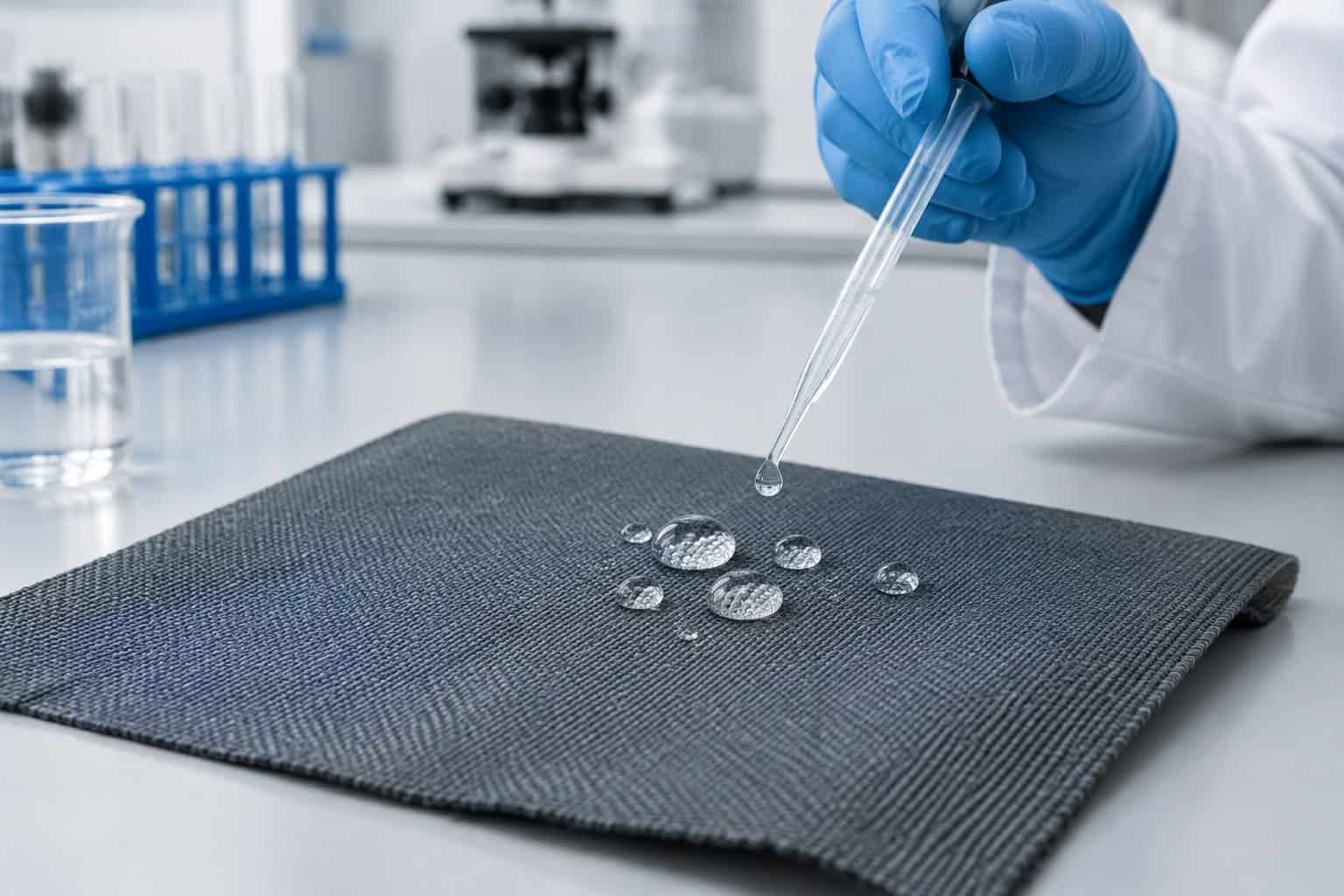
A useful purchasing specification connects chemical splash protection to the actual task, including the liquid involved and how contact occurs. That approach helps buyers select personal protective equipment (PPE) with the right evidence while avoiding unnecessary weight or restrictions on movement.
For US employers, selection begins within a workplace hazard assessment. OSHA standard 29 CFR 1910.132 requires employers to assess hazards that necessitate PPE, including protective clothing and ensembles.
What Makes a Fabric Suitable for Chemical Exposure?
Suitability comes from demonstrated performance against a defined chemical exposure. Chemical protective clothing also requires a garment design that maintains the required coverage during work.
Chemical Resistance vs. Liquid Repellency
Chemical resistance describes a material’s ability to withstand a specified chemical challenge under stated conditions. Liquid repellency describes how readily a liquid sheds from a surface, with performance influenced by the liquid and the finish.
Buyers should distinguish waterproofness, resistance, and repellency when interpreting product descriptions. A droplet beading on fabric establishes surface behavior; permeation protection requires separate evidence.
Why No Material Protects Against Every Chemical
Every protective material has chemical-specific limitations. OSHA states that no material protects against all chemicals and chemical combinations, and similar generic materials from different manufacturers show different performance.
A chemical compatibility claim therefore needs an exact material reference. Fibre name, coating family, or retained tensile strength alone leaves the buyer without evidence of how much chemical reaches the wearer.
When Repellent Workwear Fits an Assessed Splash Risk
Repellent workwear fits tasks where a competent assessment accepts limited protection against specified incidental liquid exposure. The assessment must account for splash volume, pressure, exposed body areas, and the actions available after contamination.
The specification should identify the relevant liquid tests and garment requirements. Continuous wetting, immersion, or hazardous vapor exposure calls for a separate evaluation of suitable barrier clothing.
How Do Chemicals Damage or Pass Through Fabric?
Chemicals affect protection through degradation, penetration, and permeation. These mechanisms require different evidence because a material’s appearance does not establish its barrier performance.
Degradation: Changes in Material Properties
Degradation is chemical-related deterioration of the material itself. Signs include swelling, embrittlement, discoloration, or reduced strength.
Strong acids, for example, attack some textile substrates and garment components. A fabric that retains strength still needs penetration and permeation evaluation before it is specified for wearer protection.
Penetration: Passage Through Pores, Seams, and Openings
Penetration occurs when liquid passes through openings in the protective system. Woven pores, needle holes, damaged coatings, and unsecured closures provide potential routes.
Pressure and movement affect this pathway. Liquid trapped at a bent knee or beneath a strap creates a different challenge from droplets falling onto an unobstructed fabric surface.
Permeation: Molecular Movement Through a Material
Permeation involves chemical molecules moving through a material. It occurs through an apparently intact barrier and frequently leaves no visible warning.
Laboratory testing measures the chemical reaching the collection side of a specimen over time. An intact-looking garment therefore still requires chemical-specific performance evidence and an established replacement procedure.
What Are the Limits of Common Workwear Fibres?
Common workwear fibres provide useful mechanical and comfort properties, but fibre identity alone establishes no protective rating against hazardous chemicals. Untreated cotton, polyester, nylon, polypropylene, and CVC require application-specific evaluation.
Cotton and CVC: Comfort Does Not Establish Protection
Cotton and cotton/polyester CVC are useful workwear substrates, with performance affected by construction and finishing. Their absorbency and open textile structure create important limitations during liquid exposure.
The chemical properties of cotton fabric help explain how particular reagents affect the fibre. Practical assessment of cotton’s resistance to chemicals must also address liquid passage and retained contamination against the skin.
Polyester, Nylon, and Polypropylene: Chemical-Specific Limitations
Polyester, nylon, and polypropylene respond differently to individual chemicals and exposure temperatures. A fibre’s compatibility with one reagent gives no general approval for acids, alkalis, or solvents.
Their thermoplastic behavior also requires attention where heat or flame is present. Buyers selecting a workwear fabric should separate abrasion resistance and handling properties from verified chemical protection.
Post-Treated Cotton, C/N, and CVC: Repellency Without Proven Permeation Protection
Post-treatment finishing gives suitable base fabrics a liquid-repellent surface. LEVITEX produces chemical-repellent fabrics using cotton, cotton/nylon (C/N), and cotton/polyester (CVC) substrates.
These products belong to the chemical-repellent category, with suitability tied to the documented liquid challenge and intended use. Their finishing does not establish a molecular permeation barrier or equivalent performance to barrier-based chemical-resistant fabrics.
Which Coated and Laminated Materials Should Buyers Compare?
Buyers should compare the complete coated or laminated construction against the intended exposure. Polymer chemistry, barrier thickness, supporting textile, and seam design all affect suitability.
Polymer-Coated Textiles for Defined Liquid Exposures
Polymer-coated textiles combine a supporting fabric with a coating selected for the chemical environment. Candidate coating families include PVC, polyurethane, and elastomeric materials, subject to chemical-specific evidence.
The substrate contributes strength while the coating provides the principal liquid barrier. Cracking, abrasion, and pinholes require attention because they compromise the continuity of that barrier.
Film Laminates and Multilayer Barriers for Chemical-Specific Protection
Film laminates bond a barrier layer to a supporting substrate. Multilayer constructions combine materials to address a defined range of chemical challenges.
Such constructions require evaluation as complete systems. Flexing durability, delamination, and seam compatibility affect their use, while the exact chemical and concentration govern the relevance of permeation results.
Application, Limitations, and Required Test Data: A Material Comparison
The comparison below separates material categories by application and evidence requirements. None of the categories provides universal chemical protection.
| Selection criterion | Post-treated workwear | Polymer-coated textile | Film or multilayer laminate |
|---|---|---|---|
| Candidate application | Assessed incidental splash | Defined liquid contact | Chemical-specific barrier use |
| Protective feature | Repellent surface finish | Continuous polymer coating | Barrier film or layer system |
| Key limitation | Permeation protection unestablished | Coating compatibility and damage | Chemical compatibility and laminate integrity |
| Data to request | Repellency and penetration results | Degradation, penetration, permeation | Permeation and construction durability |
| Garment evidence | Coverage and applicable spray testing | Seams and closure performance | Seams, closures, component interfaces |
Material screening should use the exact construction offered for production. A report for another coating weight or film assembly needs a documented technical justification before it supports the purchase.
Why Tychem and Tyvek Product Grades Are Not Interchangeable
DuPont’s Tychem and Tyvek names identify product families whose individual grades require separate assessment. Protection claims belong to a specified fabric and garment configuration.
For example, Tychem 4000 uses a chemical barrier film laminated to a Tyvek substrate. That construction detail does not transfer its chemical performance to another Tyvek-based product; procurement records should retain the exact grade, garment code, and seam specification.
How Do You Match Material to the Actual Exposure?
Material selection should reproduce the chemical challenge and foreseeable contact conditions as closely as practical. The specification also needs to account for the wearer’s complete PPE ensemble.
Identify the Chemical, Mixture, and Concentration
The starting information is the chemical identity, CAS number where applicable, and concentration. Mixtures require their component information and the formulation used during the task.
A report for one acid cannot establish performance against all acids. Buyers considering acid-protective fabric types should connect each candidate to the exact reagent, including additives or contaminants that change the challenge.
Account for Temperature, Duration, and Splash vs. Continuous Contact
Temperature and contact duration influence chemical transport through protective materials. The exposure description should distinguish isolated droplets from repeated splashing, continuous wetting, immersion, and pressurized contact.
Liquid pooling deserves explicit attention. An apron or coverall exposed to trapped liquid experiences prolonged contact even when the original event was a brief splash.
Assess Seams, Closures, Fit, and Compatibility With Other PPE
The garment must maintain protection across seams and interfaces throughout the task. Evaluation should include the zipper assembly, cuffs, hood, and connections to gloves or boots.
Different chemical protective clothing levels involve different ensemble configurations. Representative garments should undergo movement checks without hazardous chemicals, including reaching and kneeling, to identify gaps or strained closures.
Balance Chemical Protection With Flame, Visibility, and Comfort Needs
Each additional workplace hazard requires its own performance evidence. Flame-retardant fabrics, high-visibility fabrics, and chemical protective materials serve distinct functions within a combined specification.
Adding flame-retardant finishing does not establish chemical protection. Heat burden also belongs in the assessment, particularly when a barrier garment restricts sweat evaporation or requires layering over other personal protective equipment.
Which Tests and Standards Support the Selection?
A defensible specification combines appropriate material tests with requirements for the finished garment. Test names should be accompanied by the edition, challenge chemical, conditioning, and acceptance criteria.
ISO 6530: Liquid Repellency and Penetration Testing
ISO 6530 evaluates material behavior under a defined liquid application. It measures indices of penetration, absorption, and repellency, principally for chemicals of low volatility.
Its scope addresses limited liquid challenges, including specified low-volume splash conditions. Results support assessment of surface shedding and liquid passage; they do not supply a molecular permeation result.
ASTM F739 and ISO 6529: Interpreting Permeation Results
ASTM F739 and ISO 6529 address chemical permeation through protective clothing materials under continuous contact. Relevant outputs include breakthrough time, permeation rate, and cumulative permeation.
ASTM F739-20 defines standardized breakthrough at 0.1 μg/cm²/min. A reported time beyond the test period means that threshold was not reached during the stated period; chemical passage below the threshold remains possible.
ISO published ISO 6529:2026 in January 2026, covering laboratory permeation testing for liquid and gaseous chemicals. Comparisons require matching the test conditions and reporting conventions, including the breakthrough threshold.
EN 13034: Limited Chemical Protection and Garment Requirements
EN 13034 addresses limited-performance chemical protective clothing. Its intended exposures include light spray, liquid aerosols, and low-pressure, low-volume splashes where a complete molecular permeation barrier is unnecessary.
The standard distinguishes Type 6 suits from Type PB [6] partial-body protection. Type 6 includes a reduced whole-suit spray test, while partial-body products have a different testing scope.
NFPA 1992 References: Check Current Successor Requirements
An RFQ containing an NFPA 1992 reference requires an edition-specific check against the applicable successor requirements. The referenced standard concerns liquid splash-protective ensembles and clothing for hazardous materials emergencies.
The buyer’s safety team should establish the governing standard and edition for the intended emergency-response application. Procurement documents should then identify the exact certified ensemble configuration and applicable certification documentation.
ISO 11612 and EN ISO 11612: Heat and Flame, Not Chemical Protection
ISO 11612 and its European adoption, EN ISO 11612, address heat and flame performance. ISO 11612:2015 specifies requirements for clothing intended to protect against heat and/or flame, including defined thermal exposures.
Those results support the thermal part of a multi-hazard specification. Chemical repellency, penetration resistance, and permeation performance each require their relevant evidence, even when the same textile also carries a heat-and-flame claim.
Why Fabric Results Do Not Certify a Complete Garment
A fabric report describes the tested specimen and conditions. Finished garments introduce additional features, including seam assemblies and openings, that affect protection.
Material testing therefore forms one part of the technical file. Procurement approval also needs applicable garment testing, labeling, instructions for use, and evidence covering the specified assembly.
What Should a Supplier RFQ Include?
An effective RFQ gives suppliers a defined exposure problem and measurable acceptance requirements. It should separate required protective performance from preferences for appearance or handling.
Specify Exposure Conditions, Fabric Construction, and Intended Use
The exposure specification should state the chemical identity, concentration, temperature, contact pattern, and expected duration. Intended use should distinguish routine industrial work from emergency response or other specialized applications.
The fabric brief should also identify:
- Required composition, such as cotton, polyester, nylon, or a specified blend.
- Fabric mass, width, weave, and mechanical requirements.
- Coating or laminate construction where applicable.
- Garment type, protected body areas, and seam requirements.
- Additional flame, electrostatic, or visibility requirements.
These details help suppliers propose a construction whose chemical resistance is relevant to the task.
Request Chemical-Specific Reports and Traceable Sample Identification
Reports should identify the exact material and test specimen. The purchase file needs the product code, construction, finish, conditioning history, and the chemical challenge.
A defined fabric quality-control process supports traceability between approved samples and delivered production. A generic brochure rating should remain separate from a laboratory report for the specified material.
Confirm Finishing, Care Limits, and Evidence After Laundering
The RFQ should identify the finish and its required maintenance conditions. For reusable products, test evidence should reflect the specified laundering or conditioning sequence.
Different fabric finishes have different care requirements. Buyers should request detergent restrictions, permitted cleaning methods, inspection criteria, and any documented re-treatment process without assuming that washing restores contaminated protective clothing.
Clarify Custom Dyeing, Printing, Sampling, and Order Requirements
Commercial requirements should be agreed alongside the technical specification. The RFQ should cover shade approval, print layout, sample quantities, production tolerances, packaging, and delivery requirements.
LEVITEX offers wholesale FR fabrics, custom dyeing, custom printing, and customized fabric production. Buyers should identify which colorway and finish combination requires testing so that approval samples represent the construction intended for the order.
Choose by Exposure and Verified Performance
Chemical splash protection should be purchased against the identified exposure and documented performance of the complete protective system. The specification should distinguish limited liquid repellency from barrier protection and preserve that distinction through garment approval.
Chemical protective clothing selection also requires clear care instructions and contamination procedures. A fabric report, a finished-garment assessment, and a task-specific use procedure serve different purposes in the purchasing file.
Buyers considering LEVITEX chemical-repellent workwear should send the chemical identity, concentration, temperature, exposure type, and required testing to Charlie@levitex.com to discuss suitability and limitations.
Frequently Asked Questions
Chemical resistance questions are best resolved at the level of the exact material, chemical, and task. The following answers address common purchasing assumptions.
What is the most chemically resistant fabric for workwear?
Multilayer barrier laminates are a suitable starting category for demanding chemical exposure when their test results cover the intended chemicals. Selection still requires the exact construction and garment configuration because every material has chemical-specific limitations.
Can untreated cotton or polyester protect against chemical splashes?
Untreated cotton or polyester should not be specified as chemical splash protection on the basis of fibre composition alone. Selection requires relevant material and garment evidence for the actual liquid exposure.
Does chemical-repellent fabric protect against permeation?
Repellency performance alone establishes no permeation protection. A repellent fabric requires separate chemical-specific permeation testing before it supports a molecular barrier claim.
Are bleach-resistant shirts suitable for pressure washing chemicals?
Bleach-resistant shirts require separate protective-performance evidence before selection for pressure washing chemicals. Color retention says little about skin protection, while pressurized liquid and airborne mist create additional exposure routes.
Does laboratory breakthrough time tell me how long a garment is safe to wear?
Laboratory breakthrough time is a test result, not a safe-wear duration. The exposure assessment and manufacturer’s instructions must account for workplace conditions, garment damage, contamination, and the chemical’s health hazards when establishing replacement procedures.