Chibi Xiangyuan Special Fabric Co., Ltd. is a practical China-based candidate for buyers sourcing acid-and-alkali workwear fabrics, with a published manufacturing address, two continuous dyeing lines and two FR lines. Its product category addresses splash and light-contact applications; chemical-specific testing determines whether a particular fabric fits the intended job.
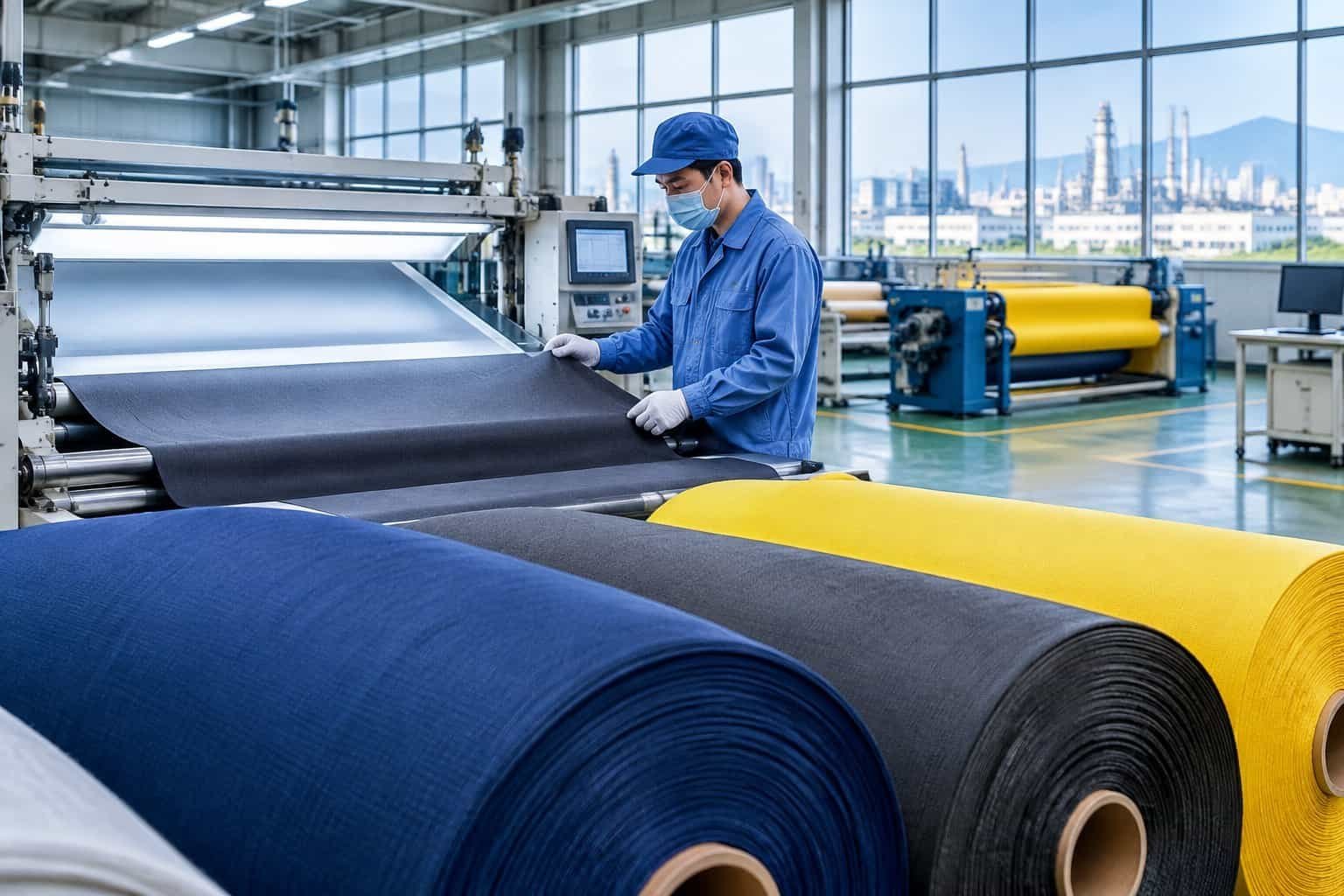
US buyers searching for chemical resistant fabric manufacturers suppliers in China encounter several distinct products under similar names. Post-finished woven workwear, coated textiles and membrane laminates serve different exposure requirements, even when their descriptions all mention chemical protection.
A useful supplier shortlist connects each company to an identifiable China operation and an exact product category. Purchase approval then connects the selected material to the chemical exposure, finished garment design and required test results.
Do You Need Chemical Resistance or Chemical Repellency?
Chemical-barrier applications require chemical-specific resistance evidence, while repellent workwear relies on a surface finish that reduces liquid wetting. The workplace exposure assessment establishes which protection mechanism belongs in the PPE specification.
Barrier Protection vs. Post-Finished Liquid Repellency
A chemical barrier is evaluated for its performance against a specified chemical under controlled conditions. Permeation testing examines molecular movement through intact material, while penetration testing addresses passage through openings or imperfections.
Post-finished liquid repellency changes how liquids wet the textile surface. Droplets that bead on a sample demonstrate surface behavior; that observation alone establishes neither permeation resistance nor protection during sustained contact.
The distinction between waterproof, water-resistant and repellent fabrics also helps explain why familiar marketing terms require precise test definitions. Chemical selection adds the identity and concentration of the challenge liquid to that assessment.
When Repellent Workwear Fits the Exposure Requirements
Repellent workwear fits tasks where a documented assessment accepts limited incidental splash and the selected fabric meets the specified performance criteria. That assessment should account for the consequences of a splash, immediate garment removal and access to emergency washing facilities.
Cotton-based workwear offers a familiar textile construction for reusable garments. Its chemical performance comes from the complete finished specification, so cotton’s response to chemicals deserves separate attention from comfort or fiber content.
Immersion, pressurized jets, hazardous vapor and sustained contact require a protection specification suited to those conditions. A qualified safety professional should establish the necessary ensemble before fabric purchasing begins.
Which China-Based Suppliers Have Verifiable Manufacturing and Product Evidence?
Chibi Xiangyuan and Qingdao Trusty provide identifiable China-based examples across functional woven textiles and non-woven protective products. LEVITEX provides a qualified example specifically for post-finished chemical-repellent fabrics; the companies occupy different purchasing categories.
Supplier Comparison: Company Identity, China Factory, Product Category, and Official Sources
The following comparison separates company and manufacturing information from the protection evidence required for an order. Inclusion identifies a sourcing candidate within its stated scope, without assigning a universal performance ranking.
| Comparison criterion | LEVITEX | Chibi Xiangyuan Special Fabric Co., Ltd. | Qingdao Trusty Industry & Trade Co., Ltd. |
|---|---|---|---|
| Company identity | LEVITEX manufacturing business, established in 1951 | Chibi Xiangyuan Special Fabric Co., Ltd. | Qingdao Trusty Industry & Trade Co., Ltd. |
| China operation | China-based fabric manufacturing | No. 9 Datianfan Road, Lushui Industrial Park, Chibi City, Hubei Province | Qingdao, Shandong Province |
| Manufacturing evidence | Custom dyeing, custom printing and wholesale fabric production | Its China operation includes two continuous dyeing lines and two FR lines | Its business includes production of non-woven protective clothing and other non-woven products |
| Relevant product category | Post-finished chemical-repellent cotton, cotton/nylon (C/N) and cotton/polyester (CVC) | Acid-and-alkali fabrics for splash and light-contact workwear | Breathable membrane-coated non-woven fabrics and protective garments |
| Buyer-confirmation item | Contracting legal entity, finishing site and requested chemical-repellency reports | Exact article, chemical challenge and post-laundering results | Fabric-roll supply, manufacturing site and garment-specific chemical tests |
Qingdao Trusty also has a listed operating address at No. 1179, Lingang Road, Huangdao District, Qingdao. The contract should identify the production and inspection locations applicable to the purchased goods.
How to Read Supplier Claims and Buyer-Confirmation Notes
A supplier’s product category establishes the starting point for technical discussions. Terms such as “acid resistant,” “three-proof” and “chemical protective” need translation into a named fabric article and measurable acceptance criteria.
LEVITEX’s scope is explicit: chemical-liquid repellency produced through post-treatment finishing on cotton, C/N and CVC base fabrics. Its chemical-repellent fabrics carry a different protection scope from barrier-based chemical-resistant fabric.
Buyer confirmation should focus on the ordered article. The relevant report must identify its construction and finish, with results for the specified chemical and exposure conditions.
How Can You Verify a Factory Rather Than a Trader?
Factory verification requires a match between the contracting entity, the actual production site and the processes used for the order. A trading company remains a viable purchasing partner when its role and manufacturing arrangements are transparent.
Match Legal Identity and Manufacturing Address to Official Records
The purchaser should obtain the Chinese business license and record the registered Chinese company name, Unified Social Credit Code and legal representative. Those details should match the sales contract and the payment beneficiary, with any authorized export arrangement documented.
China’s National Enterprise Credit Information Publicity System provides access to company registration, legal representation, business scope and location information. The registered address should be distinguished from the mill, warehouse and export office.
For workwear fabric orders, the inspection address belongs in the purchasing documentation. This prevents an office visit from being treated as evidence of dyeing or finishing capability.
Confirm In-House Processes, Subcontracting, and Audit Evidence
A process map should identify where weaving, dyeing, finishing and inspection occur. Subcontracted coating or chemical finishing should be named because those operations directly affect the protective specification.
A useful factory audit follows an actual article through production records. It examines finish-batch identification, equipment controls, inspection records and retained samples.
Factory verification of FR fabric manufacturing should also distinguish the base textile operation from the protective finishing stage. The purchase agreement should require approval before either the mill or the finishing subcontractor changes.
Which Fabric Construction Fits Your Chemical Exposure?
The appropriate construction is the one supported by test results for the actual chemical and contact conditions. Fiber names, coating names and fabric weight provide specification details, but protection requires article-specific evidence.
Match Chemical Identity, Concentration, Temperature, and Contact Duration
The exposure specification should name each chemical, its CAS number where applicable, concentration and formulation. It should also state operating temperature, contact duration, physical form and whether pressure or repeated splashing is involved.
Mixtures require particular care because the carrier solvent affects compatibility. A result for one ingredient does not establish the performance of the complete formulation.
Temperature also changes performance. NIOSH’s archived protective-clothing recommendations explain that higher temperatures accelerate chemical breakthrough. Selection of chemical-resistant fabric materials should therefore begin with the exposure description.
Compare Finished Woven Fabrics, Coatings, and Non-Woven Laminates
Finished woven fabric suits reusable workwear programs where the specified repellency and laundering performance meet the risk assessment. Its specification should include weave, composition, mass per unit area and finish identification.
Coated woven fabrics combine a supporting textile with a polymer layer. PVC-coated material, for example, requires chemical compatibility results for the exact coating formulation and thickness.
Non-woven fabric laminates combine a substrate with a film or membrane. Their evaluation should include flexing and abrasion because physical damage changes the integrity of the protective structure.
Different fabric finishes also affect the final specification. Buyers should evaluate the complete finished article, including interactions between functional treatments.
Assess Combined Chemical, Flame, and Static Hazards Separately
A workplace with chemical splash and ignition hazards needs evidence for both. Flame retardant fabric certification establishes performance only within the scope of the relevant flame test or certification.
Static control requires its own specification and an appropriate grounding system. Chemical repellency adds another set of test requirements to the same garment program.
Similarly, an arc-rated fabric has a defined electrical-arc performance scope. Neither an arc rating nor an FR designation establishes chemical-barrier protection.
What Test Documentation Should Buyers Request?
Buyers should request complete reports tied to the exact fabric article and the intended PPE configuration. A certificate summary or marketing rating leaves essential test conditions outside the purchasing specification.
Distinguish Repellency, Penetration, Permeation, and Degradation Results
Each result answers a different performance question:
- Repellency: how the challenge liquid wets or runs off the material under the stated procedure.
- Penetration: whether liquid passes through pores, defects or openings under the test conditions.
- Permeation: how a chemical moves through intact material at the molecular level.
- Degradation: how chemical contact changes physical properties, including swelling or strength loss.
ASTM F739 addresses permeation under continuous contact; ASTM F903 addresses liquid penetration under its specified procedure. The requested report should identify the applicable edition and include chemical concentration, temperature, specimen details and results.
OSHA advises that manufacturer permeation information include chemical identity, breakthrough time, permeation rate and test-system sensitivity. Those details allow meaningful comparison between reports.
Check Fabric Reports Against Garment, Seam, and Closure Requirements
Fabric testing evaluates a material specimen. Garment approval must address the assembled protective system, including seams, zippers, cuffs and interfaces with gloves or boots.
A successful fabric result therefore needs a separate garment assessment appropriate to the intended claim. The chosen chemical-protective clothing level also involves respiratory protection and ensemble configuration.
OSHA’s test-method appendix states that a gas-tight suit integrity test does not determine material resistance to permeation, penetration or degradation. Material compatibility and suit integrity require separate evidence.
Verify Laundering Conditions, Retesting, and Performance Limits
Reusable workwear reports should state the wash procedure and cycle count before testing. Detergent, drying conditions and any finish-reactivation treatment belong in the approved care specification.
Post-wash repellency results should be evaluated alongside dimensional stability and physical durability. Retesting should follow a defined schedule and any change in finish chemistry, base fabric or laundering method.
Contaminated clothing also needs a handling procedure. For lead-contaminated protective clothing, OSHA requires employer-provided cleaning and written notification to commercial laundries about lead exposure hazards. Decontamination and retained protective performance are separate approval questions.
How Do You Move From RFQ to Approved Fabric?
A successful RFQ converts the exposure assessment into an article specification, then carries that specification through sampling and bulk release. Comparable quotations require the same technical requirements and commercial basis.
Specify Exposure, Composition, Weight, Finish, and Customization
The RFQ should begin with the chemical exposure description and intended garment. The purchaser should then specify the woven fabric construction, target weight, usable width and required finish.
A practical RFQ includes:
- Chemical names, concentrations and contact conditions.
- Cotton, C/N, CVC or another defined composition.
- Fabric weight and allowable tolerances.
- Color, printing requirements and shade approval procedure.
- Required test methods and acceptance criteria.
- Laundering conditions and post-wash performance.
- Roll presentation, labeling and traceability requirements.
Selection of workwear fabric materials should account for movement, garment construction and the required care process. LEVITEX’s custom dyeing and custom printing services fit this specification stage for its post-finished chemical-repellent fabrics.
Request Comparable Quotes and Confirm MOQ, Lead Time, and Shipping Terms
Each quotation should identify the same composition, finish and usable width. MOQ should be stated by article and color, with sample quantities separated from bulk quantities.
Lead time needs a defined starting event, such as approved shade and receipt of the agreed payment. The quotation should also assign responsibility for testing, inspection and export documentation.
US importers should specify the Incoterm and named place, then obtain current customs advice for classification and landed costs. Comparing US chemical-resistant cloth sourcing options alongside China production helps buyers assess local inventory and replenishment arrangements.
Approve Representative Samples, Testing, and Bulk Quality Controls
The approval sample should represent the intended base fabric and production finish. Laboratory results should reference that sample’s article code and processing history.
The buyer should retain an approved reference sample and define bulk checks for shade, width, weight and physical properties. Protective-performance checks require an agreed sampling plan tied to the finish batch.
Documented FR fabric quality control remains relevant when flame protection forms part of the order. Chemical performance needs its own release criteria, including retesting after any approved material or process change.
Choose Suppliers by Verified Scope and Exposure Requirements
The strongest sourcing decision matches an identifiable manufacturing operation to a clearly defined chemical-protection requirement. Functional woven workwear and non-woven protective products belong on the same shortlist only when their different roles remain explicit.
Purchasing approval should connect the chemical exposure to the tested fabric and finished PPE design. The contract should preserve that specification through production, laundering guidance and change control.
Buyers seeking post-finished chemical-repellent cotton, C/N or CVC from LEVITEX are invited to email Charlie@levitex.com with chemical identities, exposure details and requested test reports. That inquiry should specify liquid-repellency requirements within LEVITEX’s stated product scope.
Frequently Asked Questions
China sourcing questions are best resolved at the level of the specific fabric article and its intended workwear or PPE application. The following answers address common purchasing distinctions.
Who are the best chemical-resistant fabric suppliers in China for my application?
Chibi Xiangyuan is a candidate for acid-and-alkali functional fabrics, Qingdao Trusty for non-woven protective products, and LEVITEX for post-finished chemical-repellent cotton, C/N and CVC. The final selection requires chemical-specific results and a match between the supplied article and the intended garment.
Does LEVITEX supply barrier chemical-resistant fabric?
LEVITEX supplies post-finished chemical-repellent fabrics on cotton, cotton/nylon and cotton/polyester bases. Its stated scope is liquid repellency, with protection levels and test requirements distinct from barrier chemical-resistant fabric.
Are PVC-coated fabrics suitable for every chemical exposure?
PVC-coated fabrics are suitable only for chemical exposures supported by compatibility evidence for the exact article. Coating formulation, thickness and exposure temperature affect selection, alongside contact duration and garment construction.
Can buyers in the USA source chemical-protective fabrics from China?
US buyers can source chemical-protective fabrics from China through a documented technical and commercial approval process. The importer should establish applicable purchasing requirements, obtain article-specific reports and arrange customs classification and shipment documentation.
Can chemical-repellent workwear retain its performance after washing?
Chemical-repellent workwear retains an approved performance claim when post-laundering testing supports the specified care procedure and cycle count. The employer’s reuse program should include inspection, contamination controls and replacement criteria.