
Water repellent FR fabric finishing adds water-shedding performance to flame-resistant textiles through a compatible surface treatment, with both properties verified on the finished fabric. For industrial buyers, this supports protective-workwear fabrics that resist surface wetting while meeting the specified FR requirements.
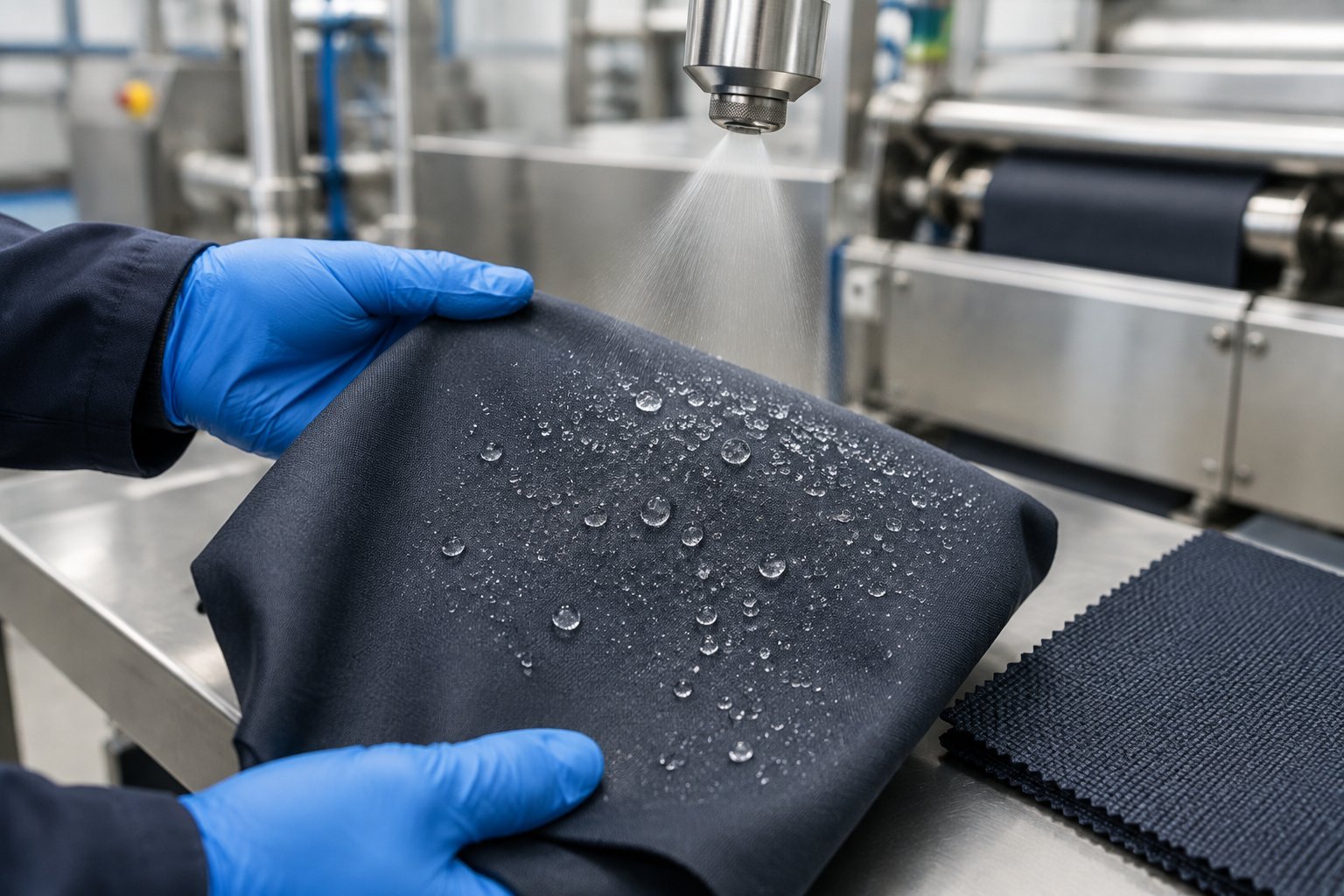
Levitex manufactures FR fabrics with water-repellent finishing on 100% cotton, cotton/nylon (C/N), and cotton-rich cotton/polyester (CVC). In these technical textiles, the purchasing specification needs to connect the intended exposure with product-specific evidence and the actual industrial care process.
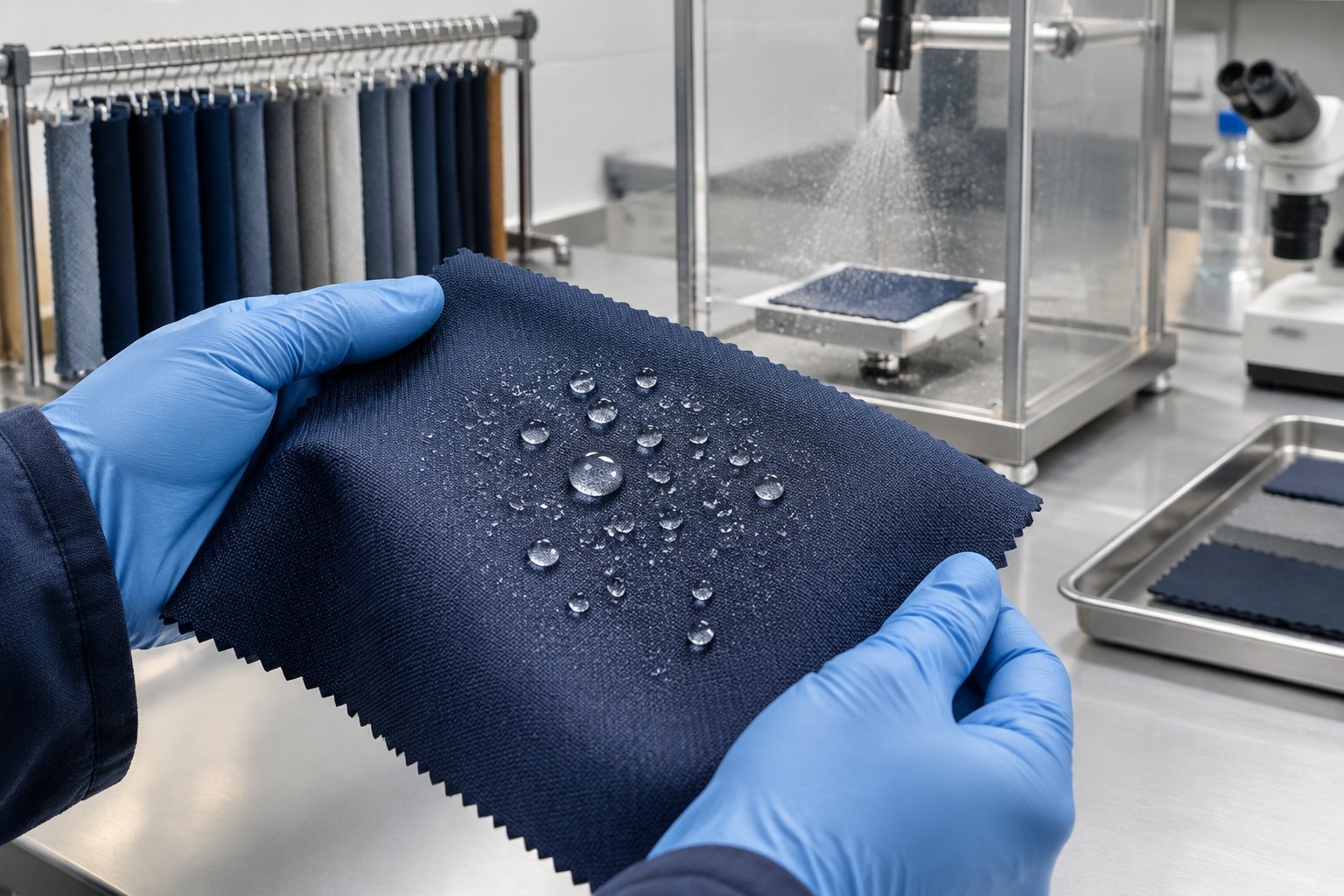
A fresh sample’s water beads provide a useful visual check. Procurement acceptance requires documented textile finishing conditions, relevant performance reports, and evidence that the specified properties remain acceptable after laundering.
What Does Water Repellency Add to FR Fabric?
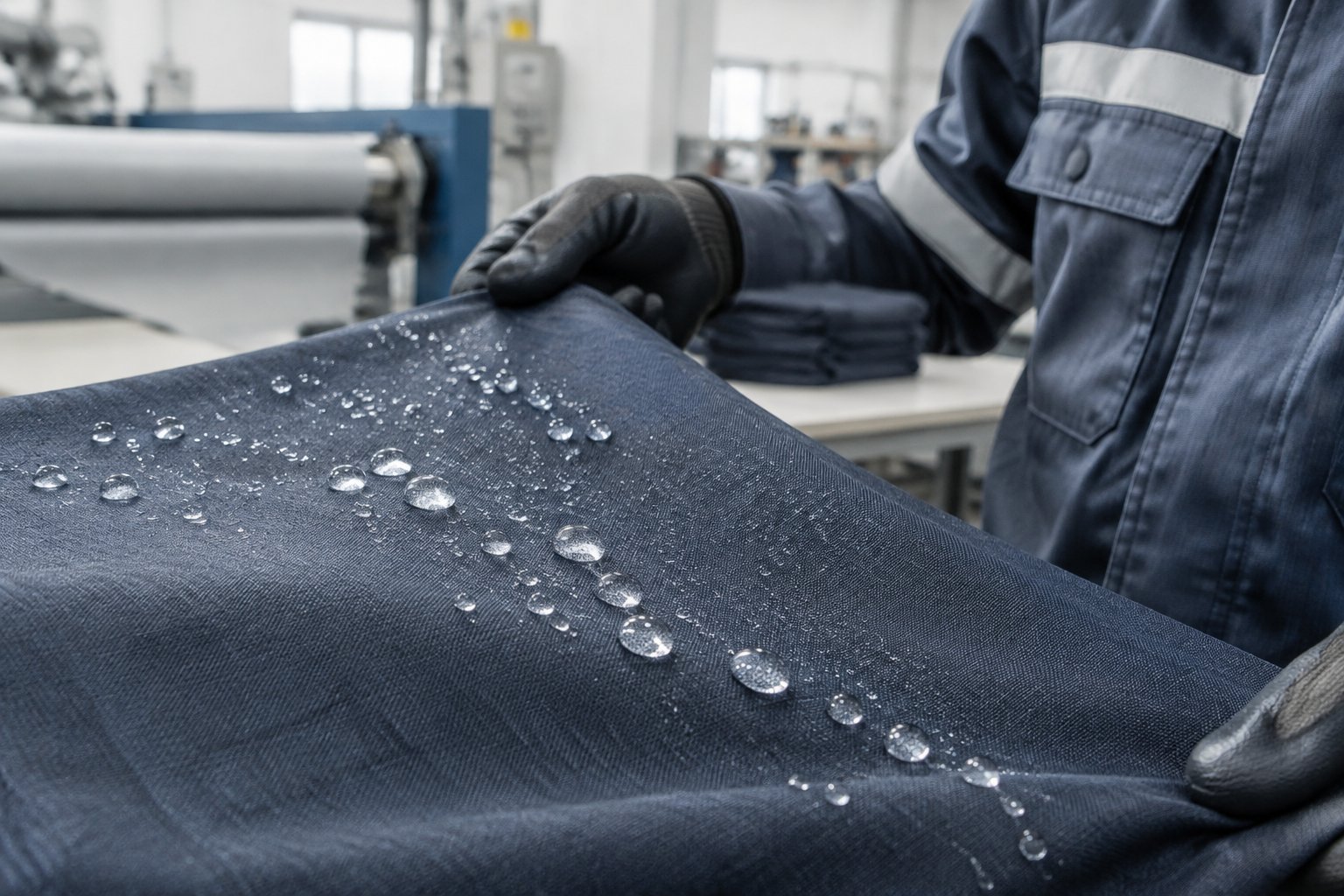
Water repellency reduces surface wetting and helps droplets shed from FR fabric. Its contribution concerns water interaction with the textile surface; pressure resistance and comfort require separate assessment.
How Surface Energy and Fiber Treatment Make Water Bead
A water repellent finish lowers surface energy at the fiber surface, reducing water’s tendency to spread. Droplets form a higher contact angle and remain more rounded when the treatment works effectively.
Yarn texture and surface contamination also influence droplet behavior. On a rough, absorbent textile, a contact-angle observation provides supporting information, while a standardized fabric test supplies a more reproducible acceptance measure.
Why Repellency Is Not Waterproofness or Barrier Protection
Water repellent fabric resists wetting during the exposure represented by its test. Sustained rain, pressure from kneeling, or contact against a wet surface introduces different demands.
The distinction between waterproof, water-resistant, and water-repellent fabrics helps define the correct purchasing claim. Waterproofing requires penetration-resistance evidence, while chemical barrier protection requires evidence addressing the specified substance and exposure.
How Air Permeability Differs from Moisture-Vapor Breathability
Air permeability measures airflow through fabric under a pressure difference. Moisture-vapor breathability describes the transfer of water vapor through a material.
A breathable fabric specification should identify which property supports the intended working conditions. Waterproof breathable fabrics illustrate the distinction: a membrane structure permits vapor transfer while restricting airflow, so the two measurements are not interchangeable.
How Are Repellent Finishes Matched to FR Base Fabrics?

Repellent finishes are matched through formulation and processing trials on the specified FR base fabric. Composition establishes the starting point, while construction and the complete finishing recipe determine the result.
Levitex Options for Cotton, C/N, and CVC
Levitex offers FR plus water-repellent finishing on all three base-fabric families: 100% cotton, cotton/nylon (C/N), and cotton-rich cotton/polyester (CVC). Buyers should identify the precise composition and construction in the inquiry.
Untreated 100% cotton requires suitable treatment to achieve flame resistance. Likewise, cotton/nylon blend properties provide useful material-selection context, but each finished construction requires its own performance evidence.
DWR Chemistry Choices: Silicone, Hydrocarbon, and Fluorinated Systems
Durable water repellent (DWR) describes a performance category encompassing several chemistry families. Water repellent finishes for textiles include silicone, hydrocarbon-based, and fluorinated systems.
Silicone DWR includes technologies based on polydimethylsiloxane (PDMS), valued for water shedding and soft handle. Hydrocarbon systems provide another non-fluorinated route, while fluorinated systems require careful PFAS review; a chemistry label alone establishes neither FR compatibility nor wash durability.
Why Compatibility Depends on Formulation and Processing Conditions
Compatibility reflects the complete recipe, including emulsifiers, crosslinkers, and other auxiliaries. Application level and curing conditions affect treatment distribution, fabric strength, and flame behavior.
Interactions between fabric finishes require validation on the selected construction. A universal processing sequence would overlook differences between chemical systems; the manufacturer should establish the sequence and verify the finished fabric after all treatments.
Why Water Repellency Does Not Establish Oil or Chemical Protection
Oil repellency requires separate evidence because oils wet surfaces differently from water. A strong water-beading result supplies no oil-repellency rating.
Chemical liquid repellency also needs testing against identified liquids under defined conditions. Levitex supplies post-treated chemical-repellent fabrics on cotton, C/N, and CVC bases; these products have distinct protection scopes from barrier-based chemical-resistant materials.
What Evidence Supports Both Claimed Properties?
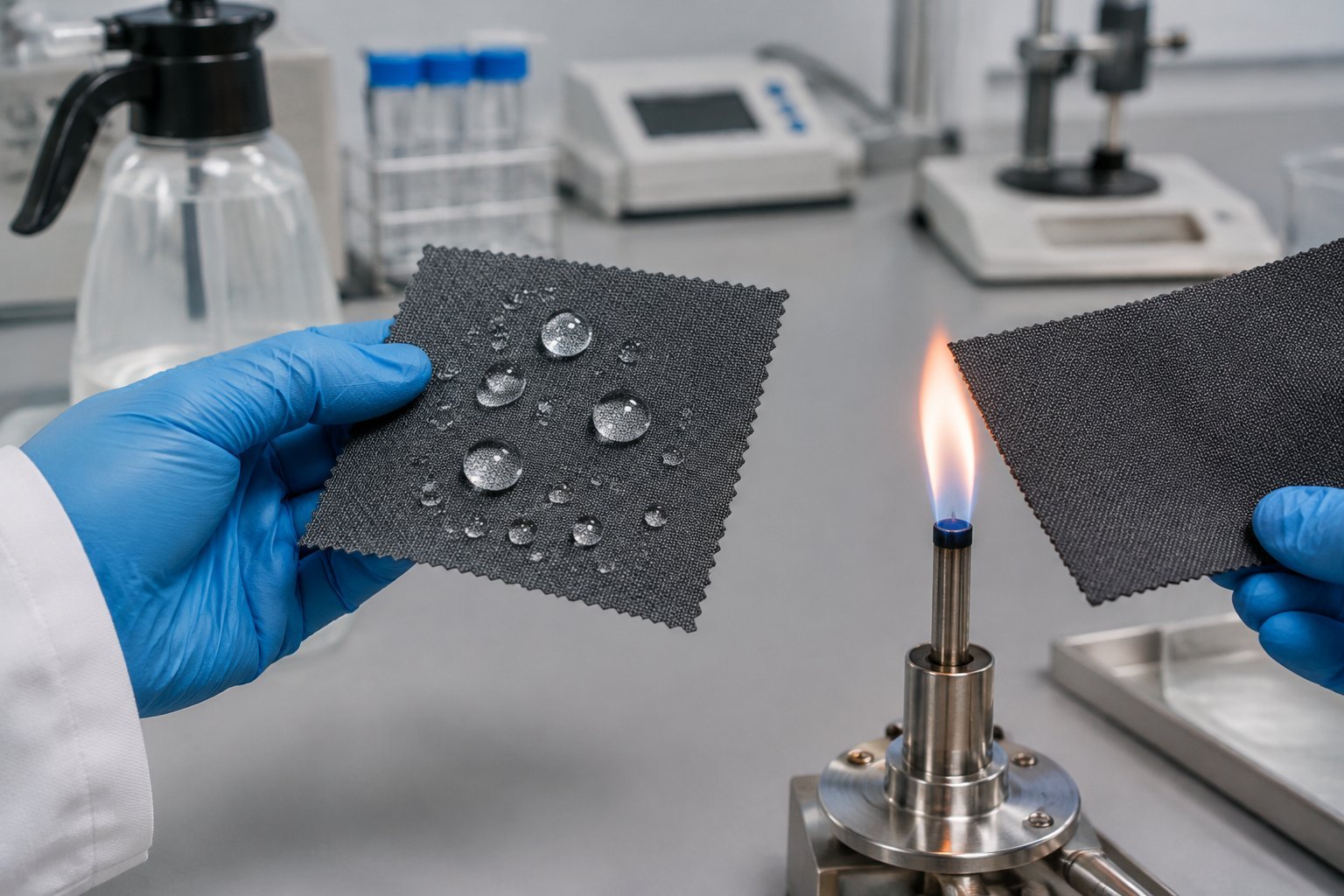
Both claims require reports traceable to the fabric after the complete FR and repellent finishing process. Acceptance criteria should identify the method, specimen condition, and required result before production begins.
What a Spray Test Shows About Surface Wetting
A spray test evaluates surface wetting under a standardized water application. Methods such as AATCC TM22 or ISO 4920 provide a defined procedure and rating framework.
The report should name the method and identify the tested face of the fabric. Photographs of droplets support sample discussion, but they lack the controlled exposure and assessment conditions needed for acceptance testing.
When Hydrostatic Pressure Testing Is Relevant
Hydrostatic pressure testing becomes relevant when the specification includes resistance to water penetration under pressure. A hydrostatic head test, such as ISO 811 or AATCC TM127, measures a different property from spray repellency.
The requested report should identify the pressure application conditions and endpoint. Water repellent fabrics should receive only the claims supported by their results; a spray rating supplies no hydrostatic-head value.
How to Match FR Reports to the Finished Fabric
FR reports should identify specimens representing the complete finishing recipe, including the water repellent finish. A report for an earlier production stage leaves the effect of subsequent processing unresolved.
Traceable testing of flame-retardant properties connects the sample identifier to composition, construction, finish revision, and conditioning. For US orders, the required standard should follow the workplace hazard and customer specification; flame testing alone supplies no arc rating.
Evidence-Request Table: Claims, Methods, Conditions, and Reports
An evidence request should translate each purchasing claim into an agreed test and acceptance condition. The following table provides a structure for supplier discussions without assigning unsupported product ratings.
| Purchasing claim | Method or assessment to request | Conditions to record | Report details required |
|---|---|---|---|
| Surface water repellency | AATCC TM22 or ISO 4920, as specified | Tested face, conditioning, laundering state | Method edition, specimen identity, result |
| Water penetration resistance | ISO 811 or AATCC TM127, when required | Pressure procedure, endpoint, pretreatment | Measured result and test configuration |
| Flame resistance | Method required by the applicable FR specification | Complete finishing state, conditioning, care pretreatment | Individual results and acceptance criteria |
| Durability after laundering | Agreed wash protocol followed by relevant performance tests | Detergent, temperature, drying, cycle count | Results at each agreed assessment point |
| Air permeability or vapor transfer | Method appropriate to the comfort requirement | Fabric state, test conditions, laundering state | Units, specimen details, measured result |
| Oil or chemical liquid repellency | Separate method suited to the claimed liquid exposure | Test liquids, contact conditions, pretreatment | Scope, results, and stated limitations |
Why Fabric Results Do Not Certify Finished Workwear
Fabric results support material selection and garment development. Finished workwear introduces seams, closures, trims, and construction details that require assessment within the applicable garment requirements.
A flame-retardant certification claim should identify its scope and the product it covers. Levitex supplies textiles; the garment manufacturer remains responsible for the finished assembly and its required conformity evidence.
How Should Performance Be Assessed After Laundering?
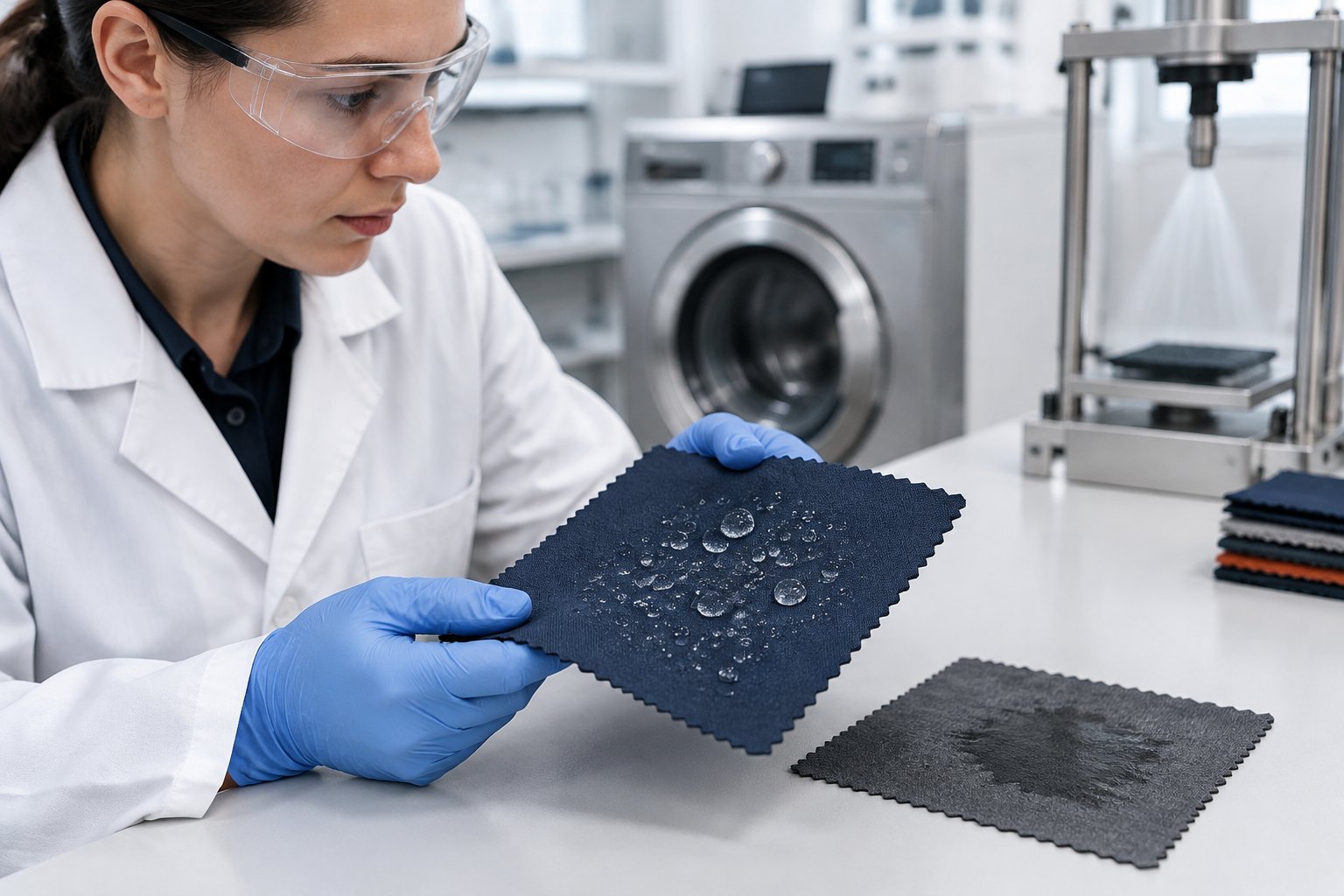
After-laundering assessment should reproduce the agreed care process and retest both water repellency and flame resistance. Durable water repellency requires a defined exposure history and acceptance threshold.
Specify the Washing, Drying, and Conditioning Protocol
The protocol should document detergent chemistry, wash temperature, mechanical action, rinsing, and drying. Conditioning before testing also needs a defined procedure.
Industrial processing and domestic washing expose textiles to different stresses. An agreed FR fabric laundering procedure should therefore reflect the intended laundry operation, with any differences recorded before sample approval.
Reassess Flame Resistance and Repellency on Comparable Specimens
Comparable specimens should originate from the same identified fabric lot and receive equivalent laundering exposure. Separate specimens are needed where testing is destructive.
Reports should show the initial condition and every agreed post-care assessment point. Repellency retention and FR retention need their own acceptance decisions, since a satisfactory result for one property establishes nothing about the other.
Distinguish Contamination, Abrasion, and Finish Deterioration
Detergent residue or oily contamination changes surface wetting behavior. Abrasion removes treatment from exposed areas and damages the textile structure.
A diagnostic review should record where wetting occurs and whether approved cleaning changes the result. When service involves repeated rubbing, the specification should include an abrasion-resistance assessment and a separate check of repellency following the defined abrasion exposure.
Validate Any Reactivation or Reapplication Before Use
Heat reactivation and chemical reapplication require an approved procedure specific to the finishing system. Drying temperature must remain within the fabric supplier’s care instructions.
Reapplication changes the chemical loading on the fabric and therefore needs compatibility review. Validation should examine FR performance and repellency after the proposed treatment, along with any effects on strength or other specified functions.
What Should an Industrial Fabric RFQ Include?

An industrial fabric RFQ should define the exposure, textile specification, and acceptance evidence in measurable terms. This gives textile manufacturers a consistent basis for sampling and quotation.
Define Exposure, Base Fabric, Construction, and Comfort Needs
The inquiry should describe the water exposure and the separate thermal hazard. A water repellent fabric intended for occasional splash has a different evidence requirement from material expected to withstand sustained pressure.
A practical RFQ checklist includes:
- Application: industrial task, hazard assessment, and intended protective-workwear use.
- Base fabric: 100% cotton, C/N, or CVC, with the required blend ratio.
- Construction: woven or knitted structure, weight, usable width, and agreed tolerances.
- Appearance: color reference, shade tolerance, and printing requirements.
- Comfort: air permeability or moisture-vapor performance, with the selected method.
- Mechanical requirements: tensile strength, tear performance, or abrasion criteria relevant to service.
- Quantity: total meters and the allocation by color or construction.
State Required Evidence Before and After Laundering
The RFQ should state the required FR specification and surface-repellency method. It should also define acceptance thresholds at delivery and after the agreed care exposure.
Production approval should identify the retained sample and the reports tied to it. FR fabric quality control should include traceability and a change-control procedure for revised chemistry, construction, or processing conditions.
Record Chemical Restrictions and Destination-Market Requirements
Chemical requirements should identify the destination states or countries and the customer’s restricted-substance policy. US PFAS requirements vary by jurisdiction, product category, and effective date.
A request concerning PFAS in FR textiles should distinguish intentionally added substances from analytical limits. Supplier declarations need a clear scope, while any laboratory request should name the method and reporting limits; broad “PFAS-free” wording alone leaves acceptance ambiguous.
Request Levitex Samples, Product Reports, and Order-Specific Terms
Levitex offers customized FR fabric production, wholesale supply, custom dyeing, and printing. Its monthly production capacity is 5 million meters, with 1.5 million meters dedicated specifically to flame-retardant fabrics.
Levitex provides a test report for each product; buyers should request the relevant report and check its scope against the RFQ. Minimum order quantity, sampling arrangements, lead time, and delivery terms require order-specific confirmation.
Fabric inquiries are welcome at Charlie@levitex.com. An effective inquiry states the base cloth, FR requirements, requested repellency evidence, care process, and quantity.
Specify Water Shedding and Verify FR Performance Together
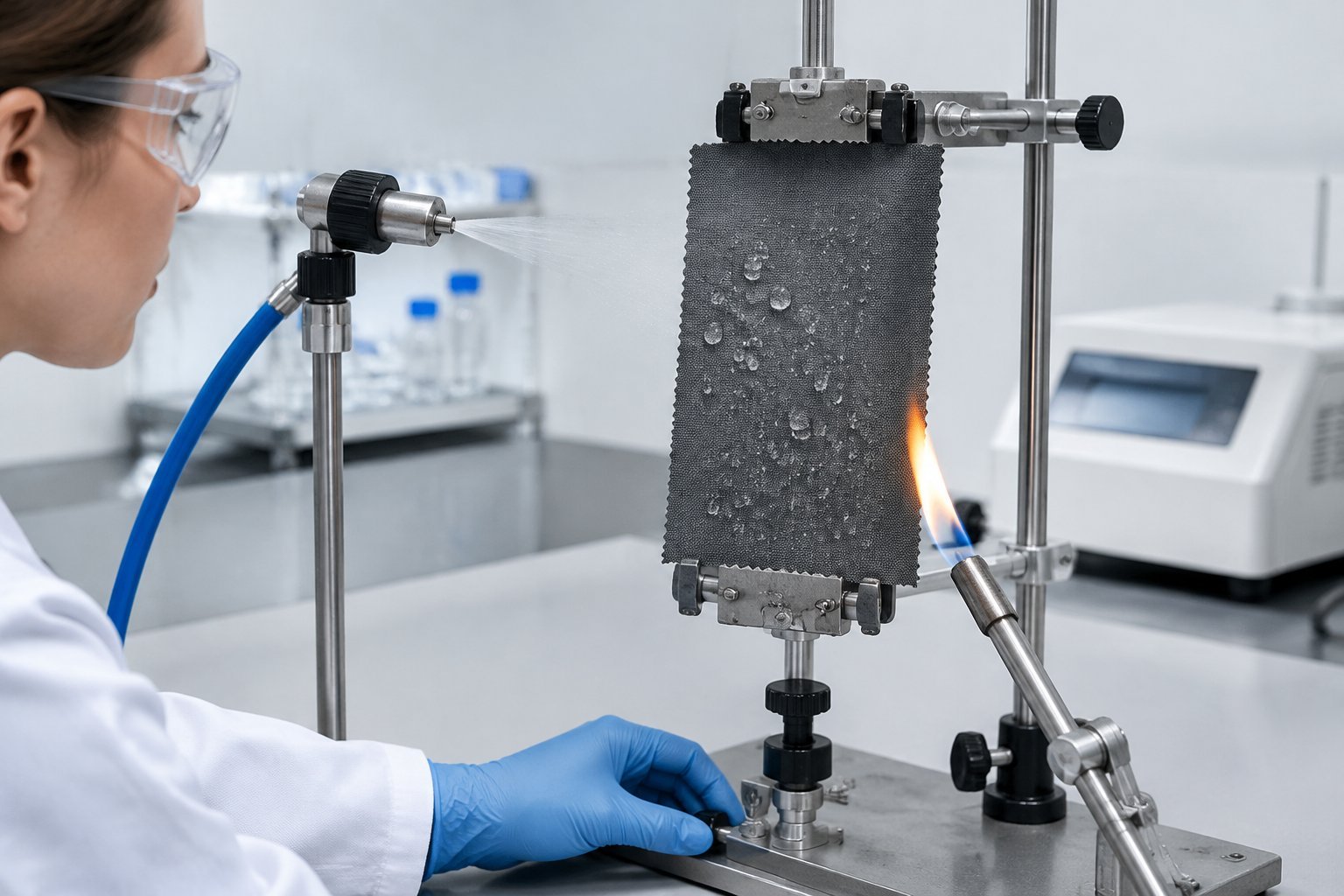
A water repellent finish should be specified alongside evidence that the fully finished fabric retains the required flame resistance. Waterproofness and chemical protection require their own exposure-specific evidence.
Purchasing approval should connect the selected cotton, C/N, or CVC construction to its product reports and agreed laundering protocol. For durable water repellency, the purchase order should record the test method, acceptance threshold, care conditions, and retesting requirements after any approved reapplication.
Frequently Asked Questions
Water-repellent FR fabric specifications require separate evidence for each claimed function. These answers clarify common purchasing terms and verification requirements.
Is water-repellent FR fabric waterproof?
Water-repellent FR fabric has a surface treatment that resists wetting; waterproof performance requires separate water-penetration evidence. Beading or a spray-test result supplies no hydrostatic-pressure rating.
Can Levitex add water repellency to cotton, C/N, and CVC FR fabrics?
Levitex offers FR plus water-repellent finishing on 100% cotton, cotton/nylon (C/N), and cotton-rich cotton/polyester (CVC). The selected construction and required performance evidence should be stated in the fabric inquiry.
Does a water-repellent finish affect flame resistance?
A water-repellent finish changes the finished textile’s chemistry, so its effect on flame resistance requires verification. Formulation and processing conditions determine compatibility, and FR evidence should represent the fully treated fabric.
How can buyers verify repellency after industrial laundering?
Buyers verify retention through standardized repellency testing after a documented industrial wash-and-dry protocol. Reports should identify the fabric lot, care conditions, assessment points, and agreed acceptance threshold.
Does PFAS-free DWR also provide oil repellency?
PFAS-free DWR identifies a water-repellent treatment with a chemical restriction claim; oil repellency requires separate performance evidence. Any oil-repellency claim should name the test method and show results before and after the specified care process.