Industrial laundering affects FR fabric repellency through wash chemistry, mechanical action, and drying conditions; retention requires separate before-and-after measurements of water and oil repellency under the intended care process. Buyers need those results alongside product-specific flame-resistance evidence to establish whether a fabric remains suitable for its protective-workwear application.
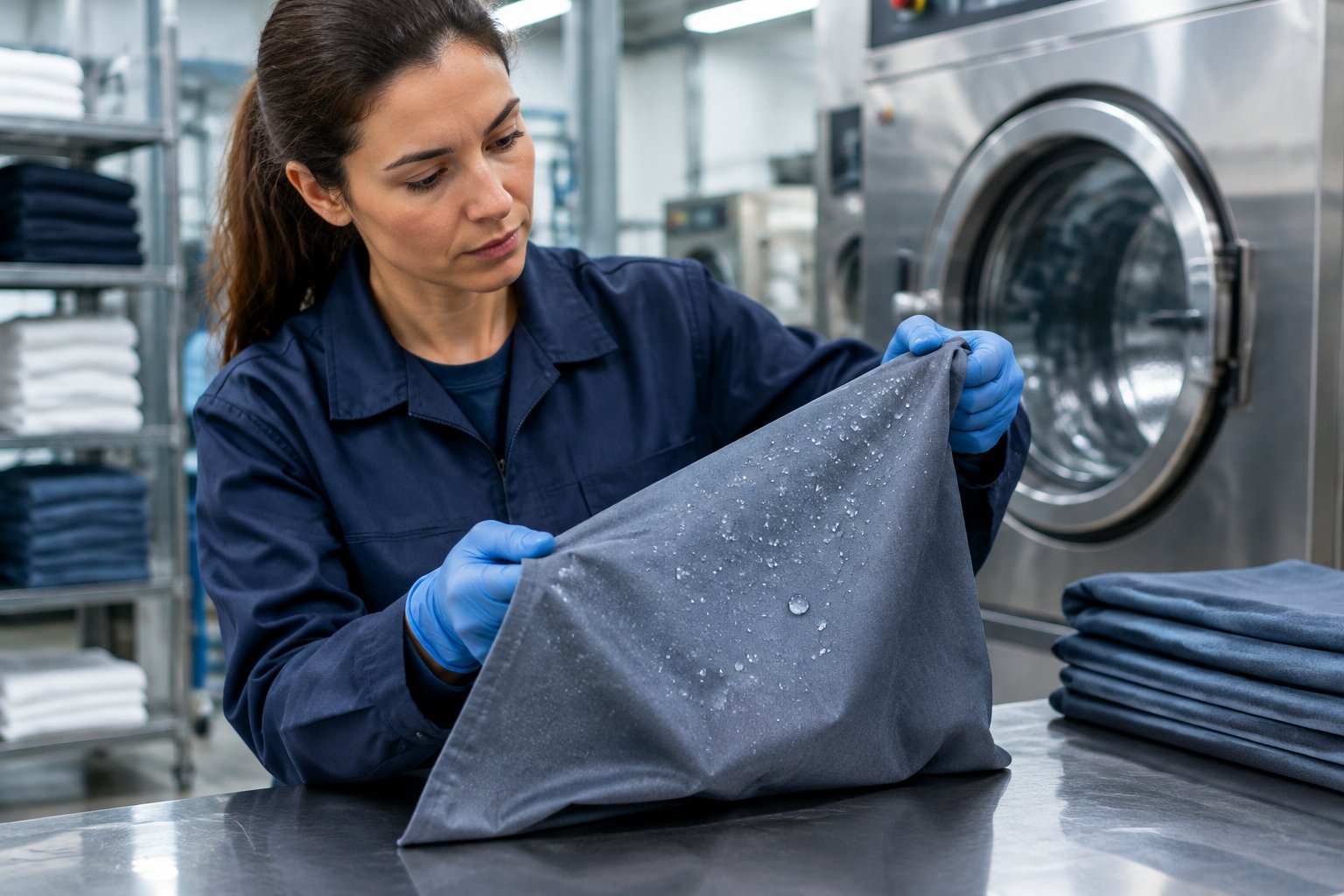
Levitex manufactures FR fabrics and offers FR plus water-repellent and FR plus oil-repellent finishing on 100% cotton, cotton/nylon (C/N), and cotton-rich cotton/polyester (CVC). For these multifunctional textiles, a useful purchasing specification connects required performance to an agreed laundry procedure and traceable fabric samples.
A change in water beading deserves investigation. Its cause and protective significance require controlled testing, especially when workplace contamination and laundry residues also affect the fabric surface.
What Can Change After Washing, and What Requires Proof?
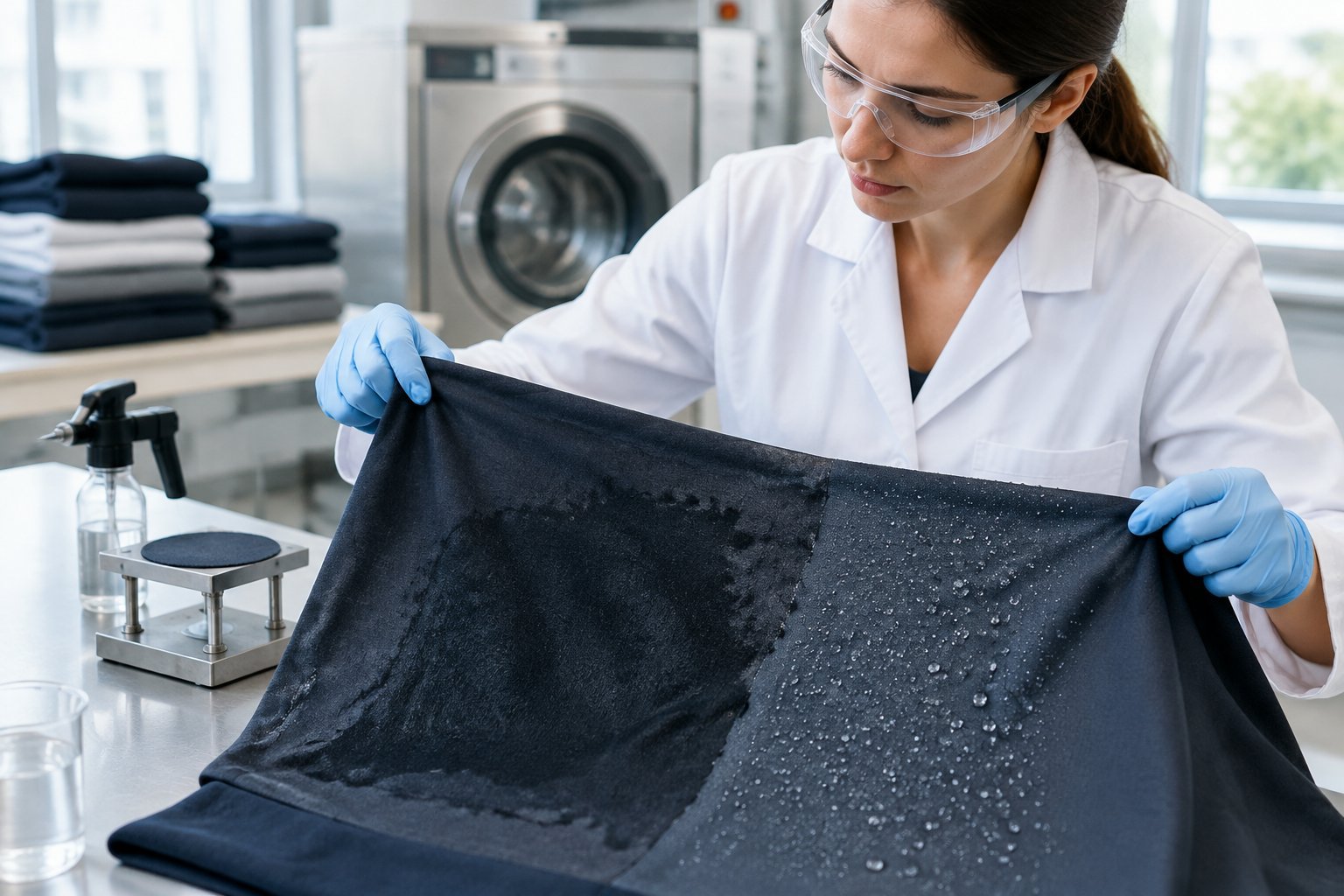
Industrial washing changes several fabric characteristics, and each performance claim needs its own evidence. Care and maintenance records help connect an observed change to the conditions that produced it.
Water and Oil Repellency Can Respond Differently
Water and oil interact differently with a treated textile surface. A fabric that continues to bead water still needs an independent oil-repellency assessment when that function forms part of the specification.
Water-repellent FR finishing addresses surface wetting. Waterproofness and liquid-barrier protection require additional evidence, so a beading demonstration supports only a limited conclusion about performance.
Reduced Repellency Does Not Establish Lost FR Protection
Repellency results describe liquid behavior on the fabric. FR protection requires relevant flame-performance testing on representative FR materials after the agreed care exposure.
A lower repellency result alone establishes neither lost nor retained flame resistance. Buyers should connect each requirement to the appropriate flame-retardant fabric testing and confirm that the report identifies the tested product and conditioning history.
Why Wash Counts Alone Cannot Predict Retention
A wash count records repetitions without describing their severity. Detergent concentration, bath conditions, load factor, extraction, and drying all affect the exposure experienced by the textile.
Consequently, a claim about FR clothing service life needs supporting care conditions. A fixed cycle threshold cannot represent every fabric construction or industrial laundry program.
How Do Buyers Set Up a Representative Laundry Trial?

A representative trial reproduces the intended industrial wash procedure and preserves a documented baseline. Production-lot samples should pass through the agreed laundering process with sufficient material reserved for each destructive test.
Match the Trial to the Actual Industrial Wash Procedure
The laundry should document machine type, load composition, water quality, wash temperatures, hold times, chemical dosing, rinsing, and extraction. Mechanical action also needs attention because a lightly loaded trial machine creates a different exposure from a production load.
The trial plan should identify whether it evaluates clean-fabric durability or performance after representative workplace soiling. These answer different questions. Approved FR fabric care instructions should govern the process boundaries.
Control Drying and Conditioning Before Comparison
Drying temperature and exposure time belong in the trial specification. Tumble drying, tunnel finishing, and pressing produce different thermal histories, even when the wash procedure remains unchanged.
Before testing, specimens should reach the atmosphere and moisture condition required by the selected method. An unwashed control and laundered specimens need comparable preparation; testing a warm panel against a conditioned panel weakens the comparison.
Build a Trial-Record Table Linking Samples, Lots and Care Conditions
Each specimen needs an identifier that survives handling and connects it to its production origin. Retained controls should remain available throughout the investigation.
The following trial-record structure supports traceability without prescribing a universal care formula.
| Record field | Required entry |
|---|---|
| Fabric identity | Product reference, composition, construction, nominal weight |
| Production origin | Fabric lot, dye lot, finishing batch, roll reference |
| Specimen identity | Unique ID, sampling location, control or exposed status |
| Wash procedure | Machine, load factor, temperatures, times, extraction |
| Laundry chemistry | Product names, concentrations, dosing sequence, water quality |
| Drying and finishing | Equipment, settings, exposure time, approved thermal treatment |
| Exposure stage | Completed cycles and sampling checkpoint |
| Test conditioning | Method-required atmosphere, duration, specimen preparation |
| Results | Water, oil, relevant FR tests, dimensions, physical observations |
| Disposition | Acceptance decision, reviewer, deviations, report references |
Which Properties Need Separate Before-and-After Measurements?
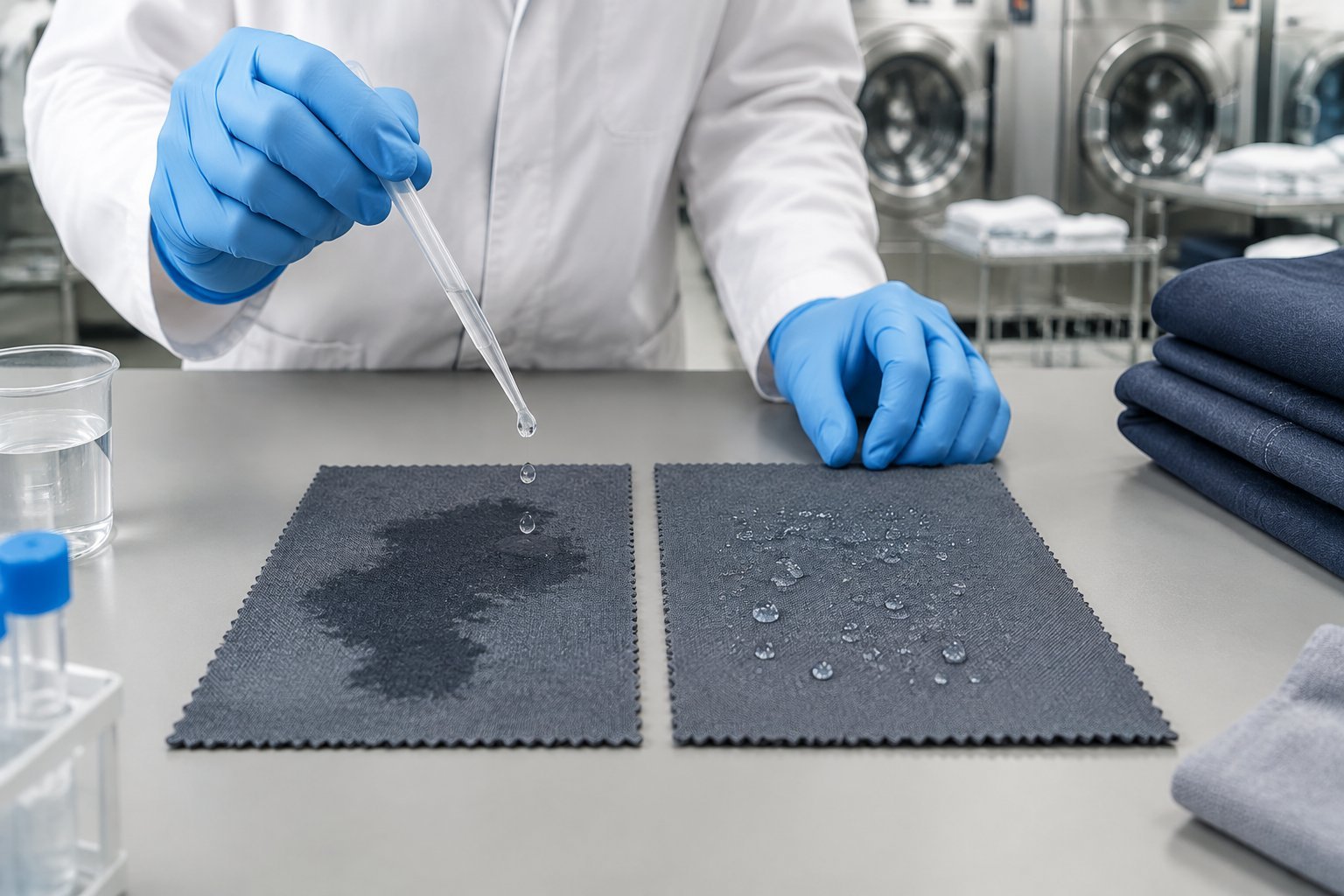
Water repellency, oil repellency, flame resistance, and dimensional stability need separately defined assessments. A complete comparison uses the same methods and reporting conventions at baseline and after the agreed laundry exposure.
Compare Water Repellency and Oil Repellency Independently
AATCC TM22 evaluates resistance to surface wetting by water spray. AATCC TM118 evaluates oil repellency using specified test liquids; the procedures measure different surface responses.
The purchasing agreement should name the method and edition, baseline requirement, post-care requirement, and sampling checkpoints. Oil-repellent fabric testing also requires consistent specimen preparation so residues or handling do not obscure the comparison.
Verify Flame Resistance Through Relevant Product-Specific Evidence
The required FR assessment should follow the intended protective application and applicable product standard. NFPA 2112 and EN ISO 11612 address defined protective-performance requirements with their own testing provisions.
A fabric report supports only its stated scope. Arc-rated clothing requires appropriate arc-performance evidence, and neither a repellency result nor a general FR report establishes an arc rating.
Check Dimensional Stability and Physical Condition
Dimensional stability affects garment coverage and fit. Baseline and post-care measurements should record lengthwise and widthwise changes using an agreed procedure.
Fabric shrinkage also changes the relationship between fabric panels and garment components. Inspection should document abrasion, holes, distortion, and other visible damage, with strength testing added where the application or specification requires it.
Distinguish Care Guidance From Protective-Performance Requirements
ASTM International’s ASTM F1449 provides guidance for industrial laundering care and maintenance of flame-resistant or arc-rated clothing. It addresses processing responsibilities and the maintenance of protective characteristics.
Its role differs from a protective clothing product standard. Acceptance documents should identify the care procedure separately from the tests and conformity requirements used to assess protection.
How Should Changes in Repellency Be Interpreted?

A lower repellency result calls for a controlled investigation of contamination, surface condition, and finish integrity. Several mechanisms produce similar wetting patterns, so visual inspection alone cannot identify the cause.
Assess Residual Contamination Before Attributing Finish Failure
Residual detergent or workplace soil affects surface wetting. The investigation should examine rinsing records and chemical dosing, then compare production-worn material with clean trial specimens exposed to the same laundry process.
Flammable contaminants require particular attention in FR garments. Persistent oil or grease warrants escalation through the industrial laundry program because contamination creates a separate safety concern, regardless of the fabric’s measured repellency.
Investigate Finish Orientation Only Under Approved Conditions
Some repellent finishes respond to approved thermal conditioning after washing. A controlled comparison between the specified care endpoint and an authorized conditioning step helps determine whether surface orientation contributed to the result.
The fabric or finish supplier should approve the temperature and exposure. An improvised high-heat treatment risks damaging the textile, and any improvement supports only the conditions evaluated.
Identify Evidence Needed to Support Finish-Loss Claims
A finish-loss claim needs more than a reduced spray rating. Useful evidence includes repeat testing, retained controls, documented cleaning history, and an appropriate supplier-supported analysis of the finish.
Multifunctional FR finish compatibility also deserves review if chemicals or processing conditions changed. A confirmed process deviation should be recorded separately from a conclusion about the mechanism of deterioration.
Recognize When Results Remain Inconclusive
Results remain inconclusive when sample history is incomplete or comparison conditions differ. An unidentified production panel and a newly finished laboratory swatch provide a weak basis for assigning cause.
The report should state the unresolved variables and required follow-up. Affected material should remain subject to the agreed quality or safety hold until the responsible parties reach a documented disposition.
What Evidence Should Buyers Agree With Levitex?
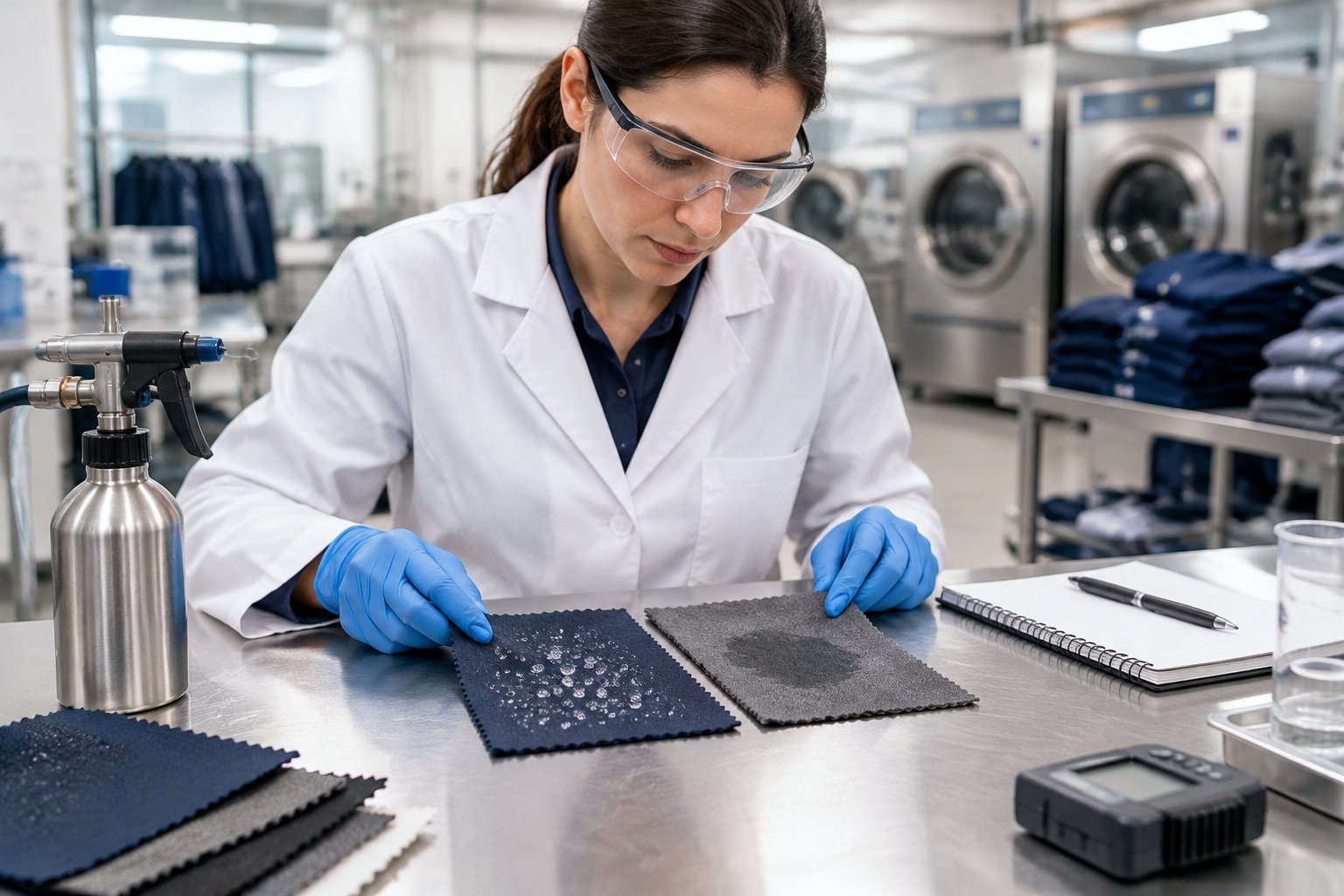
Buyers and Levitex should agree on a fabric-specific validation package that connects required functions to care conditions and acceptance results. Levitex supplies textiles; garment suppliers retain responsibility for finished-garment requirements within their scope.
Define the Base Fabric and Required Repellent Functions
The inquiry should identify 100% cotton, C/N, or CVC, together with construction, weight, color, and intended industrial use. Water repellency and oil repellency should each appear explicitly when both functions are required.
Requests involving chemical-repellent fabrics also need the relevant liquid exposure defined. Liquid repellency has a different protective scope from barrier-based chemical resistance.
Use an Acceptance Checklist for Care Conditions, Results and Traceability
Acceptance criteria should be agreed before the trial starts. Each requirement needs a clear report reference and an identified decision-maker.
- Product match: Tested specimens correspond to the specified fabric and production lot.
- Care match: The recorded wash and drying procedure matches the approved trial.
- Conditioning match: Baseline and exposed specimens receive method-consistent preparation.
- Repellency evidence: Water and oil results meet their separate agreed requirements.
- FR evidence: Relevant product-specific protective-performance requirements are addressed.
- Physical condition: Dimensional change and damage meet the agreed limits.
- Traceability: Sample IDs connect results to rolls and finishing batches.
- Disposition: Deviations and acceptance decisions receive documented approval.
This checklist supports FR fabric quality control by connecting each claim to identifiable evidence.
Agree When Process or Product Changes Require Revalidation
Change-control triggers should cover alterations to fabric composition, construction, finishing chemistry, or processing route. A different laundry formula or drying system also warrants a review of the existing validation.
The parties should define whether a change requires a targeted comparison or a broader repeat trial. The revised record should identify the change and explain the scope of the additional evidence.
Separate Levitex Fabric Evidence From Garment-Supplier Responsibilities
Levitex’s fabric evidence should identify the textile tested and the conditions represented. The garment supplier should address finished FR clothing performance, including seams, closures, trims, fit, and labeling as applicable.
The industrial laundry and employer also have care and maintenance responsibilities. Their operating procedures should include contamination control, inspection, repair, and removal-from-service decisions appropriate to the garment program.
Specify Repellency Retention Through Verified Care Conditions
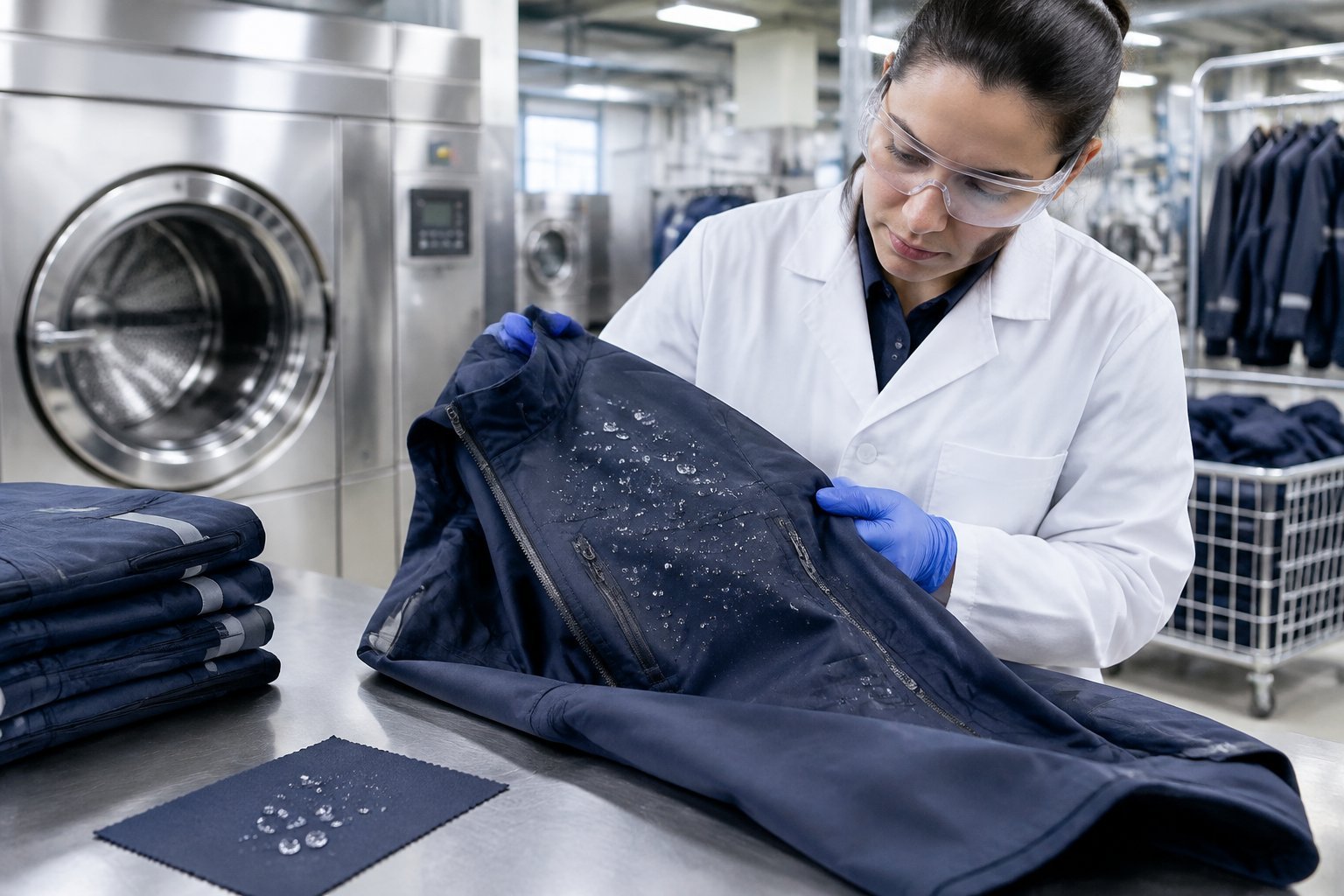
Repellency retention becomes a usable purchasing requirement when it is tied to verified industrial laundering conditions and separate performance measurements. A controlled baseline, traceable samples, and agreed acceptance criteria allow buyers to evaluate FR fabrics without assuming a fixed deterioration rate.
Levitex buyers seeking a fabric-specific validation discussion should contact Charlie Luo at Charlie@levitex.com with the intended care process, required after-conditioning performance, and fabric references. The request should include the proposed wash and drying conditions alongside the water- and oil-repellency requirements.
Frequently Asked Questions
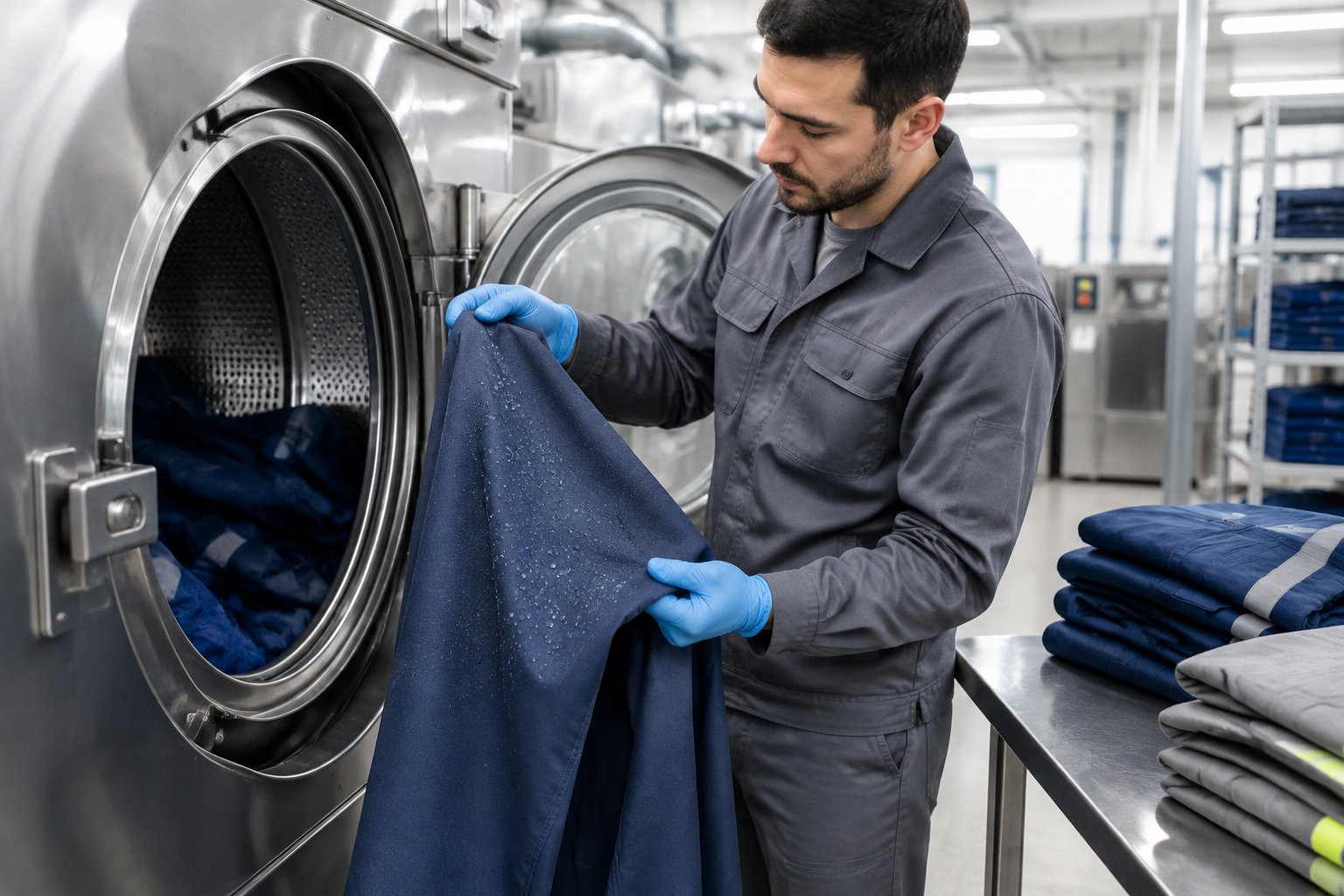
Industrial laundry decisions require evidence matched to the fabric and its approved care route.
Can industrial laundering wash out flame-retardant treatment?
Incompatible industrial laundering can damage some applied flame-retardant treatments. Durable treated FR fabrics require product-specific care evidence, and a change in repellency alone provides no measure of treatment retention.
Which detergent should an industrial laundry use for repellent FR fabrics?
An industrial laundry should use chemistry approved for the specific fabric and garment care instructions. Detergent selection should address finish compatibility and soil removal, with dosing and rinsing validated under the production process; an “FR-safe” label alone provides insufficient detail.
Does reduced water repellency mean flame resistance has failed?
Reduced water repellency establishes a change in water-wetting behavior. Flame resistance requires its own relevant assessment, while persistent flammable contamination warrants a separate safety review.
Can water repellency recover without applying a new finish?
Water repellency can recover when removable residues or reversible finish orientation caused the reduction. Any cleaning or thermal-conditioning investigation should follow supplier-approved conditions and confirm recovery through repeat testing.
How many wash cycles should buyers specify for a validation trial?
Buyers should specify checkpoints that represent the intended care frequency and service period. The agreed plan should also satisfy applicable product requirements and include intermediate measurements where early changes need investigation.
Can home laundering or dry cleaning results replace industrial laundry testing?
Home laundering and dry cleaning results support the care processes they represent. An industrial laundry program needs evidence for its own chemistry, mechanical exposure, and drying conditions, with any proposed equivalence reviewed by the responsible suppliers.