
Oil repellent fabric testing uses AATCC 118 or ISO 14419 to evaluate resistance to wetting by a graded series of liquid hydrocarbons; the reported grade identifies the highest-numbered test liquid that passes the method’s criteria. For buyers sourcing oil-repellent fabric for industrial applications, that result provides a measurable basis for finish approval and bulk acceptance.
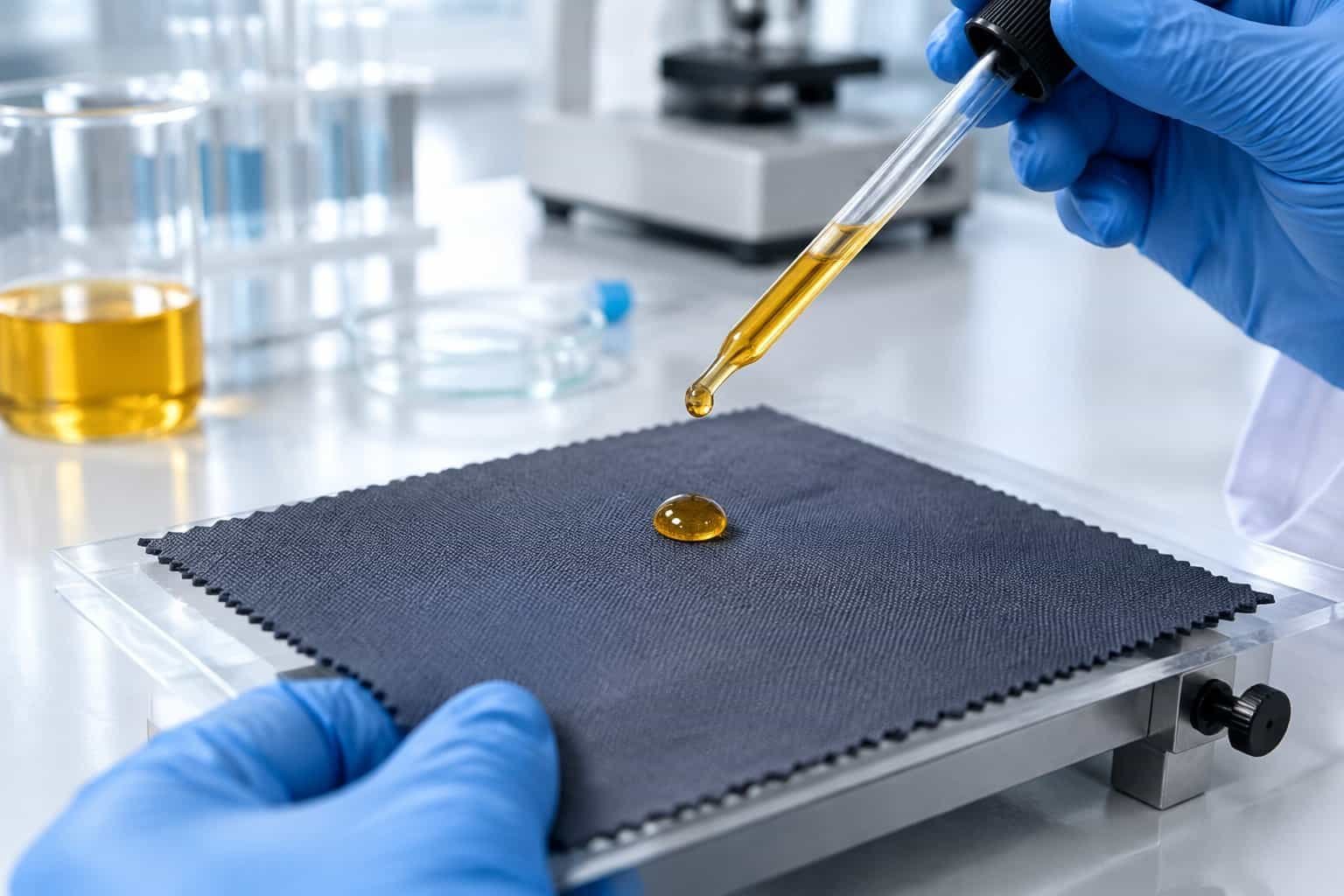
Levitex manufactures flame-resistant textiles and offers FR plus oil-repellent finishing on 100% cotton, cotton/nylon (C/N), and cotton-rich cotton/polyester (CVC). A useful purchasing specification connects the selected fabric to its required test method and performance after the intended care procedure.
A laboratory grade has a defined scope. Its purchasing value comes from traceable samples, controlled testing, and a report that identifies the condition of the fabric tested.
What Do AATCC 118 and ISO 14419 Measure?
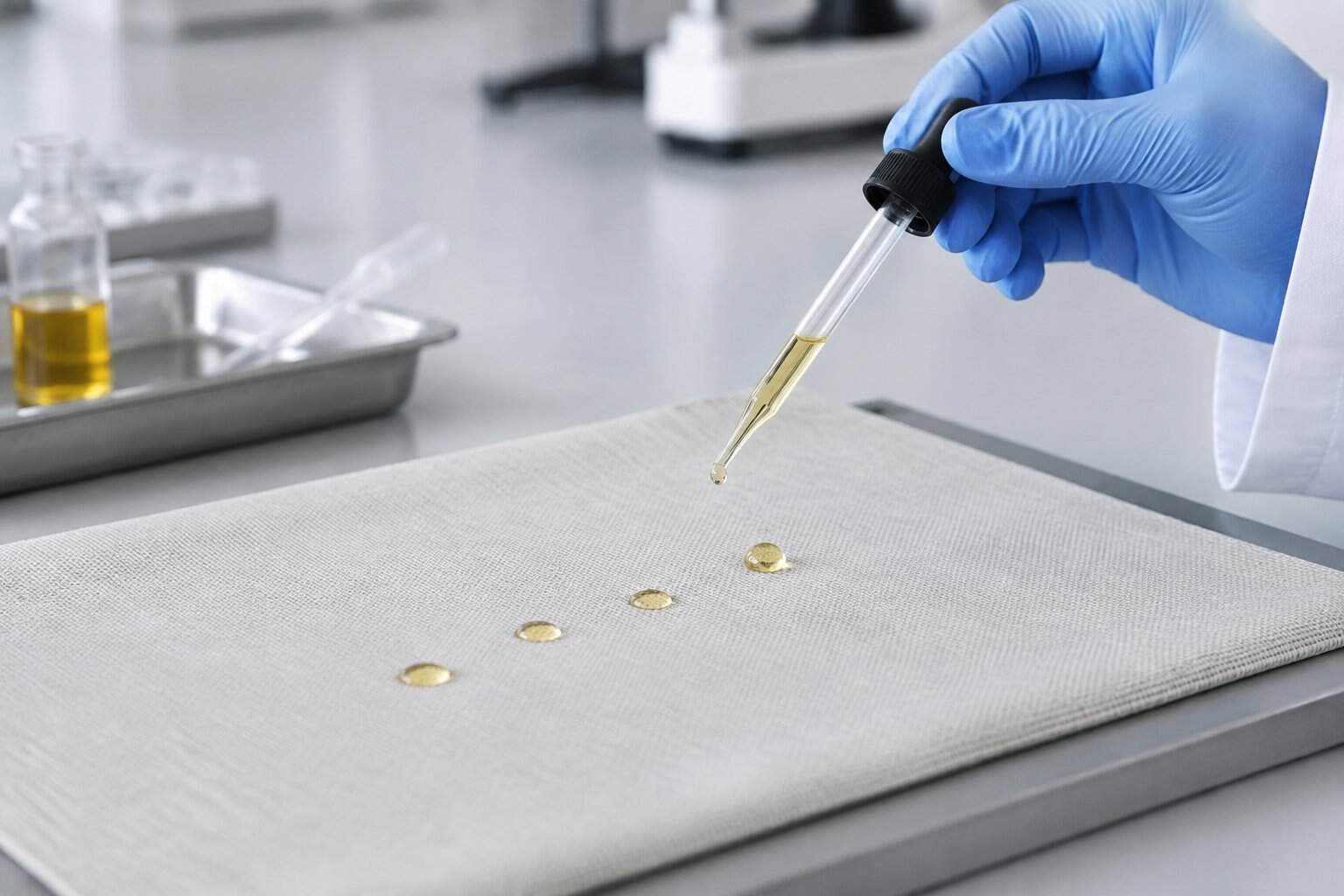
AATCC 118 and ISO 14419 measure surface resistance to wetting by selected hydrocarbons with different surface tensions. ISO 14419:2025 also describes the result as a rough index of oil stain resistance and supports evaluation of changes following washing or dry cleaning.
How Surface Tension Determines Resistance to Oil Wetting
Lower-surface-tension liquids spread more readily across many textile surfaces. The standard hydrocarbon series presents increasingly demanding wetting challenges as the liquid number rises.
An oil-repellent finish lowers the fabric’s surface energy, helping droplets retain their shape during the prescribed observation period. Fabric construction and surface contamination also influence the observed behavior, so fiber composition alone cannot establish a grade.
Oil Repellency vs. Stain Release and Water Repellency
Oil repellency describes resistance to initial wetting by oily liquids. Stain release describes how effectively an applied stain leaves the textile during laundering; AATCC 130 addresses that separate question.
Water repellency concerns surface wetting by water. ISO 4920 and AATCC 22 use spray testing for this purpose, while oil testing uses the prescribed hydrocarbon liquids.
These distinctions apply directly to water-repellent FR fabric finishing. A water spray result supports a water-repellency claim; an oil claim requires its own evidence.
Why Hydrocarbon Resistance Does Not Establish Chemical Permeation Protection
Chemical permeation involves molecular movement through a material and requires testing against the specified chemical under defined exposure conditions. A surface droplet test supplies no breakthrough-time or permeation-rate measurement.
ISO 14419:2025 expressly excludes estimation of resistance to penetration by oil-based chemicals and points to ISO 6530 for that separate evaluation. Penetration and permeation also describe different transport mechanisms.
Selecting chemical-protective clothing levels therefore requires a broader exposure assessment. An oil-repellency result alone does not establish solvent-barrier protection or suitability for prolonged chemical contact.
How Is the Laboratory Test Performed?
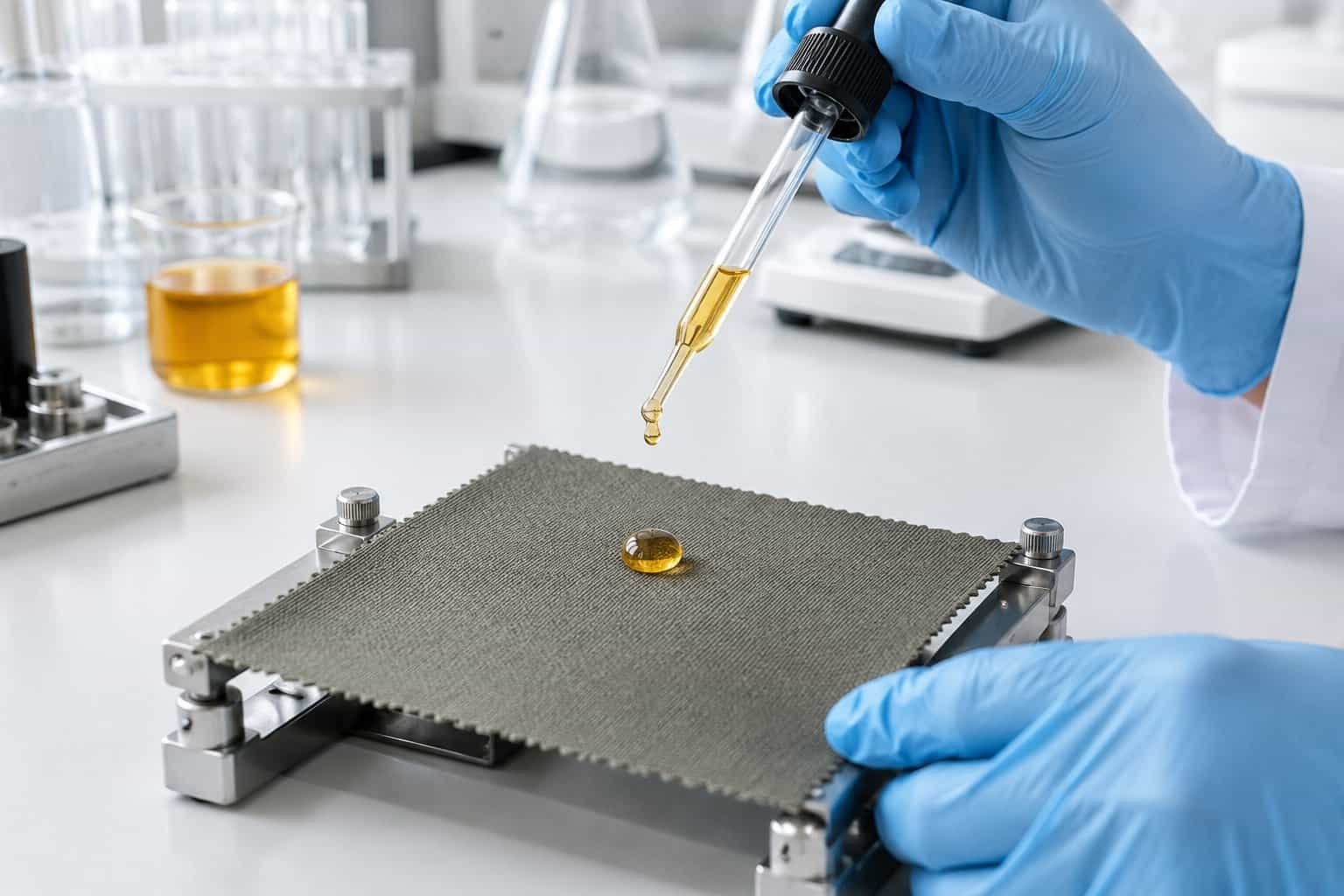
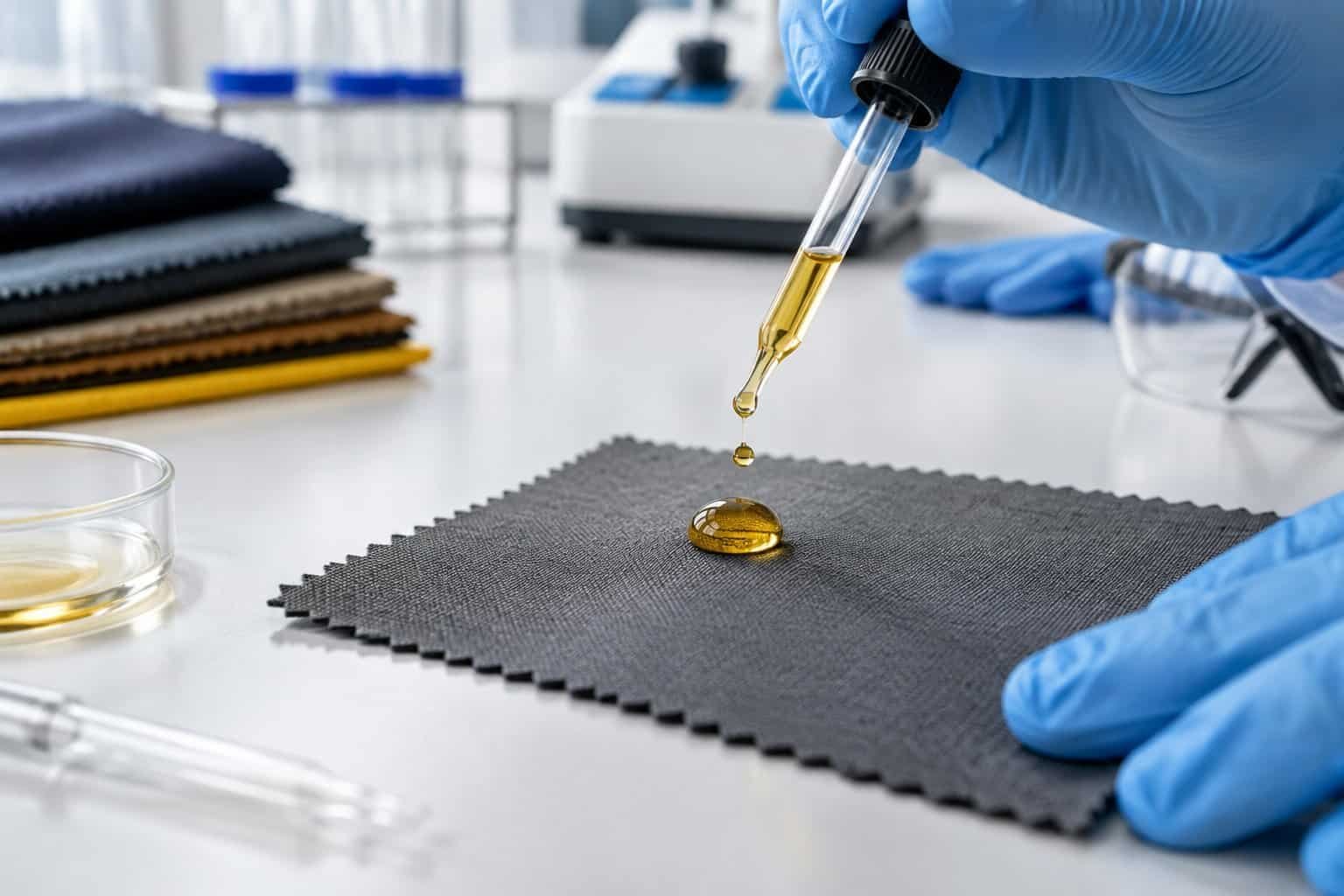
The laboratory tests conditioned specimens with the method’s prescribed hydrocarbon liquids and assesses their wetting behavior over the specified observation period. Reproducible oil repellency testing requires controlled sample preparation and clean handling throughout.
Identify the Fabric, Finish Lot, Test Face, and Conditioning
The submission should identify the fabric reference, composition, construction, finished weight, shade, and finish lot. The laboratory also needs the designated test face and the specimen’s laundering or dry-cleaning history.
Conditioning must follow the selected standard and edition. Its purpose is to bring specimens to a controlled moisture state before textile testing.
Traceable fabric finishes help connect the laboratory result to the production treatment. A report for a development sample provides limited purchasing evidence unless the approved bulk construction and finishing route are identifiable.
Apply the Prescribed Liquid Hydrocarbons in Sequence
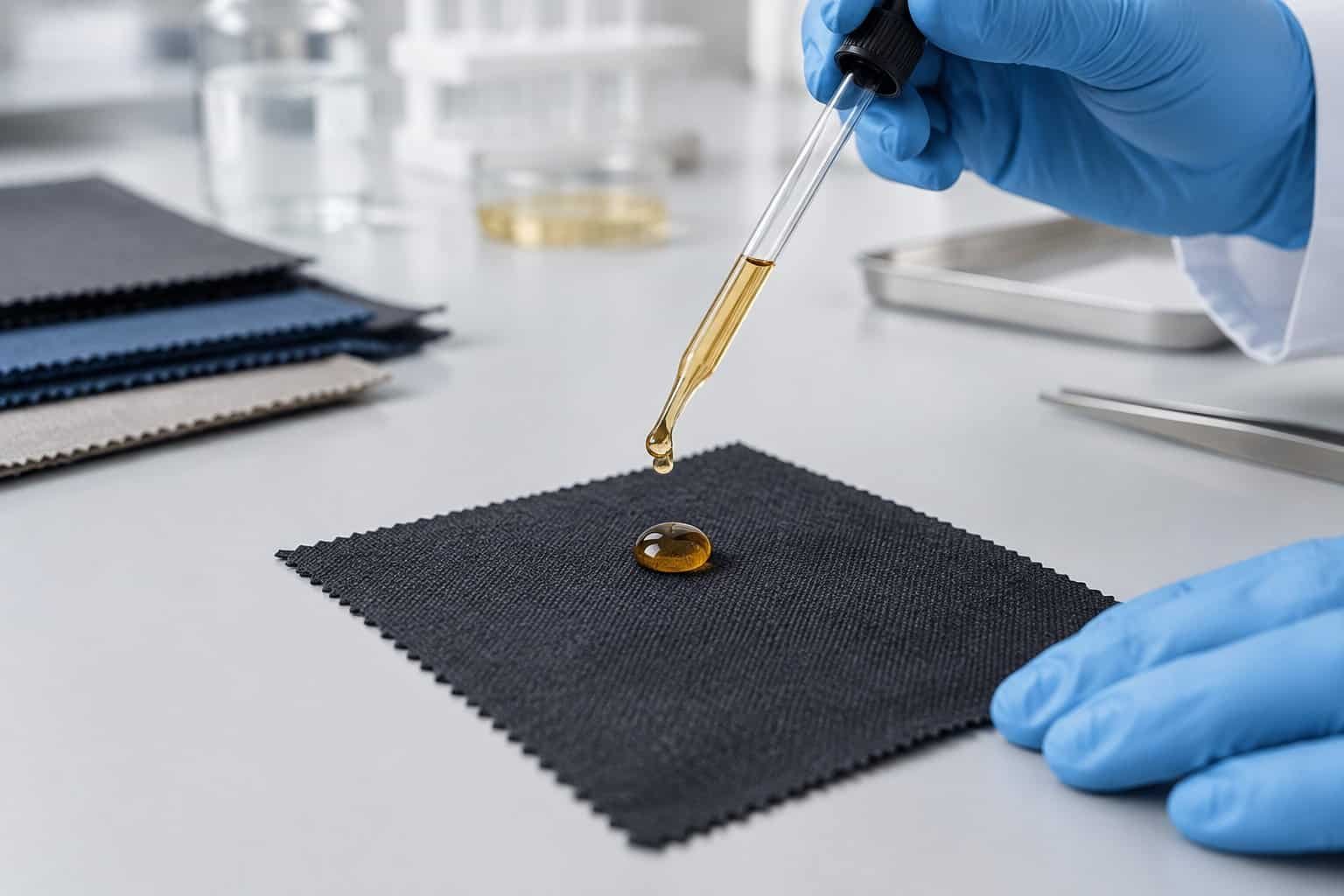
The technician places the specimen on the support required by the method and applies drops using the specified equipment. Drop quantity, placement, and observation time follow the applicable edition.
Testing proceeds through the prescribed liquid sequence according to the method’s pass/fail rules. Improvised substitutes such as machine oil or diesel create a different exposure and cannot produce a standard AATCC 118 or ISO 14419 grade.
Thin or open constructions require particular attention to specimen support and layering. Liquid contact with the underlying surface creates a potential source of misleading observations.
Observe Wetting, Wicking, and Contact Behavior Safely
The assessor observes spreading, darkening, and wicking into the textile during the required period. Droplet shape and contact angle help describe surface behavior, but a separate contact-angle measurement does not replace the standard’s assessment criteria.
Hydrocarbon test liquids require trained handling, suitable ventilation, and controls for ignition sources. The laboratory should follow safety data sheets and applicable workplace requirements for storage and disposal.
Clean equipment is also essential. Silicone residues, lubricants, or handling contamination alter surface behavior and compromise the usefulness of the result.
How Should Buyers Interpret the Results?

An oil repellency rating identifies performance against a defined liquid series under controlled conditions. Buyers should read it together with the method edition and specimen state before making an acceptance decision.
What the Highest Passing Test Liquid Means
The oil repellency grade corresponds to the highest-numbered liquid meeting the method’s non-wetting requirements. In the conventional numbered series, higher grades indicate resistance to lower-surface-tension liquids.
The result supplies a comparative index of surface performance. Actual oil stain resistance also involves the contaminant’s viscosity and composition, along with the fabric’s construction and other treatments.
A grade therefore supports comparison most directly when the same substrate receives different finishes under matching test conditions. Predictions about workplace contamination need the intended exposure to be defined separately.
Read a Results Table Without Treating Grades as Percentages
The following table illustrates reporting logic only. It contains no Levitex product results or recommended acceptance thresholds.
| Illustrative observation | Reported interpretation | Purchasing implication |
|---|---|---|
| First test liquid fails | Grade 0 in the conventional scale | No passing resistance within that liquid series |
| Liquid 3 passes; liquid 4 fails | Grade 3 | Highest passing liquid is number 3 |
| Liquid 4 passes; liquid 5 fails | Grade 4 | Greater resistance within the same test series |
| Initial and washed specimens differ | Separate results for each state | Acceptance depends on the specified state |
A grade of 4 does not mean 40% repellency, and a grade of 8 does not mean protection against every oil. The scale represents successive test-liquid challenges, with no percentage conversion.
Compare Reports Only When Methods and Test Conditions Match
Valid comparisons require the same method and edition, along with matching specimen preparation and after-care conditions. The tested face must also match the face exposed during use.
AATCC 118 and ISO 14419 address closely related hydrocarbon-resistance questions. A purchasing contract should still name the accepted method, with written approval for any substitution.
Within FR fabric quality control, the report identifier should connect to the approved fabric and production lot. Results lacking that connection leave uncertainty about which delivered material the grade represents.
What Changes After Laundering and Production?
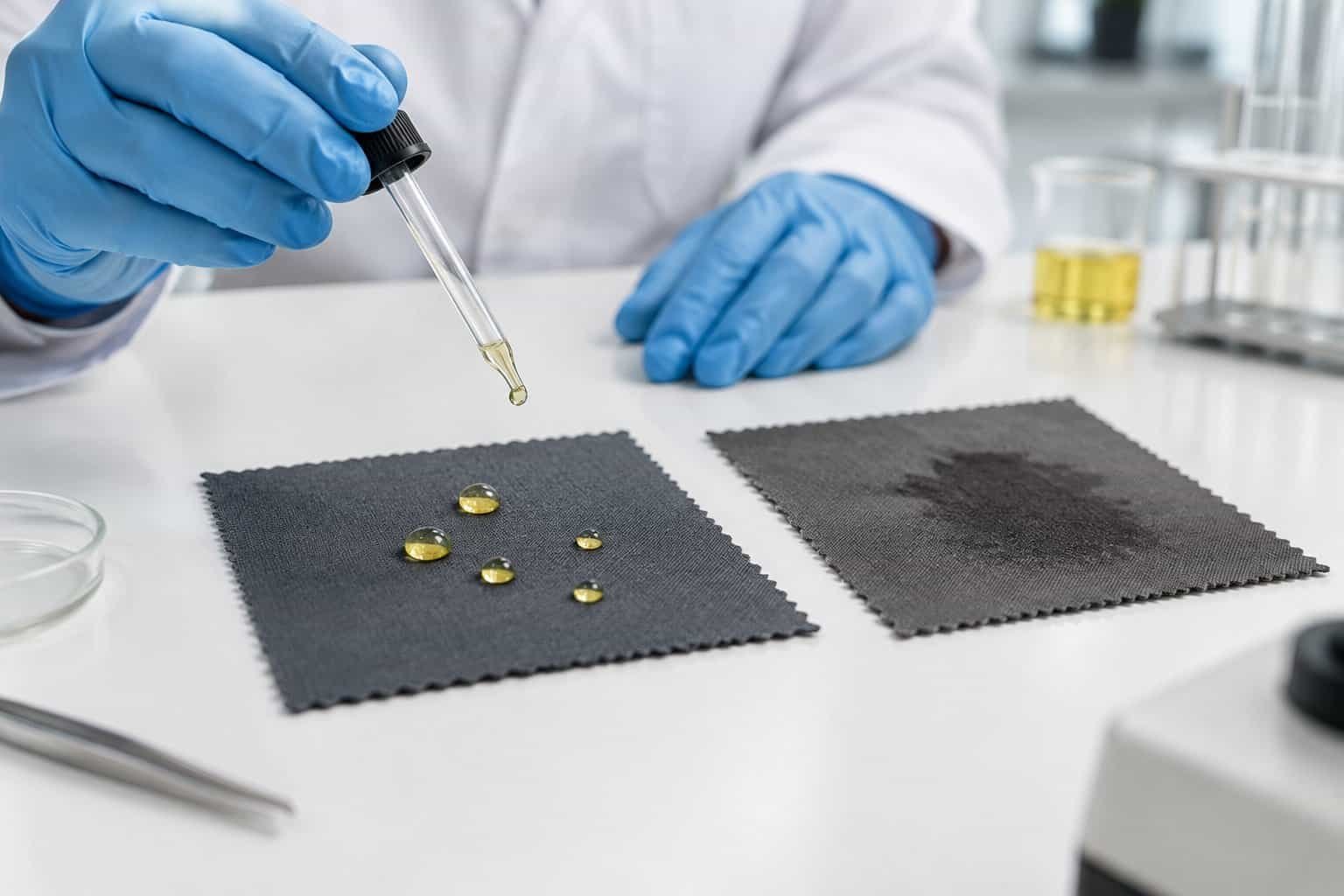
Laundering and production variation affect the surface condition responsible for oil repellency. Initial approval and after-care approval therefore require separately identified test results.
Distinguish Initial Results From Post-Laundering Performance
An initial result describes the specimen in its tested, unwashed state. A post-laundering result describes performance after a particular sequence of washing and drying.
Detergent residues, abrasion, and finish changes influence subsequent oil wetting. Oil stain resistance during service also involves contamination that a clean laboratory specimen has never encountered.
The appropriate durability requirement follows the intended maintenance system. No fixed wash life follows from the terms “oil-repellent,” “cotton,” or “FR.”
Specify the Care Procedure and Reported Test State
A useful after-care specification names the laundering procedure and number of cycles. It also records detergent, drying conditions, and any permitted heat treatment or finish replenishment.
ISO 14419:2025 identifies ISO 6330 and ISO 3175 as relevant washing and dry-cleaning procedure families. Industrial maintenance requires an agreed procedure that represents the intended service conditions.
Compatible care for flame-resistant fabrics must remain part of the specification. Reapplication of a repellent finish should be disclosed because it changes the meaning of an after-care result.
When Changes in Fabric or Finishing Require Reassessment
Changes to the substrate, finish formulation, or cure conditions require review of the existing approval evidence. A shade change also warrants assessment where dyeing or auxiliary chemistry affects the finished surface.
The review should consider all required functions. A repellent adjustment has implications for flame-retardant fabric treatment when it changes the final combined finishing system.
Reassessment should follow a documented change-control plan. That plan identifies the affected tests and establishes who authorizes release of the revised fabric.
What Should an RFQ for FR and Oil-Repellent Fabric Include?
An RFQ should define the exposure and convert it into measurable requirements for the final finished fabric. For industrial applications, the specification also needs clear boundaries between textile performance and external finished-garment requirements.
Define the Exposure, Test Method, and Required Performance
The exposure description should identify the oil or process fluid and explain how contact occurs. Relevant details include liquid temperature, contact duration, and whether pressure or repeated contamination is expected.
The performance requirement should then state:
- Test method and accepted edition.
- Minimum initial oil repellency grade.
- Required grade after the specified care procedure.
- Designated test face.
- Any separate penetration, permeation, or stain-release requirements.
A supplemental test with the actual process fluid requires its own documented procedure. Its result should remain distinct from the standardized hydrocarbon grade.
Specify Cotton, C/N, or CVC With Levitex
Levitex offers FR plus oil-repellent finishing on 100% cotton, cotton/nylon (C/N), and cotton-rich cotton/polyester (CVC). The RFQ should state the required composition and construction, then identify finished weight, usable width, and shade requirements.
The chemical properties of cotton fabric help explain substrate behavior, while the finished fabric’s test report establishes the relevant performance. A blend name alone supplies no oil-repellency grade.
Levitex manufactures textiles for protective-workwear applications. Garment design, seam construction, and assembly remain separate downstream responsibilities.
Request Product-Specific Reports for Repellency and Flame Resistance
Buyers should request reports covering the exact fabric and final combined finishing system. The submission should distinguish oil-repellency evidence from flame-resistance testing.
Each report needs a recognizable sample description and an identified test state. Where the RFQ includes after-care requirements, the evidence should cover those conditions.
Levitex provides product test reports, and buyers should confirm their applicable methods and scope during fabric review. The existence of a report alone establishes no particular grade, wash durability, or garment-level conformity.
Confirm Finish Chemistry Requirements and Bulk Acceptance Criteria
The RFQ should identify applicable chemical restrictions and destination-market requirements. A performance result does not reveal the finish chemistry or establish PFAS-free status.
Bulk acceptance also needs agreed sampling rules. The purchase specification should address roll selection, lot coverage, retained samples, and procedures for resolving disputed results.
Buyers seeking fabric review should send their intended exposure, base cloth, required test method/grade, and care conditions to Charlie@levitex.com. These details give Levitex a defined basis for reviewing the requested FR and oil-repellent combination.
Buy to a Verified Method and Product-Specific Report

A purchasing decision should connect the required oil repellency to a named method and a traceable report for the finished fabric. Initial and after-care results need separate identification, with any maintenance treatments disclosed.
For FR textiles, acceptance should also cover flame-resistance evidence for the combined finish. The purchase order should retain the approved fabric reference, test edition, care procedure, and bulk sampling agreement.
Frequently Asked Questions
Oil-repellency claims are most useful when each claim has a defined test scope. The following answers address common purchasing and laboratory-documentation questions.
Does a water-repellent fabric also repel oil?
Water repellency alone provides no evidence of oil repellency. Oils present different wetting challenges, so an oil claim requires an appropriate oil repellency test such as AATCC 118 or ISO 14419.
Which fabrics resist absorbing oil?
Fabrics with a suitable oil-repellent surface treatment resist wetting by the oils covered by their verified performance. Cotton, C/N, and CVC support such finishing, with the final construction and treatment determining the measured result.
Can an oil repellency testing kit replace a laboratory report?
A kit supports in-house screening when trained personnel follow the complete method with suitable equipment and controlled conditions. Contractual acceptance still requires the report and laboratory arrangements specified by the buyer, including independent testing where required.
Where can buyers obtain official AATCC 118 and ISO 14419 documents?
Official AATCC 118 documents are available through AATCC, and ISO 14419 documents through ISO or authorized national standards bodies. Buyers and laboratories should confirm the edition named in the purchase specification before testing begins.
Does OEKO-TEX certification prove oil repellency?
OEKO-TEX certification by itself does not establish an oil-repellency grade. The applicable certification scope should be checked separately, while the repellency claim requires a product-specific report under the agreed test method.