
Color fastness to rubbing is tested by moving a standardized white cotton cloth across a fabric with a crockmeter under controlled pressure, then grading the color transferred during separate dry and wet tests. For industrial textile buyers, the results help identify fabrics that risk staining adjacent materials during handling or wear.
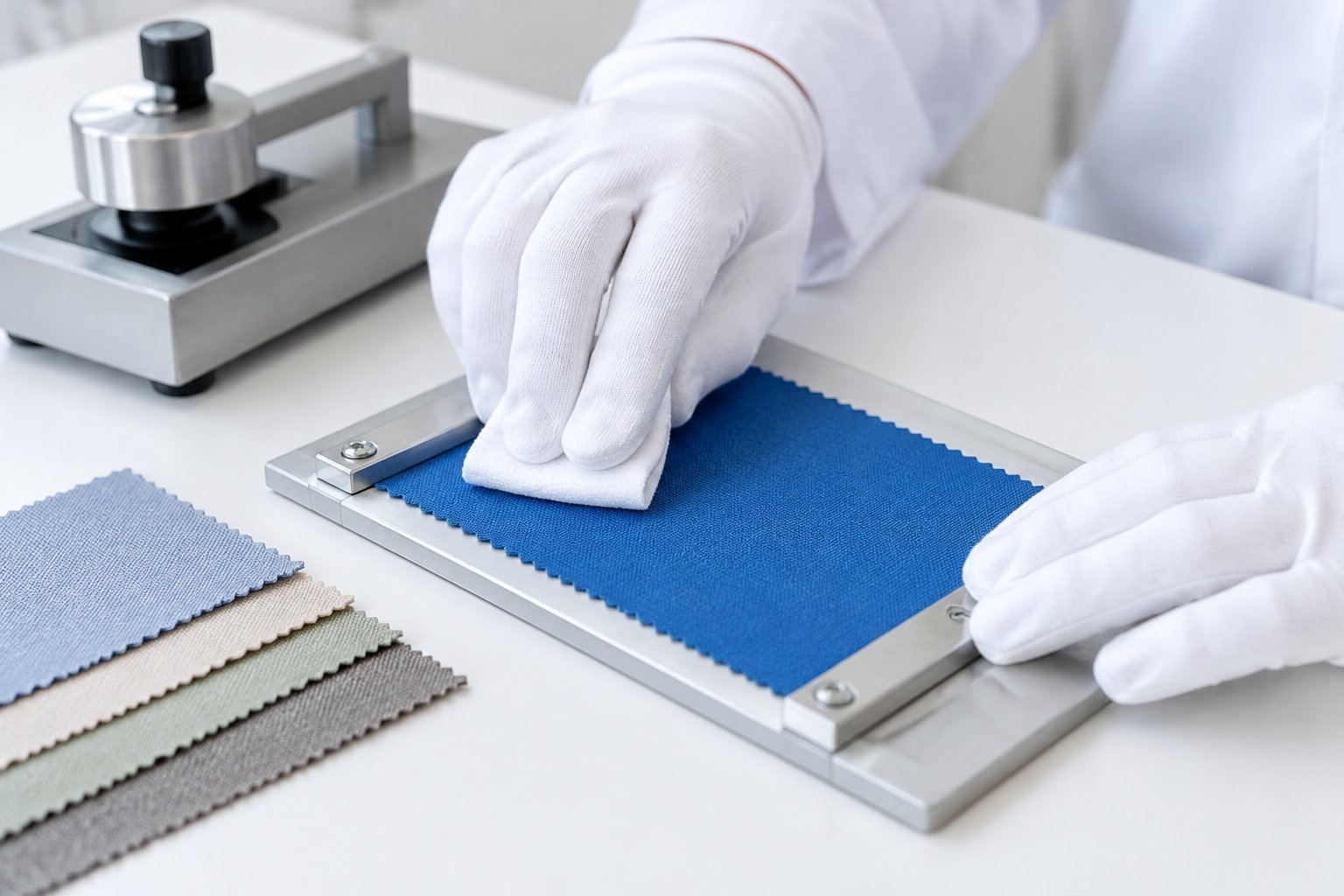
Known as crocking in US textile testing, this color transfer is assessed on the white test cloth. Levitex manufactures dyed, printed, and flame-resistant workwear textiles, where colorfastness to rubbing forms one part of the finished-fabric quality specification. Comparable results require an agreed method and clearly reported test conditions.
How Do Dry and Wet Crocking Tests Work?
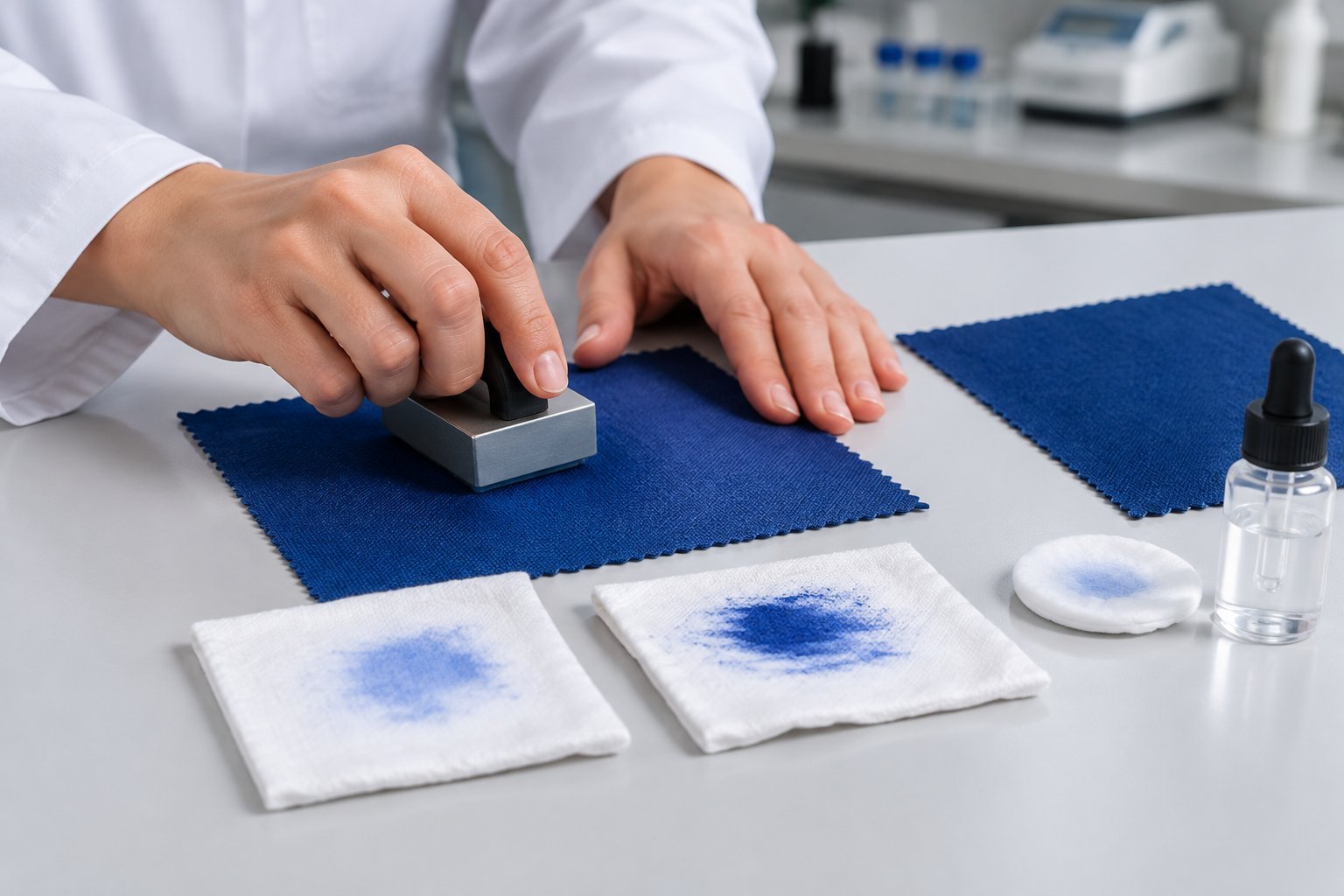
Dry and wet crocking tests use controlled friction to transfer surface color onto separate standardized rubbing cloths. The wet test adds a measured amount of water to the rubbing cloth before testing.
Which Method Applies: ISO 105-X12 vs. AATCC TM8?
The purchase specification determines whether the laboratory uses ISO 105-X12 or AATCC TM8, also called AATCC 8. Both evaluate rubbing transfer, but their preparation requirements affect comparability.
| Test detail | ISO 105-X12 | AATCC TM8 |
|---|---|---|
| Test conditions | Dry and wet | Dry and wet |
| Wet-cloth water pickup | 95%–100% | 65% ± 5% |
| Specimen orientation | Lengthwise and widthwise specimens | Preferably oblique to yarn direction |
| Main reported result | Rubbing-cloth staining | Crocking-cloth staining |
The laboratory should follow the specified edition in full. A report carrying an ISO method name alongside an AATCC wetting procedure represents a modified procedure; any agreed deviation belongs in the report.
AATCC test methods also include other crocking procedures. The method number therefore needs to appear on the order and report, alongside the test name.
Preparing Specimens, Rubbing Cloths, and the Crockmeter
Representative specimens should come from the production material being evaluated. For shipment approval, that means fabric after the specified dyeing, printing, and finishing operations. Lab dips establish color direction, while finished-bulk specimens represent production processing.
Preparation includes:
- Conditioning specimens and dry rubbing cloths in the atmosphere required by the method.
- Identifying the tested face and specimen orientation.
- Securing the fabric flat without unintended stretching or slippage.
- Using a standardized white cotton rubbing cloth.
- Checking the crockmeter’s rubbing head, loading, travel, and operation.
ISO testing distinguishes warp and weft directions. Knitted constructions require corresponding identification of lengthwise and crosswise orientation. Pile fabrics require attention to pile direction and the applicable rubbing-head arrangement; these details belong in the laboratory instructions.
Performing the Dry Rubbing Test
The technician mounts a fresh, conditioned rubbing cloth securely over the crockmeter finger. The finger travels over the fabric using the method’s specified force and stroke length.
For conventional flat-fabric arrangements, the procedure uses approximately 9 N of force and 10 complete back-and-forth cycles. Ten cycles equal 20 individual traverses. The laboratory must apply the exact equipment tolerances and operating requirements from the selected standard.
After rubbing, the technician removes and identifies the cloth for assessment. Separate tracks and fresh cloths prevent one determination from contaminating another. Printed fabrics require sampling that represents the relevant colors, especially when a standard rubbing track covers only part of the pattern.
Controlling Moisture in the Wet Rubbing Test
Wet rubbing uses a measured water pickup, calculated against the rubbing cloth’s conditioned mass:
Water pickup (%) = [(wet mass − conditioned mass) ÷ conditioned mass] × 100
For example, a cloth weighing 0.20 g before wetting and 0.33 g afterward has 65% water pickup. The calculation refers to water held relative to the initial cloth mass.
The technician wets the cloth using the specified water, removes excess liquid, and checks its mass before testing. Prompt handling limits evaporation. After rubbing, the stained cloth dries as the method requires before evaluation; residual moisture changes its appearance and interferes with visual grading.
How Are Staining Grades Assessed and Reported?
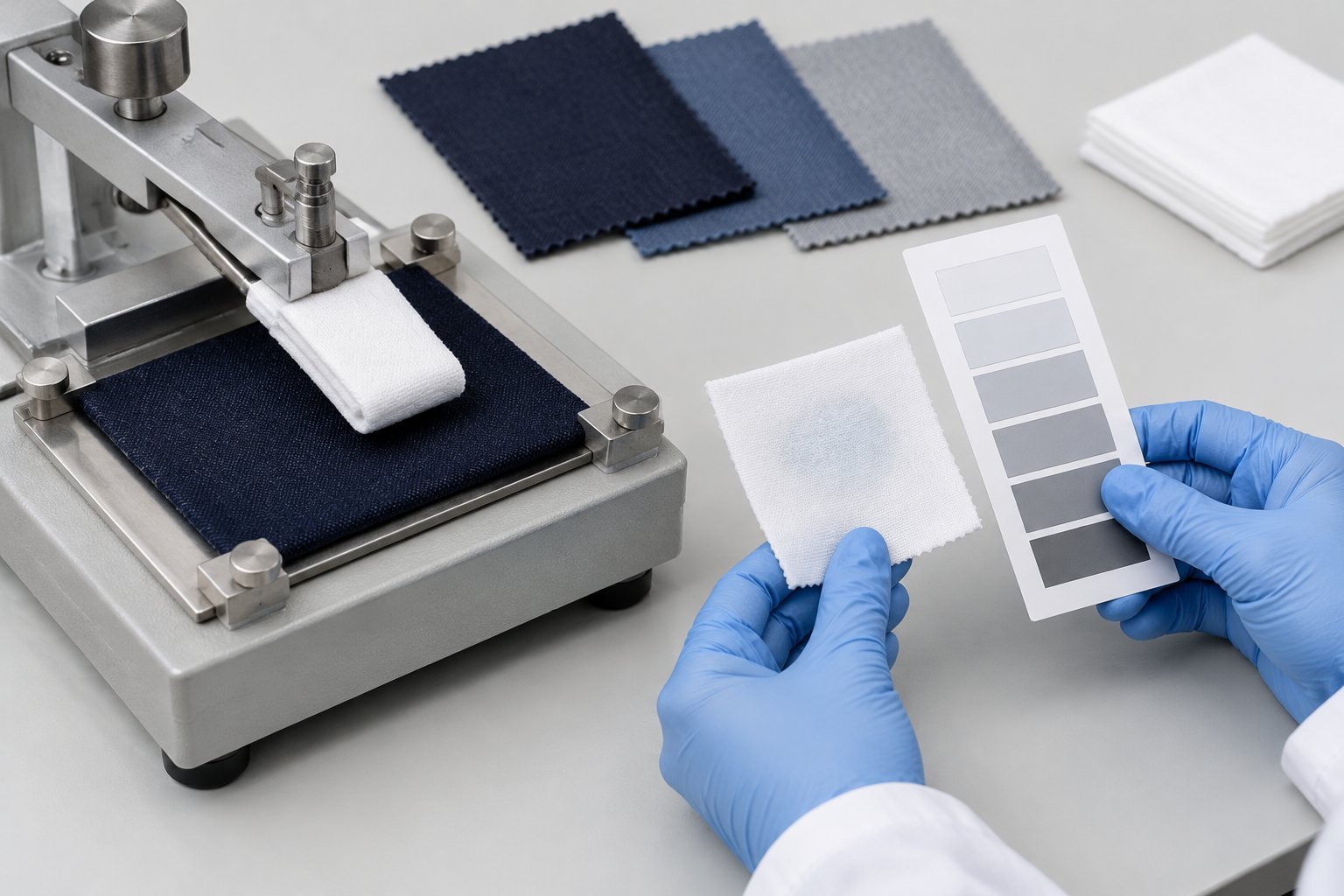
Staining grades describe the color transferred onto the rubbing cloth under the recorded test conditions. A useful report preserves separate results for each condition and required specimen orientation.
Reading the Grey Scale for Staining
The gray scale for staining, also spelled grey scale for staining, compares the contrast between an unstained reference cloth and the tested cloth. Assessment takes place under controlled viewing conditions with the backing specified by the method.
The scale runs from grade 5 to grade 1:
- 5: No staining.
- 4: Slight staining.
- 3: Moderate staining.
- 2: Marked staining.
- 1: Heavy staining.
Intermediate grades include 4–5 and 3–4. These are visual contrast ratings; a grade does not express a percentage of dye lost.
The assessor evaluates color staining on the rubbing cloth. Color change in the original fabric is a separate observation requiring an appropriate assessment procedure. Any permitted removal of loose fibers must follow the selected method so that handling does not alter the stain.
Recording Separate Results by Condition and Specimen Direction
A report should identify the test method and edition, sample reference, tested face, and specimen preparation. Wet-cloth pickup and any procedural deviations provide essential context for interpreting the grades.
For a direction-specific program, the result entries should remain distinct:
- Dry rubbing, warp direction.
- Dry rubbing, weft direction.
- Wet rubbing, warp direction.
- Wet rubbing, weft direction.
When AATCC testing uses an oblique specimen, the report should state that orientation. Additional buyer-requested directional tests need equivalent identification.
Averaging results into one “rubbing fastness” value conceals differences between conditions. Effective FR fabric quality control connects each result to the relevant fabric article, shade, and production lot.
Setting Buyer Acceptance Criteria Without a Universal Pass Grade
Buyer acceptance criteria assign minimum staining grades to the specified method and application. Dry and wet limits should be written separately, with any shade-specific requirements agreed before bulk production.
Industrial workwear specifications should account for contact with lighter materials and the expected exposure to moisture. Requirements for printed fabrics also need to address which colors or pattern areas receive testing.
A complete acceptance clause identifies:
- The test method and edition.
- Minimum dry and wet grades.
- Required specimen directions and tested face.
- Whether testing applies as delivered or after defined pretreatment.
- The sampling and retest rules.
The laboratory reports performance against those criteria. The method itself supplies the procedure, without establishing one universal commercial pass grade.
Why Crocking Results Do Not Prove Wash Fastness or Protective Performance
Crocking measures friction-driven transfer at the fabric surface. Washing fastness assesses color behavior under specified laundering conditions, including color change and staining of adjacent materials. Color bleeding describes color release in liquid and requires the relevant exposure test.
Within the ISO 105 family, ISO 105-C06 addresses color fastness to washing. ISO 105-B02 evaluates color fastness to light using xenon-arc exposure and blue wool references under its specified procedure.
Color fastness to perspiration and color fastness to sea water require their respective tests. Perspiration fastness introduces exposure conditions that a water-wetted rubbing cloth does not reproduce.
Protective performance also requires independent evidence. A crocking grade establishes no flame resistance, arc rating, or chemical protection. Likewise, industrial laundering and fabric repellency require defined evaluation conditions beyond the rubbing test.
What Causes Poor Results, and How Can Mills Improve Them?
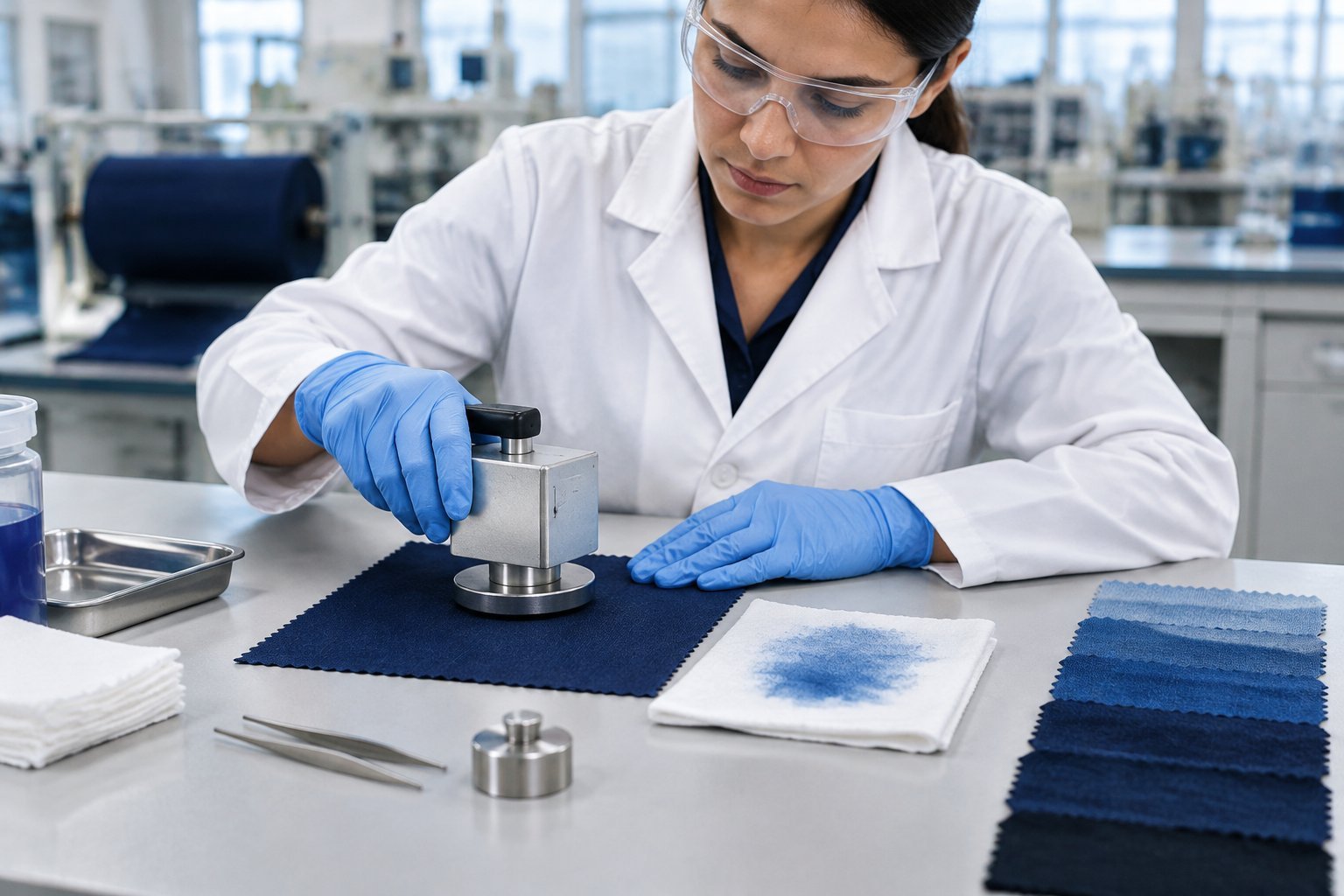
Poor rubbing fastness results from transferable surface color, colored fiber fragments, or insufficiently secured pigment. Corrective action starts with the coloration system and the production stage responsible for the transfer.
How Fiber Type, Fabric Construction, and Shade Depth Affect Transfer
Fiber type determines which coloration systems are suitable and how the substrate responds to moisture. The chemical properties of cotton fabric support reactive dyeing, while water absorption and swelling influence wet friction behavior.
Fabric construction affects the contact between the rubbing head and the surface. Raised fibers, prominent yarns, and textured areas concentrate abrasion or release colored fragments.
Greater dye concentration increases the challenge of removing residual surface color from deep shades. Shade depth alone does not predict a grade: fixation, wash-off efficiency, and surface condition determine the finished result.
Improving Dye Fixation, Wash-Off, and Print Binder Curing
For reactive dyes, the mill should review dye fixation and the removal of hydrolyzed or unfixed dye. Relevant controls include the dyeing process temperature profile, alkali dosing, and the subsequent soaping and rinsing sequence.
Pigment coloration requires a different investigation. Pigment particles rely on binder adhesion, so the mill should check binder selection and application level alongside curing conditions. The fabric’s achieved curing temperature and dwell time provide stronger process evidence than the machine’s setpoint alone.
Changes to fabric finishes also deserve review when rubbing results shift after finishing. A corrective treatment requires checks for shade change and handle, followed by repeat crocking tests on the finished material.
Checking FR and Repellent Finishes After Process Changes
Changes to a workwear fabric’s finishing recipe require a review of every affected specification. Softeners and fixing agents alter surface behavior, while additional thermal processing changes the fabric’s treatment history.
For multifunctional materials, FR and repellent finishing compatibility requires evaluation of the finished combination. An improvement in rubbing fastness supplies evidence for that property alone.
Levitex offers FR plus water-repellent and FR plus oil-repellent finishing on 100% cotton, cotton/nylon (C/N), and cotton-rich cotton/polyester (CVC) base fabrics. Product-specific reports and the agreed specification should establish the performance claimed for each supplied article.
Verifying Levitex Bulk Fabric Against the Agreed Test Specification
Levitex bulk-fabric approval should use representative samples from the agreed production stage. The company manufactures textiles and provides custom dyeing and printing; finished-garment assessment remains a separate responsibility within the supply chain.
Buyers should distinguish a color-approval sample from a bulk-performance sample. The latter needs traceability to the supplied shade and finishing route, with clear identification of any pretreatment.
For an order review, prospective buyers can send the fabric reference, shade, and required crocking method to Sales Manager Charlie Luo at Charlie@levitex.com. Including the required dry and wet limits allows the discussion to focus on the relevant product-specific test specification.
Specify the Method and Verify the Finished Fabric
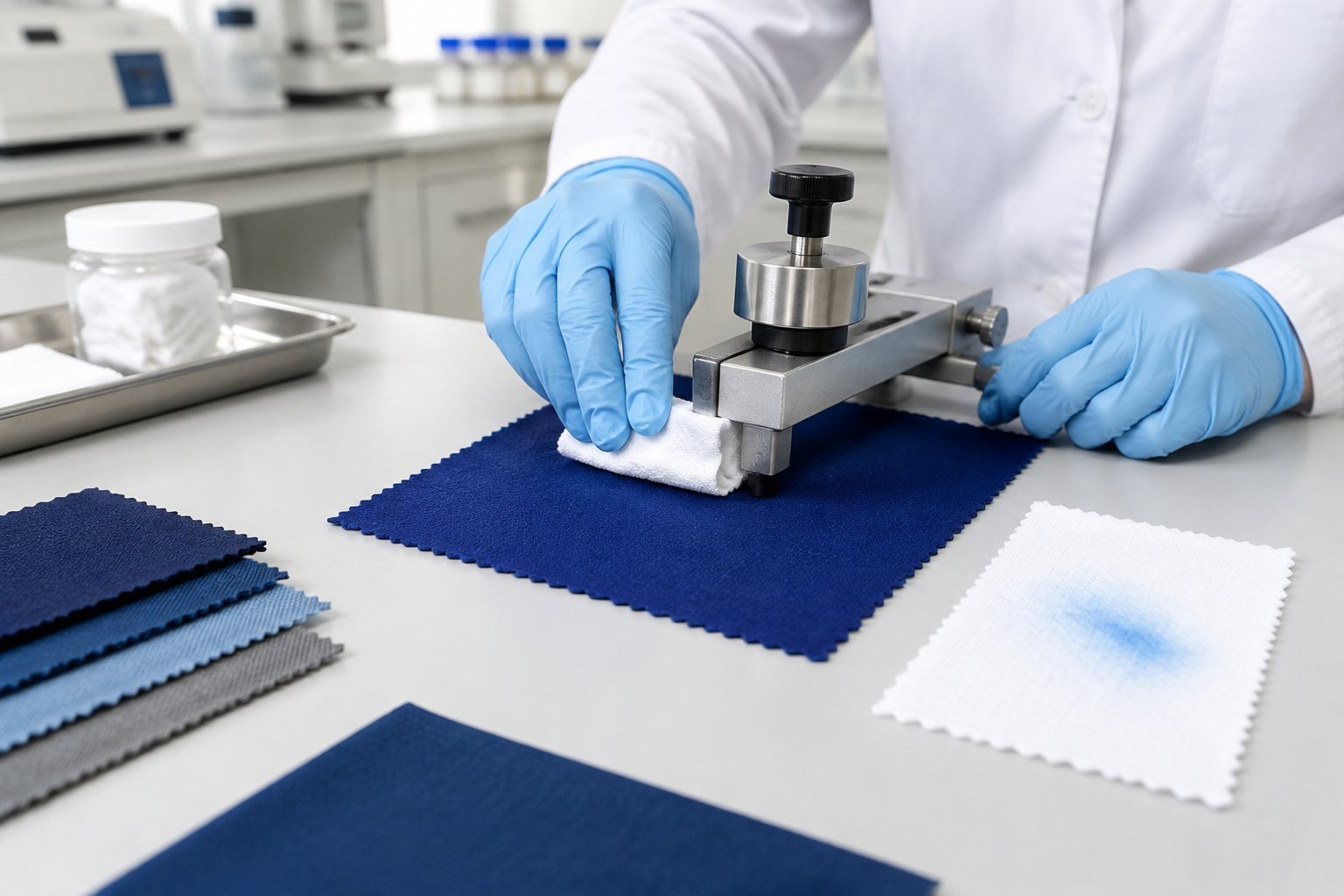
Reliable color fastness to rubbing results require a named method, controlled preparation, and separate dry and wet staining grades. Finished-bulk samples provide the relevant evidence for shipment acceptance.
For textile quality control, the purchase order should record the method edition, acceptance limits, specimen orientation, and test stage. Approval should use the matching production-lot report, with washing fastness and protective performance supported by their own specified evaluations.
Frequently Asked Questions
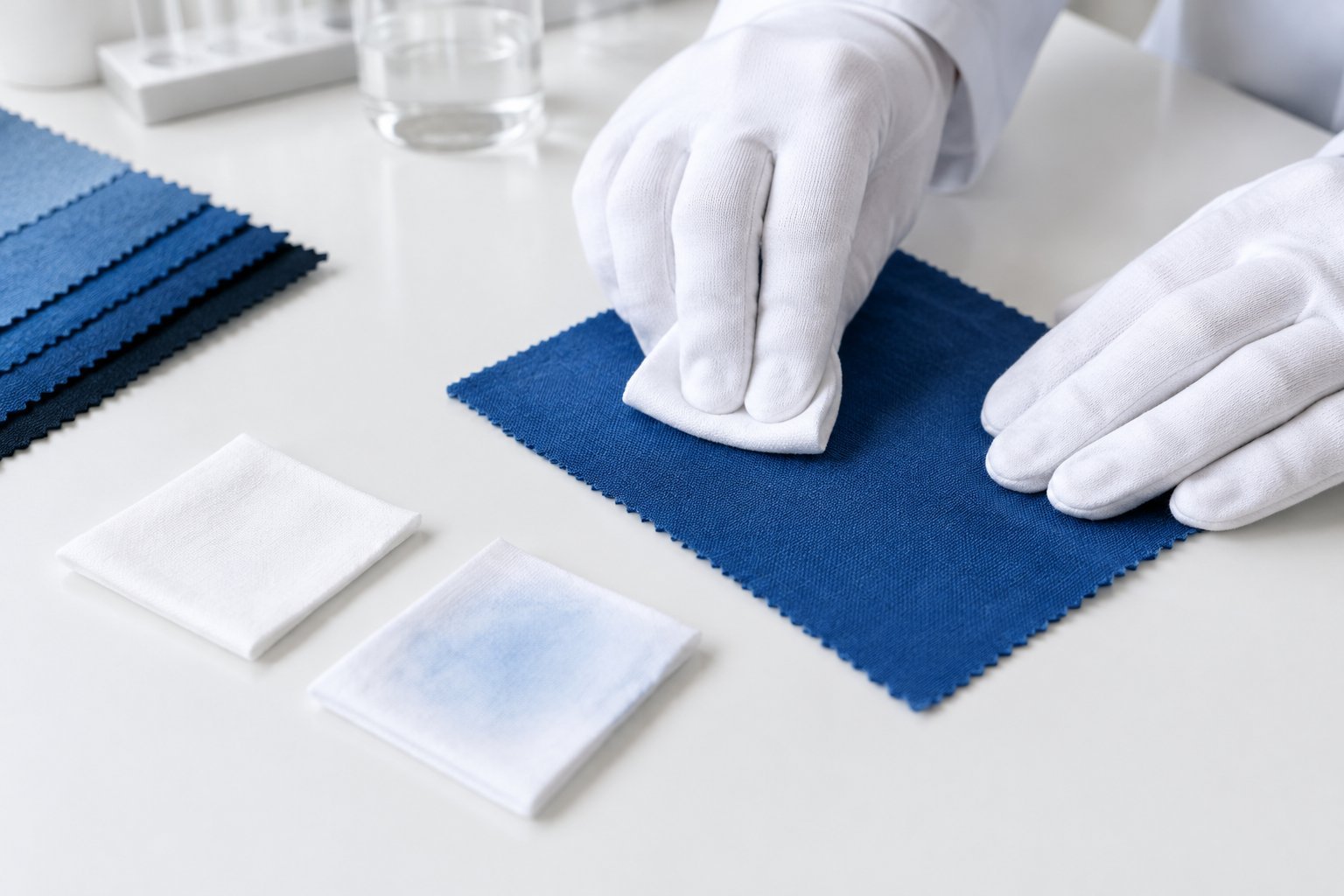
Crocking FAQs focus on terminology and the practical interpretation of laboratory results.
What is the difference between crocking and rubbing fastness?
Crocking describes color transfer caused by rubbing, while rubbing fastness describes the fabric’s resistance to that transfer. US laboratories commonly use “crocking” for the test and its results.
Why is wet rubbing fastness often lower than dry rubbing fastness?
Water promotes the movement of some residual dyes and changes friction at the fiber surface. Wet rubbing grades therefore often fall below dry grades, with the difference influenced by the coloration system and surface condition.
What is a good rubbing fastness grade for industrial workwear fabric?
A good grade meets the buyer’s agreed dry and wet requirements under the named test method. A report containing only a grade, without the method and condition, provides insufficient detail for acceptance.
Can a fabric pass washing fastness but fail rubbing fastness?
Yes, a fabric can meet washing fastness requirements while failing rubbing fastness. Surface pigment or colored fiber fragments create transfer under friction even when the material performs satisfactorily in the specified wash test.
Should rubbing fastness be tested before or after FR finishing?
Shipment-acceptance testing should assess the fabric after FR finishing and all subsequent production treatments. Earlier testing supports process diagnosis, while final-fabric testing represents the material supplied.