You can source arc flash clothing materials made from FR-treated cotton, cotton-rich blends, aramid blends, modacrylic-containing engineered blends, and specialized blends incorporating PBI, provided the exact fabric or layered system has documented arc-test performance. Your purchasing goal is to match that evidence to the material supplied while securing the comfort and durability your workwear requires.
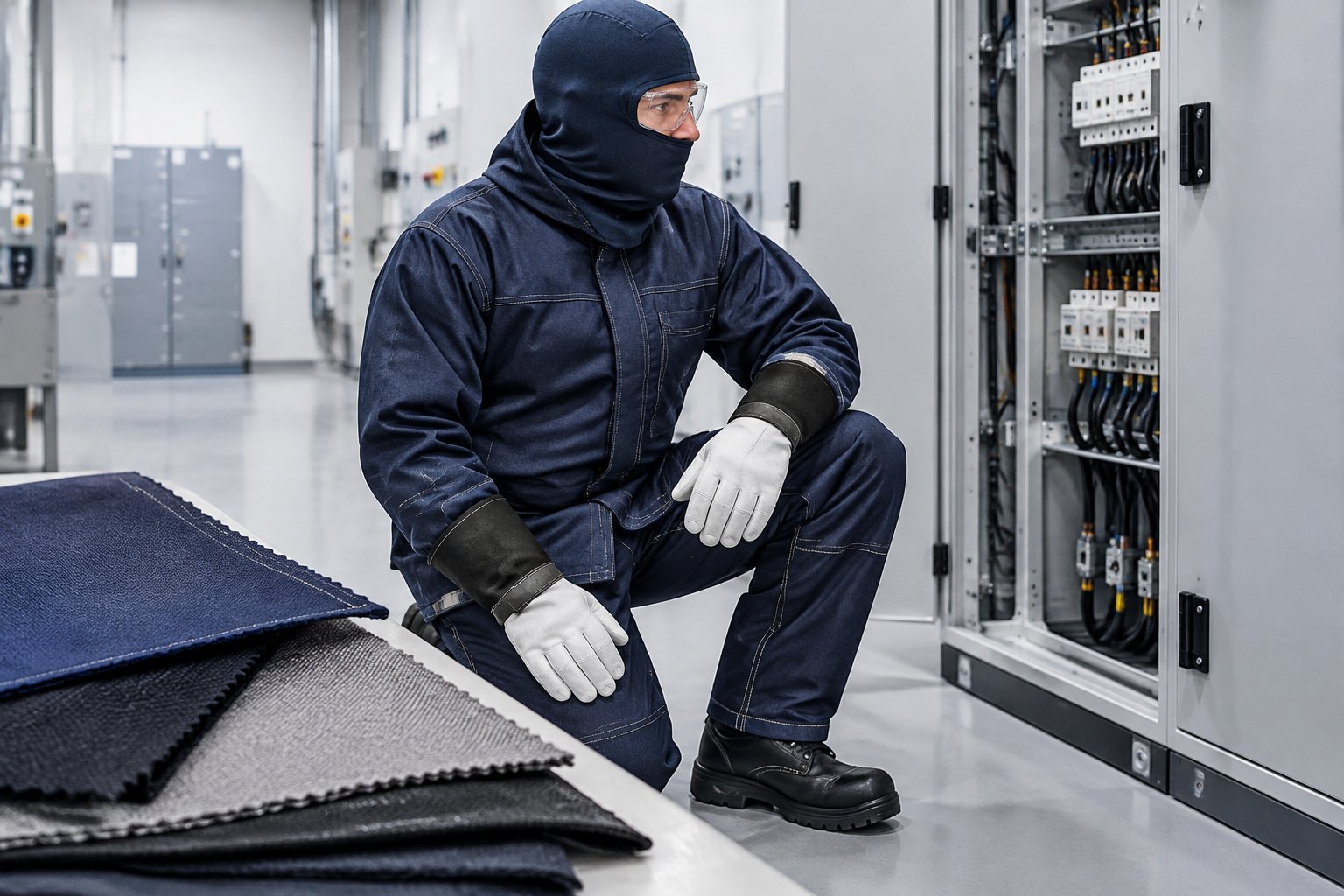
You gain a more reliable specification by identifying the complete textile construction, including its finish and intended layers. A familiar fiber name gives you useful background; the finished fabric’s test documentation establishes its measured protective performance.
What Fabrics Can Arc Flash Clothing Be Made From?
You have four principal textile categories to consider, with different approaches to flame resistance and wear performance. Use the comparison below to organize your shortlist without assigning a protection ranking to any fiber family.
| Buying consideration | FR-treated cotton/cotton-rich blends | Aramid blends | Modacrylic-containing engineered blends | Specialized blends including PBI |
|---|---|---|---|---|
| FR approach | Applied durable treatment | Inherent FR fibers | Engineered FR fiber mixture | Inherent high-performance fibers |
| Composition detail to verify | Cotton and reinforcement percentages | Meta-/para-aramid proportions | Every component and percentage | PBI and companion fibers |
| Wear characteristic to evaluate | Hand and abrasion resistance | Flexibility and tear resistance | Stretch and moisture handling | Bulk and flexibility |
| Arc evidence required | Exact finished fabric | Exact finished fabric | Exact finished fabric | Exact fabric or assembly |
FR-Treated Cotton and Cotton-Rich Blends
You obtain flame resistance in these fabrics through a treatment applied to cotton or a cotton-rich substrate. Your options include treated cotton and blends incorporating reinforcement fibers such as nylon.
You should assess softness alongside abrasion resistance and laundering requirements. A durable FR treatment has a defined care regime, so request evidence supporting its performance after the specified cleaning procedures. Your evaluation of flame-retardant cotton should distinguish the treated textile from ordinary untreated cotton.
Aramid Fibers and Blends
You encounter aramids as a fiber family encompassing meta-aramid and para-aramid. Their inherent flame resistance comes from their polymer chemistry, and their thermal response involves decomposition and charring rather than ordinary thermoplastic melting.
You should check the blend proportions because companion fibers influence strength, hand, and moisture handling. Inherent flame resistance survives laundering as a fiber characteristic, while contamination and physical damage still affect garment serviceability. Your arc-performance requirement remains specific to the finished textile.
Modacrylic-Containing Engineered Blends
You will find modacrylic incorporated into engineered mixtures with fibers selected for comfort or reinforcement. The full formulation determines how the fabric behaves during thermal exposure and everyday wear.
Request every constituent’s percentage, including any cellulosic, synthetic, or antistatic component. You should evaluate the actual sample for stretch recovery and surface wear. The word “modacrylic” alone establishes neither an arc rating nor an acceptable laundering life.
Specialized High-Performance Blends Including PBI
You may encounter polybenzimidazole, or PBI, combined with aramid fibers in specialized thermal-protective textiles. PBI contributes inherent flame resistance and thermal stability.
For an electrical-workwear specification, require arc-test evidence identifying the proposed PBI-containing fabric or assembly. You should also assess stiffness and finished-garment mobility before approving a construction. A high-performance fiber designation does not establish a universal advantage in weight, comfort, or protection.
What Evidence Establishes a Fabric’s Arc Protection?
You establish arc protection through documented testing of the exact material or layer assembly proposed for your application. Your review should connect the reported result to an identifiable fabric specification and test method.
Arc-Test Evidence for the Exact Fabric or Layered System
Your report should identify the tested sample through its composition, construction, mass, and finishing details. Check the laboratory, report number, test date, conditioning, and reported result.
For open-arc testing, you will encounter results expressed in calories per square centimeter, including ATPV or EBT. Keep detailed arc-rating interpretation separate from your material comparison so the rating terminology does not obscure sample identity.
For a layered system, verify each constituent and its order. You cannot add individual layer ratings to calculate the assembly’s rating; require evidence for the specified combination.
How ASTM F1959, ASTM F1506, and IEC 61482 Differ
You should distinguish a test method from a broader performance specification. ASTM F1959 measures the arc rating of clothing materials or material assemblies using an electric arc.
ASTM F1506 addresses a wider set of requirements. Your clothing specification should account for its arc rating, flame resistance, mechanical durability, garment construction, and labeling requirements.
Within IEC 61482, you will encounter open-arc testing under IEC 61482-1-1, box testing under IEC 61482-1-2, and clothing requirements under IEC 61482-2. Request the exact part and edition; a box-test protection class does not translate directly into an open-arc rating. For a US purchase, identify the standards and editions required by your employer’s electrical-safety program.
Why Thermal Protection Is Not Electrical Shock Insulation
You use arc-rated clothing to reduce injury from an arc’s thermal effects. Electrical shock protection requires separately selected insulating equipment and electrical safe-work practices.
Keep these functions separate in your purchasing documents. OSHA warns that wearing flame-resistant or rubber-insulated PPE does not necessarily provide arc flash protection. Your fabric selection therefore belongs within a broader hazard assessment, without treating clothing as voltage-rated insulation.
How Do Fabric Choices Affect Comfort and Durability?
You influence comfort and durability through the complete fabric construction, its mass, the layer arrangement, and its finish. Compare these characteristics using samples and documented performance under your intended wear conditions.
Construction and Fabric Mass
You should specify whether the textile is woven or knitted, then identify its weave or knit structure. Yarn characteristics and fabric density influence drape, air permeability, and resistance to mechanical damage.
Compare mass in consistent units, such as oz/yd² or g/m². A heavier fabric within a similar construction changes bulk and heat transfer, but mass alone cannot predict an arc rating across different textiles. Your workwear fabric selection should also reflect the abrasion and snagging exposure of the job.
Layering, Mobility, and Heat Management
You should evaluate comfort with the proposed garment layers worn together. Added layers change bulk and evaporative heat loss, while fit influences how freely you reach or bend.
Ask for a trial garment when movement is critical. Check sleeve travel, shoulder reach, and whether closures maintain coverage throughout the task. If your specification includes a flame-resistant lining, include that lining in the assembly documentation and fit assessment.
Finishes, Laundering, and Wear
You should identify every finish applied after fabric formation, including repellency or moisture-management treatments. Additional finishing changes the supplied textile and requires confirmation that the protective documentation remains applicable.
Build your FR-fabric laundering requirements around the manufacturer’s approved process. Check restrictions on cleaning chemistry and drying conditions, and establish procedures for removing combustible contamination. Inspect garments for thinning, open seams, and damage that compromises coverage.
What Should Buyers Include in a Material Specification?
Your material specification should define the textile precisely enough to control repeat orders and verify supporting documentation. Include measurable acceptance criteria and a process for approving changes.
Exact Fiber Composition and Fabric Construction
You should list each fiber by generic name and percentage. Include woven or knitted construction, fabric mass with tolerance, usable width, color, and all functional finishes.
Request additional construction details where they control performance, such as yarn specification or weave density. Your purchase order should require approval before substitutions to fibers, construction, or finishing chemistry. A shared trade name or similar appearance provides insufficient detail for change control.
Matching Arc-Test Documentation to the Supplied Fabric
You need a traceable connection between the test report and the production material. Ask the supplier to map its article number and finish designation to the tested sample.
Check the report’s sample description against the technical data sheet and purchase specification. Where a report covers a defined product range, request the documented basis for including your variant. Your fabric quality checks should include lot identification and records of approved specification changes.
Dimensional Stability and Laundering Durability
You should establish acceptable dimensional change using the intended cleaning and drying procedure. Shrinkage affects garment sizing and coverage, including sleeve length and closure alignment.
Request results after a stated number of cleaning cycles, together with the conditioning and measurement methods. Include retained flame performance and relevant mechanical properties in your acceptance requirements. Your contract should identify both the test procedure and the pass criteria, avoiding an undefined claim of “wash durable.”
Details to Include in a Fabric Specification Inquiry
You will receive a more useful technical response when your inquiry includes:
- Your intended garment and work environment.
- The arc-performance requirement established by your safety program.
- Required standards, editions, and test documentation.
- Preferred fiber composition and construction.
- Target fabric mass, usable width, and tolerances.
- Color, printing, and finishing requirements.
- Laundering process and durability acceptance criteria.
- Order quantity, sample needs, and delivery requirements.
You can discuss these details with Levitex when evaluating customized FR-fabric manufacturing, custom dyeing, or custom printing. Send your exact fabric specifications and required arc-test documentation to Charlie@levitex.com, and request confirmation of the evidence applicable to the proposed material before approving production.
Frequently Asked Questions
You can resolve common purchasing questions by separating material composition from documented performance and intended use.
Can ordinary cotton be used for arc flash clothing?
You should specify tested arc-rated material when your hazard assessment requires arc flash protective clothing. Ordinary cotton supports combustion, so a cotton-content label alone provides no evidence of arc protection.
Can arc-rated fabrics contain nylon or polyester?
You can accept nylon or polyester content within an engineered fabric when the exact textile meets your applicable protective requirements. Verify the full composition and finished-fabric test evidence; a result for one blend does not transfer to another formulation.
Which fabric should electricians choose for arc flash clothing?
You should choose a documented arc-rated fabric that meets your employer’s task-specific protection requirement and remains practical for your working conditions. Use the established hazard assessment to select arc flash PPE, then compare qualifying fabrics for mobility, laundering compatibility, and wear durability.
Does arc-rated fabric also provide flash-fire, welding, or chemical protection?
You need separate evidence for flash-fire, welding, or chemical protection. Specify applicable requirements such as NFPA 2112 for flash-fire clothing or the relevant welding standard, and distinguish liquid repellency from barrier protection when chemical exposure is involved.
What should I request when buying arc-rated fabric wholesale?
You should request a technical data sheet, applicable arc-test reports, laundering instructions, and lot-traceability documentation tied to the article you intend to buy. Before placing a bulk order, obtain an approval sample and written agreement on tolerances, acceptance testing, and notification of material changes.