
Conductive-yarn grids are the stronger starting point for buyers specifying repeatedly laundered protective workwear because the charge-control structure is incorporated into the fabric; topical antistatic finishes suit applications where treatment-specific humidity and care results meet the required performance. In the conductive yarn vs antistatic finish comparison, both routes require evidence from the finished textile under its intended operating conditions.
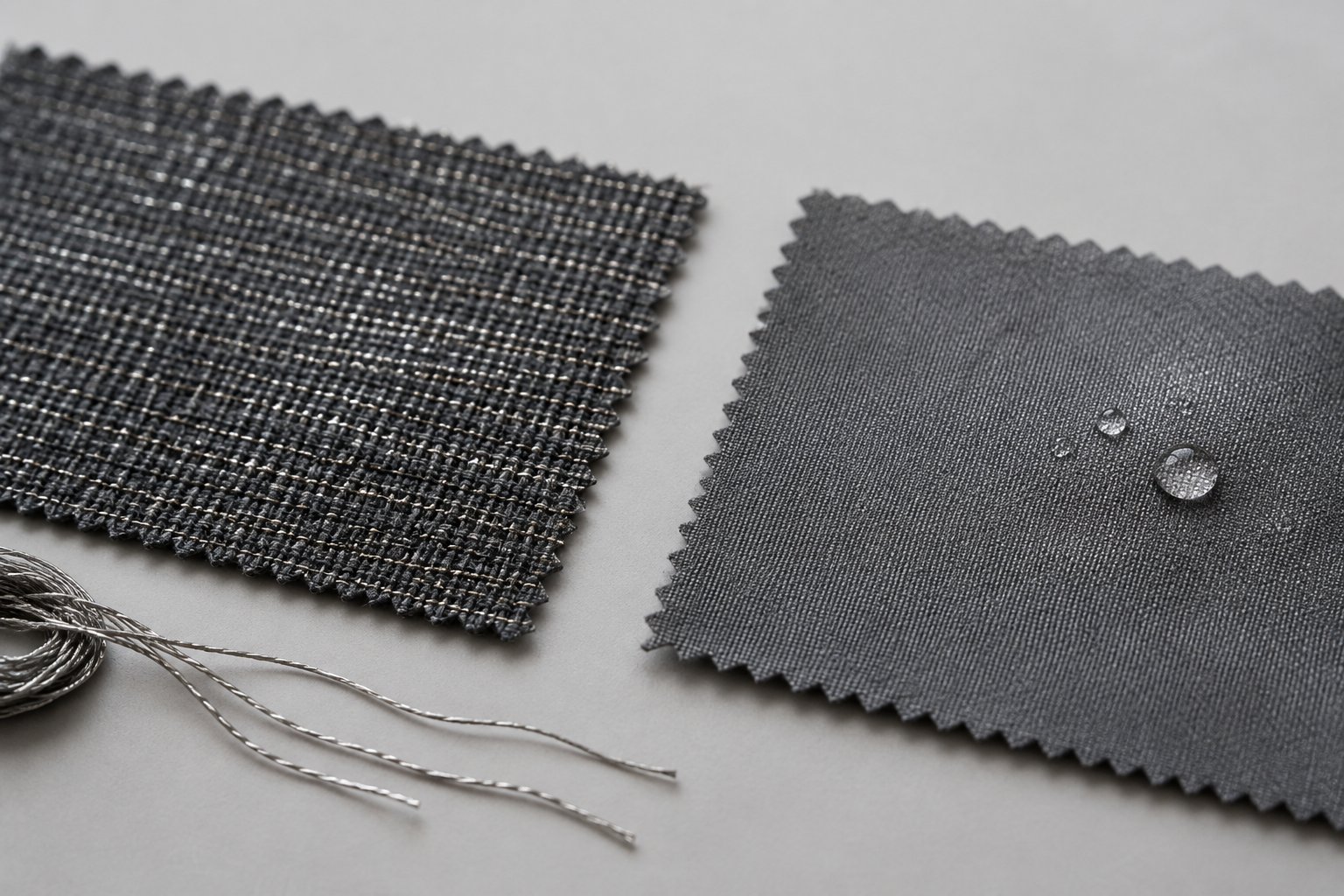
Static control in industrial textile materials supports protection against electrostatic ignition and other application-specific hazards. Levitex manufactures flame-resistant fabrics for protective-workwear applications, where electrical behavior must remain compatible with the required FR performance.
A visible conductive grid identifies a construction feature. A documented electrical result establishes performance under stated conditions. That distinction gives purchasing teams a practical basis for comparing samples and approving bulk fabric.
Which Approach Fits Your Workwear Fabric Requirements?
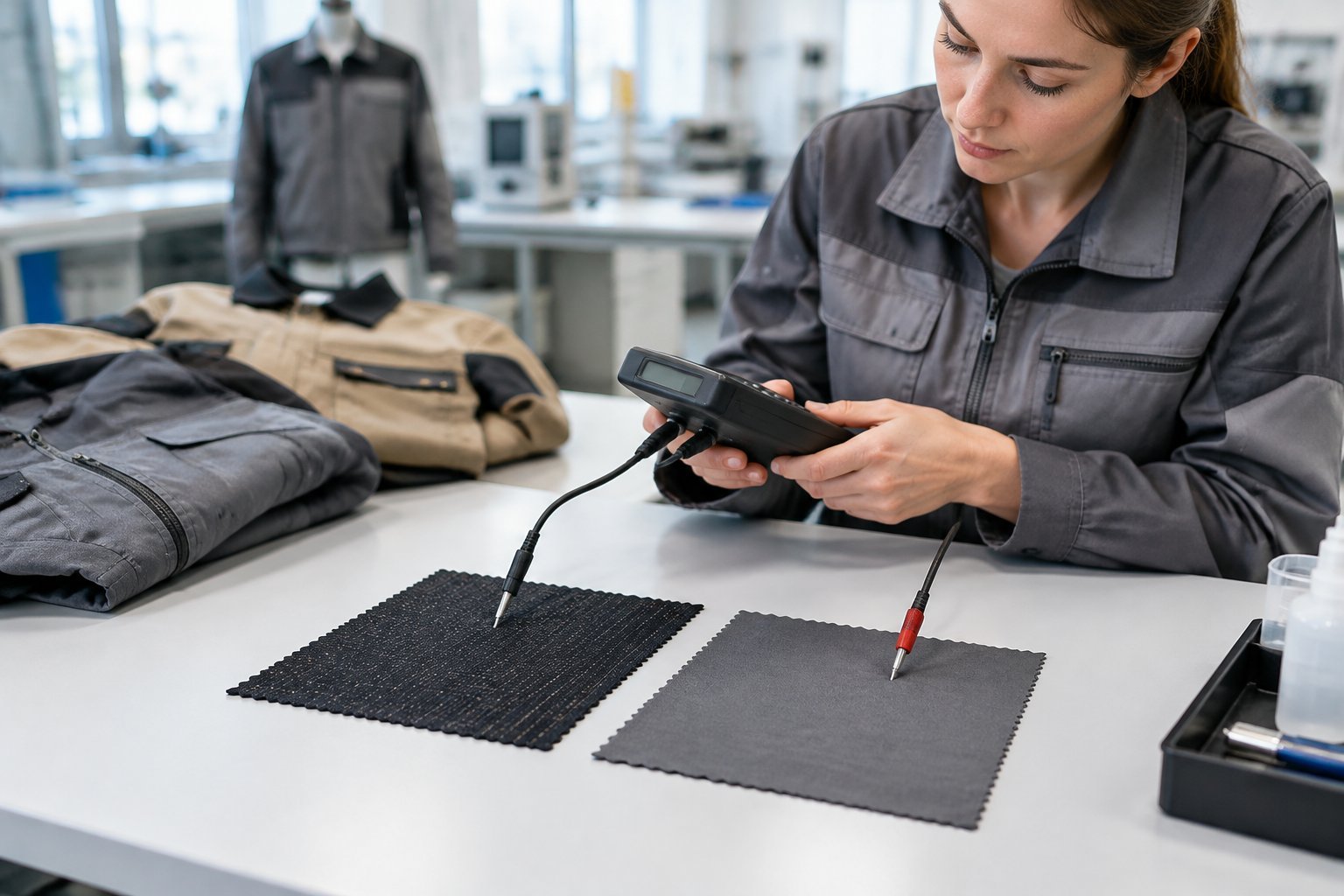
Conductive yarn provides an integrated charge-control structure, while antistatic finishes modify the fabric surface. The purchasing decision should connect that construction choice to operating humidity and the intended care process.
Buyer Comparison Table: Construction, Humidity, Care, and Evidence
The table distinguishes route characteristics from performance that requires testing. Neither construction alone establishes suitability for a hazardous workplace.
| Buyer criterion | Conductive-yarn grid | Topical antistatic finish |
|---|---|---|
| Construction | Incorporated yarn network | Applied surface treatment |
| Charge-control mechanism | Conductive pathways; field-dependent dissipation | Moisture-mediated or conductive coating |
| Humidity sensitivity | Material- and construction-dependent | Chemistry-dependent; strong for hygroscopic agents |
| Care vulnerability | Yarn damage; network disruption | Removal; migration; coating damage |
| Production control | Yarn identity, placement, continuity | Wet pickup, add-on, drying |
| Required evidence | Finished-fabric electrical and post-care results | Finished-fabric electrical and post-care results |
The relevant workwear fabric requirements also include mechanical durability and comfort. A treatment that meets an electrical target still needs acceptable strength and permeability.
When to Specify a Conductive Grid or Consider a Topical Treatment
A conductive grid deserves priority during development when the workwear faces frequent laundering or dry operating conditions. The specification should identify the conductive yarn and its placement, with acceptance based on the finished fabric after representative care.
A topical treatment deserves consideration when its documented electrical response meets the application’s conditions. Durable polymeric treatments and temporary hygroscopic agents belong to different performance categories; the purchasing specification should identify the proposed chemistry and required retention of function.
Why Antistatic, Conductive, and ESD Are Not Interchangeable
Antistatic describes behavior that limits electrostatic charge accumulation. Conductive describes the ability to transport electrical charge, while ESD refers to electrostatic discharge and the controls used around it.
A conductive textile might serve static dissipation, sensing, or another electrical function. Electronics-protection requirements and protective-workwear requirements establish different acceptance criteria, so a broad “ESD fabric” label provides insufficient detail for industrial PPE procurement.
How Do Yarn Networks and Surface Treatments Control Charge?
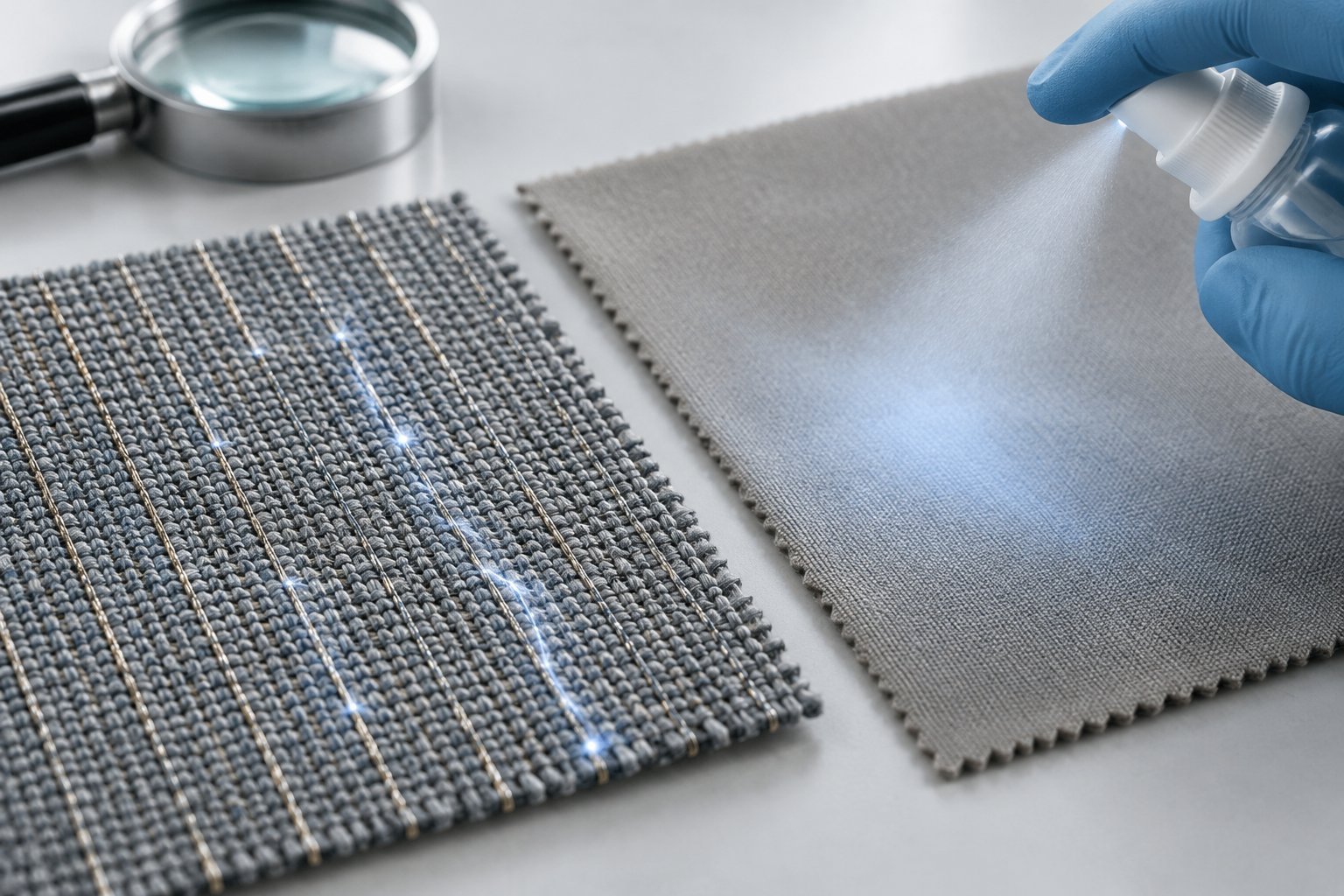
Yarn networks distribute conductive elements within the textile, while surface treatments change how charge moves across fiber surfaces. Their effectiveness follows the material mechanism and the continuity of the resulting structure.
Conductive Fibers Create Distributed Pathways Within the Fabric
Conductive fibers, also spelled conductive fibres, introduce electrically active elements into an otherwise higher-resistance textile. Their arrangement determines directional behavior: yarns placed along one direction produce a different structure from a grid extending across both directions.
Depending on their construction, conductive elements support charge redistribution or field-dependent discharge mechanisms. Grid spacing, yarn continuity, and exposure at the fabric surface influence the result, so the conductive-yarn datasheet alone cannot establish finished-fabric performance.
Antistatic Agents Modify Surface Behavior
Hygroscopic antistatic agents attract moisture and support ionic charge transport along treated surfaces. Their performance follows the availability of absorbed moisture, making low-humidity evaluation important.
Other fabric finishes use conductive particles or polymers to form electrically connected domains. These coatings depend on deposited material and particle contact, giving them a different humidity response from a moisture-mediated treatment.
Carbon Black, Metals, and Conductive Polymers: Different Material Routes
Carbon black incorporated into a polymer fiber creates conductive regions when the formulation and geometry provide connected pathways. Metal fibers and metal-coated yarns offer another route, with performance influenced by mechanical damage and chemical exposure.
Conductive polymers such as PEDOT:PSS and carbon-based materials such as graphene also appear in conductive-textile development. Their names identify material families; industrial-workwear suitability requires evidence covering the complete formulation, processing conditions, and intended care.
Why Fabric Conductivity Does Not Prove Garment Grounding
Grounding requires an effective electrical connection through the intended protective system. An electrical measurement on a swatch describes that specimen under the test arrangement.
Garment continuity, wearer contact, footwear, and flooring require separate assessment where the application depends on grounding. Antistatic workwear also provides no automatic protection against electrical shocks from energized equipment; arc-flash clothing materials require their own hazard-specific evidence.
What Changes Performance During Production and Use?
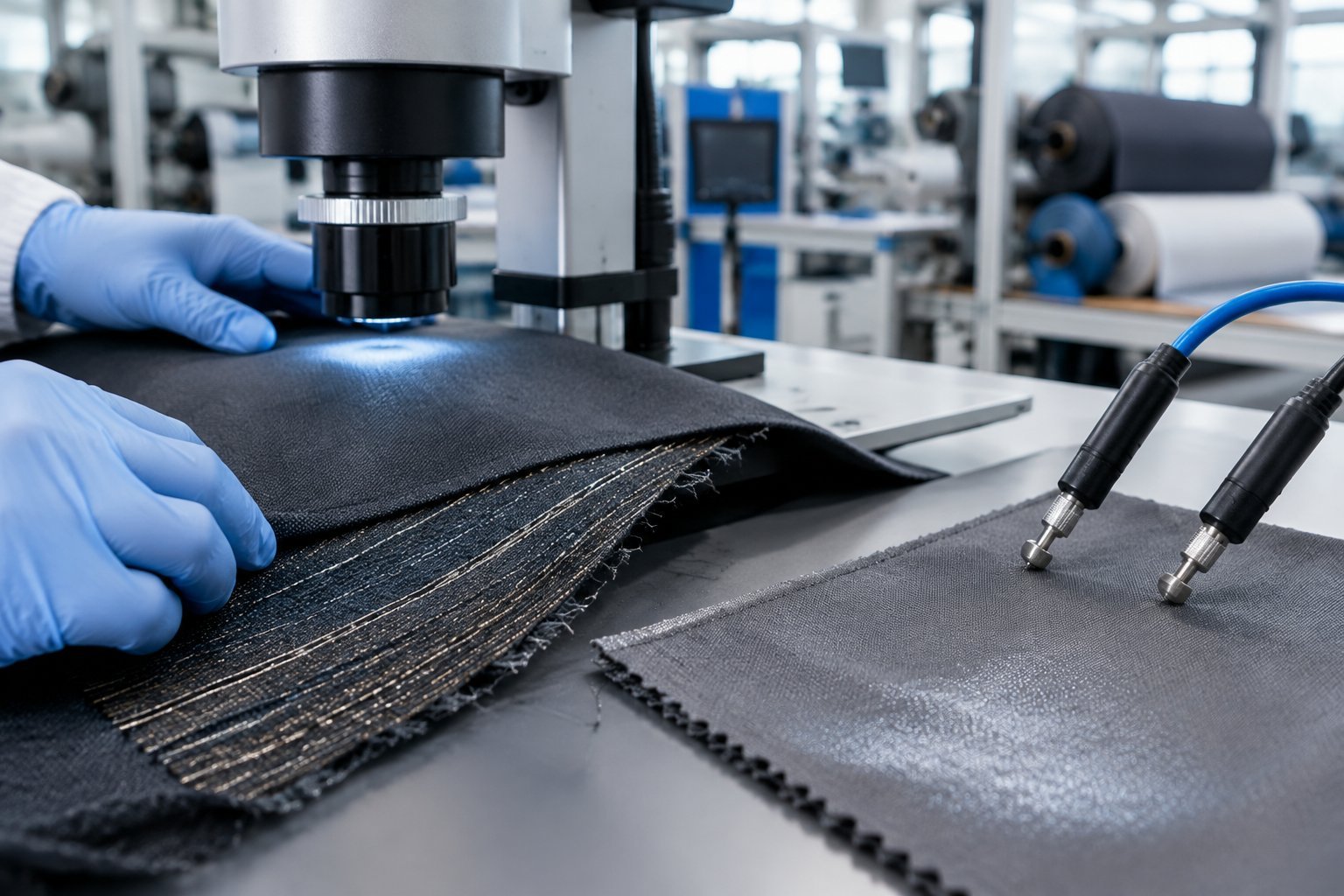
Performance changes when processing or service alters moisture availability, conductive continuity, or the deposited treatment. Protective clothing specifications therefore need electrical acceptance criteria after the intended production and care sequence.
Humidity Sensitivity Depends on the Charge-Dissipation Mechanism
Moisture-mediated finishes lose part of their charge-dissipation capability when the surrounding air provides less moisture. A result obtained after humid conditioning gives limited information about performance in a dry facility.
Conductive yarns and particle-based coatings require their own low-humidity checks because the surrounding fibers and contact geometry also influence measurement. The report should state temperature, relative humidity, and conditioning duration.
Laundering, Abrasion, and Flexing Can Disrupt Either Route
Laundering removes loosely attached agents and exposes treatments to chemical and mechanical stress. Conductive-yarn fabrics face different failure modes, including filament breakage or damage to a conductive coating on the yarn.
Repeated flexing and abrasion deserve attention where the application concentrates wear. The specified FR clothing care process should identify detergent chemistry, drying conditions, and prohibited additives so post-care testing represents the intended service.
Wet Pickup, Binder, and Drying Affect Finish Uniformity
Wet pickup measures the liquid retained by the fabric relative to its dry mass after application. Bath concentration alone leaves the deposited treatment uncertain because fabric absorbency and application settings affect retention.
Binder improves attachment, but excess insulating binder separates conductive particles. Drying migration also creates uneven deposits; sampling across the usable width and along the production lot helps identify high-resistance areas that a central measurement misses.
FR and Repellent Finishes Require Compatibility Checks
The complete finishing package needs evaluation because additional chemistry changes fiber surfaces and contact between conductive elements. Flame-retardant fabric treatment also introduces processing conditions that the conductive component must tolerate.
Levitex offers FR plus water-repellent and FR plus oil-repellent finishing on 100% cotton, cotton/nylon (C/N), and cotton-rich cotton/polyester (CVC) base fabrics. A combined antistatic requirement needs product-specific confirmation, with FR and electrical evidence corresponding to the proposed finished construction.
What Evidence Should Buyers Request?
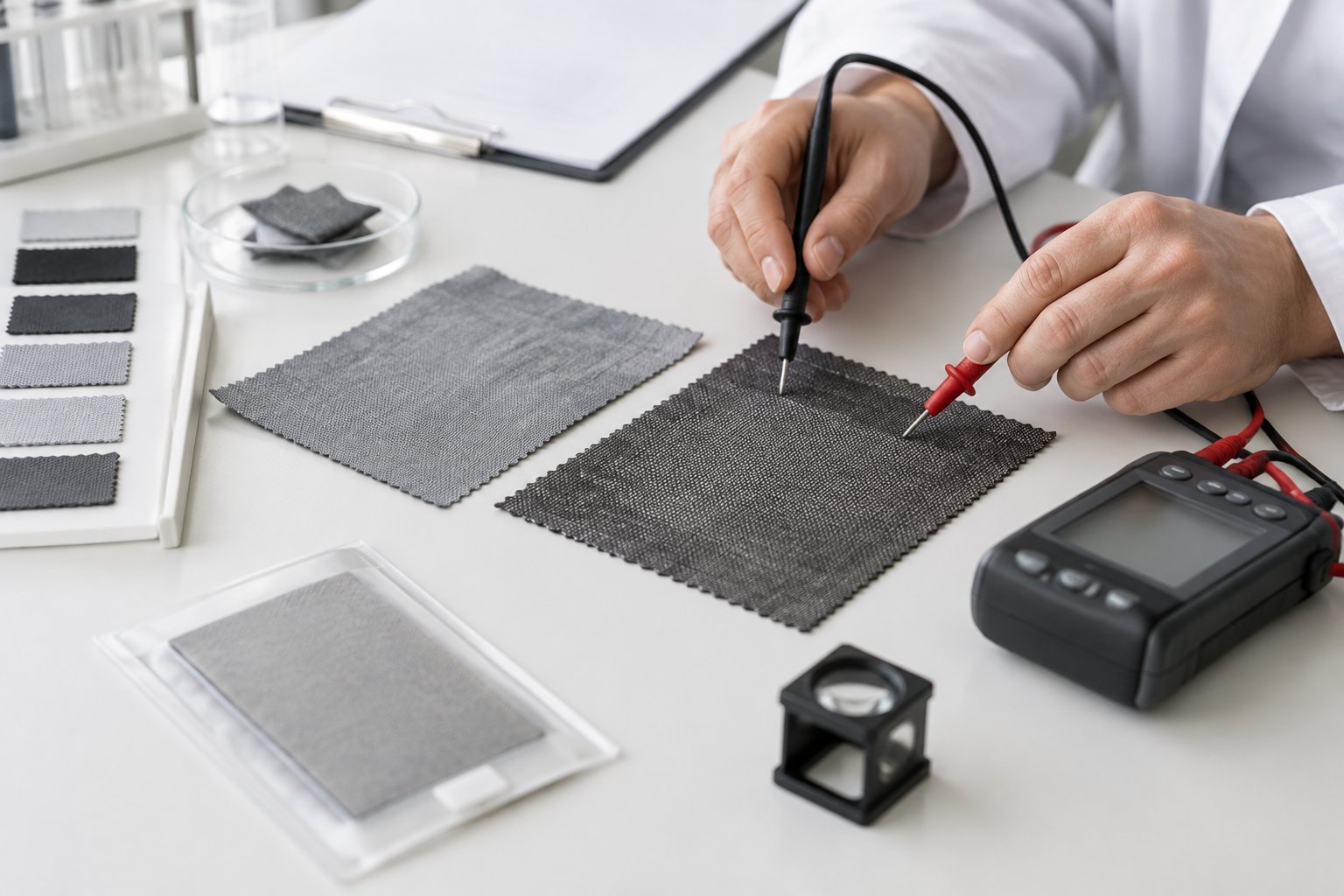
Buyers need traceable electrical reports that identify the specimen, measurement method, conditioning atmosphere, and care history. Comparable evidence uses the same test conditions and reports the relevant measurements without substituting one electrical property for another.
Surface Resistance vs. Surface Resistivity: Read the Measurement Correctly
Electrical resistance describes opposition to current flow between specified electrodes and is reported in ohms (Ω). Surface resistance depends on the electrode arrangement and the path measured across the specimen.
Surface resistivity accounts for electrode geometry through the method’s calculation and is commonly expressed as Ω/square. Reports describing the surface resistivity of fabrics should identify the method and calculation, especially for patterned conductive textiles whose measurements change with electrode placement.
What AATCC TM76 and Static Decay Tests Actually Demonstrate
AATCC TM76 addresses the electrical surface resistivity of fabrics under specified measurement and conditioning conditions. It provides evidence about that electrical property; it leaves charge-generation behavior and assembled-system grounding for separate evaluation.
Static decay tests measure the reduction of an applied or induced charge under a defined procedure. Charge decay half-life describes the time needed for the measured charge-related signal to fall to half its initial value; the charging method and endpoint must accompany the result.
Compare Conditioned, Dry-Humidity, and Post-Care Results
An effective evidence package includes initial results and results after the specified care sequence. Dry-humidity measurements should reflect the operating environment while following the agreed test procedure.
Both yarn directions deserve evaluation when the construction is directional. As part of FR fabric quality control, the report package should identify sampling locations and retain individual results so local variation remains visible.
EN 1149 in Brief: Material Evidence vs. Garment Requirements
The EN 1149 series addresses electrostatic properties through material test methods and requirements for electrostatic-dissipative protective clothing. Material evidence supports fabric selection; garment design and use requirements belong to the assembled protective system.
For US purchasing, an EN 1149 claim should appear in the customer specification only where the application or contract requires it. FR performance also needs separate evidence, including the relevant flame-retardant fabric testing for the intended hazard.
How to Specify an Antistatic FR Fabric With Levitex
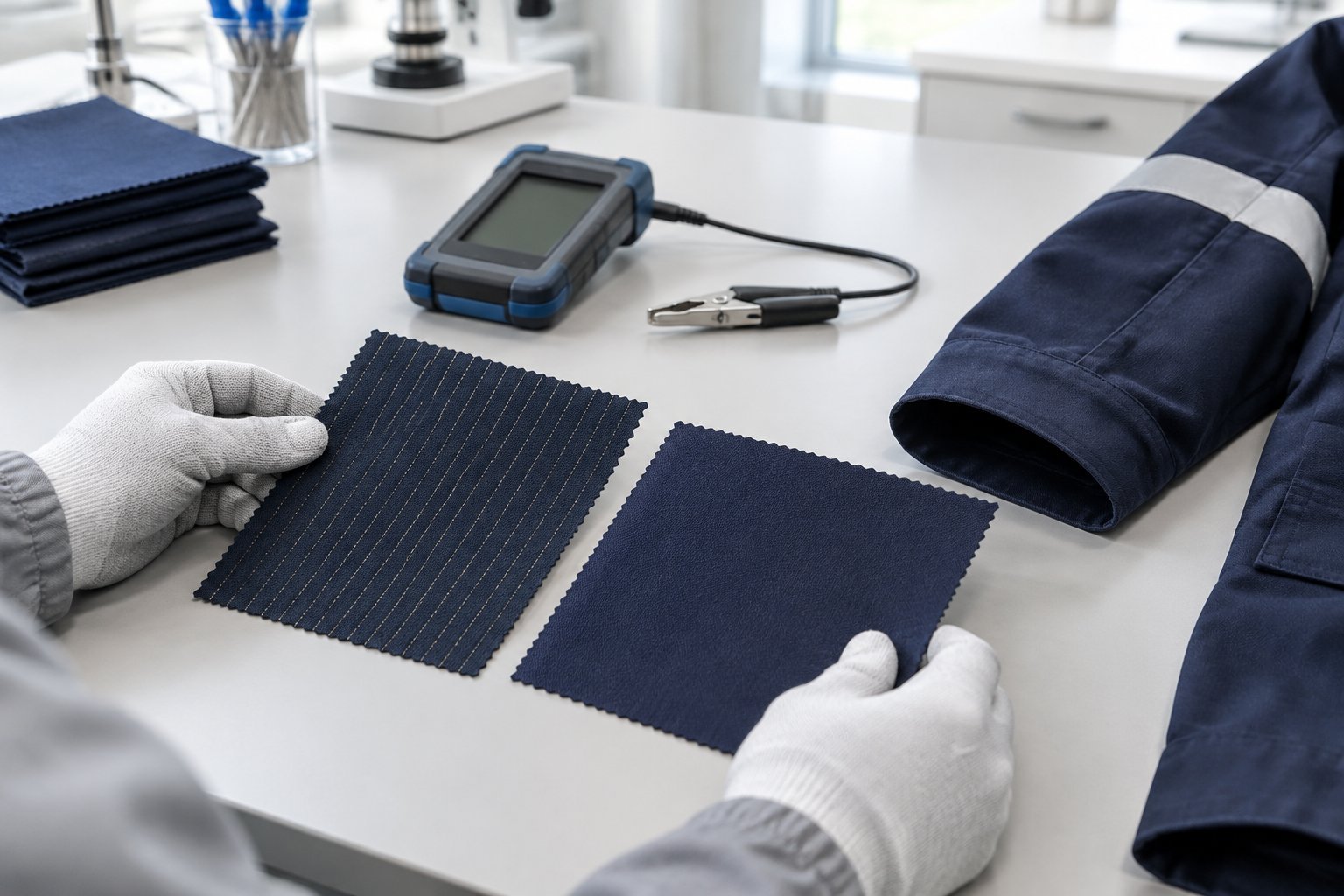
A useful Levitex inquiry defines the required finished-fabric performance and the conditions under which it must remain effective. Levitex supplies textile materials for protective workwear; garment design, assembly, and garment-level assessment remain outside its offering.
Define the Hazard, Operating Conditions, and Intended Care
The application description should identify the electrostatic hazard and any separate thermal exposure. Flammable atmospheres and electronics-sensitive production create different static-control objectives.
Operating details should include the expected humidity range and contamination exposure. Care details should describe washing chemistry, drying, and any re-treatment process, with the required reports identified before sampling begins.
Confirm the Cotton, C/N, or CVC Base and Conductive Construction
Levitex manufactures FR fabrics in three principal composition families: 100% cotton, cotton/nylon (C/N), and cotton-rich cotton/polyester (CVC). These families are available as woven fabrics and can also be produced as knitted constructions.
The selected cotton/nylon blend properties or other base-fabric characteristics should match the mechanical and comfort requirements. Conductive yarn addition requires an agreed final composition and construction specification, including yarn identity and placement where applicable.
Buyer Specification Checklist: Performance, Sampling, and Acceptance
The purchasing specification should turn each requirement into a measurable acceptance item. Terms such as “durable antistatic” need a defined method and care condition before they support approval.
- Application: Industrial task, identified hazard, destination market, and applicable customer requirements.
- Base fabric: Final composition, woven or knitted construction, finished weight, width, and agreed tolerances.
- Static-control route: Conductive yarn identity and arrangement, or the proposed antistatic treatment mechanism.
- Electrical acceptance: Test method, measurement property, limits, electrode arrangement, and directional testing.
- Conditioning: Temperature, relative humidity, conditioning duration, and any required dry-condition evaluation.
- Care protocol: Washing and drying procedure, specified care sequence, permitted additives, and re-treatment rules.
- FR compatibility: Required thermal tests covering the finished fabric and combined treatment package.
- Sampling: Across-width and lot sampling locations, sample quantity, and retained reference specimens.
- Bulk acceptance: Report traceability, allowable variation, change-control requirements, and procedures for nonconforming material.
Commercial sampling should also distinguish a representative appearance swatch from a sample intended for technical testing. The latter needs enough material for the complete agreed test program.
Request Product-Specific Evidence Before Approving Bulk Fabric
Levitex’s antistatic fabric offering provides a starting point for product discussions. Any required arc performance needs a dedicated product-specific report; a catalogue label or address establishes no arc rating.
Levitex provides a test report for each product. Bulk approval should follow review of the relevant methods and report scope, with the tested specimen matched to the proposed fabric and finishing package.
Textile buyers seeking a quotation should send the application, FR and antistatic requirements, care process, and required reports to Charlie@levitex.com. That information supports a focused discussion of suitable textile constructions and the evidence needed for approval.
Choose the Route Your Conditions and Evidence Support
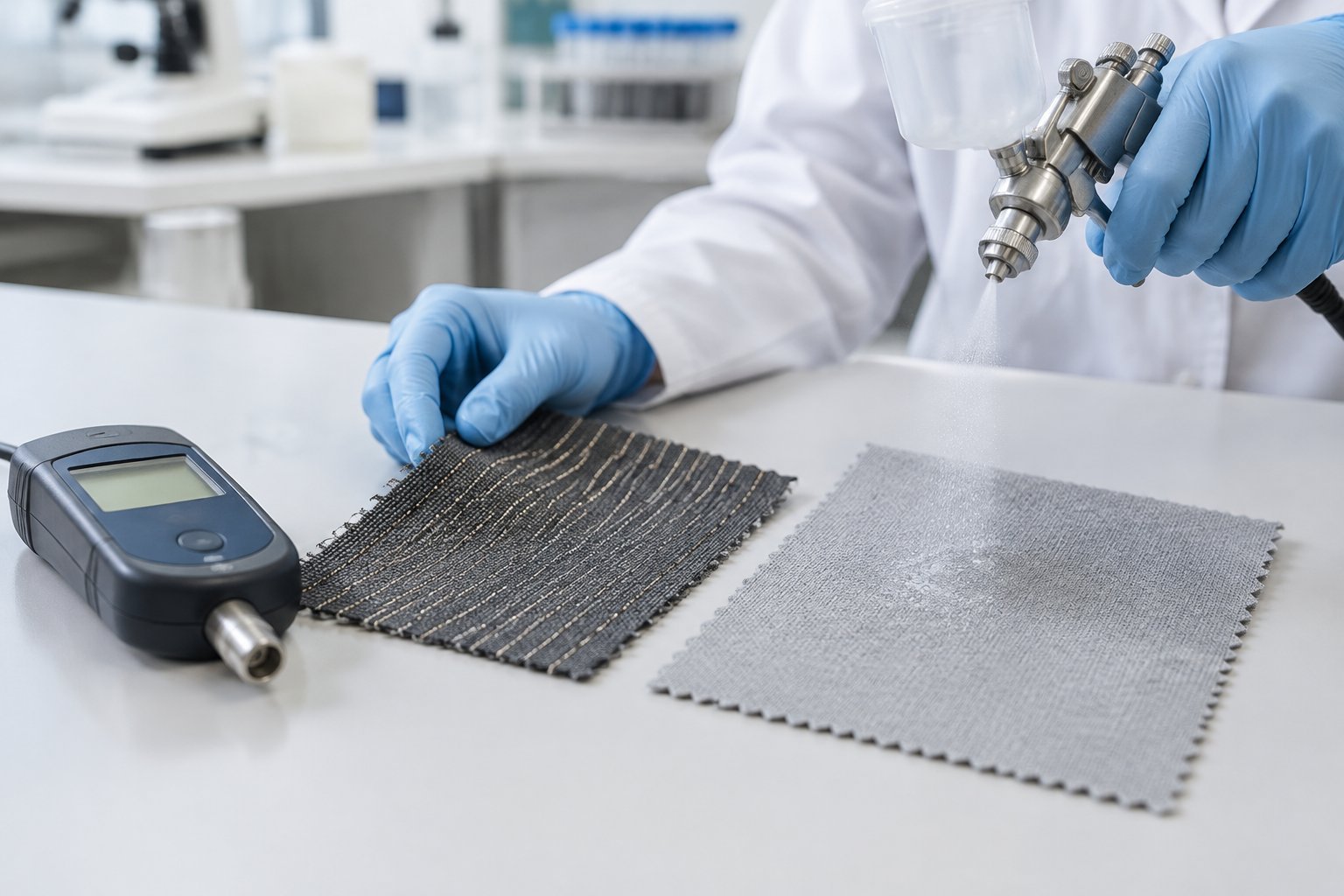
Conductive-yarn grids provide an integrated starting point for demanding protective workwear, while topical treatments remain valid candidates when their documented performance matches the application. Humidity and care results determine whether either route meets the purchasing requirement.
Static control belongs within the complete protective-workwear specification. Fabric approval should require matching electrical and FR reports for the proposed construction, followed by the applicable garment-level assessment.
Frequently Asked Questions
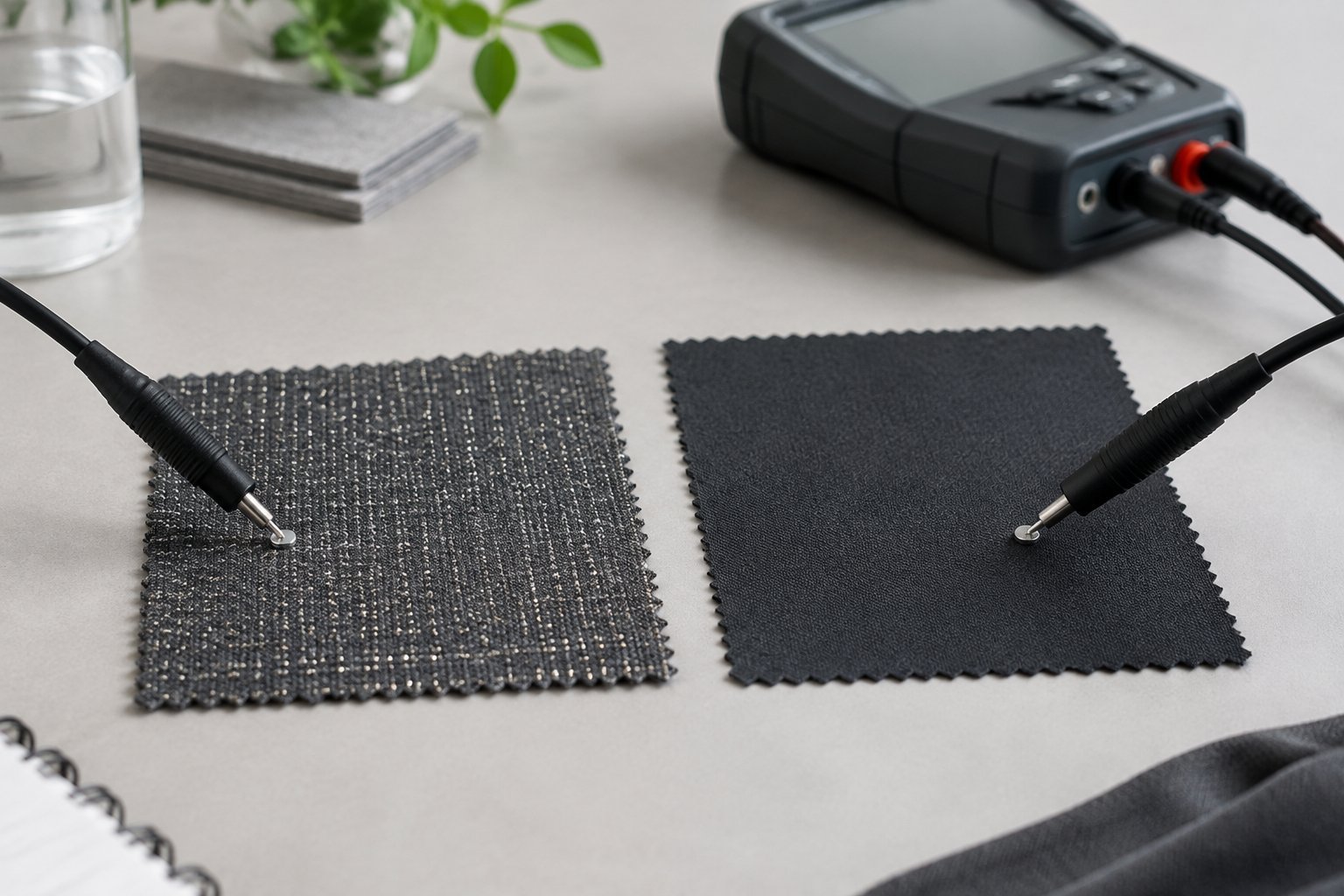
Purchasing decisions require clear definitions of the material’s electrical role and evidence tied to its intended use. The following distinctions help prevent broad product labels from becoming unsupported specifications.
Is anti-static the same as conductive?
Antistatic and conductive describe different properties, with overlap in textiles designed to dissipate charge. An antistatic claim needs a defined performance criterion, while conductivity describes charge transport through the material under stated measurement conditions.
What is an antistatic finish in textiles?
An antistatic finish is an applied treatment that helps limit electrostatic charge accumulation on textile surfaces. Its mechanism might involve moisture-assisted ionic transport or a connected conductive coating, each requiring its own humidity and care evidence.
Can an antistatic finish replace conductive yarn in FR workwear fabric?
A topical finish is a valid substitute when the finished FR fabric meets the specified electrical requirements throughout the agreed care sequence. Substitution also requires confirmation that the changed finishing package preserves the required FR performance.
Does conductive yarn retain performance after repeated industrial washing?
Conductive yarn supports durable static control when its material and construction withstand the specified industrial-care process. Post-care testing of the finished fabric establishes retention, including any effects from yarn damage or treatment changes.
Are ESD fabrics and antistatic protective-workwear fabrics interchangeable?
ESD fabrics and antistatic protective-workwear fabrics require separate application-specific assessment before substitution. Electronics-control evidence alone leaves thermal protection and hazardous-atmosphere suitability unresolved, so approval requires the reports specified for the intended industrial use.