
For industrial workwear, you use flame retardant fabrics made from inherently flame-resistant fibers or durably treated textiles to limit continued burning under specified test conditions. You select treated cotton, cotton-rich blends, aramids, or modacrylic blends by matching documented performance to your workplace hazards. Each material offers useful properties, but no single fabric provides the best protection for every exposure.
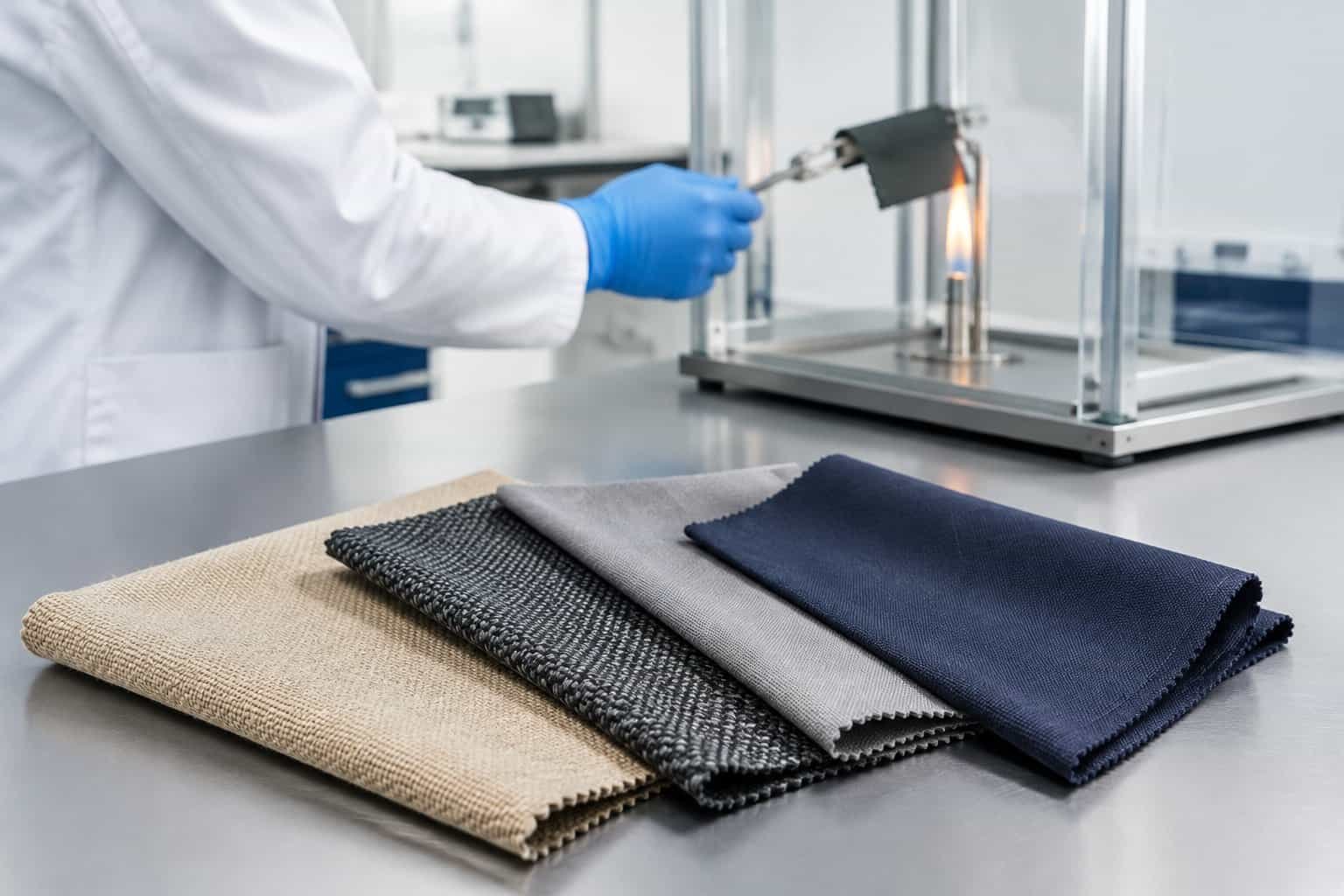
Your purchasing specification needs to connect the textile to the finished garment. Fiber content and fabric weight help you shortlist materials; hazard-specific test reports establish the protection you are buying. That distinction helps you avoid approving a comfortable sample whose supporting paperwork covers a different construction or finish.
How Do Inherent and Treated FR Fabrics Differ?
You distinguish inherent and treated FR fabrics by where their flame-resistant properties originate: within the manufactured fiber or through a treatment applied to the textile. Either route requires evidence that your chosen fabric meets its intended workwear requirements.
Inherent Flame Resistance in Engineered Fibers
With inherent FR materials, you obtain flame resistance from the fiber’s chemical structure or from components incorporated during fiber manufacture. Your options include aramid fibers and modacrylic fibers, which belong to different polymer families.
You should treat “inherent” as a description of the material technology. It does not establish an arc rating, a molten-metal splash classification, or an unlimited service life. Wear, contamination, and changes in garment condition still affect your protective clothing program.
For procurement, you need the full blend composition. An inherently flame-resistant component within a blend does not establish the performance of every other fiber or of the completed textile.
Flame-Retardant Treatments for Cotton and Cotton-Rich Fabrics
When you specify flame-retardant-treated fabric, you start with a base textile whose burning behavior is modified through finishing. Durable treatments for cotton promote char formation and reduce the release of combustible decomposition products.
Your ordinary untreated cotton remains combustible. You obtain flame-retardant performance from cotton fabric through an appropriate treatment supported by testing.
For washable industrial workwear, specify a durable treatment and documented performance after the required laundering procedure. A temporary treatment intended for decorative textiles gives you insufficient evidence for repeated workwear use.
How Do Common Industrial FR Materials Compare?
You gain different combinations of comfort, mechanical strength, and thermal behavior from each FR material family. Compare the exact constructions offered for your application, because the family name alone leaves important performance differences unresolved.
Treated Cotton and Cotton-Rich FR Blends
Treated cotton gives you a familiar hand feel and moisture absorbency for everyday industrial clothing. Your comfort assessment should also include drying behavior, garment fit, and the effect of perspiration during physical work.
Cotton-rich FR blends introduce other fibers to adjust properties such as abrasion resistance or dimensional stability. A cotton/nylon blend and a cotton/polyester blend require separate evaluation, even when their cotton content is similar.
Ask for performance results covering the specified blend ratio and finished construction. You should also assess tear strength after laundering, since a garment needs sufficient mechanical integrity throughout its service period.
Meta-Aramid and Para-Aramid Fibers
You encounter meta-aramid and para-aramid as distinct members of the aramid family. Meta-aramid contributes thermal stability and flame resistance, while para-aramid contributes high tensile strength and reinforcement.
In protective textiles, you will encounter these fibers in blends designed to balance thermal and mechanical requirements. Your specification should identify the proportions and any additional fibers.
You still need application-specific evidence for an aramid fabric. Its fiber chemistry does not establish the protection level of your garment assembly, and your durability review should address abrasion and ultraviolet exposure where relevant.
Modacrylic Blends and Their Performance Tradeoffs
With modacrylic blends, you obtain flame-resistant fiber technology combined with companion fibers selected for wearability or mechanical performance. You will encounter modacrylic blended with cotton, FR cellulosic fibers, or aramids.
Modacrylic is chemically distinct from aramid. You should evaluate its blend composition and heat-response results separately, including shrinkage and melting or dripping behavior under the applicable test conditions.
Your choice between treated cotton and modacrylic requires a documented comparison at the garment’s intended weight and use conditions. Neither material family earns a universal preference across all industrial hazards.
Comparison Table: Composition, Comfort, Durability, and Limitations
You can use this table to organize your shortlist before requesting samples and reports. Treat each entry as a material characteristic to investigate, with approval based on the exact textile.
| Selection criterion | Treated cotton | Cotton-rich FR blends | Aramid fabrics | Modacrylic blends |
|---|---|---|---|---|
| Composition to verify | Cotton plus durable FR treatment | Cotton, companion fibers, FR treatment | Meta-/para-aramid proportions; other fibers | Modacrylic proportion; companion fibers |
| Comfort to assess | Absorbency; drying time | Hand feel; moisture behavior | Fabric construction; stiffness | Softness; moisture behavior |
| Durability to assess | Wash retention; tear strength | Abrasion; shrinkage; wash retention | Abrasion; UV exposure | Pilling; abrasion; dimensional change |
| Principal limitation | Treatment and care requirements | Blend-specific thermal behavior | Assembly-specific protection | Blend-specific heat response |
When comparing arc-flash clothing materials, add their documented arc ratings to your evaluation. You cannot derive that rating from this material comparison.
Which Tested Performance Matches Your Workplace Hazards?
Your hazard assessment determines which performance evidence you need for flame, welding, electric arc, or splash exposure. Keep separate requirements for each hazard when your workwear must address several risks.
Flame and Heat Exposure
For flame and heat hazards, you need evidence covering the relevant exposure mechanism. Limited flame spread, radiant heat, and contact heat describe different challenges for your clothing.
For US industrial flash-fire applications, you should evaluate finished-garment certification to NFPA 2112 where your safety program requires it. Your supporting documentation must distinguish material test results from certification of the garment.
You might also encounter ISO 11612 requirements in international purchasing specifications. Check the particular performance classifications requested, because a broad reference to heat-and-flame protection leaves the required exposure levels unclear.
Welding Sparks and Spatter
For welding, your selection needs to account for the process, working position, and expected spatter exposure. Garment design also affects whether hot particles lodge in cuffs or pockets.
You should evaluate ISO 11611 classifications and relevant test results when that standard forms part of your specification. Your evidence needs to cover the intended welding conditions and the finished clothing requirements.
When reviewing materials unsuitable for welding clothing, include ordinary melt-prone synthetics in your assessment. Approve a protective blend through its documented behavior under the required tests.
Electric Arc Exposure
For electrical work, you need arc-rated clothing selected through your electrical safety assessment. An FR designation by itself supplies no arc rating.
You use ASTM F1506 when specifying relevant protective textile and clothing requirements. ASTM F1506 covers textile materials for occupational apparel exposed to momentary electric arc and related thermal hazards.
Ask for the arc rating expressed in cal/cm² and the applicable test documentation, such as ASTM F1959 results. Your arc-flash PPE selection should follow the applicable NFPA 70E selection method, including its conditions and limitations.
Molten-Metal Splash and Chemical Splash Require Different Evidence
For molten-metal work, you need results relevant to the metal involved and the expected splash conditions. A result for one metal does not establish equivalent performance against another.
For chemical splash, you need evidence tied to the chemical, its concentration, and the expected contact duration. Distinguish liquid repellency and penetration resistance from resistance to chemical permeation through a material.
With Levitex’s chemical-repellent textiles, you are evaluating post-treatment finishing on cotton, cotton/nylon (C/N), or cotton/polyester (CVC) base fabrics. Specify these as chemical-repellent fabrics; barrier-based chemical-resistant clothing requires different protective evidence.
What Should Buyers Verify Before Ordering?
Before ordering, you should approve a traceable specification that connects the exact fabric to its test reports and intended garment. Your purchase documents should also establish how substitutions and production changes will be controlled.
Fiber Composition, Fabric Weight, and Working Conditions
Record your complete fiber composition, blend percentages, finished fabric weight, construction, and usable width. State weight units clearly, especially when your US specifications use oz/yd² and your supplier works in g/m².
Connect those details to the working environment. Include physical exertion, ambient heat, outdoor exposure, abrasion, and the other PPE worn with the garment.
Your sample review should consider mobility and coverage in working positions. Extra fabric weight does not establish a higher protection level without the corresponding test results.
Exact Fabric Test Reports and Applicable Standards
Your report review should begin with sample identification. Match the fabric code, composition, weight, construction, finish, and conditioning procedure to the material you intend to order.
When you verify flame-retardant properties in fabrics, separate test methods from performance specifications. ASTM D6413 measures vertical flame behavior, including afterflame, afterglow, and char length; the method alone does not certify a garment for flash-fire or arc exposure.
Ask for:
- The test method and edition used.
- The relevant acceptance criteria and measured results.
- Laundering or other conditioning completed before testing.
- Laboratory identification and report number.
- A clear connection between the tested sample and your ordered article.
You should also distinguish protective-performance documents from chemical-safety or management-system credentials. Each document addresses its own scope.
Laundering Durability and Care Instructions
You need laundering evidence that reflects your planned care process. Home washing and industrial laundering use different conditions, so a report covering one procedure leaves the other unproven.
Request the wash method, completed cycle count, drying procedure, and post-laundering results. Add dimensional stability and strength retention to your review when garment fit and durability are procurement requirements.
Your instructions for laundering flame-retardant fabric should follow the manufacturer’s approved care label. Confirm restrictions on bleach, softeners, and other laundry additives before placing the garments into service.
Garment Construction and Finished-Garment Requirements
Your fabric approval is one part of finished-garment qualification. Sewing thread, closures, pocket design, and reflective trim also require appropriate selection.
Evaluate coverage during bending and reaching, including the interfaces between jackets, trousers, gloves, and other PPE. Where you specify a flame-resistant lining fabric, confirm how it performs within the intended assembly.
For layered arc-rated systems, request evidence for the tested combination. Adding individual layer ratings does not establish your system’s arc rating.
Custom Dyeing, Printing, and Functional Finishes
You should include the final shade, print, and functional finishes in your approval process. A report for an unfinished base cloth leaves subsequent processing outside its documented scope.
Your FR fabric finishing specification should identify any additional properties you require, such as antistatic performance or liquid repellency. Ask how the finished article will be checked for compatibility with the required protective performance.
For a custom textile program, you can discuss wholesale FR fabrics, custom dyeing, custom printing, and customized production with Levitex. Include sample approval and the agreed testing plan before authorizing bulk production.
Start With a Hazard-Matched Textile Specification
Your strongest purchasing specification links the workplace exposure to documented textile performance and finished-garment requirements. Use composition and weight to define the article, then confirm its test evidence and laundering conditions before approval.
For your FR fabric manufacturing inquiry, send your application, composition, fabric weight, and required test standards to Charlie@levitex.com for a fabric discussion. Include your intended garment and care process so the discussion addresses the conditions your workwear must meet.
Frequently Asked Questions
You can resolve common purchasing questions by checking the exact fabric’s documented performance and intended use.
What kind of fabric is flame retardant?
You can specify inherently flame-resistant textiles, including aramid and modacrylic blends, or fabrics made flame-retardant through durable treatment. Your workwear selection should identify the full composition and the tests demonstrating suitability for its intended hazard.
Is any fabric 100% fireproof?
You should treat every workwear fabric as having defined exposure limits. Even a fabric that resists burning transfers heat, and your protection depends on the exposure duration and garment assembly.
Is treated FR cotton better than modacrylic blends?
You should choose treated FR cotton when its documented performance and wear characteristics meet your specification; modacrylic blends offer another route with different composition-specific tradeoffs. Compare the exact options for comfort, thermal behavior, laundering durability, and required hazard ratings.
Can flame-retardant workwear fabric provide electric arc protection?
You can obtain electric arc protection from an FR textile with a documented arc rating suitable for your assessed exposure. Require the applicable test results and finished-clothing documentation before approving it for electrical work.
Can flame-retardant fabrics be washed?
You can wash washable FR workwear using its approved care instructions. Verify that the supporting performance evidence covers your laundering procedure and required service conditions.
Can I order custom flame-retardant fabric in rolls?
You can discuss custom roll-fabric production with Levitex, including dyeing and printing requirements. Provide your composition, weight, usable width, application, and required test standards so the proposed specification can be reviewed.