UPF fabric testing measures ultraviolet transmission through a textile and calculates its sun-protection performance under defined laboratory conditions, commonly using AATCC TM183 for U.S. procurement. Industrial buyers need a report that identifies the finished fabric and connects the result to its tested condition.

Levitex manufactures flame-resistant textiles for industrial protective workwear. For buyers selecting workwear fabrics, textile UV protection adds a separate evidence requirement: the proposed cloth needs UV testing alongside any required flame-resistance evaluation.
A credible sun protection claim starts with production-representative samples. A result from an unfinished swatch or a different color provides limited support for the fabric delivered against a purchase order.
What Does a UPF Result Actually Prove?
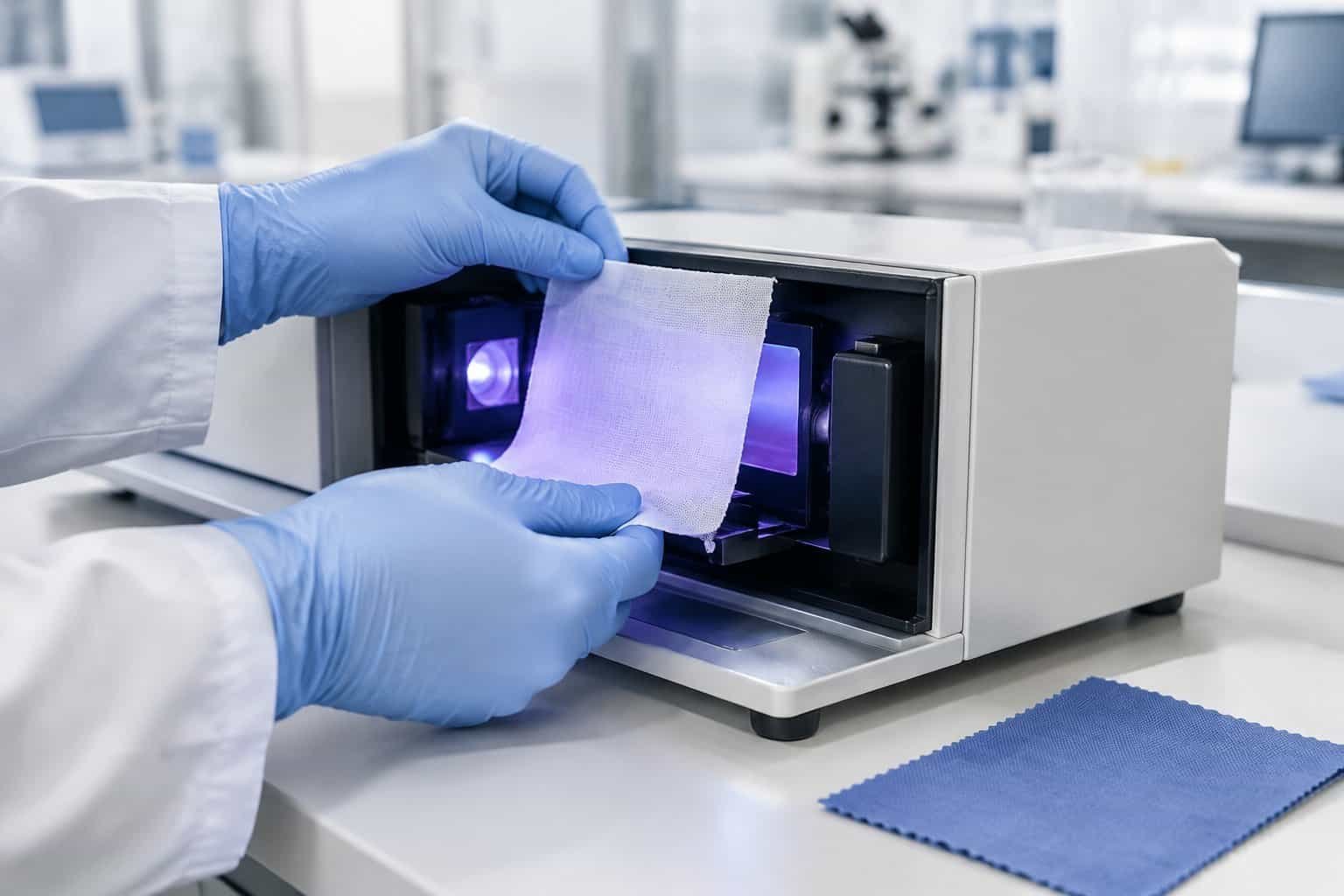
A UPF result establishes the tested textile’s resistance to erythemally weighted solar ultraviolet transmission under the report’s stated conditions. Its scope follows the sample identity and preparation procedure.
How UPF Measures Erythemally Weighted UV Transmission
Ultraviolet protection factor (UPF) compares skin-reddening-effective UV radiation incident on fabric with the amount transmitted through it. The UPF calculation weights measured transmission by the solar spectrum and the erythemal action spectrum, which describes wavelength-dependent sunburn effectiveness.
In simplified form:
UPF = weighted incident UV ÷ weighted transmitted UV
Testing covers the solar UVA and UVB region specified by the method. Because the weighting varies with wavelength, UPF differs from a simple average percentage of all ultraviolet radiation transmitted. Separate UVA and UVB transmission results provide additional detail.
What Do UPF 30 and UPF 50+ Mean?
UPF 30 corresponds to approximately 1/30, or 3.3%, transmission of erythemally weighted solar UV. UPF 50 corresponds to 2% transmission. A UPF 50+ label requires the result to satisfy the applicable classification and labeling rules.
The assigned upf rating also reflects the standard’s treatment of specimen variability and rounding. A high individual measurement alone provides insufficient grounds for assigning a label.
Reducing UV exposure supports protection against sunburn and cumulative skin damage associated with skin cancer. A fabric rating applies to covered areas under tested conditions; it does not establish a universally safe exposure duration.
Why Solar UV Results Do Not Establish Flame Resistance or Welding Protection
Solar UPF testing evaluates optical transmission. Flame-resistance testing evaluates behavior during specified thermal or flame exposures, using separate methods and acceptance criteria.
Welding introduces artificial radiation with a different spectrum and exposure intensity, alongside sparks and heat. UVC from artificial sources also falls outside the ordinary solar-protection claim. Atmospheric absorption removes solar UVC before it reaches ground level.
Likewise, arc-flash clothing materials require hazard-specific evidence. A UPF report supplies no arc rating or welding-protection classification.
How Do Laboratories Measure and Classify UV Protection?

Laboratories measure wavelength-by-wavelength UV transmission, calculate UPF, and apply the requested classification rules. Measurement, sample preparation, and labeling each require an identified standard and edition.
How a Spectrophotometer Measures Fabric Transmission
A spectrophotometer directs UV radiation through the specimen and measures the transmitted signal across the specified wavelength range. Suitable systems use an integrating sphere to collect diffuse transmission from the textile.
Instrument calibration establishes the wavelength and transmission scales. The laboratory measures multiple specimens or positions as required by the method, with orientation controlled during testing.
Local variation deserves attention. An open stripe or lightly printed area produces a different measurement from a densely covered region, so sample placement must represent the fabric’s least-protective relevant areas.
Which Standards Govern Measurement, Classification, and Labeling?
For U.S. orders, AATCC Test Method 183, also written AATCC TM183, measures transmittance or blocking of erythemally weighted ultraviolet radiation through fabrics. ASTM D6603, published by ASTM International, addresses labeling of UV-protective textiles. ASTM D6544 addresses preparation procedures used before UV transmission testing.
International specifications also reference:
- AS/NZS 4399: Evaluation and classification of sun protective clothing; contracts should identify the applicable national adoption and edition.
- EN 13758-1: Measurement of solar UV protective properties of apparel fabrics.
- BS EN 13758-1: The British adoption of that test method.
Garment-level requirements belong to the relevant clothing evaluation framework. A fabric measurement alone does not establish finished-garment compliance.
How Should Finished-Fabric Samples Be Selected and Conditioned?
Samples should represent the cloth after production processing, including dyeing and the complete finishing sequence. Fabric finishes alter the material presented to the instrument, so a greige sample cannot represent a subsequently treated product.
The sampling plan should identify the production lot, roll references, and sampling positions. Different constructions, colors, or printed regions need appropriate representation.
Conditioning brings specimens to the atmosphere prescribed by the method before measurement. Buyers should obtain the laboratory’s submission requirements in advance, including sample dimensions and any instructions for retaining enough material for repeat or conditioned testing.
When Should Wet, Stretched, or Laundered Samples Be Tested?
Use-condition testing belongs in the purchase specification when workwear encounters moisture, extension, or repeated cleaning. A dry, relaxed measurement supports that stated condition; additional conditions require their own preparation and results.
The laboratory brief should define the wetting procedure, imposed extension, laundering protocol, and test stage. Requirements for industrial washing should match the intended care process.
Cleaning also changes textile geometry. Fabric shrinkage increases cover in some constructions, while finish loss or damage reduces protection in others. Results should identify the tested state without assuming a fixed direction of change.
Which Fabric Variables Can Change the Result?
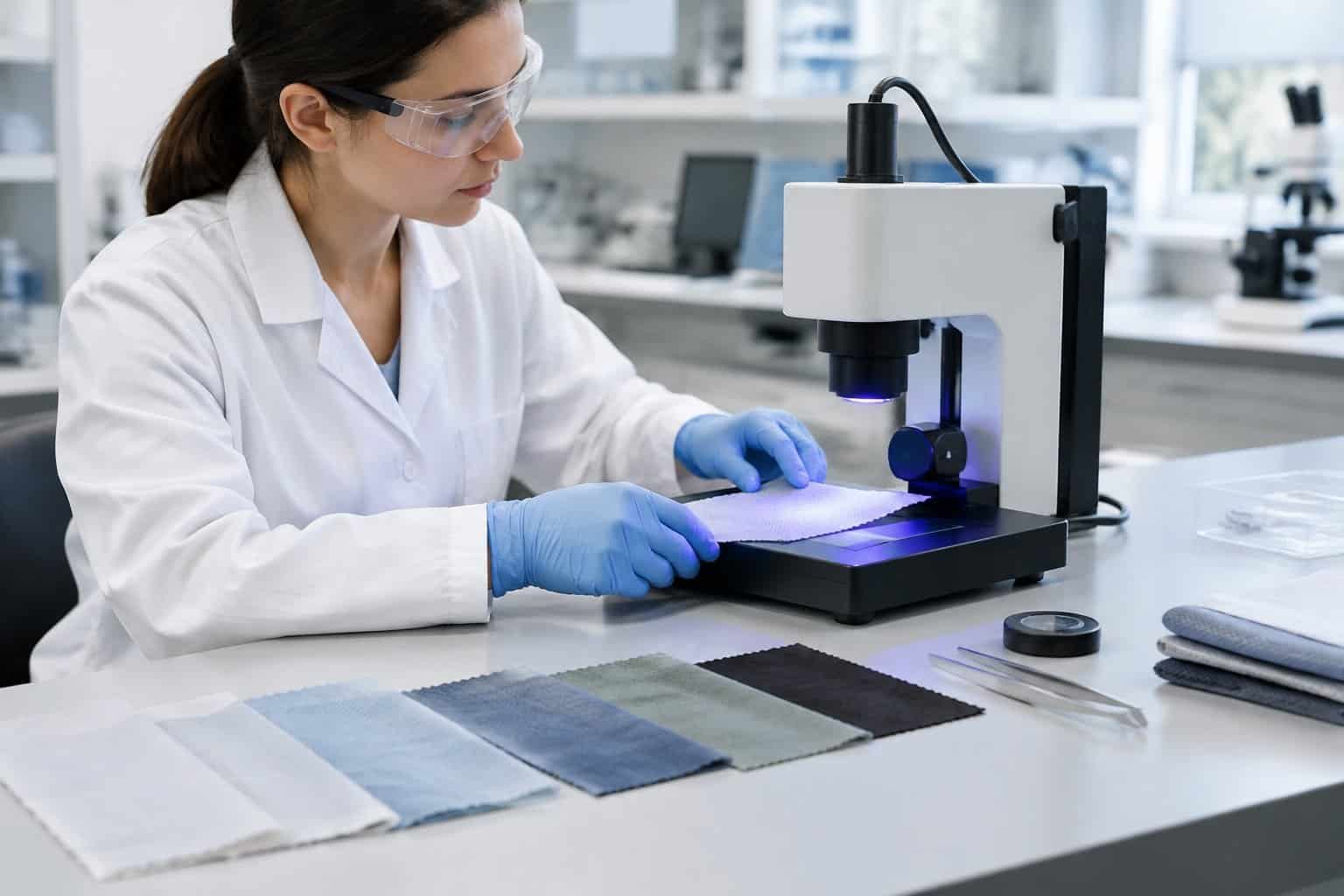
Fabric geometry and UV absorption together determine transmission. Composition, color, and processing provide useful development variables, but each finished specification needs supporting measurements.
How Cover Factor and Woven or Knitted Construction Affect Transmission
Cover factor describes how fully yarns cover the fabric area. Smaller open spaces reduce direct pathways for UV radiation, while yarn properties determine how much radiation passes through the covered portion.
Woven fabrics derive their geometry from yarn size, weave, and thread density. Knitted fabrics depend on loop structure and stitch density, with dimensions changing under tension.
Construction names alone provide limited evidence. Two fabrics described as twill or jersey still differ in openness, thickness, and dimensional stability. Procurement specifications should capture measurable construction details alongside the material description.
Why Composition and Weight Cannot Guarantee a Rating
Polyester, nylon, and cotton differ in UV absorption, but the finished fabric’s transmission also reflects its geometry and processing. No fiber name establishes a UPF rating.
Weight measures mass per unit area. It does not describe the distribution of that mass or the size of openings between yarns. A heavier, open structure therefore needs the same evidence-based evaluation as a lighter, compact cloth.
The chemical properties of cotton fabric help explain its response to processing. They supply material-selection context without establishing a tested UV classification.
How Fabric Color, Optical Brighteners, and Finishing Affect Measurements
Dyes absorb radiation according to their chemistry and concentration. Darker shades frequently absorb more UV, but visible color depth supplies no reliable numerical UPF prediction.
Optical brighteners absorb UV and emit visible light. Their fluorescence requires suitable instrument procedures because it influences spectral measurement. A laboratory should know whether the sample contains fluorescent dyes or brighteners.
UV absorbers and other finishing ingredients also change transmission. For multifunctional workwear, water-repellent FR finishing belongs within the final tested specification, together with every other production treatment.
Why Stretch, Wetness, and Wear Need Separate Verification
Stretch changes yarn spacing and opens knitted loops. The test extension should represent the intended service condition and remain documented so results from different specimens are comparable.
Water changes the optical interaction between fibers and their surroundings. Its effect varies with the textile, so a dry measurement supplies insufficient evidence for wet-state performance.
Abrasion and weathering introduce further changes through thinning, fading, or fiber damage. A claim for UPF 50+ fabric throughout service needs an agreed durability evaluation, with exposure procedures defined before testing.
What Evidence Should Industrial Fabric Buyers Request?
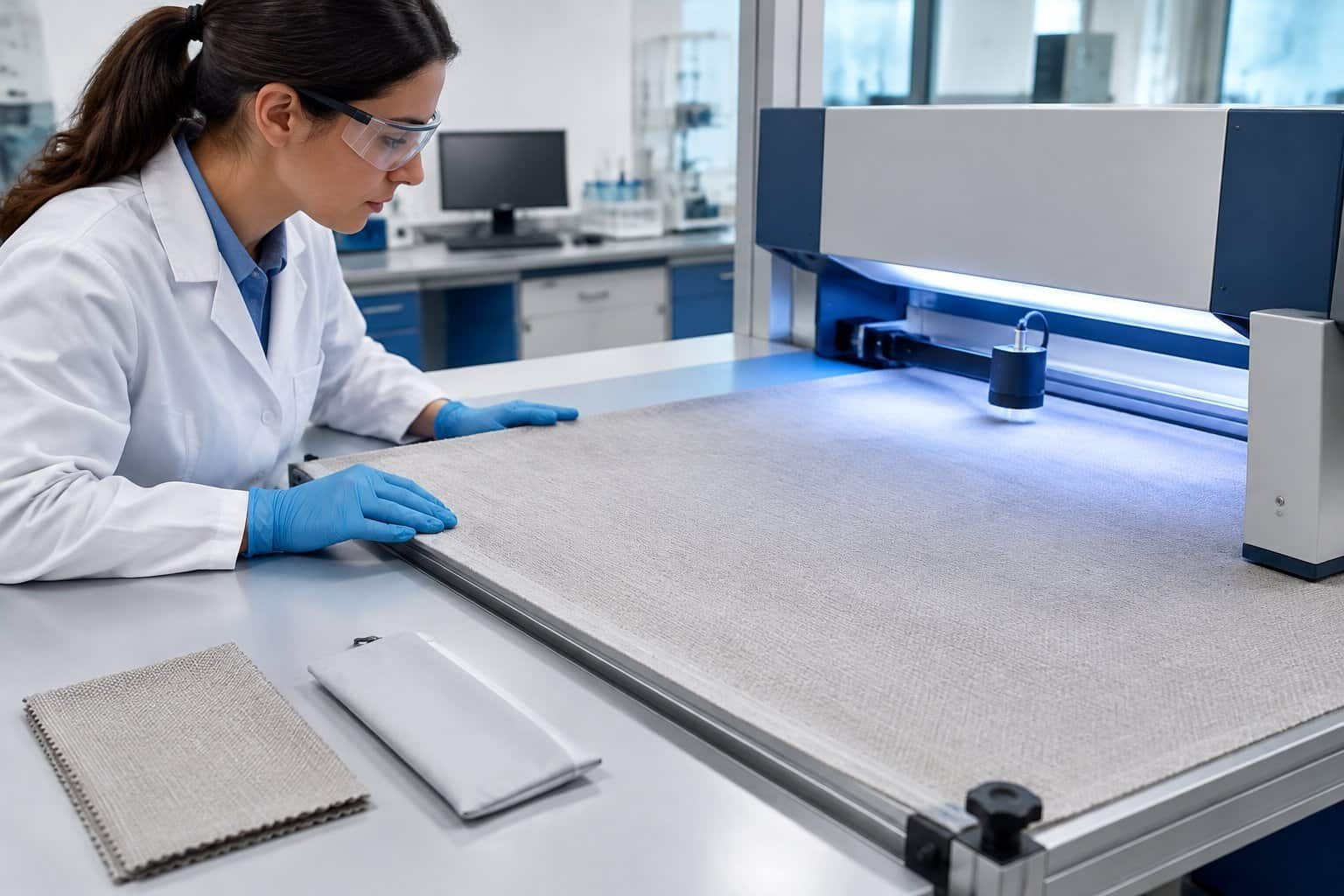
Industrial buyers should request traceable reports for the finished specification and a written plan for verifying production changes. A general test certificate provides insufficient detail for matching an upf rating to an order.
A Report-Reading Checklist for Sample Identity, Method, Conditions, and Results
A usable report should connect the laboratory result to the supplied textile. Buyers should check:
- Identity: Fabric code, composition, construction, finished weight, color reference, and finish description.
- Traceability: Production lot or roll references and the party responsible for sampling.
- Method: Full test designation, edition, and any deviations.
- Preparation: Conditioning, laundering, wetting, stretching, or other pretreatments.
- Results: Calculated UPF, assigned rating where requested, specimen variation, and available UVA/UVB transmission data.
- Laboratory details: Report number, issue date, authorization, and relevant accreditation scope.
- Claim scope: The conditions and product variants represented by the report.
These checks complement FR fabric quality control, particularly where several functional claims share one production specification.
A Change-Control Table for Construction, Color, and Finishing Changes
Changes to the approved fabric require a documented assessment of whether the existing evidence still applies. The following table provides a procurement framework; the laboratory and buyer should agree on the verification scope.
| Production change | UV evidence requiring review | Verification before claim release |
|---|---|---|
| Weave, knit structure, or yarn density | Cover factor and transmission | Test the revised finished construction |
| Yarn size, composition, or finished weight | Absorption and fabric geometry | Evaluate representative revised samples |
| New color or dye formulation | Shade-specific spectral transmission | Test the shade or justify a validated grouping |
| New print or changed pattern coverage | Transmission through different regions | Include the least-protective relevant areas |
| Added or altered finish | Absorption, fluorescence, and dimensional effects | Test the complete revised finishing sequence |
| Changed laundering or curing process | Finish retention and dimensional stability | Repeat the affected preparation and measurements |
An unchanged commercial fabric name does not establish technical equivalence. Approval records should identify the specific revision covered by testing.
How to Verify UV and FR Performance Separately
UV and FR claims need separate test requirements, even when both reports concern the same finished cloth. Each requirement should identify its hazard, method, acceptance criteria, and pretreatment.
Selection among flame-retardant fabrics starts with the applicable thermal exposure. The UV requirement then adds an optical-performance criterion.
Both evaluations should represent the complete finish package. If a formulation or curing condition changes, the technical review should consider every affected protection claim. Matching fabric codes and revision details across reports prevents evidence from different processing stages being combined into one unsupported specification.
Specifying Levitex Cotton, C/N, and CVC Fabrics for Evaluation
Levitex manufactures 100% cotton, cotton/nylon (C/N), and cotton-rich cotton/polyester (CVC) FR fabrics. These composition families are available as woven fabrics and can also be produced as knitted constructions for industrial applications.
A sampling brief should state the required composition, construction, finished weight, color, and finishing package. Cotton/nylon blend properties support material selection, while a CVC versus 100% cotton comparison helps distinguish alternative base fabrics.
Levitex’s product reports should be reviewed for their specific scope. A UV grade requires a corresponding UV report for the proposed finished specification. Levitex supplies textiles; garment coverage and finished-clothing labeling remain external evaluation responsibilities.
Specify the Finished Fabric and Verify Each Protection Claim
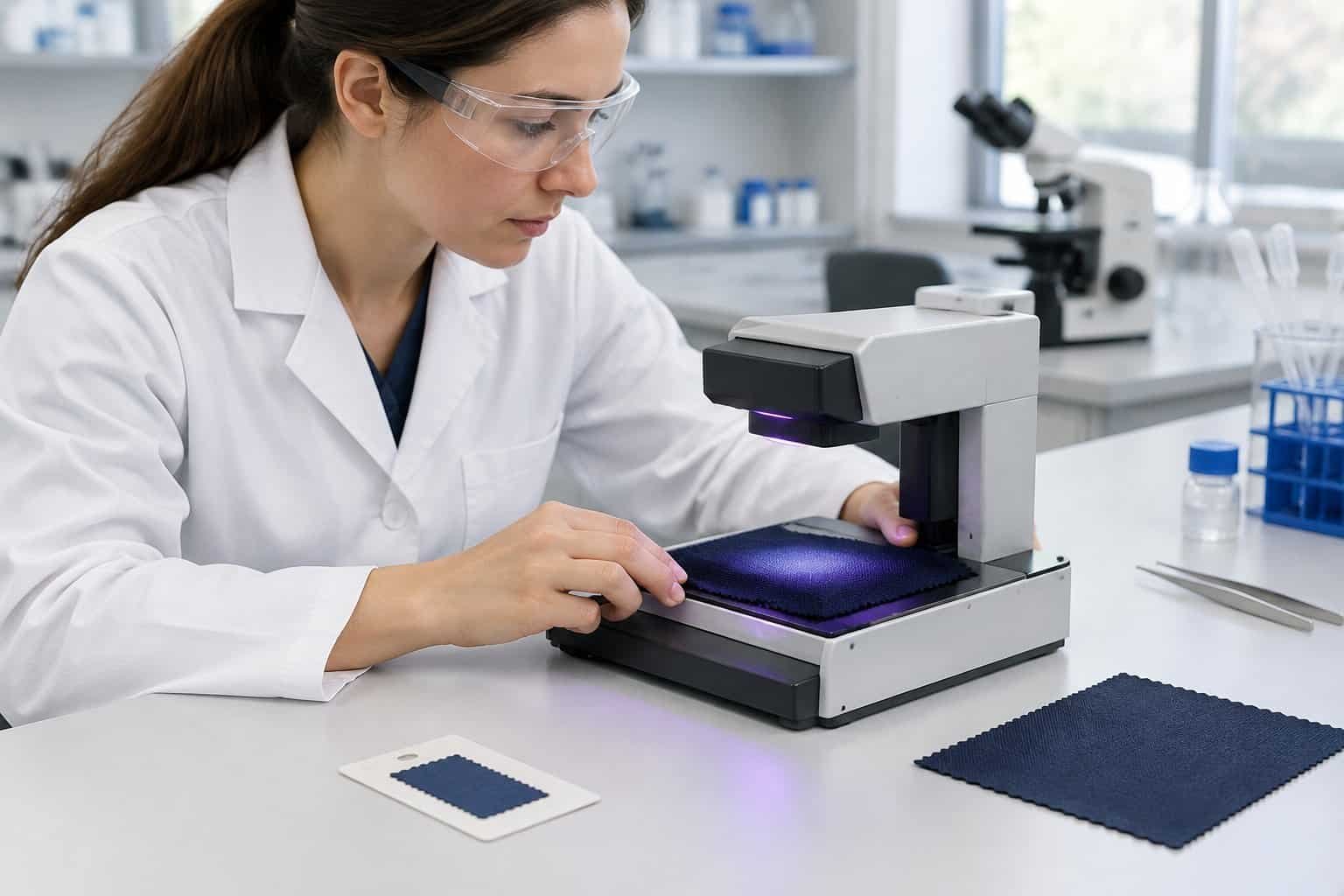
Reliable UPF procurement connects the intended claim to a defined finished fabric and a traceable laboratory report. The specification should identify the method, relevant use conditions, and changes that trigger further verification.
UV and FR evidence should remain separately identifiable throughout approval and production. Neither composition nor a dark shade replaces the required measurements.
Buyers seeking Levitex upf fabric evaluation are invited to share their required UV/FR evidence and textile specifications with Charlie@levitex.com for feasibility review. The brief should include the target market, fabric construction, color, complete finish package, and intended care conditions.
Frequently Asked Questions
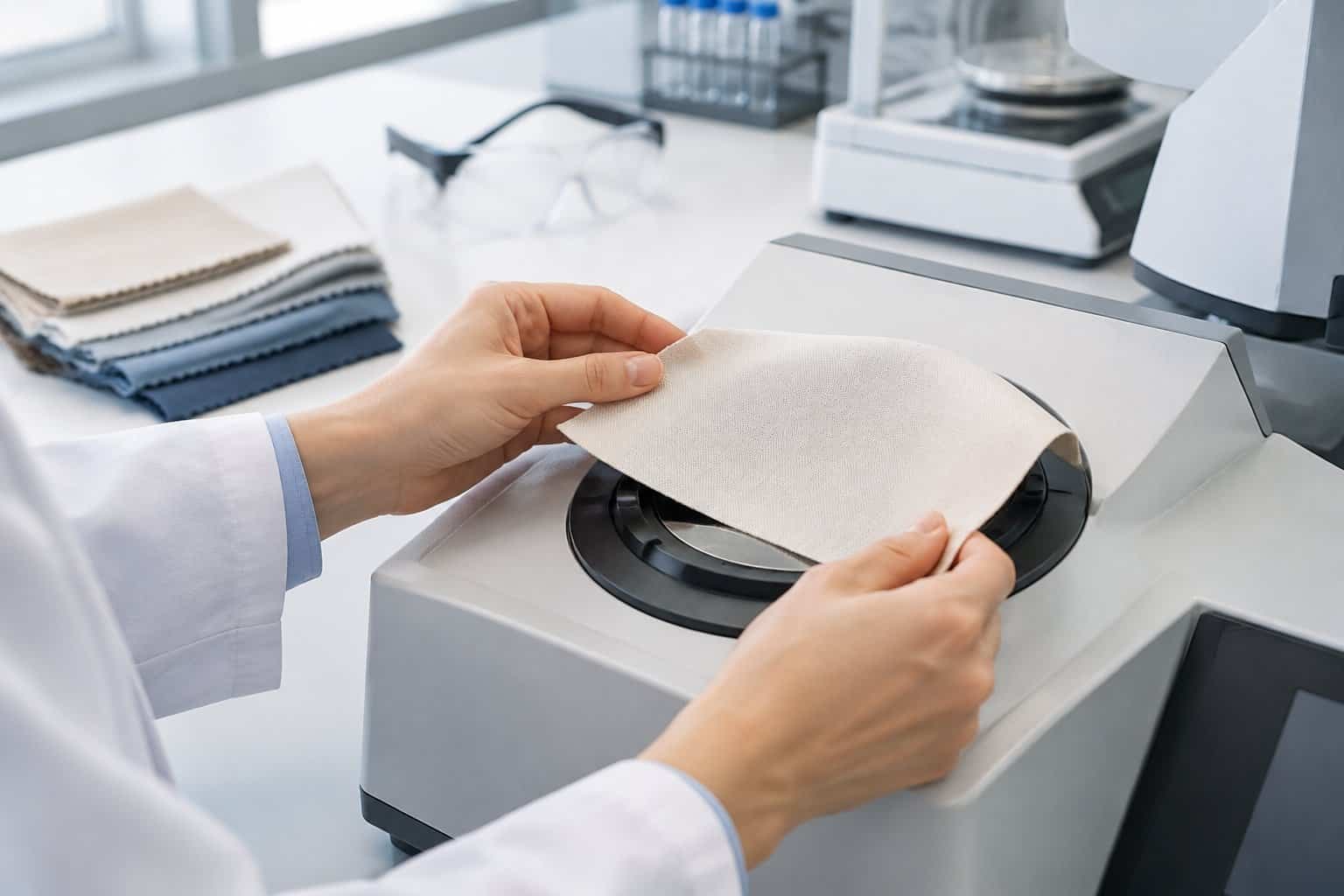
Laboratory evidence establishes a defensible UPF claim; visual checks and broad material descriptions provide screening information only.
Can a home testing kit or UV test card establish a UPF rating?
A home kit or UV test card cannot establish a standardized upf rating. Its response lacks the spectral weighting, controlled preparation, and specimen assessment required for laboratory classification.
How much does laboratory UPF testing cost?
Laboratory pricing is quoted per sample or testing program. Buyers should request separate charges for each color, pretreatment, and test condition, plus any classification or labeling assessment.
Can UV rays pass through thick or dark fabric?
UV radiation passes through thick or dark fabric whenever its structure and absorption permit transmission. Thickness and shade support preliminary selection, but measurement establishes the protection level.
Which fabric is best for blocking UV rays in industrial workwear?
A densely covered finished fabric with verified UV performance under intended use conditions is the strongest procurement choice. Selection must also satisfy the workplace’s thermal hazards and comfort requirements.
Does an FR fabric report also prove UPF 50+ protection?
An FR fabric report establishes only the performance evaluated by its listed methods. UPF 50+ protection requires appropriate UV testing and classification for the relevant finished fabric.