
EN 1149-5 sets material performance and garment design requirements for electrostatic dissipative protective clothing; Parts 1, 2 and 3 describe test methods used to evaluate a material’s electrostatic properties. Part 5 applies to clothing used within a total earthed system to help prevent discharges capable of igniting an explosive atmosphere.

For industrial textile buyers, the distinction connects fabric purchasing to workplace protection. A laboratory result establishes a specific material property, while finished protective clothing requires suitable construction and documented conditions of use.
Levitex manufactures flame-resistant textiles for industrial protective-workwear applications. Selecting materials for workwear involves matching textile evidence to the intended garment and the hazards identified by the employer.
What Does Part 5 Require Beyond Material Testing?

Part 5 combines material performance requirements with rules for garment construction, marking and user information. Its design requirements address the way clothing is worn and the risk of incendiary discharges during use.
Material Performance and Garment Design Have Different Roles
Material testing evaluates a fabric specimen under controlled laboratory conditions. The resulting report identifies the method and records the specimen’s performance.
Garment assessment considers how that textile functions after cutting and assembly. Coverage, closures, exposed components and the arrangement of materials require evaluation against the applicable requirements. A passing fabric result supplies part of the evidence needed for finished protective clothing.
Which Edition and National Adoption Should Buyers Specify?
EN 1149-5:2018 is the European Standard titled Protective clothing: Electrostatic properties: Part 5: Material performance and design requirements. It superseded the 2008 edition.
CEN national members adopt the European Standard through their national standards systems. BS EN 1149-5:2018 identifies the British adoption; the BS prefix identifies the adopting body.
Purchase specifications should state the full designation and edition. For international orders, buyers should also identify the destination market and applicable conformity documentation, since a standard designation alone establishes no product certification.
What the Standard Covers and What It Excludes
The scope includes electrostatic dissipative protective clothing and integral items such as hoods and caps. It addresses use where the explosive atmosphere’s minimum ignition energy is at least 0.016 mJ.
Separate gloves and footwear fall outside its scope. Protection against mains voltage also falls outside the standard, and its requirements may be insufficient in oxygen-enriched flammable atmospheres.
Additional equipment worn or carried against clothing requires its own assessment. The garment requirements provide no automatic assurance that breathing apparatus or other attached equipment is adequately earthed.
How Do Parts 1, 2 and 3 Differ?

Parts 1, 2 and 3 examine different electrical behaviors: conduction along a surface, conduction through the material and the decay of electrostatic charge. Part 5 determines which evidence supports its material requirements and adds garment-level obligations.
| Comparison point | EN 1149-1 | EN 1149-2 | EN 1149-3 | EN 1149-5 |
|---|---|---|---|---|
| Document role | Test method | Test method | Test method | Requirements standard |
| Main subject | Surface resistance | Vertical resistance | Charge decay | Material and garment |
| Measurement approach | Along the surface | Through thickness | Induction and decay | Assessment of evidence |
| Supports Part 5 material route | Yes, where applicable | No independent route | Yes, specified method | Defines acceptance |
| Addresses garment design | No | No | No | Yes |
Part 1: Measuring Surface Resistance
EN 1149-1:2006 describes a test method for measuring surface resistance. Electrodes positioned on the material’s surface establish the electrical resistance along that surface under specified conditions.
The measurement helps characterize how charge moves across the textile. Electrode contact and specimen conditioning influence the result, so an isolated resistance value needs the corresponding method information.
For heterogeneous fabrics containing conductive elements, specimen orientation and construction deserve particular attention. The laboratory report should identify the tested material clearly enough to connect the result to the purchased fabric.
Part 2: Measuring Vertical Resistance Through the Material
EN 1149-2:1997 measures vertical resistance through a material’s thickness. Electrodes on opposing faces establish the resistance between the outer and inner surfaces.
This result describes a different electrical path from the surface measurement in Part 1. A textile’s behavior across its face does not establish its behavior through its thickness.
Part 2 provides useful characterization for applications that require through-material resistance information. It supplies no independent alternative to the Part 1 or Part 3 material routes specified by Part 5.
Part 3: Measuring Charge Decay
EN 1149-3:2004 describes methods for measuring charge decay. For the Part 5 material assessment, the relevant route uses the specified induction method, commonly identified as Method 2.
The test evaluates the material’s response to an induced electrostatic charge. Reported parameters include charge-decay half-time and shielding factor.
These measurements provide information beyond a static resistance reading. A report should identify the method used and the applicable result parameters, since the phrase “charge decay tested” leaves the assessment incomplete.
Which Test Evidence Supports Part 5 Material Requirements?
Part 5 provides material assessment routes using the applicable Part 1 surface-resistance evidence or Part 3 induction charge-decay evidence. The correct route must suit the material construction and satisfy the associated requirements.
A procurement file should preserve the actual results and assessment basis. A certificate listing “EN 1149” without a part number leaves the measured property unclear.
Where a supplier provides a Part 2 report, the buyer should establish its intended purpose. The finished-garment conformity file still needs the material evidence required by Part 5.
Why Must Garment Design and Grounding Work Together?

Electrostatic dissipation relies on the clothing functioning within an earthed system during actual work. Protective garments require suitable coverage and a verified connection between the wearer and earth.
Conductive Fibres and Finishes: Material Context, Not Proof of Compliance
Conductive fibres, including carbon yarn, provide one approach to controlling electrical charge in textiles. Antistatic finishing provides another approach, with performance determined by the particular formulation and fabric construction.
The distinction between conductive yarn and antistatic finish helps explain how a material is engineered. Product-specific testing establishes whether that construction meets the required electrostatic criteria.
A visible conductive grid supplies no substitute for a report. Equally, a finish description establishes no service life or retained performance after laundering.
Coverage, Closures and Accessories Affect Protective Garments
Protective garments must maintain the required coverage during normal movement. Exposed clothing underneath, open fasteners or poorly overlapping garment pieces require attention during the design assessment.
Exposed conductive components and added accessories also require evaluation. Zippers, badges and external equipment introduce details that a flat fabric specimen does not represent.
Reflective materials add another assessment task when visibility protection is specified. Requirements for flame-resistant high-visibility workwear extend to the relevant components and finished garment configuration.
The Wearer, Footwear and Floor Form a Total Earthed System
EN 1149-5:2018 defines a total earthed system as one in which personnel and other conductors connect to earth through a resistance below 10⁸ Ω. This is a system condition requiring verification.
Suitable conductive footwear or another approved earthing arrangement must work with the floor and workplace procedures. Footwear selection also requires consideration of any electrical-shock hazard identified at the site.
Contamination, insulating floor coverings and changes in footwear affect the earthing arrangement. The employer’s inspection and verification procedures should address these conditions throughout use.
How Does Electrostatic Protection Relate to Other Workplace Hazards?
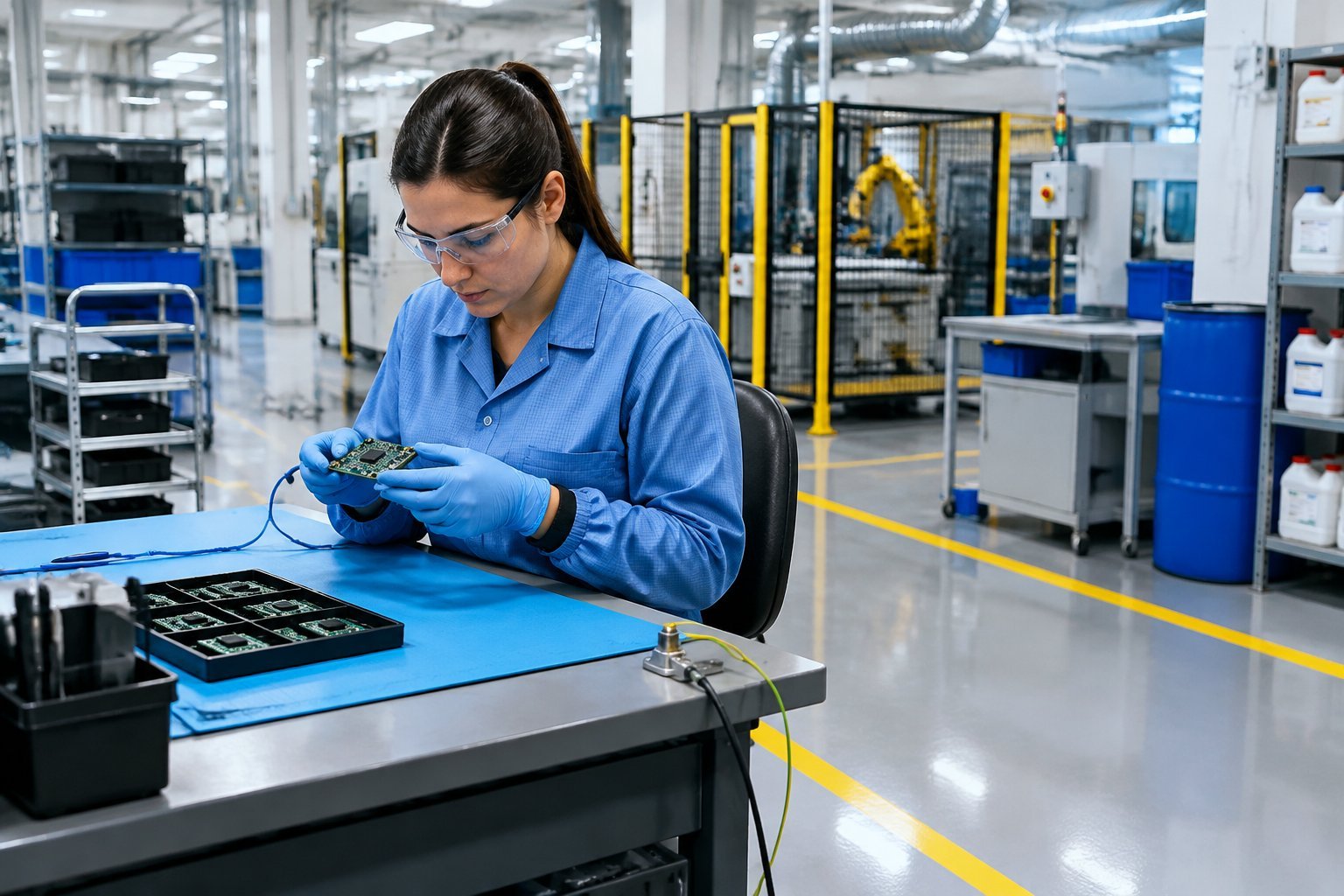
Electrostatic protective clothing addresses one ignition mechanism within a broader workplace risk assessment. Thermal protection, electric-arc protection and electronics ESD control each require evidence suited to their own hazards.
ATEX Workplaces Require a Site-Specific Ignition Risk Assessment
ATEX provides the European framework for explosive-atmosphere risks. The workplace assessment considers the presence of combustible substances and whether ignition sources, including electrostatic discharges, become effective during the task.
Antistatic protective clothing forms one element of that control strategy. Process containment and ventilation remain essential, alongside suitable equipment and work procedures.
For US operations, an EN clothing specification must fit the applicable US workplace requirements and site assessment. An EN standard designation establishes no automatic compliance with every local obligation.
Heat and Flame Protection Need Separate Evidence
EN ISO 11612 addresses protective clothing against heat and flame. Its performance codes describe specific exposures, making the relevant EN ISO 11612 codes important when specifying multi-hazard garments.
References shortened to EN 11612 should be clarified to the complete designation and edition. EN ISO 14116, sometimes shortened to EN 14116, addresses limited flame spread and has a different scope.
Electrostatic evidence supplies no heat-and-flame performance claim. For US flash-fire applications, the distinction between EN ISO 11612 and NFPA 2112 also requires attention when interpreting a purchase specification.
Arc Protection, Electrical Insulation and Electronics ESD Are Different
An arc-rated fabric requires dedicated evidence for the thermal effects of an electric arc. EN 1149-5 supplies neither an arc rating nor an arc protection class.
Electrical insulation against dangerous voltage requires separately selected equipment and safe work practices. NFPA 70E addresses workplace electrical safety; it is not an antistatic material test.
Electronics ESD programs focus on protecting sensitive components against electrostatic discharge. Clothing selected for explosive-atmosphere ignition control requires a separate suitability assessment before use within an electronics ESD program.
Which Industrial Processes May Create Flammable Atmospheres?
Flammable-atmosphere hazards arise from substances and operating conditions. Relevant activities include:
- Hydrocarbon handling at refineries, petrochemicals facilities and oil and gas production sites.
- Fuel dispensing at service stations.
- Solvent handling during industrial painting.
- Combustible dust generation in the food industry, wood processing or the plastic industry.
- Specific operations in electroplating and metallurgy.
Each process requires assessment of the substance involved, its ignition characteristics and the circumstances of release. A sector name alone establishes neither the required PPE nor the suitability of a particular garment.
What Evidence Should Buyers Request for Levitex Textiles?

Buyers should request product-specific textile reports and connect each result to the exact fabric under consideration. Assessment against the EN 1149-5 standard also requires garment and use information from the responsible parties.
Match the Fabric Reference to Its Product-Specific Test Reports
Levitex supplies textiles and states that each product has a test report. The relevant report must establish which electrostatic properties were assessed for the selected fabric.
A practical FR fabric quality-control review connects the report’s specimen identification to the commercial reference and production documentation. Composition or fabric weight alone establishes no electrostatic dissipation performance.
For initial anti-static inquiries, Levitex’s anti-static textile reference provides a product discussion starting point. Its URL establishes no dedicated arc performance.
Check Test Methods, Conditioning and Documented Care Instructions
The evidence review should include:
- Exact fabric reference and specimen description.
- Standard part, edition and test method.
- Conditioning temperature and relative humidity.
- Reported results and applicable acceptance basis.
- Pretreatment and laundering procedures used before testing.
- Documented washing and drying instructions.
- Repair restrictions and criteria for reassessment.
- Changes to construction or finishing since the specimen was tested.
Conditioning deserves particular scrutiny because moisture affects electrical behavior. The report should also distinguish an as-received specimen from one evaluated after specified pretreatment.
Changes to fabric finishes require review against the approved specification. Any additional finishing should be included in the tested construction where it affects the claimed performance.
Keep Fabric Evidence Separate From Finished-Garment Conformity
Levitex’s offering covers textile production. Finished-garment conformity requires the garment manufacturer’s assessment of the assembled product and its intended use.
Fabric reports support that process, while the garment file addresses construction and user information. For products placed on regulated markets, the responsible economic operator must also establish the applicable conformity-assessment obligations.
The employer then verifies compatibility with the workplace earthing arrangements. These responsibilities should remain explicit in purchasing and supply agreements.
Discuss Textile Requirements With Levitex Without Assuming Certification
Levitex manufactures flame-resistant fabrics in 100% cotton, cotton/nylon (C/N), and cotton-rich cotton/polyester (CVC) families. An inquiry should identify the required electrostatic performance and FR requirements without assigning compliance from the base-fabric family.
Buyers seeking a textile specification review are invited to send the required electrostatic standard, FR requirements, intended care procedures and garment use to Sales Manager Charlie Luo at Charlie@levitex.com. Those details support a discussion of the relevant fabric reference and product-specific reports.
Match Material Evidence to the Complete Protective System

EN 1149-5 connects qualifying material performance with protective-garment requirements and use within a total earthed system. Parts 1 and 3 support the applicable material assessment routes, while Part 2 characterizes through-material resistance.
A complete purchasing decision therefore needs the exact textile report, finished-garment evidence and documented workplace earthing arrangements. The approved specification should also preserve the care instructions and identify changes that trigger reassessment.
Frequently Asked Questions
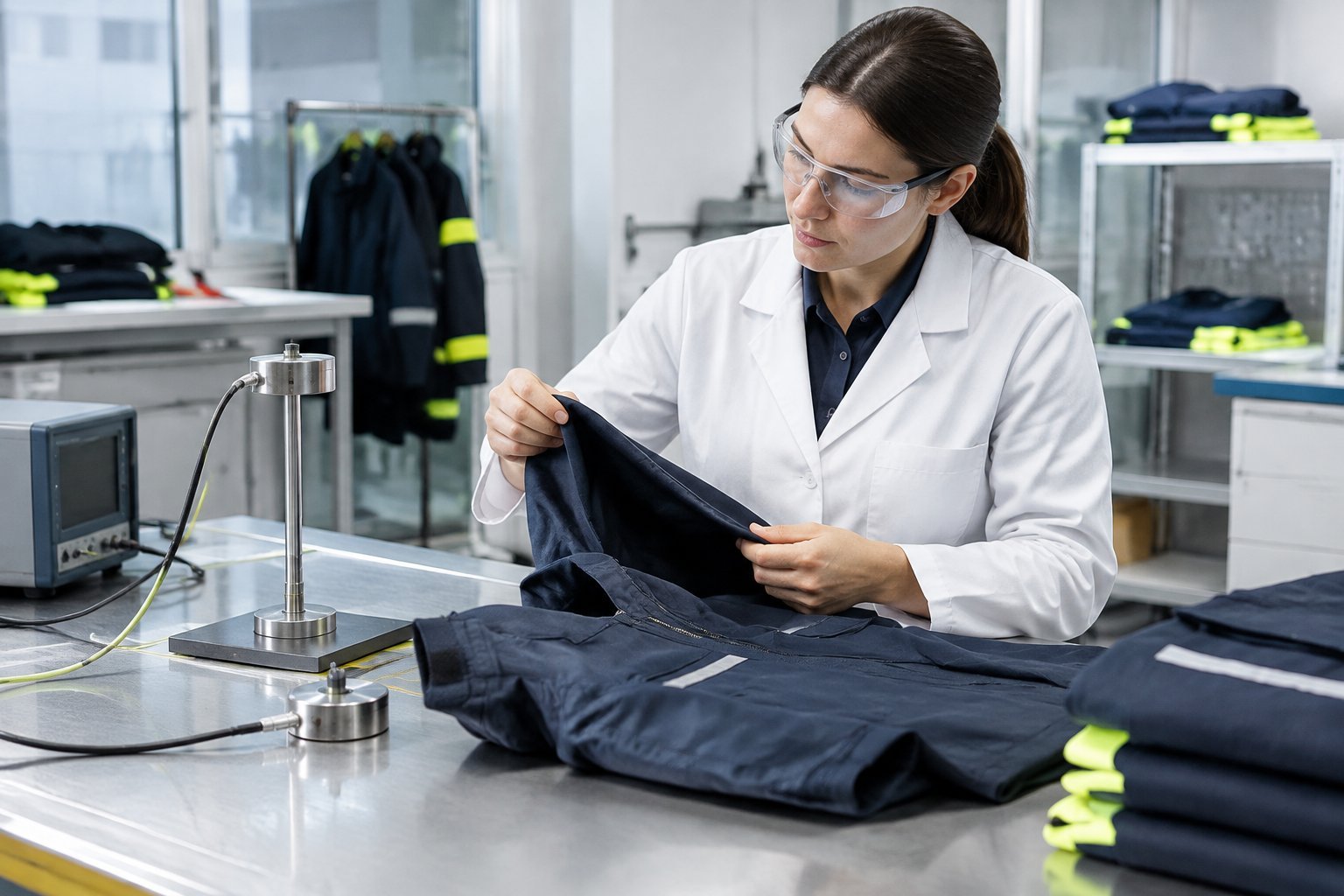
The following answers address common questions about interpreting reports and maintaining the specified protection.
Does passing EN 1149-3 mean a garment complies with EN 1149-5?
Passing the applicable EN 1149-3 assessment supports the material portion of the conformity assessment. The assembled garment still requires assessment against Part 5’s design and information requirements.
Is EN 1149-2 an alternative to surface resistance or charge decay testing?
EN 1149-2 supplies a through-thickness resistance measurement, with a separate technical purpose. It provides no independent alternative to the applicable Part 1 or Part 3 material assessment routes under Part 5.
Does EN 1149-5 also provide flame or arc protection?
Flame and arc protection require separate performance evidence. EN ISO 11612 addresses heat and flame, while arc-flash clothing materials require dedicated arc testing for the claimed protection.
Can washing or repairs affect electrostatic performance?
Washing or repairs affect electrostatic performance when they alter the conductive structure, surface condition or approved garment construction. Continued use should follow the manufacturer’s documented care instructions and repair restrictions.
Where Is the Official EN 1149-5 PDF Available?
The official PDF is available through national standards bodies and authorized standards distributors. The purchaser should check the full designation, edition and license terms before ordering.