
Fabric singeing removes protruding fibers by briefly exposing the textile surface to a controlled flame or heated metal surface, improving smoothness and print clarity while reducing surface fuzz. For industrial fabric buyers, this textile pretreatment helps establish a cleaner appearance before downstream processing, provided that heat exposure preserves the underlying yarn structure.
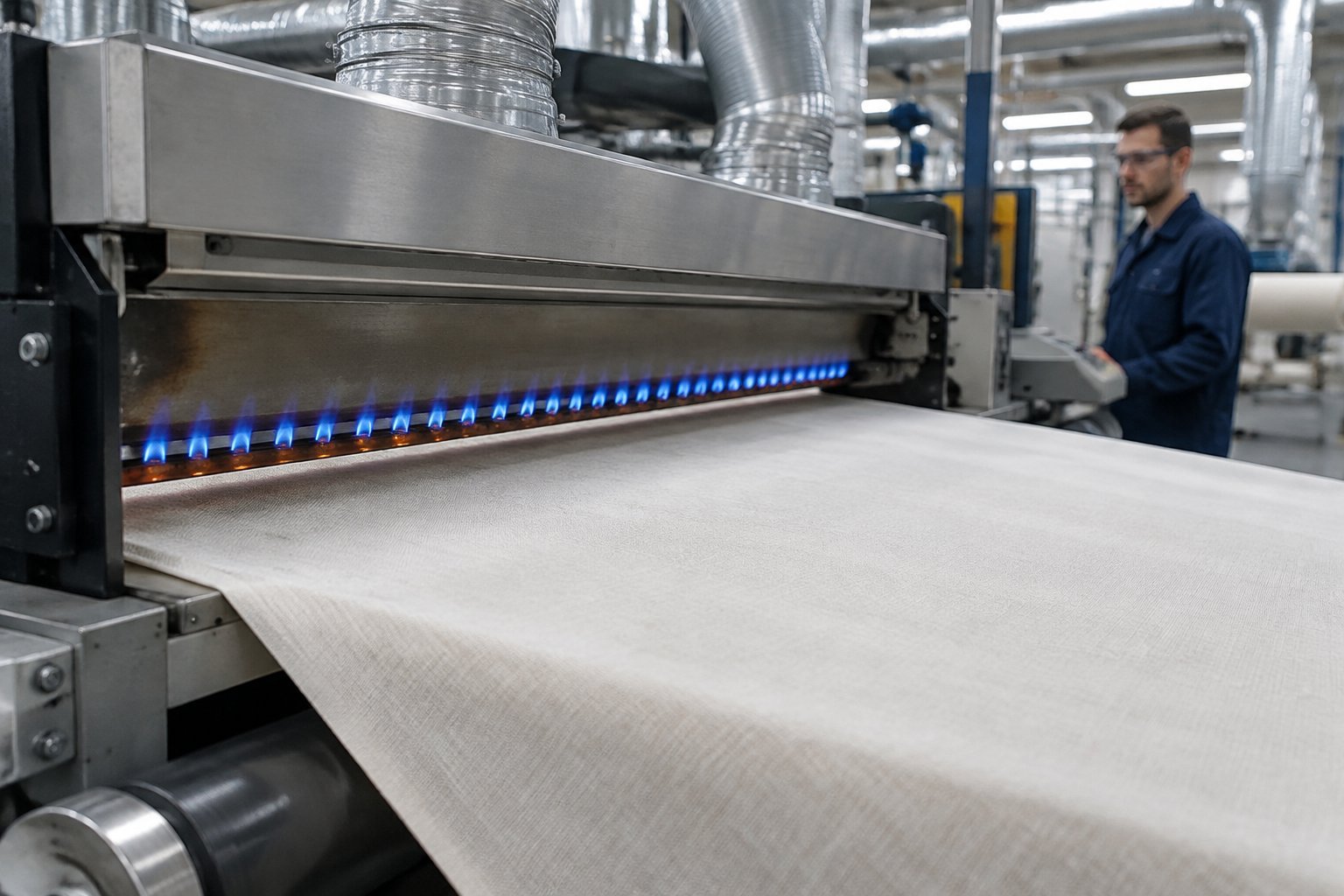
Surface hairiness affects how evenly a dyed fabric reflects light and how clearly a printed edge appears. Excessive heating creates another problem: scorching or strength loss that compromises fabric quality.
Levitex, established in 1951, manufactures flame-resistant textiles for industrial and protective-workwear applications. Surface preparation serves a distinct purpose within that production context, alongside the finishing and testing required for the finished fabric’s intended performance.
How Are Surface Fibers Removed Without Damaging the Fabric?
The singeing process uses brief, controlled heat exposure to burn projecting fibers while limiting heat transfer into the fabric body. A singeing machine coordinates fabric movement with the heating zone and subsequent extinguishing or cooling arrangements.
Why Controlled Surface Heating Improves Smoothness and Print Clarity
Fine projecting fibers heat rapidly because they have little mass and extensive exposure to the heat source. The compact yarn body takes longer to heat, creating a processing window for surface-fiber removal.
Removing fuzz reduces scattered light and reveals the fabric structure more clearly. On printed industrial textiles, fewer stray fibers interfere with fine boundaries between colors.
Singeing belongs among the fabric finishes that change surface characteristics. Its effect centers on hairiness; internal impurities and residual processing chemicals require separate preparation steps.
Gas Flame vs. Plate and Roller Singeing
Gas singeing exposes the moving fabric to a controlled burner flame. Also called flame singeing or gas flame singeing, this method provides adjustable exposure through burner arrangement and fabric travel.
Plate singeing and roller singeing transfer heat through contact with hot metal. Their effectiveness depends on consistent contact across the textile surface.
| Processing feature | Gas flame singeing | Plate singeing | Roller singeing |
|---|---|---|---|
| Heat source | Gas burner | Heated curved plate | Heated rotating cylinder |
| Fabric contact | Flame exposure | Metal contact | Metal contact |
| Surface access | Exposed surface hairs | Raised contact points | Raised contact points |
| Key uniformity control | Burner consistency | Plate temperature | Cylinder temperature |
A gas singeing machine offers flexible flame positioning. A plate singeing machine or roller singeing machine requires particular attention to contact conditions, especially where seams or surface relief alter exposure.
Where Singeing Fits Before Desizing, Scouring, and Dyeing
For cotton woven goods, singeing commonly takes place early in textile manufacturing, followed by desizing and scouring. Bleaching follows where the required shade or whiteness calls for it.
The singeing and desizing process combines complementary functions. Singeing removes surface hairs; desizing breaks down or removes the size applied to warp yarns during weaving.
A suitable wetting agent supports uniform penetration during wet processing. Scouring removes waxes and other impurities that interfere with wetting and dye absorption, while washing clears singeing residues. A smoother surface improves visual color uniformity, but dyeing still requires properly prepared fibers.
Which Manufacturing Controls Determine Surface Quality?
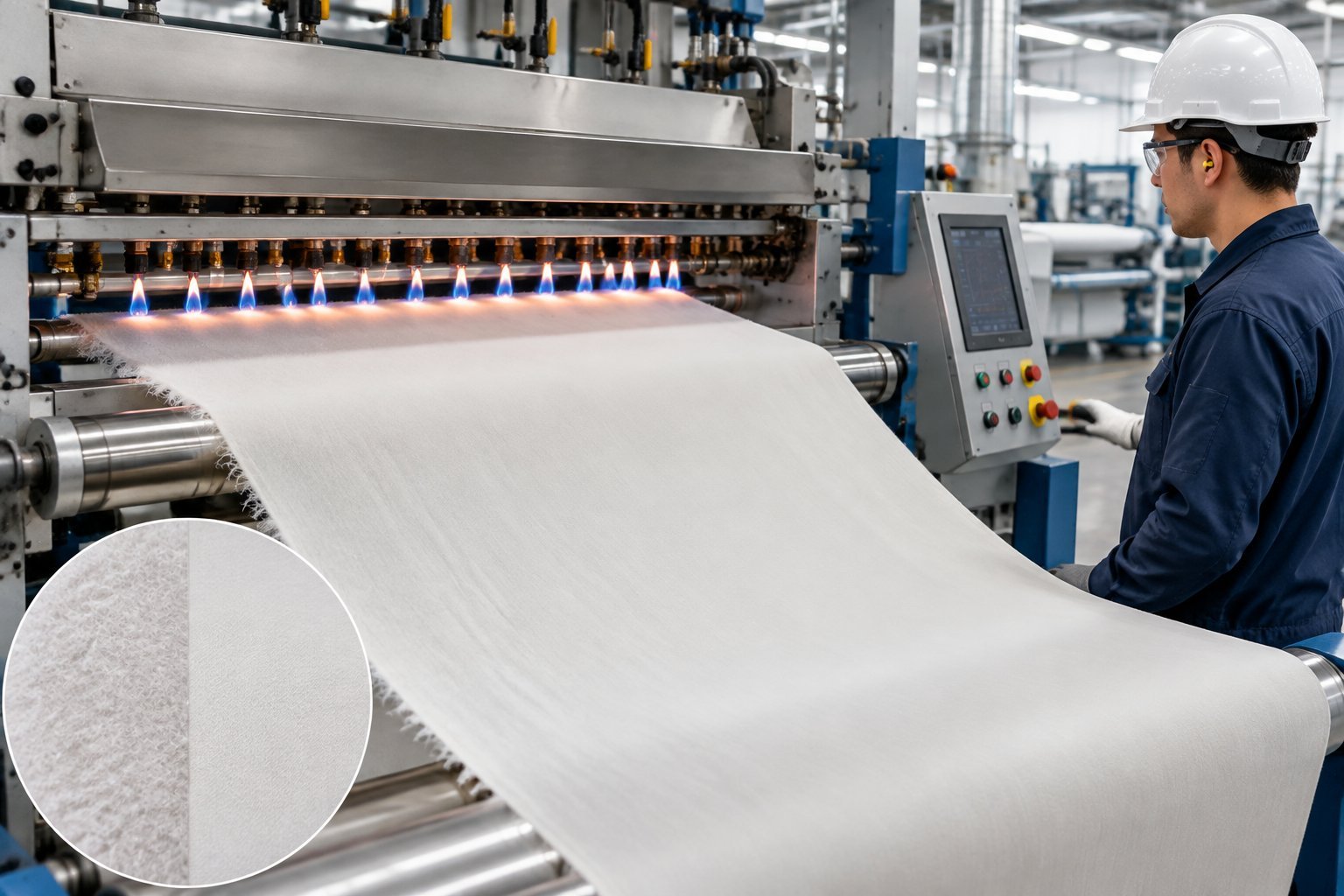
Surface quality is determined by the balance between heat exposure and fabric presentation across the full working width. Stable singeing machines maintain that balance through speed changes as well as steady production.
Balancing Flame Intensity, Fabric Speed, and Singeing Position
Flame intensity and fabric speed jointly determine the thermal exposure received by each area of cloth. A slowdown increases exposure unless the machine’s control system compensates.
Singeing position changes how the flame meets the surface. Tangential singeing directs the flame along the fabric face, while other arrangements expose cloth supported by a roller or traveling through a free span.
The appropriate combination requires trials for the particular construction and fiber blend. Burner distance and the number of treated faces also belong in the production record; a speed value alone cannot define an equivalent process.
Managing Fabric Tension, Moisture, and Burner Uniformity
Consistent fabric tension presents a flat surface to the heating zone. Creases shield some areas and expose adjacent ridges more strongly, creating uneven treatment.
Moisture content must remain controlled across the width and through the batch. Damp patches change the energy needed to heat the surface, making a previously suitable setting unreliable.
Burner cleanliness and a stable fuel-air supply support uniform exposure. For stretch-sensitive constructions, tension control also helps limit distortion associated with fabric bowing and skewing.
Recognizing Incomplete Singeing, Streaks, and Thermal Damage
Incomplete singeing leaves visible hairs that become easier to detect under angled lighting or magnification. Uneven singeing produces differences across the width or along the length.
Lengthwise streaks warrant examination of burner uniformity and fabric presentation. Crosswise bars suggest a transient event, such as a speed change or interruption.
Over-singeing produces warning signs such as yellowing, a harsh hand, or localized holes. Thermoplastic blends also require inspection for hard melted beads. Thermal damage requires investigation even when subsequent processing reduces its visible appearance.
Checking Surface Cleanliness, Pilling, and Strength Retention
Singeing efficiency is assessed by comparing treated cloth with an approved surface reference under consistent lighting. Magnification helps distinguish residual hairs from melted fiber ends or loosely attached debris.
A fabric pilling test evaluates the finished material’s response to repeated rubbing. The agreed method and assessment stage should accompany any pilling requirement.
Strength checks provide a separate safeguard against excessive heating. Comparing tensile performance and fabric tear strength before and after processing helps identify damage that surface inspection misses. Samples should represent both fabric directions and multiple positions across the width.
What Changes for Cotton, Blends, and Protective-Workwear Textiles?
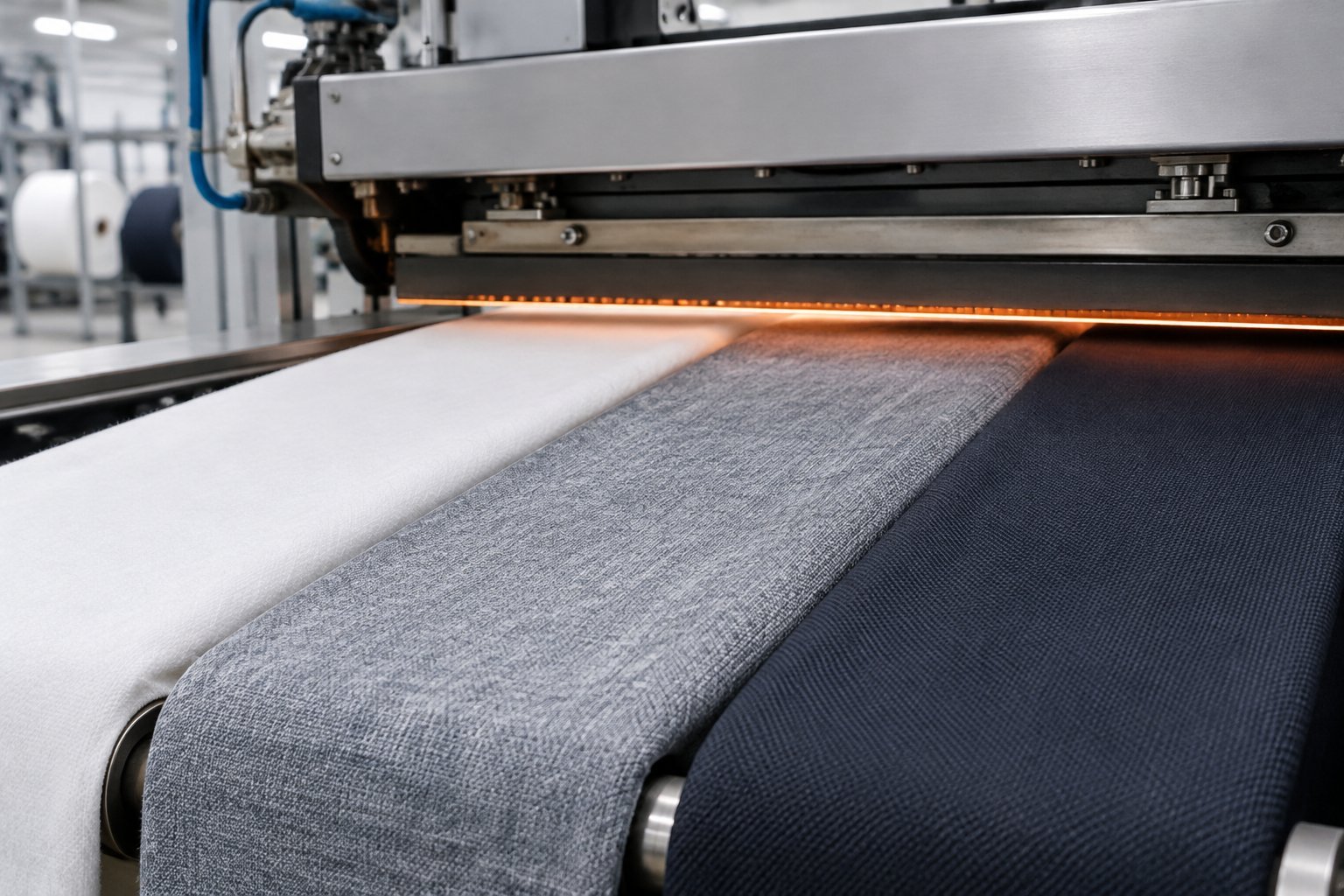
Fiber composition and textile construction determine how safely a fabric tolerates singeing. Protective-workwear textiles also require a processing sequence that preserves the performance established for the finished material.
Cotton vs. C/N and CVC: Different Responses to Heat
Cotton fabric develops hairiness from the staple fibers in cotton yarn and from friction during manufacturing. Its protruding cellulose fibers burn during controlled exposure, leaving residues for subsequent cleaning.
Cotton/nylon (C/N) and cotton-rich cotton/polyester (CVC) blended fabrics introduce thermoplastic components. Under excessive heat, nylon or polyester melts and forms hard surface beads that affect hand and appearance.
The properties of cotton/nylon blends require consideration alongside the actual construction. The same applies to CVC: cotton dominance alone does not establish a safe singeing setting. Polyester distribution and yarn structure influence surface response.
Woven vs. Knitted Constructions: Stability and Surface Exposure
Woven fabric provides a relatively stable sheet for controlled travel through a singeing machine. Even within woven fabrics, differences in weave and cover alter how readily heat reaches exposed fibers.
Knitted fabric requires closer attention to stretch and loop geometry. Excessive tension changes width and exposes loop surfaces unevenly, while curled edges create additional processing difficulties.
Knitted fabrics and other knit fabrics therefore need construction-specific trials and suitable handling equipment. Levitex manufactures both woven and knitted FR fabrics within its 100% cotton, C/N, and CVC composition families; changing the structure also changes the preparation requirements.
When Biopolishing or a Different Processing Sequence Makes Sense
Biopolishing uses enzymes to remove surface cellulose fuzz. It provides an alternative for cotton-containing fabrics when the desired hand or construction favors an enzymatic route.
Cellulase treatment acts on the cellulosic portion of a blend, leaving synthetic fibers outside its direct action. Excessive treatment also removes useful cellulose, so weight loss and strength retention require control.
For synthetic fibers and blends, trials must establish singeing’s position relative to dyeing and heat setting. Melted fiber ends develop different dye uptake, while later heat exposure risks shade changes. The approved textile finishing sequence should address both effects before bulk production.
Why Surface Preparation Does Not Establish Flame Resistance
Flame resistance comes from the fiber system or a suitable FR treatment, supported by testing of the finished textile. Singeing changes surface hairiness and provides no independent evidence of protective performance.
Untreated cotton remains combustible after surface preparation. Producing flame-retardant cotton fabric requires an appropriate treatment route and verification against the specified requirements.
Additional finishes also require compatibility assessment. For example, multi-functional FR finishing involves interactions between treatments, so a clean appearance cannot establish the finished combination’s performance. Product-specific reports must support any protection claim.
Discussing Surface Requirements With Levitex
An effective surface discussion starts with the intended result: an approved level of hairiness, clear print definition, or a specified hand. These details give the manufacturer a measurable target without assuming a particular machine or treatment route.
Levitex supplies textiles, including custom dyeing and printing, for industrial workwear applications. Garment design and assembly remain outside its offering, so finished-garment requirements need separate coordination with the garment manufacturer.
Buyers discussing a fabric project with Sales Manager Charlie Luo at Charlie@levitex.com should include the composition, construction, intended finishing combination, and an approved surface sample. Levitex provides a test report for each product; the relevant report should be reviewed for its stated methods and scope.
Specify a Clean Surface Without Compromising Fabric Performance
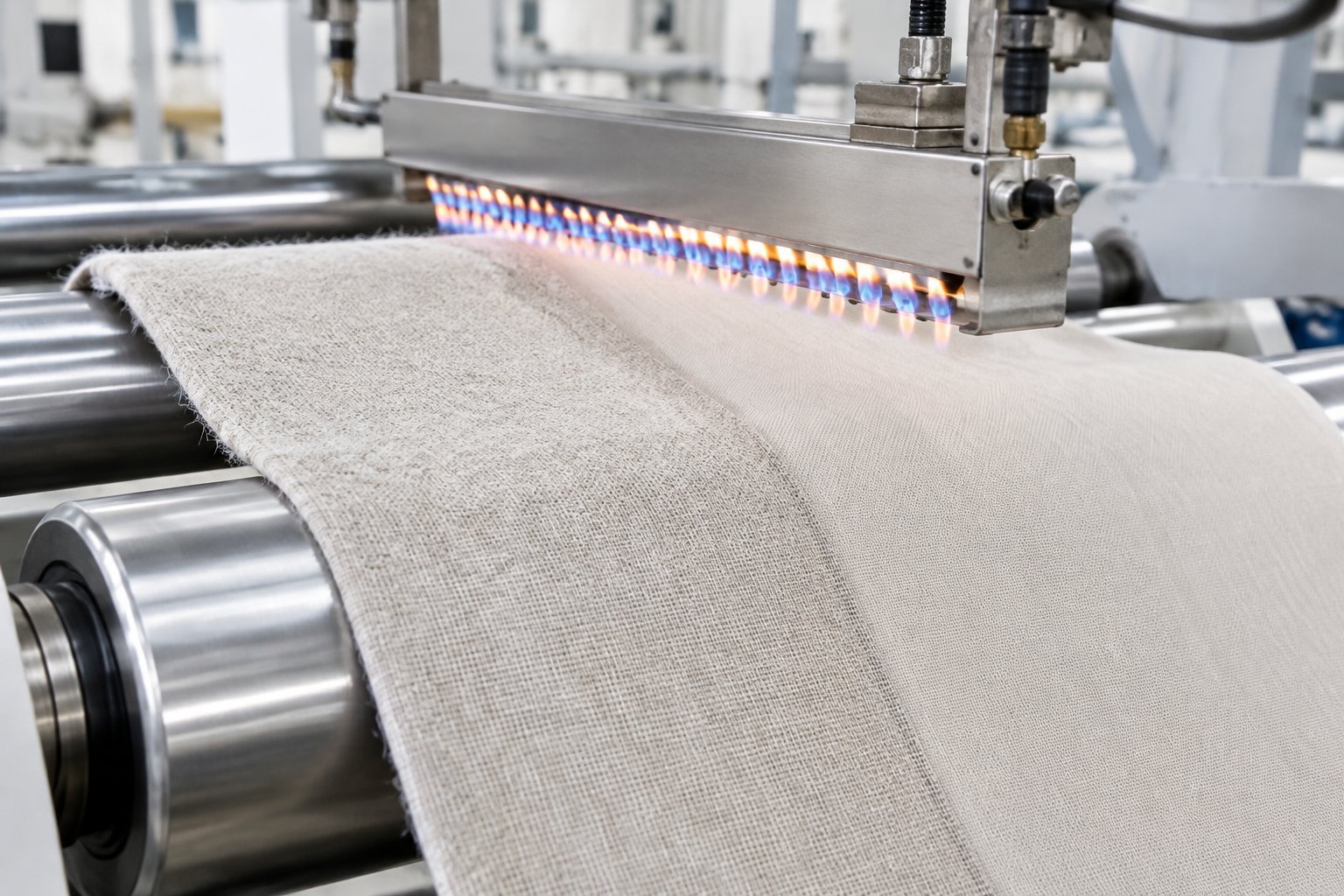
A useful singeing specification pairs an approved surface appearance with evidence that processing preserves the fabric’s required properties. Surface cleanliness belongs alongside strength and finished-fabric performance in the acceptance criteria.
For production approval, the specification should identify:
- The face or faces requiring treatment.
- A reference sample assessed under agreed lighting.
- Acceptable residual hairiness and freedom from scorch marks or melted beads.
- Applicable strength and pilling requirements.
- The processing stage at which acceptance checks occur.
For protective textiles, flame-retardant performance testing must address the finished material and its specified treatment combination. The purchase specification should keep surface acceptance and protective-performance evidence as separate, documented requirements.
Frequently Asked Questions
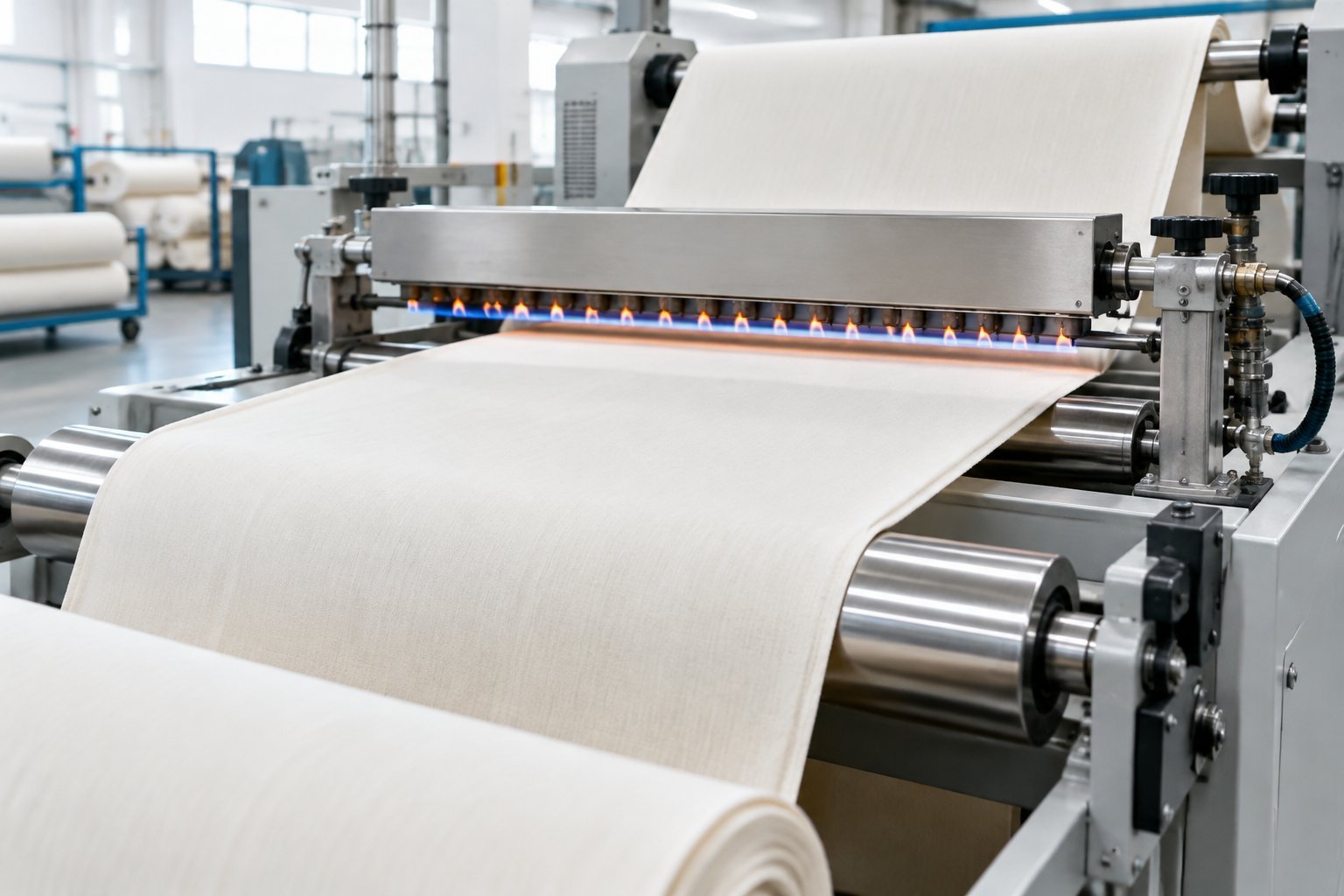
Fabric singeing addresses surface hairiness, with its suitability established for the particular textile and production route.
What is the purpose of singeing fabric?
Singeing removes projecting fiber ends to create a cleaner surface. It improves visual smoothness and supports sharper printing on fabrics requiring clear surface definition.
Does singeing make cotton fabric flame resistant?
Singeing leaves untreated cotton combustible. Flame-resistant cotton requires an appropriate FR treatment and product-specific testing.
Can singeing completely prevent pilling?
Singeing reduces an initial source of loose surface fibers, but it cannot completely prevent pilling. Wear and laundering expose additional fibers, making yarn construction and fiber properties important to long-term results.
Can knitted fabrics and polyester blends be singed?
Knitted fabrics and polyester blends are suitable for singeing when equipment and trials establish a controlled process. Knits require careful tension management, while polyester blends require protection against melted surface beads.
What is the difference between singeing and desizing?
Singeing removes protruding fibers through controlled surface heating. Desizing removes the sizing materials applied to yarns for weaving, preparing the fabric for subsequent wet processing.