
Textile metamerism occurs when two fabrics match under one light source but look different under another because they reflect different combinations of wavelengths. For industrial textile buyers, an approved shade needs to remain acceptable across the lighting conditions encountered during inspection and use. A match under factory lighting alone leaves room for visible differences elsewhere.
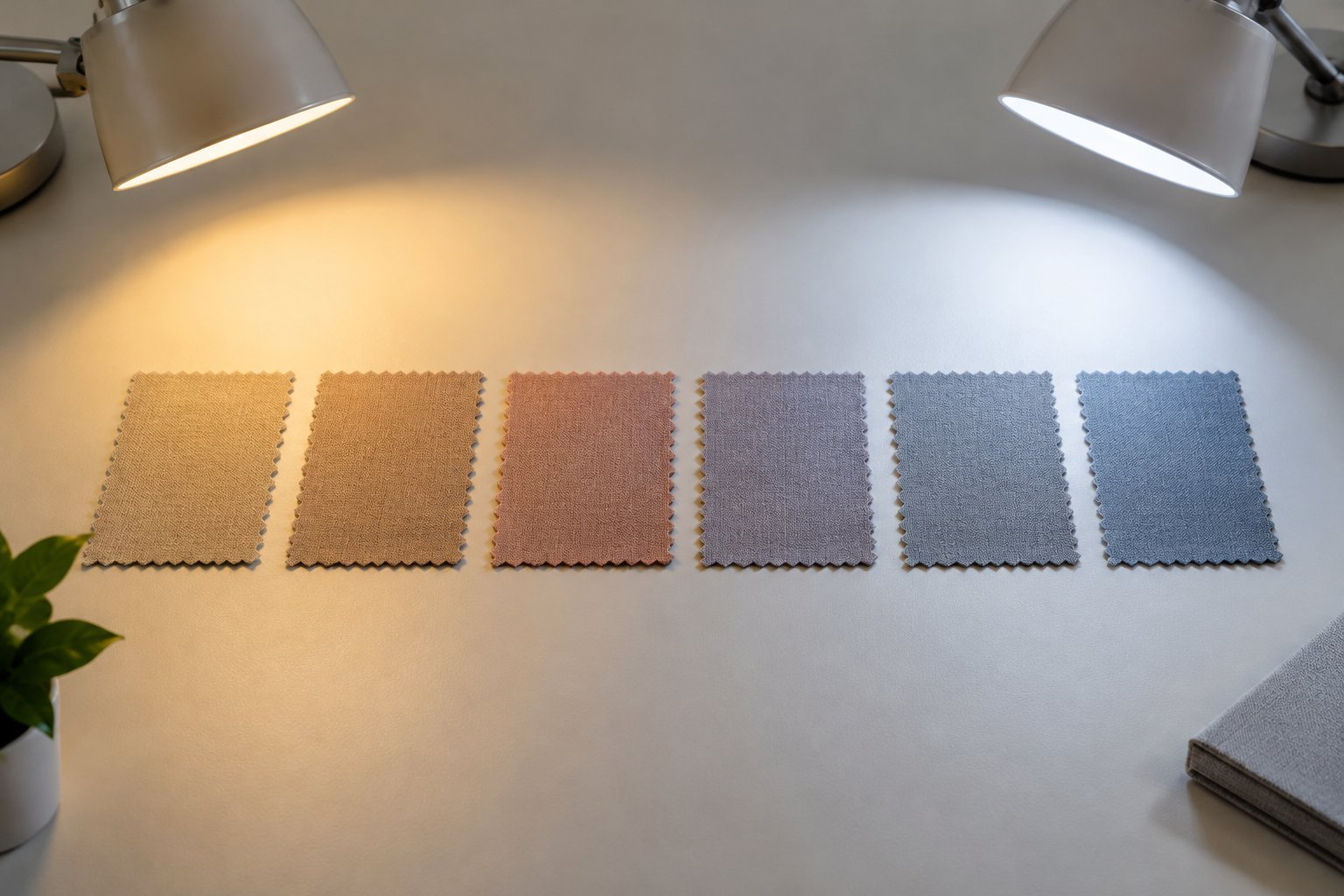
Metameric color matches create a particular challenge in textile color matching: two swatches look equivalent during approval, yet separate into different undertones under another lamp. Color consistency therefore requires agreement on the illumination used to judge the pair.
Levitex manufactures flame-resistant fabrics and provides custom dyeing and custom printing for industrial workwear applications. For these textiles, color approval belongs alongside control of the base fabric and its functional finishing route.
Why Do Matching Fabrics Look Different Under Another Light?
Matching fabrics separate under another light when their different reflectance characteristics interact with that source’s spectral power distribution. Metamerism in textiles involves the relationship between the material, illumination, and observer.
How Different Reflectance Curves Produce a Metameric Match
A spectral reflectance curve records how much light a material reflects at each wavelength. Two fabrics with different spectral reflectance curves still produce similar responses in the eye under a particular illuminant.
Changing light sources changes the wavelengths available to illuminate those fabrics. A warm tungsten source and a daylight simulator distribute energy differently, so the original balance between the samples shifts.
This loss of agreement is called illuminant metamerism or illuminant metameric failure. A change in one fabric’s color appearance under different lights is color inconstancy; identifying a metameric match requires comparison between specimens.
How Dyes, Fiber Blends, and Finishes Affect the Match
Different combinations of dyes and pigments produce different absorption patterns. The distinction between reactive dyes and pigment dyes illustrates why a shared shade name provides little information about the underlying colorant system.
Fiber type and fiber composition also influence textile dyeing. Different fibers within blends accept colorants differently, introducing additional variables when a cotton fabric is matched to a cotton/polyester reference.
Fabric construction and surface finishes affect reflected light through texture, gloss, and scattering. Directional appearance differences deserve separate investigation because a mismatch caused by viewing angle has a different mechanism from illuminant metamerism.
Optical brighteners add fluorescence by absorbing shorter-wavelength radiation and emitting visible light. Differences in brightener content become especially important when inspection sources contain different amounts of ultraviolet energy.
How Metamerism Differs From Fading and Dye-Lot Variation
Metamerism reveals an existing spectral difference when viewing conditions change. Returning both samples to the original controlled source restores their previous relationship, assuming their physical condition remains unchanged.
Fading involves a physical color change following exposure or use. Color fastness to light concerns resistance to light-induced change over time; a metamerism check concerns the relationship between samples under specified illumination.
Dye-lot variation describes differences between production batches. Two dye lots might differ under every inspection source, or they might match under daylight and separate under warm light. The second situation combines batch variation with a metameric mismatch.
How Do You Test a Fabric Match Across Light Sources?

A reliable assessment combines controlled light-booth comparisons with spectral measurements under agreed evaluation conditions. Each result needs a defined reference, illuminant, and measurement method.
Compare Samples Under D65 and Agreed Secondary Sources
CIE D65 represents a standardized daylight condition and provides a useful primary reference for textile color measurement. A maintained light booth supplies a practical daylight simulation for visual comparison.
Secondary sources should reflect the purchasing specification and intended environment. Appropriate choices include illuminant A, a specified fluorescent source, or a defined industrial LED source.
“Cool white” and “4000 K LED” leave important details unresolved. Lamps with the same correlated color temperature can have different spectral power distributions, so approval records should identify the agreed source precisely.
Use Spectral Measurements Rather Than a Single Color Reading
Spectrophotometry records wavelength-by-wavelength information about a sample. A spectrophotometer supports comparison of reflectance curves and calculation of color coordinates under multiple defined illuminants.
Conventional tristimulus colorimeters provide color-coordinate readings without the full spectral information needed for this analysis. A single colorimeter reading therefore provides limited evidence about the behavior of a pair under other sources.
For meaningful comparisons between color measurement instruments, laboratories should align measurement geometry and calibration procedures. Spectrophotometers also require consistent settings for aperture, specular reflection, and the standard observer used in calculations.
Interpret Delta E and the Metamerism Index Together
Delta E expresses color difference under a specified set of conditions. A low Delta E under D65 establishes closeness under that calculation condition; the pair still needs evaluation under the agreed secondary sources.
A metamerism index characterizes the sensitivity of the match to a defined change in conditions. Its interpretation depends on the selected method, including how the calculation handles an imperfect initial match.
Acceptance records should state the Delta E formula, tolerance for each illuminant, and metamerism-index method where applicable. There is no single numerical limit suitable for every fabric or purchasing contract.
Control Sample Presentation, Observer Differences, and UV Conditions
Sample preparation directly affects measurement repeatability. A practical inspection procedure should specify:
- Fabric conditioning before assessment.
- The number of layers and backing material.
- Face-side presentation and warp or nap direction.
- Measurement aperture and sampling locations.
- Viewing geometry and a neutral surround.
- Instrument and booth UV conditions.
Observer metamerism occurs when observers disagree about a spectrally dissimilar pair under unchanged illumination. Trained assessors and documented escalation procedures help manage observer metameric failure during borderline approvals.
Fluorescent specimens need additional care because changing a calculation illuminant alone does not fully reproduce changed physical excitation. UV light conditions should be controlled in both instrumental and visual evaluation as part of FR fabric quality control.
How Can Buyers Control Color From Lab Dips to Finished FR Fabric?
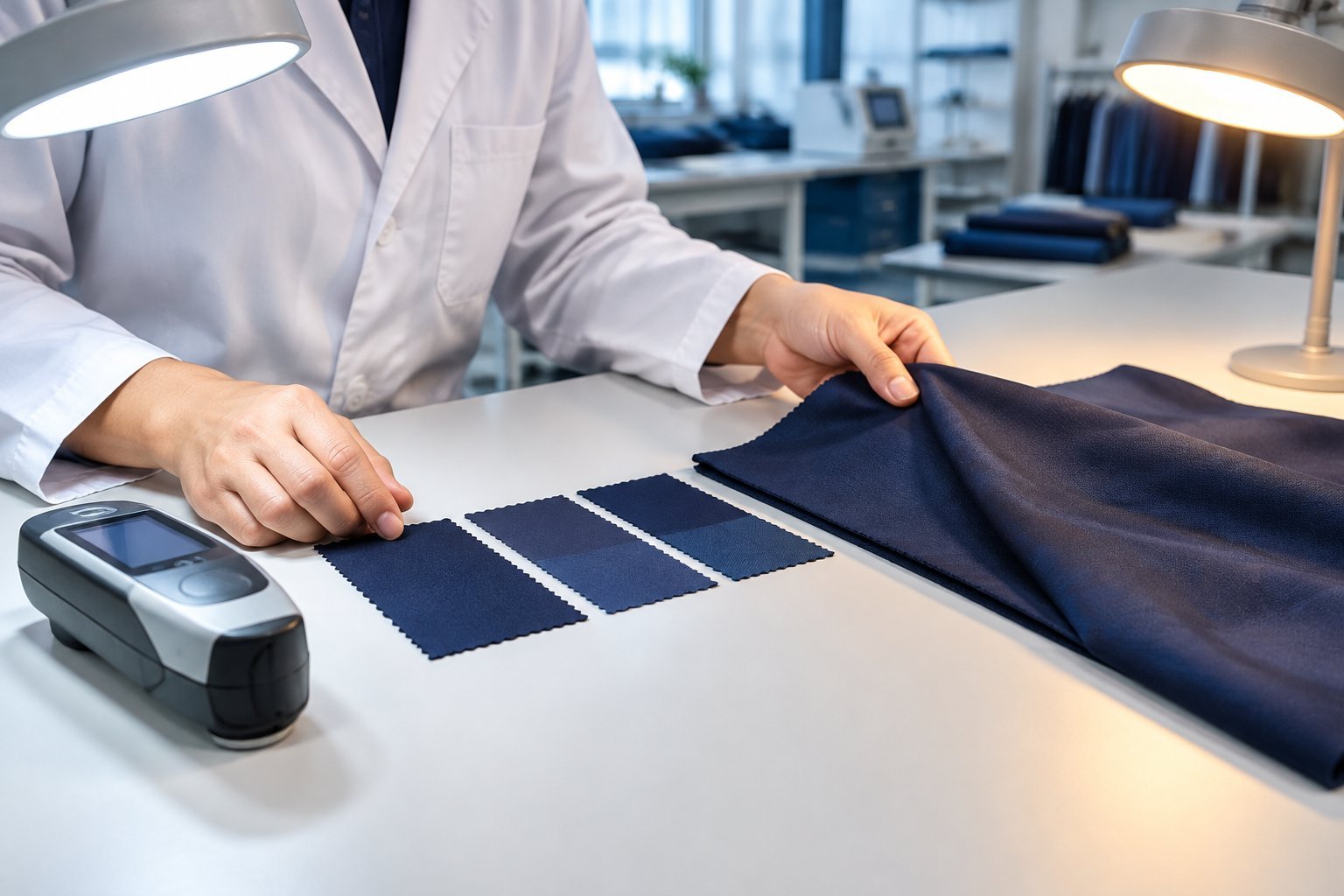
Buyers control color by carrying one documented reference and approval method from development through finished bulk production. Early agreement prevents a dyehouse, inspection team, and buyer from applying different definitions of an acceptable match.
Agree on Physical References, Illuminants, and Acceptance Criteria
A physical reference establishes the intended appearance more reliably than a screen image. The reference should have an identifier, approval date, and defined storage conditions to protect it from contamination or light exposure.
The color specification should identify the base fabric, construction, finish state, primary illuminant, secondary sources, and instrumental tolerances. It should also explain how visual judgments and numerical results will be reconciled.
A fabric lab dip represents a proposed laboratory color match. Its approval needs a recorded relationship to the master reference and the conditions under which the buyer accepted it.
Choose Dye Formulations for Spectral Similarity
Color formulation should seek a reflectance curve that follows the reference closely across the visible spectrum. Optimizing only the primary-source color difference leaves greater opportunity for separation under another illuminant.
Dye formulations also need to suit the substrate and production route. A recipe developed for 100% cotton requires separate evaluation before use on cotton/nylon or cotton-rich cotton/polyester.
For buyers in the textile industry, recipe control includes colorant identity and supplier references. Substitution of dyes or pigments should trigger renewed spectral and visual assessment, even when the initial color coordinates remain close.
Approve Lab Dips and Recheck After Functional Finishing
Lab dips should undergo multi-illuminant approval before bulk dyeing begins. Where finishing follows dyeing, development samples should represent the intended finished condition closely enough to expose shade changes early.
Flame-retardant treatment and additional finishes affect the optical behavior of the substrate. Compatibility between functional FR finishes therefore requires attention during both color development and performance verification.
Finished bulk fabric needs comparison against the approved finished reference. A pre-finishing approval provides incomplete evidence for the shade delivered after the complete process.
Maintain Reference and Recipe Control Across Repeat Orders
Repeat orders need continuity of reference, recipe, and process records. A retained sample from an approved lot supports investigation when a later delivery develops a different undertone.
Useful records include dye-lot identification, substrate details, finishing conditions, measurement settings, and approval decisions. Samples from multiple positions within bulk production help identify within-lot variation that a single cutting would miss.
Sampling plans should also account for development stages and production scheduling. Clear FR fabric sampling and lead-time requirements give both parties a defined point for approval before the next production step begins.
Discuss Custom Dyeing and Printing Requirements With Levitex
Levitex offers custom dyeing and custom printing on textiles for industrial protective-workwear applications. Its base-fabric families include 100% cotton, cotton/nylon, and cotton-rich cotton/polyester.
A useful inquiry includes the physical color reference, substrate specification, intended functional finishes, and required inspection sources. Printed fabrics also need agreement on which pattern areas will be measured and how the complete pattern will be judged visually.
Buyers planning a custom fabric order can discuss these requirements with Sales Manager Charlie Luo at Charlie@levitex.com or (+86) 1551 730 3033. Levitex supplies textiles; coordination of finished-garment components and garment-level approval remains with the relevant downstream parties.
Approve Fabric Color Across the Lighting That Matters

Fabric color approval should combine multi-illuminant evaluation with reference control through the final finishing stage. Spectral data explain why a pair separates, while controlled visual assessment establishes whether that difference is acceptable for the intended application.
For industrial workwear fabrics sourced from Levitex, the purchase specification should preserve the approved substrate and finish state alongside the color requirements. Each repeat order should be checked against the controlled reference under the same agreed lighting and measurement conditions.
Frequently Asked Questions
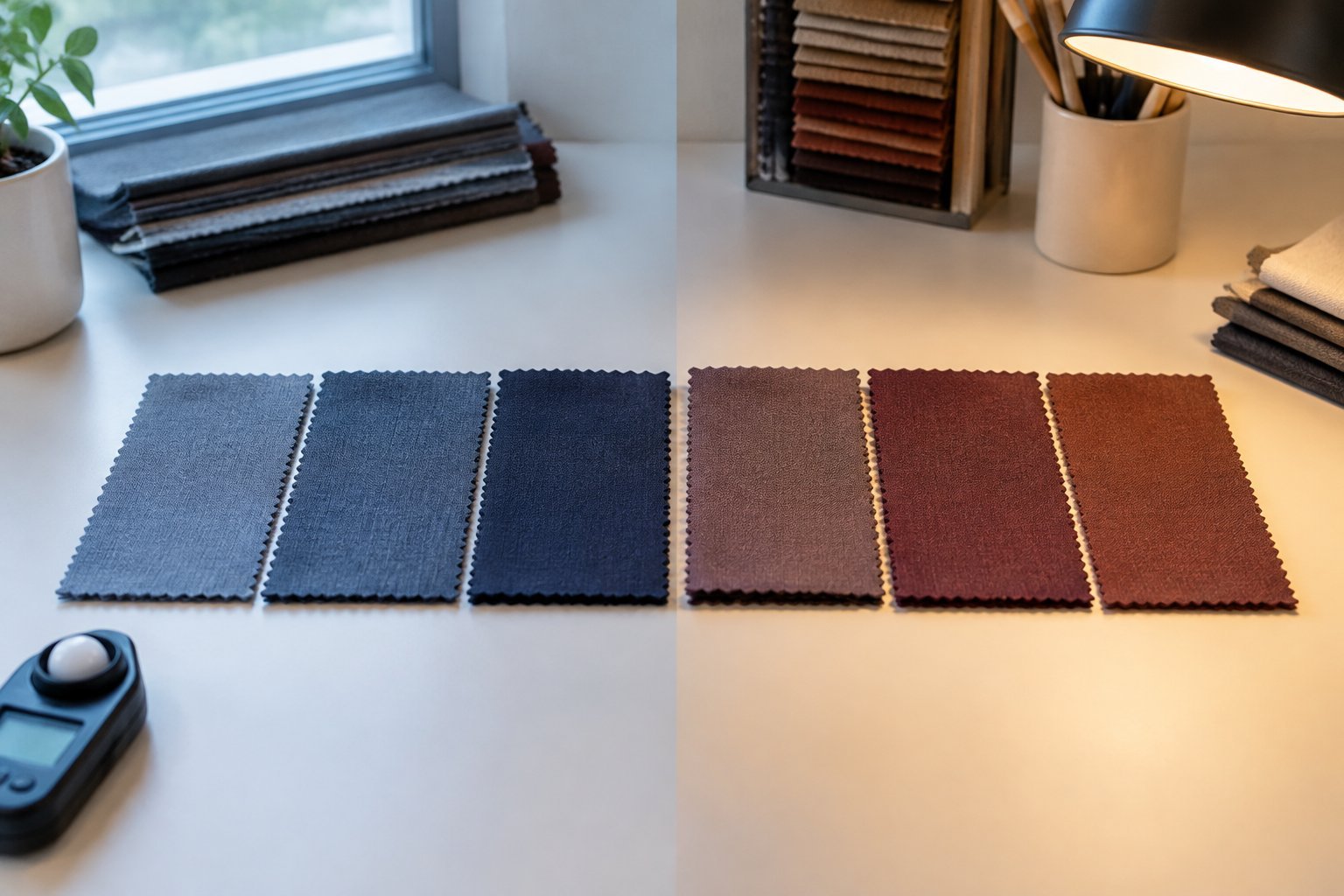
What is an example of metamerism in industrial workwear fabric?
Two navy workwear fabrics might match under D65 but separate into reddish and greenish undertones under a warm indoor source. That pair demonstrates metamerism when the fabrics remain physically unchanged and the different illumination reveals their spectral differences.
Can two fabrics have a low Delta E and still be metameric?
Yes, a low Delta E describes closeness under the illuminant and observer conditions used in that calculation. The same pair needs separate evaluation under secondary illuminants to establish whether the match remains acceptable.
Is observer metamerism the same as illuminant metamerism?
Observer metamerism involves disagreement between observers about a sample pair under the same illumination. Illuminant metamerism involves a changed match when the light source changes while the observer conditions remain fixed.
Can metamerism be eliminated completely?
Closely matched spectral reflectance substantially reduces illuminant metamerism, but a guarantee covering every substrate and viewing condition is impractical. Purchasing specifications should define acceptable agreement under named sources, with separate requirements for properties such as color fastness to washing.
Can flame-retardant finishing change an approved color match?
Yes, flame-retardant finishing can alter shade or spectral reflectance and change the relationship between an approved sample and its reference. Finished fabric needs renewed color assessment, while flame-retardant property testing provides separate evidence about protective performance.