
Buyers should assess food pharma workwear fabric through documented soil-removal results and measured fiber or particle shedding after laundering under the facility’s intended care conditions. Acceptance limits should reflect the production zone, product exposure, and contamination risks.
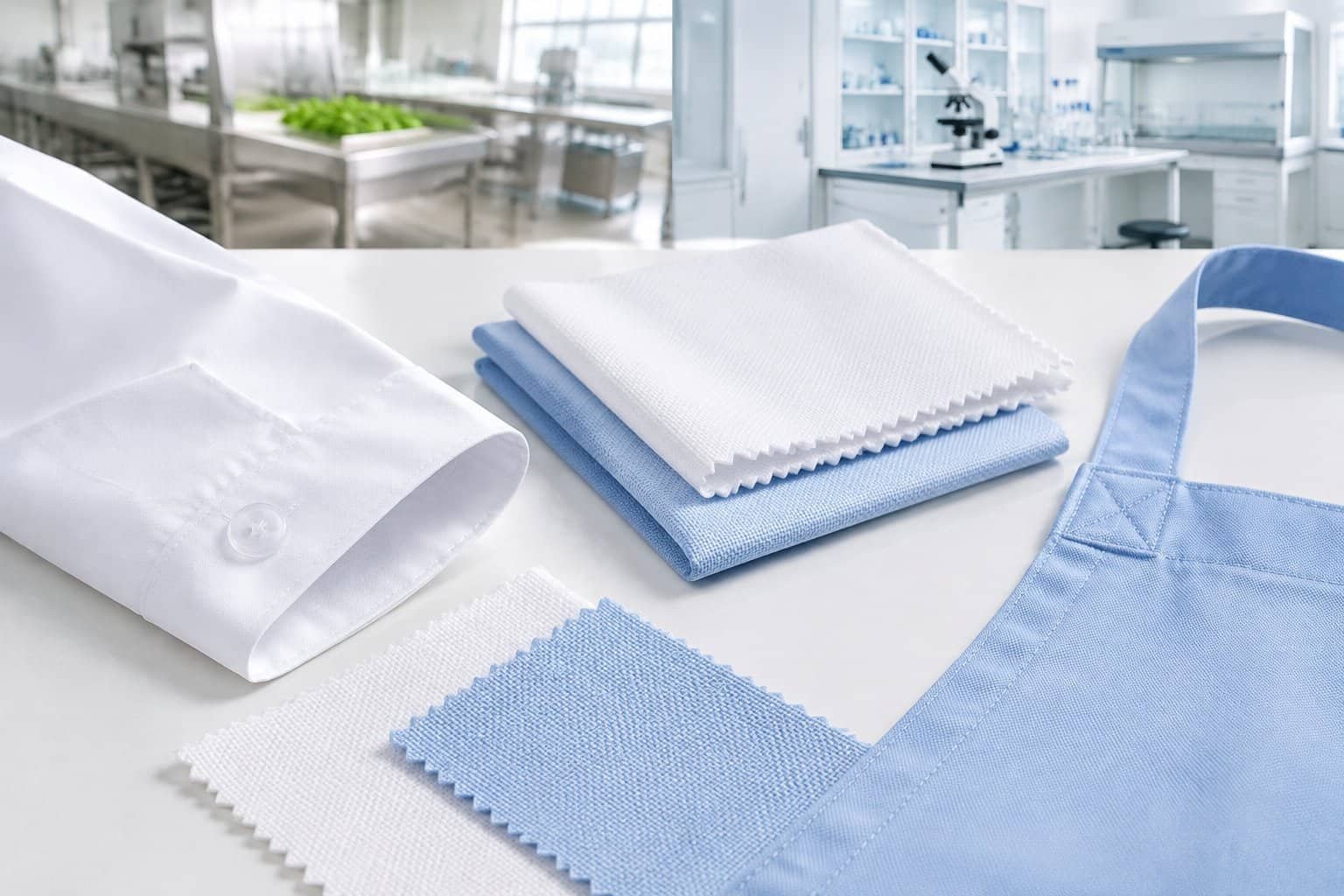
Levitex manufactures industrial workwear fabrics, including cotton-based textile families. For food and pharmaceutical buyers, a useful specification connects the proposed fabric to its cleaning process and required evidence. A white appearance or smooth hand alone provides little information about residual contamination or shedding during use.
What Evidence Does Your Production Environment Require?

The production environment determines the evidence required for textile acceptance. Exposed-product operations need a different assessment from enclosed packaging areas or classified pharmaceutical spaces.
Define the Application, Contamination Risks, and Acceptance Criteria
The specification should identify where the textile will be worn and how contamination could reach the product. Relevant hazards include loose fibers, transferred allergens, microorganisms, and residues from processing or laundering.
Acceptance criteria should translate those hazards into measurable requirements:
- Representative soils and the method used to assess removal.
- Fiber or particle release limits under a defined test.
- Residual detergent or processing-chemical limits where relevant.
- Dimensional stability and surface condition after repeated cleaning.
- Sampling frequency and rules for rejecting a batch.
Food safety clothing should also remain serviceable through the approved care process. Fraying or surface breakdown creates a separate contamination concern even when soil removal remains satisfactory.
Distinguish Ordinary Production Uniforms from Validated Cleanroom and Sterile Uses
Ordinary production uniforms support workplace hygiene under facility-defined controls. Classified cleanroom clothing requires additional evidence addressing particle release and contamination containment within the complete clothing system.
Sterile applications introduce further requirements for validated sterilization and maintenance of the required condition through handling and use. Cotton, cotton/nylon, and cotton-rich cotton/polyester compositions carry no automatic cleanroom or sterile-use suitability.
For U.S. pharmaceutical operations, the quality unit should approve textile requirements within the facility’s applicable manufacturing controls. A fabric supplier’s general product report alone cannot establish that approval.
How Does HACCP Inform Textile Requirements?
HACCP identifies food-safety hazards and the controls needed to manage them. A HACCP uniform program translates relevant findings into clothing selection, changing procedures, laundering controls, and segregation between production zones.
Food safety uniforms should therefore be specified against the facility’s hazard analysis. “HACCP” on a product description provides insufficient detail to establish shedding performance or cleaning effectiveness.
Textile acceptance records should identify the approved material and its intended application. Uniform handling and replacement procedures require their own documented controls.
How Should Buyers Compare Cleanability and Lint?
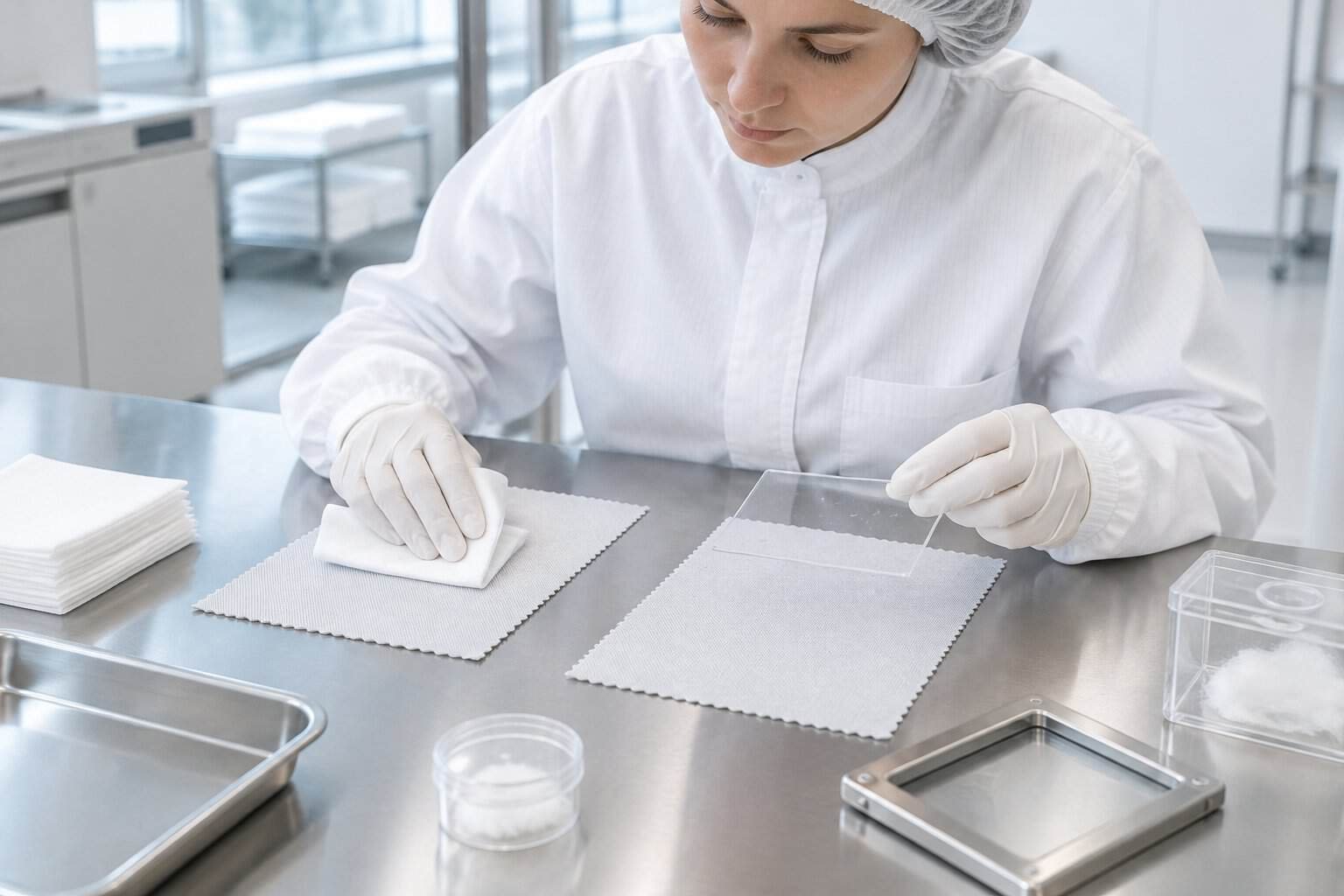
Buyers should compare finished fabrics using equivalent cleaning and shedding tests. Composition helps explain behavior, while yarn selection and processing determine important differences between individual products.
Compare Cotton, Cotton/Nylon, and Cotton-Rich Cotton/Polyester
Cotton fabrics absorb moisture and suit applications where absorbency is useful. Short staple fibers also require attention during shedding assessment, particularly as abrasion and laundering disturb the surface.
Cotton/nylon introduces a synthetic component that contributes to mechanical behavior. Cotton-rich cotton/polyester, or CVC, combines a cotton-majority composition with polyester; neither blend name establishes hygienic cleanability.
| Assessment point | 100% cotton | Cotton/nylon (C/N) | Cotton-rich cotton/polyester (CVC) |
|---|---|---|---|
| Composition | Cotton only | Cotton and nylon | Cotton-majority polyester blend |
| Moisture behavior | Absorbent | Cotton-content dependent | Blend dependent |
| Yarn evidence needed | Staple length, hairiness | Fiber form, hairiness | Fiber form, hairiness |
| Cleaning review | Cotton and finish compatibility | Both fibers and finish | Both fibers and finish |
| Shedding evidence | Measured results | Measured results | Measured results |
The cotton-versus-polyester comparison helps explain differences in moisture behavior and soil interaction. Selection still requires results for the proposed construction, especially where oily residues or particulate contamination dominate.
Assess Yarn, Construction, Surface Finish, and Measured Shedding
Yarn hairiness, exposed fiber ends, and surface abrasion influence lint generation. A tightly woven staple-fiber fabric still contains short fibers; a smooth initial appearance requires confirmation after laundering.
The comparison should record yarn type, weave or knit structure, density, and finished weight. A fabric weight specification supports product identification, but weight alone establishes no shedding limit.
Fabric finishes also affect the assessment. Initial smoothing or binding effects require post-care verification, and the laboratory should distinguish loose-fiber release from airborne particle generation.
Compare Textile Data Under Equivalent Test and Laundering Conditions
Comparable reports require matching methods and sample preparation. Results from an unwashed swatch and a repeatedly laundered sample describe different material conditions.
The comparison record should include:
- Test method, version, and measurement units.
- Sample area and number of replicates.
- Conditioning temperature and humidity.
- Laundry chemistry and complete cycle settings.
- Sample age and number of completed care cycles.
- Agitation, rubbing, or other release mechanism.
- Acceptance limit and individual results.
For food processing clothing and food manufacturing uniforms, testing should represent likely exposure during movement. Cut-edge shedding should be controlled or separately reported when the method permits.
Will the Fabric Withstand Your Cleaning Process?
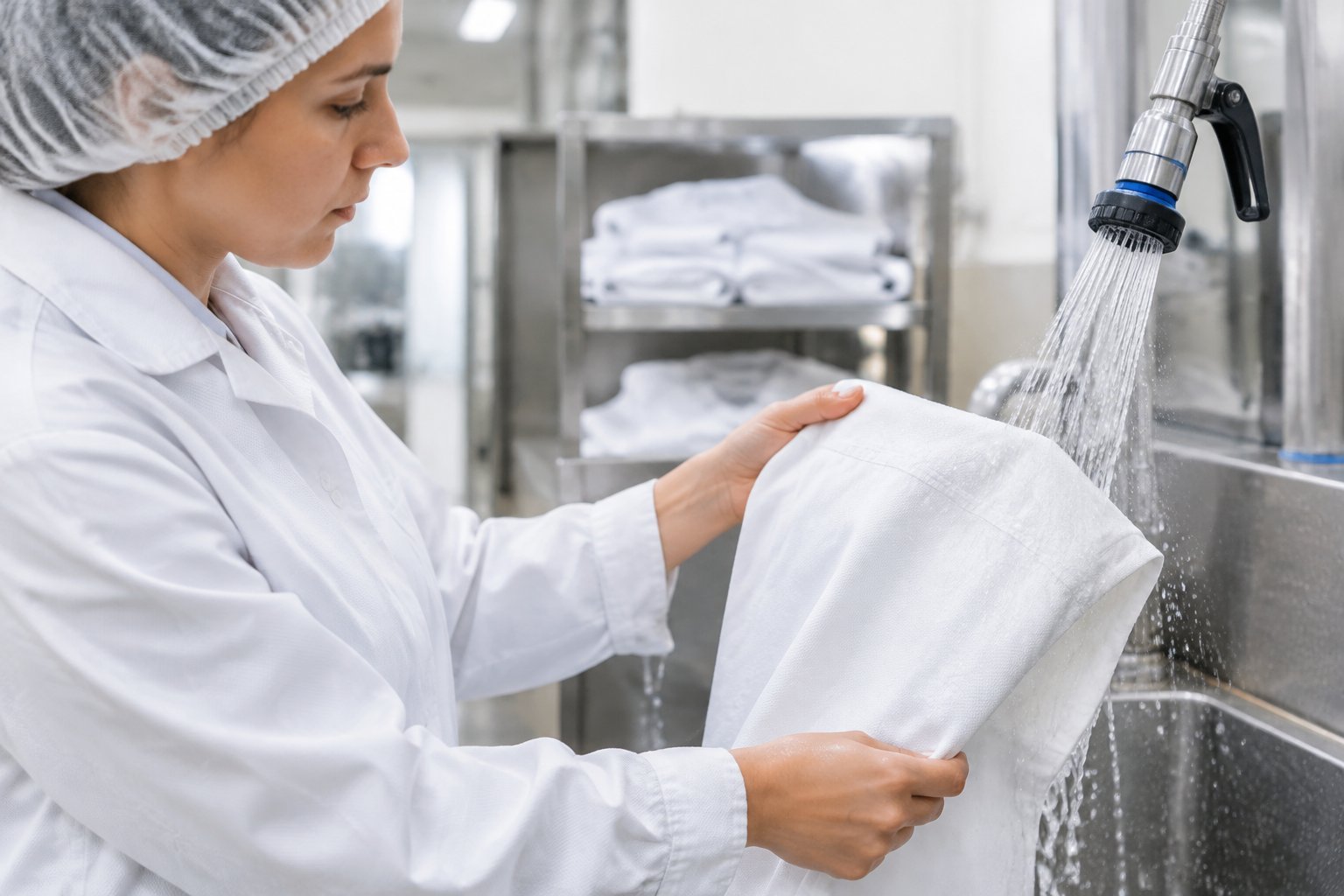
A fabric qualifies for a cleaning process only when it retains required properties after the complete wash-and-dry sequence. Qualification should use the proposed laundry recipe, including any disinfection or finishing stages.
Match Care Chemistry, Temperature, and Drying to the Proposed Textile
The laundry specification should state detergent type and dose, wash pH, water quality, temperature, exposure time, mechanical action, rinsing, and drying conditions. Bleaches and sanitizing agents need explicit compatibility review.
The chemical properties of cotton help explain why chemical concentration and exposure conditions affect fiber durability. Blend components and applied finishes introduce additional compatibility requirements.
A supplier’s maximum wash temperature leaves several questions unanswered. Tumble-drying heat, overdrying, and chemical carryover also require control, particularly when the textile includes a protective finish.
Check Soil Removal, Residual Contamination, and Post-Wash Shedding
Cleaning trials should use soils relevant to the operation. Protein and fat residues require different challenges from dry pharmaceutical powder or colored processing ingredients.
The verification plan should separate visible soil removal from residual contamination testing. Facilities should select appropriate analytical or microbiological methods for the hazard; a visually clean swatch provides no direct measurement of allergen removal or microbial control.
Post-wash assessment should also include surface wear, strength retention, and fabric shrinkage. Shedding measurements at agreed service-life checkpoints help identify deterioration that an initial test would miss.
Why Repellency and Antimicrobial Claims Do Not Prove Hygienic Cleanability
Repellency tests measure resistance to wetting or liquid penetration under defined conditions. Antimicrobial tests measure specified activity against selected organisms under a particular protocol.
Neither result measures the complete removal of production soil during laundering. For example, oil-repellency testing supplies useful surface-performance data, while residual oil after washing requires a separate assessment.
An antimicrobial claim also requires review of its organism scope and post-care performance. It does not replace validated cleaning, facility sanitation, or contamination-control procedures.
What Should a Fabric Procurement Checklist Include?

A procurement checklist should make the proposed textile reproducible and its acceptance evidence traceable. Responsibilities for fabric approval and uniform-program approval should be assigned separately.
Specify Application, Composition, Construction, Care Conditions, and Acceptance Evidence
An RFQ should connect material details to measurable outcomes. A purchasing specification should include:
- Application: production zone, product exposure, and contamination sensitivity.
- Composition: exact fiber percentages and permitted tolerance.
- Construction: yarn details, weave or knit, density, and finished weight.
- Finish: required treatments and restrictions on additional chemistry.
- Care: approved wash, disinfection, drying, and finishing conditions.
- Acceptance: soil-removal criteria, shedding method, and post-care limits.
- Traceability: product code, lot identification, sampling plan, and change notification.
Where buyers compare CVC fabric with 100% cotton, both quotations should use the same acceptance requirements. A composition substitution requires technical review before purchasing approval.
Separate Textile Evidence from Garment and Uniform-Program Requirements
Fabric reports cover the tested textile and stated conditions. Butcher coats, food processing coats, and other finished garments introduce seams and components that require separate assessment.
The external garment supplier should address closure security, seam cleanliness, coverage, and any pocket restrictions established by the facility. Those requirements belong in the garment specification.
A HACCP uniform program also addresses clean and soiled segregation, changing frequency, transport, and repairs. Textile approval supports that program without establishing the performance of every subsequent handling stage.
Add Flame Resistance Only When the Hazard Assessment Requires It
Flame resistance belongs in the specification when the task exposes workers to an identified thermal hazard. Some maintenance or utility roles within food and pharmaceutical facilities require protective workwear beyond routine production hygiene clothing.
Untreated 100% cotton is combustible. Cotton content alone therefore supplies no evidence of flame protection.
Where FR performance is required, procurement should request the applicable product-specific report and compatibility with the intended cleaning recipe. A protective finish creates an additional property to verify throughout the approved service period.
Confirm Levitex’s Textile Supply Scope and Product-Specific Reports
Levitex supplies textiles for industrial production and protective-workwear applications. Its base-fabric families include 100% cotton, cotton/nylon (C/N), and cotton-rich cotton/polyester (CVC), with woven and knitted manufacturing capability.
The company offers wholesale fabrics, custom dyeing, custom printing, and customized flame-retardant fabric production. Finished garments and garment-design or assembly solutions fall outside its supply scope.
Each product has a test report. Procurement should verify the report’s methods and tested conditions against the application; FR fabric quality control addresses protective-textile performance, while hygienic cleanability and lint require their own relevant evidence.
Levitex’s industrial textile offering carries no promise of sterile suitability or cleanroom validation. Buyers should submit application-specific evidence requirements before material selection.
Choose Fabric Proven for Your Process

Fabric approval should follow application-specific cleaning and shedding results. Comparable reports, representative laundering, and documented acceptance limits provide the basis for selecting material and controlling repeat orders.
Buyers with industrial textile requirements are invited to contact Charlie Luo at Charlie@levitex.com. An initial inquiry should identify the production application, proposed composition, care recipe, and required test evidence so Levitex can address the textile supply requirement.
Frequently Asked Questions

Procurement questions are resolved most effectively through application-specific specifications and comparable product reports. The distinctions below help keep commercial discussions aligned with technical approval.
What fabric is best for food and pharmaceutical workwear?
The best candidate is a finished fabric that passes the facility’s cleaning and shedding acceptance criteria. Cotton-based workwear fabrics offer different absorbency and durability characteristics, so approval should identify the exact construction and finish.
What does food-safe fabric mean for production uniforms?
“Food-safe fabric” should describe suitability for a defined production-uniform application supported by relevant evidence. The term alone establishes no universal cleaning performance, and any intended direct food contact requires its own assessment.
Are cotton-rich fabrics automatically suitable for cleanrooms?
Cotton-rich fabrics require application-specific qualification before cleanroom use. Approval should address particle release and the complete clothing system, including any required sterilization process.
How can buyers verify low-lint claims after laundering?
Buyers should request measured shedding results after the specified laundry process and at agreed care intervals. Reports should identify the release method, particle or fiber measurement, sample preparation, and acceptance limit.
What affects the price of food and pharma workwear fabric?
Price reflects fiber composition, yarn quality, construction, finishing, and order quantity, along with testing requirements. Quotations for food processing uniforms should keep textile costs separate from garment conversion and uniform-program services so buyers compare equivalent supply scopes.