
EN 13034 Type 6 covers at least the trunk and limbs and includes a reduced whole-suit spray test; Type PB[6] provides partial body protection without that whole-suit test. Both classifications address limited protective performance against liquid chemicals, with material testing that evaluates liquid repellency and resistance to penetration.

For protective-workwear buyers, the distinction separates evidence about a fabric from evidence about the clothing assembled from it. A jacket and trousers require assessment as a specified combination before their separate markings support a Type 6 claim.
Levitex manufactures chemical-repellent textiles through post-treatment finishing on cotton, cotton/nylon, and cotton-rich cotton/polyester fabrics. Its textile-production role makes the boundary between material performance and finished-garment requirements especially relevant to industrial sourcing.
How Do Coverage and Testing Differ Between Type 6 and PB[6]?
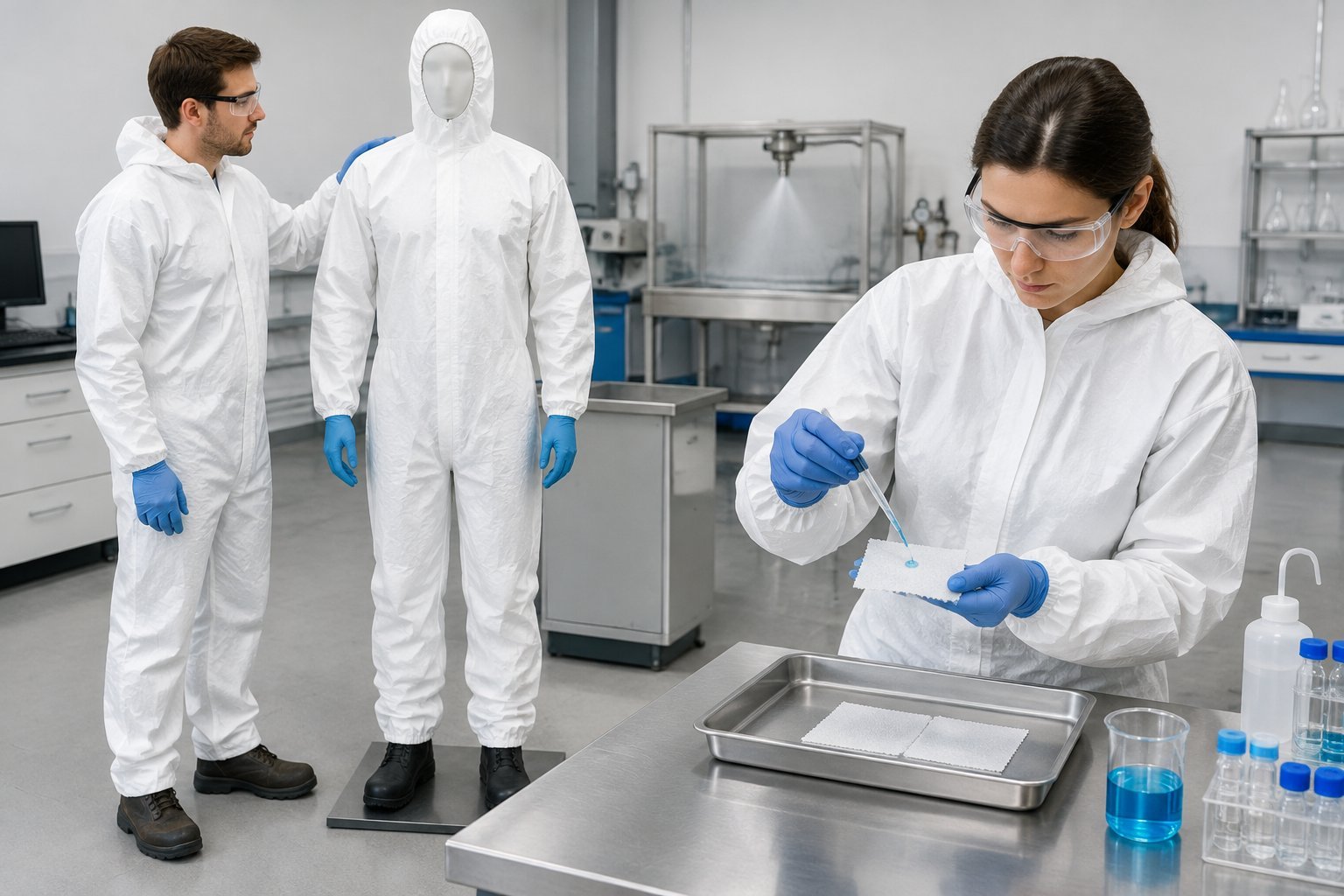
Coverage and whole-suit testing distinguish Type 6 from PB[6] under EN 13034. Both classifications require evidence of limited protective performance, but their garment-level assessment scopes differ.
| Criterion | Type 6 | Type PB[6] |
|---|---|---|
| Coverage | At least trunk and limbs | Specified body areas |
| Clothing examples | Coverall or two-piece suit | Apron, coat, sleeves |
| Material performance requirements | Applicable | Applicable |
| Reduced whole-suit spray test | Required | Not required |
| Evidence scope | Specified complete suit | Specified partial-body item |
Type 6 Covers the Trunk and Limbs in a Coverall or Two-Piece Suit
Type 6 chemical protective clothing covers at least the trunk and limbs. A one-piece coverall or an assessed two-piece suit satisfies this coverage format; a hood or integrated foot protection depends on the design.
“Full-body” descriptions require careful reading because hand, face, and respiratory protection remain separate considerations. Manufacturer instructions identify the additional equipment and garment configuration used for the suit assessment.
PB[6] Protects Specific Body Areas Without Whole-Suit Spray Testing
PB means partial body protection. Examples include an apron covering the front of the body or sleeves protecting designated areas of the arms.
PB[6] items remain subject to applicable material, construction, and information requirements. Their marking establishes a limited protection claim for the covered area, while leaving the complete ensemble’s leakage performance unassessed by the Type 6 whole-suit test.
Why Combining Separately Marked Garments Does Not Establish Type 6 Conformity
Separate PB[6] markings establish the assessed scope of each item. Wearing those items together introduces interfaces whose behavior requires assessment, including the jacket-to-trouser overlap during movement.
A Type 6 claim needs documentation identifying the approved combination and its whole-suit assessment. These chemical protective clothing levels describe defined protection scopes; garment compatibility requires evidence beyond matching labels.
What Do the Material and Garment Tests Actually Measure?
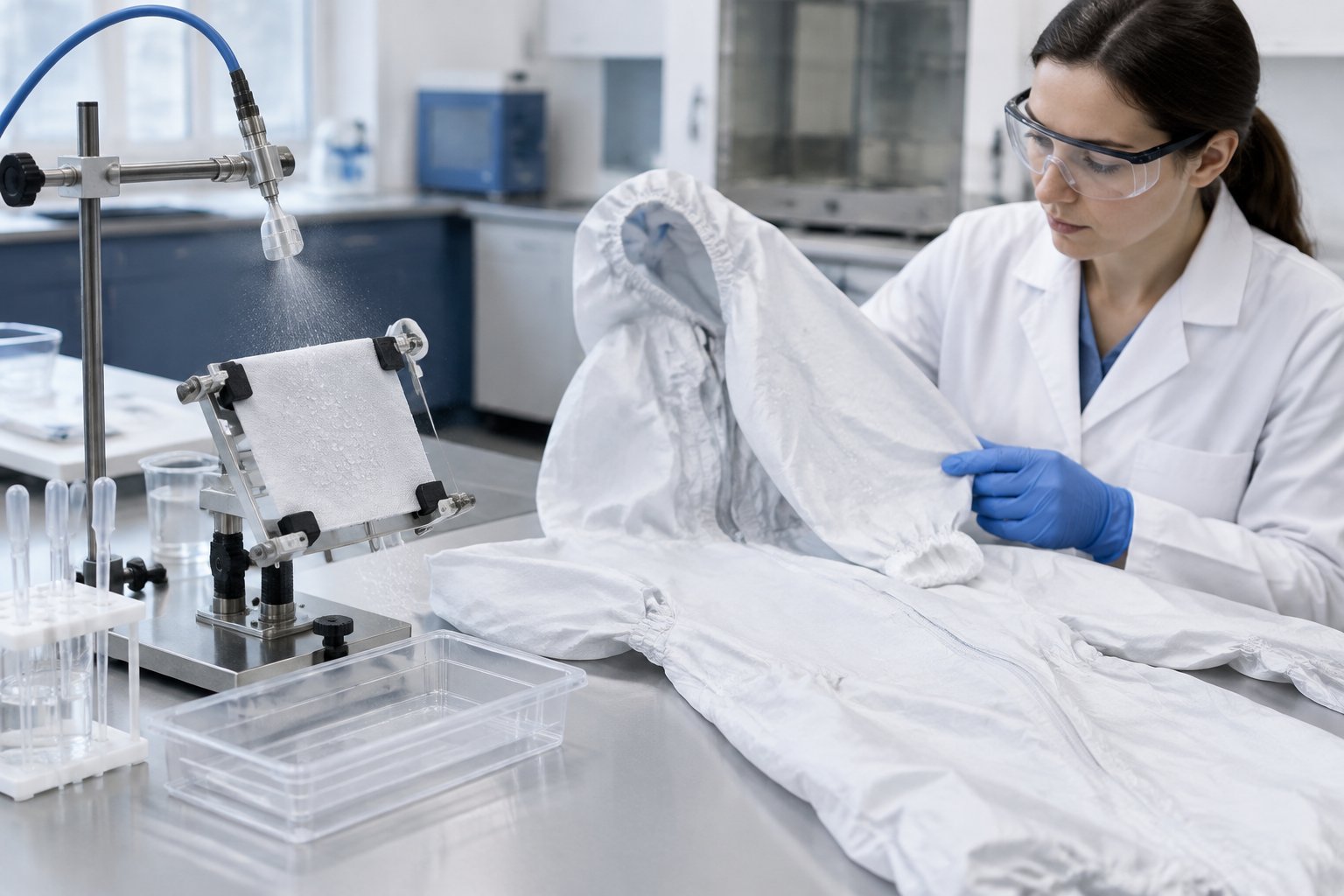
Material tests measure liquid behavior and physical durability, while the Type 6 light spray test evaluates leakage through the assembled suit. Each result answers a different performance question.
Liquid Repellency and Penetration Are Separate Material Results
Liquid repellency measures the proportion of an applied test liquid that runs off the material under specified conditions. Resistance to penetration by liquids measures how much passes through the specimen during that test.
A report therefore needs both results for each relevant chemical. The distinction between waterproof, water-resistant, and water-repellent fabrics also illustrates why visible beading alone provides incomplete evidence of protective performance.
The Light Spray Test Assesses Leakage Through the Complete Suit
The reduced whole-suit light spray test checks inward leakage through the assembled clothing. It evaluates vulnerable areas such as closures and connections between garment parts under a defined spray challenge and prescribed wearer movements.
An absorbent undergarment reveals liquid ingress for evaluation against the method’s acceptance criteria. This suit-level result differs from the chemical-specific material test: the spray test does not expose the wearer to the workplace chemical or establish molecular permeation resistance.
Mechanical Strength and Seams Have Their Own Requirements
Applicable performance requirements include abrasion resistance, tear resistance, tensile strength, puncture resistance, and seam strength. These properties address the clothing’s ability to retain integrity during use.
Stitched seams introduce needle holes and local construction effects that material-only testing cannot characterize. Their suitability depends on the assessed garment design and required performance; the standard does not prescribe one universal seam construction for every product.
Material Reports Do Not Replace Garment Conformity Assessment
A fabric report supports the documented material claim. EN 13034 certified protective clothing also requires assessment of the finished product within its declared scope.
For EU-market Category III PPE, the conformity route involves a notified body and ongoing production conformity procedures. FR fabric quality control supports consistent textile production, while finished-garment assessment remains the clothing manufacturer’s responsibility. US employers must also assess suitability under applicable workplace PPE obligations.
Which Chemicals Are Tested, and What Do the Results Mean?

Chemical-specific results establish performance against the liquids and concentrations identified in the report. The EN 13034 marking alone does not establish protection against every reference chemical or workplace substance.
Reference Liquids: Sulphuric Acid, Sodium Hydroxide, o-Xylene and Butan-1-ol
The reference liquids associated with EN 13034 material testing are:
- Sulphuric acid (H2SO4), 30% aqueous solution.
- Sodium hydroxide (NaOH), 10% aqueous solution.
- o-Xylene, undiluted.
- Butan-1-ol, undiluted.
Butan-1-ol is also called n-butanol. These liquids represent selected chemical challenges; procurement teams should check which were tested and which achieved the required results.
Why Chemical Identity and Concentration Matter
Chemical name, concentration, and formulation affect interaction with a textile and its finish. A result for 30% sulphuric acid provides evidence for that specified test condition, without establishing behavior against concentrated acid or an acid mixture.
The same discipline applies to acid-resistant fabric claims: supporting evidence needs an identified chemical and exposure condition. Temperature and contaminants also deserve attention when the workplace liquid differs from the laboratory solution.
How to Read Chemical-Specific Results Without Assuming Universal Protection
Each chemical entry should identify the tested concentration, liquid repellency result, penetration result, and specimen condition. A pass or class without those details leaves the intended exposure insufficiently described.
A sodium hydroxide result supports a specific claim about that solution; broader alkali resistance requires evidence relevant to the material and conditions involved. For mixtures or other solvents, the buyer should request exposure-specific evaluation before accepting a protection claim.
When Is Limited Splash Protection Insufficient?
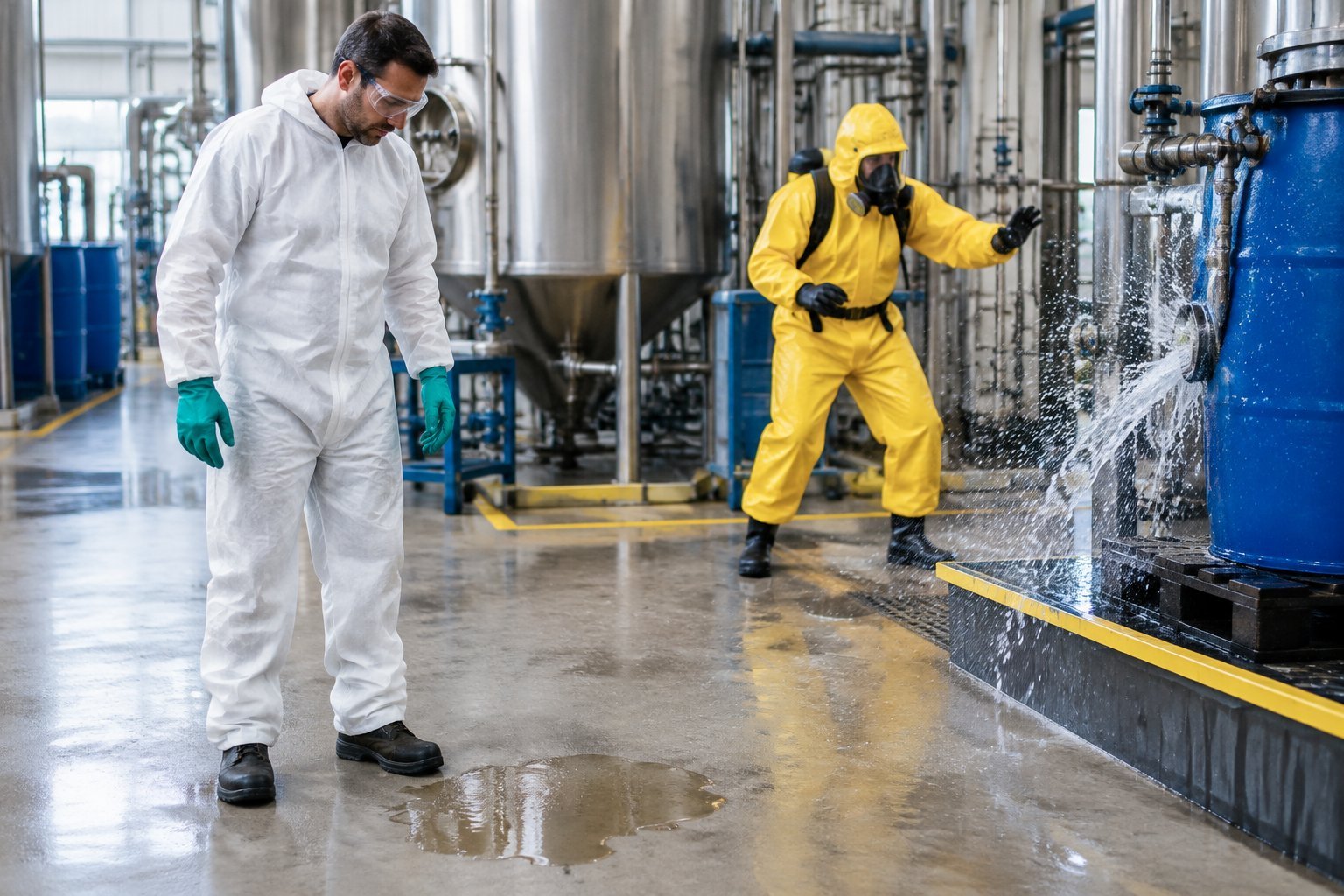
Limited splash protection is insufficient when the exposure demands greater liquid exclusion or a verified permeation barrier. Exposure intensity and the chemical’s health effects both determine the required protective system.
Assess Splash Volume, Pressure, Duration and Chemical Hazard
EN 13034 protective clothing addresses potential exposure to light spray, liquid aerosols, or low-pressure, low-volume splashes where a complete liquid permeation barrier is unnecessary. Suitability still requires a task-specific risk assessment.
Sustained wetting, pressurized releases, immersion, or contamination trapped against clothing exceed that limited-exposure premise. Even a small splash warrants stronger protection when the substance causes severe harm through skin contact or absorption.
How EN 14605 Type 3 and Type 4 Address Different Exposure Conditions
EN 14605 covers protective clothing against liquid chemicals with liquid-tight connections for Type 3 and spray-tight connections for Type 4. Their garment tests address more demanding liquid exposure conditions than the reduced Type 6 spray test.
Selection still requires chemical-specific material evidence and an assessed ensemble. The type designation describes an exposure-performance category; the manufacturer’s documentation establishes which chemicals and use conditions the clothing supports.
Why Penetration Results Do Not Establish Permeation Resistance
Penetration describes liquid movement through openings, pores, seams, or defects. Permeation describes molecular transport through a material, including absorption into one surface and diffusion through its structure.
A chemical-resistant fabric claim therefore needs a clearly defined test basis. Low penetration during a short liquid test supplies no measured breakthrough time or permeation rate for prolonged chemical contact.
Other PPE and FR or Anti-Static Requirements Need Separate Assessment
Chemical protection requires coordinated assessment of gloves, footwear, eye protection, and any necessary respiratory equipment. Interfaces between those items and the clothing also affect exposure.
EN 13034 does not automatically require EN ISO 11612 flame protection or EN 1149-5 electrostatic properties. Where a workplace includes thermal or electrical hazards, the difference between arc-rated and flame-resistant clothing also requires separate consideration and supporting evidence.
How Do Washing and Preconditioning Affect Protection?
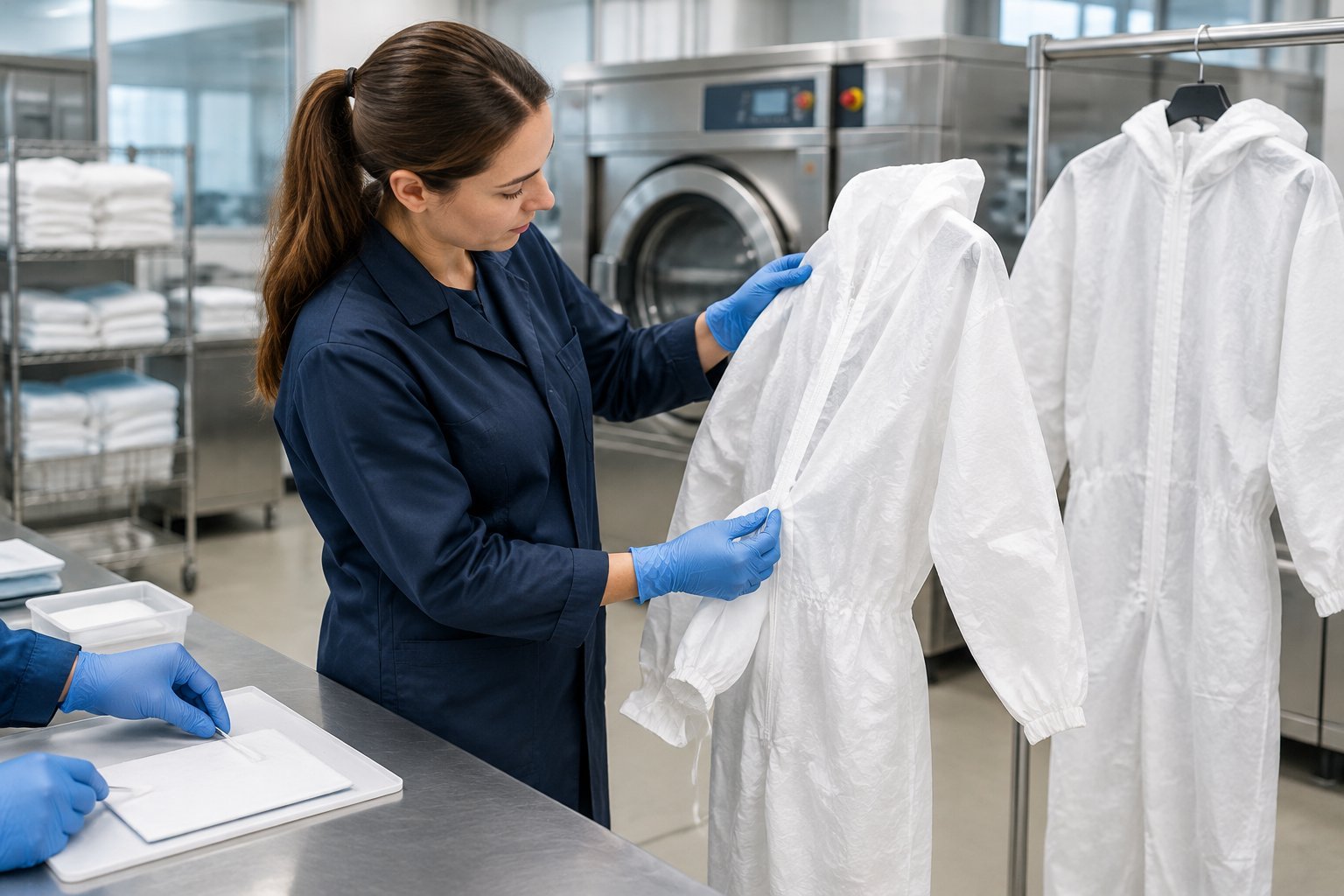
Cleaning and preconditioning affect how closely reported performance represents clothing in service. Reports and care instructions should identify the conditions under which liquid repellency and resistance to penetration by liquids were assessed.
Check Whether Reports Describe New or Care-Preconditioned Materials
A new-fabric result describes the specimen before the stated care exposure. A care-preconditioned result describes performance after the documented cleaning procedure.
Buyers should check the washing method, drying conditions, and any treatment applied before testing. A cycle count without those details provides an incomplete basis for comparing suppliers or specifying reusable EN 13034 protective clothing.
Follow Validated Cleaning, Reactivation and Retreatment Instructions
Some repellent finishes require heat reactivation under specified drying conditions. Other care systems include controlled retreatment to restore the intended surface performance.
The validated instructions must identify the permitted process and treatment chemistry. With water-repellent FR fabric finishing, the assessment also needs to account for the interaction between the repellent treatment and flame-resistant performance.
Do Not Assume a Universal Wash Life or Retreatment Interval
EN 13034 does not give every reusable garment a common service life or retreatment schedule. The validated care system and product-specific evidence determine the supported conditions.
For multifunctional clothing, washing flame-resistant fabric clothing requires attention to every claimed property. Visible beading after laundering remains insufficient proof of chemical penetration performance or continued garment conformity.
Where Do Levitex Chemical-Repellent Fabrics Fit?
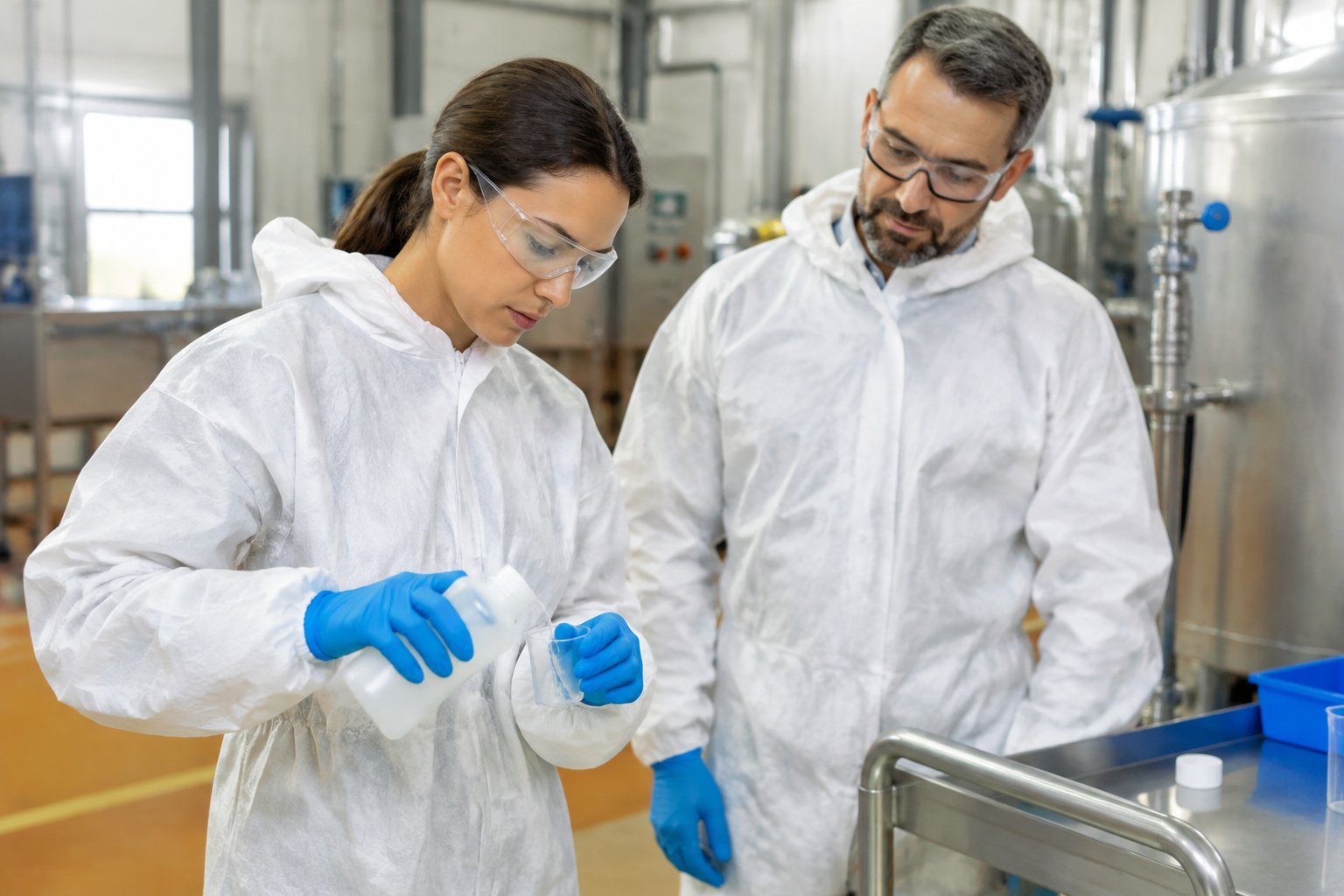
Levitex supplies post-treated chemical-repellent textiles for industrial protective-workwear applications. Their suitability for a particular chemical exposure requires product-specific evaluation and evidence.
Post-Treatment Repellency on Cotton, Cotton/Nylon and CVC
Levitex produces chemical-repellent fabric through post-treatment finishing on cotton, cotton/nylon (C/N), and cotton-rich cotton/polyester (CVC) base fabrics. The treatment provides chemical liquid repellency.
These fabrics occupy a different protection category from barrier-based chemical-resistant materials. The chemical properties of cotton fabric help explain substrate behavior, but composition alone establishes neither a chemical protection level nor a finished-product conformity claim.
Separate Levitex Fabric Capabilities From Finished-Garment Requirements
Levitex is a textile producer, not a finished-garment or garment-design-solution supplier. Its offering supports the material stage of a protective-workwear supply chain.
The finished-clothing manufacturer remains responsible for the garment design and applicable conformity assessment. A Type 6 claim must include evidence for the assembled suit, including its closures and garment-to-garment connections where relevant.
Request Relevant Product Evidence for the Intended Chemical Exposure
A useful technical request identifies the chemical, concentration, temperature, exposure pattern, and laundering conditions. It also states whether the requirement concerns material testing, partial body protection, or a complete suit.
Buyers may send those details and the required evidence to Charlie Luo at Charlie@levitex.com. Levitex’s evaluation should precede any protection commitment; general product reports do not establish suitability for an unspecified chemical exposure.
Match Coverage and Verified Chemical Performance to the Exposure
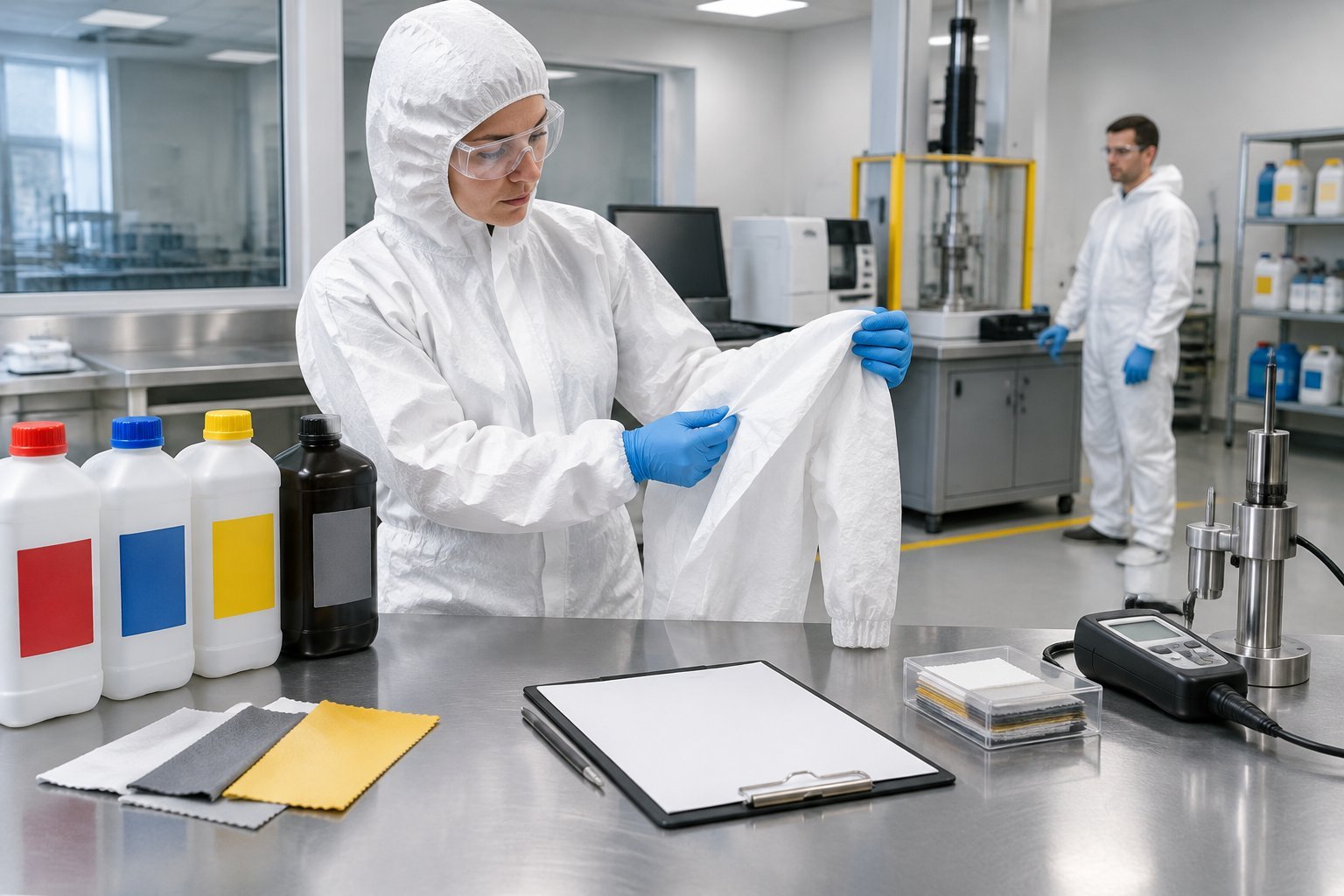
Type 6 supports a complete-suit claim covering at least the trunk and limbs, while PB[6] supports partial body protection for specified areas. Chemical-specific material evidence and garment-level assessment establish different parts of the protection claim.
Selection should connect the expected liquid chemicals to the documented test conditions and validated care process. For a two-piece Type 6 suit, the procurement record should identify the exact approved jacket-and-trouser combination.
Frequently Asked Questions
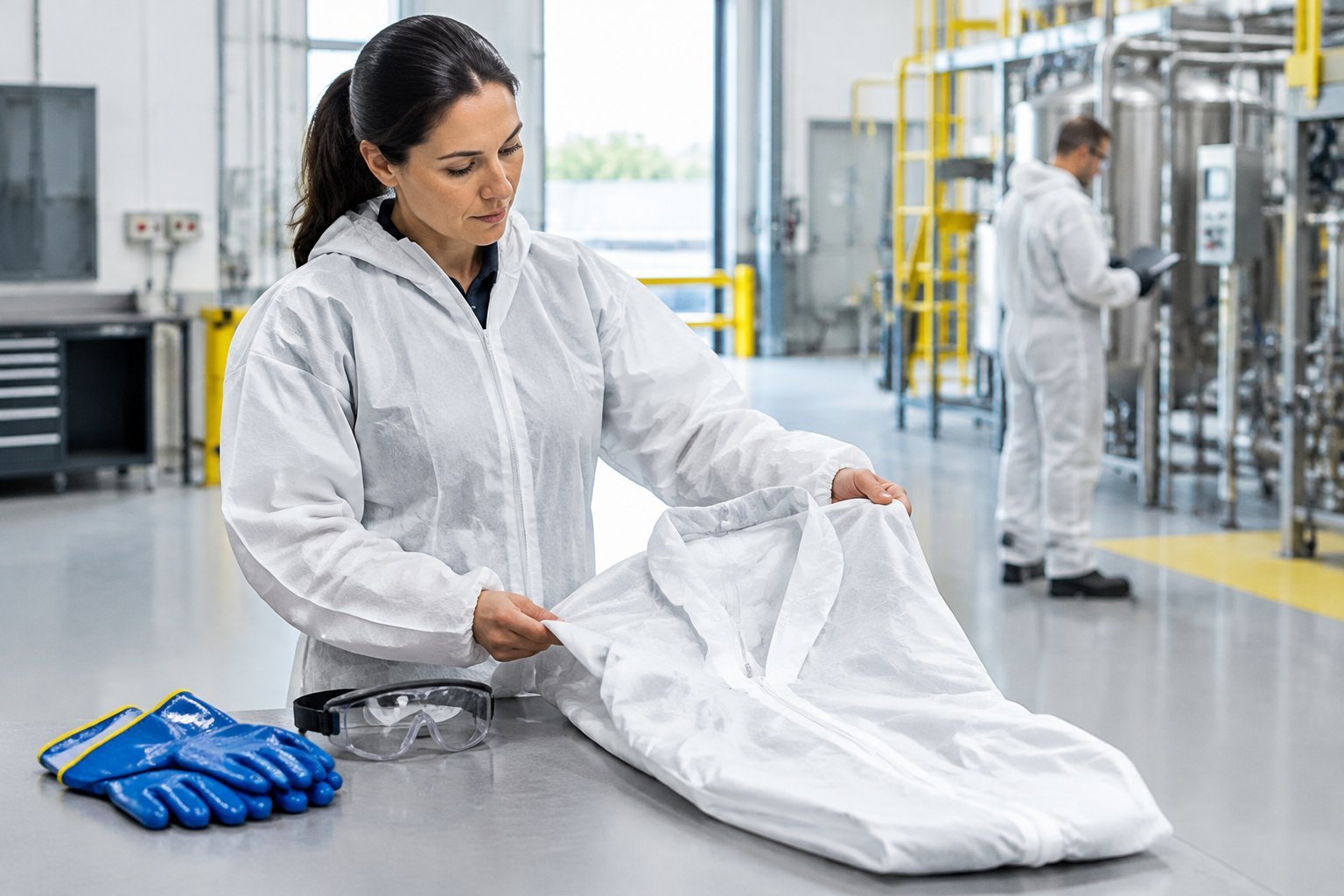
EN 13034 claims should be read alongside the product’s instructions and conformity documentation. The following distinctions resolve common questions about combination garments and adjacent standards.
Can a jacket and trousers qualify together as Type 6?
A jacket and trousers qualify together as Type 6 when the specified combination has undergone the applicable complete-suit assessment. Separate PB[6] markings do not establish that combined claim.
Does EN 13034 protect against every acid and solvent?
EN 13034 provides chemical-specific evidence within its limited-protection scope. Protection against a particular acid, solvent, or mixture requires results relevant to its identity, concentration, and exposure conditions.
Does Type 6 also provide Type 5 particle protection?
Type 6 classification establishes limited liquid chemical protection. Type 5 airborne solid-particle protection requires separate assessment under EN ISO 13982-1, with both claims documented for dual-classified clothing.
Does EN 13034 also require EN ISO 11612 or EN 1149-5 compliance?
EN 13034 does not automatically require compliance with either standard. Workplace thermal and electrostatic hazards determine whether those additional performance requirements belong in the specification.
Where can I obtain the official EN 13034 standard PDF?
Authorized national standards bodies, including BSI and DIN, supply official EN 13034 documents. The referenced designation is EN 13034:2005+A1:2009; purchasers should confirm the applicable edition, amendments, and national adoption with the issuing body when ordering.