
Ordinary cotton absorbs oil and many chemical liquids and provides no general protective barrier against them. For workwear buyers, cotton fabric offers a comfortable base that supports liquid-repellent finishing when the finished material meets the intended exposure requirements.
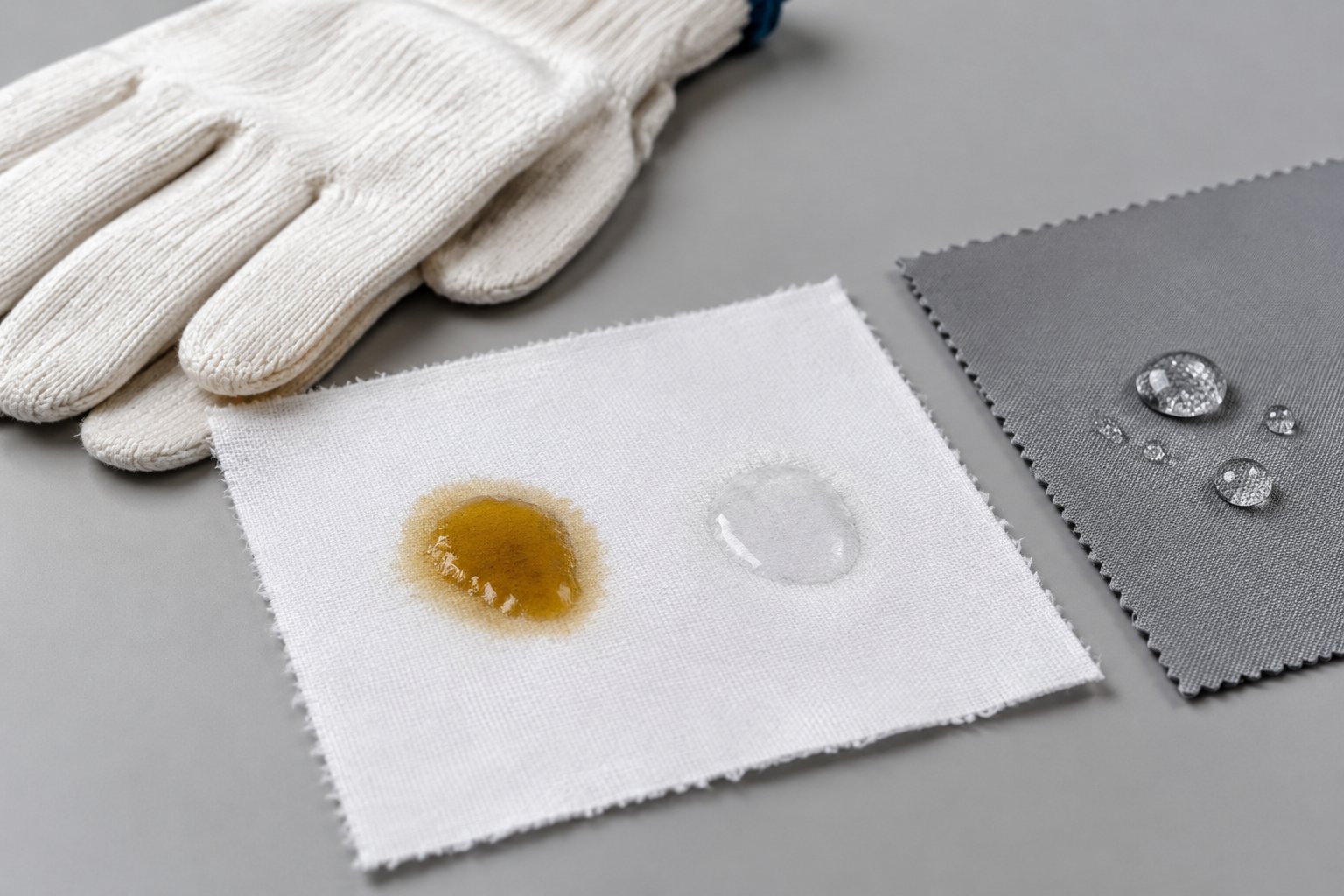
A useful specification separates liquid uptake, damage to the fabric, and exposure of the wearer. Oil-soaked cotton might retain its strength while holding contamination against the skin. Chemical-repellent finishing addresses surface wetting; hazardous exposure requires evidence covering the particular chemical and the completed garment.
Liquid Absorption Is Not the Same as Chemical Damage
Liquid absorption describes how contamination enters and remains in fabric, while chemical damage describes changes to the material itself. A garment’s appearance reveals only part of its condition after exposure.
Why Does Untreated Cotton Take Up Oil and Other Liquids?
Cotton fibers form yarns with spaces that draw wetting liquids through the fabric by capillary action. Cellulose fibers also interact with water through their hydroxyl groups and hydrogen bonds. Oil uptake occurs largely through wetting and retention within the textile structure.
Processing removes much of raw cotton’s natural surface material, so raw-fiber behavior provides a poor basis for judging finished workwear. The chemical properties of cotton fabric explain its fiber behavior, while garment suitability requires exposure-specific evidence.
Can Fabric Stay Intact While Chemicals Reach the Skin?
Chemicals reach the skin through porous fabric without first destroying its fibers. A shirt that retains its color and shape therefore provides no assurance that exposure has been prevented. Retained liquid also extends contact after the initial splash.
The consequences extend beyond visible irritation. Chemical contact causes effects including burns and sensitization, and some substances enter the body through skin absorption. Inspection must accompany the site’s exposure-response procedure.
Which Chemicals Can Damage Cotton?
Strong acids and uncontrolled oxidizing treatments damage cotton, while its response to alkalis and solvents requires qualification by exposure conditions. Cotton fabric compatibility never establishes skin protection by itself.
How Do Acids and Alkalis Affect Cotton Differently?
Strong mineral acids attack cellulose and reduce cotton’s strength. Damage depends on acid identity and concentration, with heat and prolonged contact increasing the risk. Dilute exposure also warrants attention because deterioration is not always immediately visible.
Cotton tolerates many alkaline textile-processing conditions, including carefully controlled caustic treatment. This alkali resistance concerns the fiber’s integrity. Sodium hydroxide remains hazardous to skin even when the cotton fabric survives contact.
How Do Solvents and Oxidizing Agents Affect Cotton?
Many common organic solvents leave cellulose fibers structurally intact during brief contact. They still wet porous textiles and might affect dyes or finishes. Solvent-contaminated clothing also introduces skin-exposure and flammability concerns.
Oxidizing agents require careful control because excessive treatment weakens cellulose. Chlorine bleach and peroxide behave differently under different processing conditions. A chemical’s use in textile processing does not establish the safety of uncontrolled workplace contact.
Why Do Concentration, Temperature, and Contact Time Matter?
Chemical compatibility describes performance under defined conditions. Higher temperatures accelerate many degradation reactions, and longer contact gives liquids more opportunity to spread through a textile. Concentration effects require chemical-specific assessment because mixtures do not behave predictably from their ingredients alone.
A cool, brief splash and sustained contact with hot process liquid require different specifications. Buyers should record the actual exposure conditions alongside the chemical name. A broad description such as “acid-resistant cotton” leaves essential variables unresolved.
Comparing Untreated Cotton, Finished Blends, and Engineered Barriers
Untreated cotton, repellent-finished fabrics, and engineered chemical barriers serve different functions. Adding nylon or polyester changes textile properties, but blend identity alone establishes no chemical-protection rating.
Comparison Table: Liquid Uptake, Repellency, and Protection Limits
The comparison below describes material categories, with performance dependent on the specific construction and finish. Engineered barriers also require chemical-specific testing. No category provides unrestricted protection against every substance.
| Criterion | Untreated cotton | Repellent-finished cotton | Finished cotton/nylon (C/N) | Finished cotton/polyester (CVC) | Engineered chemical barrier |
|---|---|---|---|---|---|
| Liquid uptake | Absorbs wetting liquids | Reduced for qualifying liquids | Finish-dependent | Finish-dependent | Construction-dependent |
| Surface repellency | No dependable rating | Test-defined | Test-defined | Test-defined | Product-specific |
| Main function | General workwear base | Reduced surface wetting | Repellency plus blend properties | Repellency plus blend properties | Chemical-specific isolation |
| Permeation evidence | None from fiber identity | Separate testing required | Separate testing required | Separate testing required | Chemical-specific results required |
| Principal limitation | Contamination retention | Finish and exposure limits | Blend provides no barrier rating | Blend provides no barrier rating | Compatibility and service-life limits |
How Do Cotton/Nylon and Cotton/Polyester Blends Change Performance?
Nylon contributes abrasion resistance in appropriately designed cotton blends. Polyester contributes dimensional stability and lower moisture uptake than cotton. The practical cotton versus polyester comparison also includes comfort and care requirements.
These changes do not close every pathway through a woven fabric. Yarn structure and fabric density influence liquid movement alongside the finish. Procurement documents should identify the exact blend and construction tested.
When Is an Engineered Chemical Barrier Needed?
An engineered barrier is appropriate when the hazard assessment requires isolation from hazardous liquids or vapors. Sustained contact, pressurized spray, and substantial splash exposure demand particular attention. The selected material must address the named substance under the expected conditions.
Broader chemical-resistant fabric selection includes coated materials and laminates with documented compatibility. NIOSH states that suggested protective barriers should be confirmed with the vendor for use limitations. Garment design and replacement criteria belong in the same selection decision.
What Can Chemical-Repellent Finishing Actually Do?
Chemical-repellent finishing reduces wetting by specified liquids when applied successfully to a compatible fabric. Its useful scope follows the finished material’s test results and care requirements.
How Can Post-Finishing Reduce Liquid Wetting?
Post-finishing modifies the textile surface so qualifying liquids resist spreading into the fabric. Droplets bead or run off under suitable conditions. The effect depends on the liquid’s surface tension and the condition of the treated surface.
Levitex offers chemical-repellent post-treatment on cotton, cotton/nylon, and cotton/polyester (CVC) base fabrics. These fabric finishes support reduced liquid wetting within their evaluated scope. Water beading alone provides insufficient evidence of oil repellency.
Why Does Repellency Not Establish Permeation Resistance?
Repellency evaluates surface wetting, while permeation concerns chemical movement through material at the molecular level. A visible droplet test leaves molecular transport unmeasured. Penetration through textile openings is another separate exposure pathway.
AATCC 118 evaluates hydrocarbon wetting; its 1997 edition observes droplets for 30 ± 2 seconds. That observation period establishes no safe garment-wear duration. The distinctions between water resistance and fabric repellency likewise require careful interpretation of each test’s scope.
Why Must Flame Resistance Be Assessed Separately?
Flame resistance addresses behavior under defined thermal exposure. Chemical repellency addresses interaction with liquids. Neither property establishes the other.
Where workwear needs both functions, testing should cover the finished combination after its specified care treatment. Flame-resistant finishing must remain compatible with other treatments applied to the fabric. Oil or solvent contamination creates an additional hazard that belongs in the garment’s removal-from-service procedure.
What Evidence Supports Workwear Suitability?
Workwear suitability requires chemical-specific test evidence tied to the supplied material and its intended garment construction. Broad performance labels leave exposure pathways and service limits unresolved.
Which Chemical-Specific Test Reports Should Buyers Request?
Buyers should request reports identifying the exact fabric, finish, and challenge chemical. Conditions must include chemical concentration, test temperature, exposure duration, and any pretreatment. The report should distinguish repellency from penetration and permeation.
The evidence package should address the claimed function:
- Oil repellency: the AATCC 118 method edition and achieved grade.
- Liquid penetration: the test method, chemical, applied pressure, and result.
- Permeation: breakthrough time, permeation rate, and detection or reporting threshold.
- Condition after exposure: relevant strength loss or other degradation observations.
ASTM F903 addresses liquid penetration, while ASTM F739 addresses permeation under continuous contact. OSHA identifies breakthrough time, permeation rate, and system sensitivity among the details needed to interpret permeation evidence. A laboratory breakthrough result requires safety review before it informs a wear schedule.
How Can Laundering, Wear, and Contamination Affect Performance?
Laundering and abrasion alter the surface condition of finished workwear. Detergent residues and accumulated contamination also interfere with liquid behavior. New-fabric results therefore describe a different condition from garments already in service.
Buyers should specify performance after the intended cleaning process and number of care cycles. For multifunctional garments, washing flame-resistant clothing requires attention to the manufacturer’s instructions. An approved FR wash process establishes no chemical-repellent durability claim by itself.
Why Do Seams, Closures, and Garment Coverage Matter?
Seams and openings provide routes around a protective fabric. Stitch holes, zippers, cuffs, and pocket openings all require evaluation against the expected exposure. Movement also changes coverage and places stress on garment interfaces.
Cotton protective clothing with long sleeves covers more skin than short sleeves, but coverage alone establishes no splash-protection rating. Gloves and boots must integrate with the garment without exposing gaps. Fabric swatch results cannot establish the performance of those interfaces.
What Should Happen After Chemical Contamination?
Contaminated clothing requires prompt handling under the chemical’s Safety Data Sheet (SDS) and the site’s response procedure. Trained personnel should control garment removal to limit transfer to skin or clean areas. Any suspected bodily exposure requires the specified first-aid or medical response.
Affected garments should be isolated for an authorized decision on decontamination or disposal. DIY neutralization and routine home washing are unsuitable substitutes for that assessment. Chemical residues, handling hazards, and waste controls must be addressed before cleaning begins.
What Should Buyers Ask Before Ordering Fabric?
A purchase-ready specification connects the exposure profile to measurable fabric requirements and an approved garment design. Cotton fabric, nylon blends, and polyester blends should be identified precisely enough to match the test evidence.
Which Chemicals and Exposure Conditions Must Be Specified?
Buyers should identify each oil or chemical by name and provide its SDS. CAS numbers help distinguish substances with similar commercial names. For mixtures, the supplied formulation and concentration range belong in the assessment.
The exposure description should include liquid temperature, contact duration, splash volume, pressure, and frequency. It should also identify whether exposure involves mist, vapor, or contact with contaminated surfaces. “Oil exposure” alone leaves significant differences between process fluids unresolved.
Which Fabric, Finish, and Care Requirements Need Confirmation?
The specification should state fiber percentages, fabric weight, construction, and finish identity. Required performance must match the intended laundering process. Cotton/nylon and cotton/polyester fabrics should be evaluated as their own constructions.
A procurement checklist should include:
- Chemical-specific test methods and acceptance criteria.
- Laundering procedure and required post-care performance.
- Any flame-resistance or antistatic requirements.
- Traceability between samples, reports, and production lots.
- Garment inspection and retirement criteria.
Documented FR fabric quality control supports thermal-performance purchasing requirements. Chemical-repellency acceptance needs its own defined evidence within the same purchase specification.
When Should Safety Personnel Approve the Workwear Specification?
Qualified safety personnel should approve the specification before ordering garments intended for hazardous chemical exposure. Their assessment should account for engineering controls and the complete PPE ensemble. Procurement staff then translate that decision into material and garment requirements.
For U.S. workplaces, OSHA’s 29 CFR 1910.132 requires employers to assess hazards that necessitate PPE. Reassessment is appropriate when the chemical formulation or process changes. Replacement decisions also need review when garments show unexpected wetting or deterioration.
Match Cotton Workwear to Verified Exposure Requirements
Cotton workwear should be selected against documented exposure requirements, with separate evidence for liquid repellency and any required barrier protection. Fiber durability, surface beading, and wearer protection describe different aspects of performance.
Buyers seeking Levitex chemical-repellent fabric can send the oil or chemical identity, exposure scenario, base fabric preferences, and test requirements to Charlie@levitex.com. That information supports a discussion of post-finished cotton, cotton/nylon, or cotton/polyester CVC without guaranteeing protection for the application.
Frequently Asked Questions
Cotton fabric suitability follows the chemical-specific evidence for its construction and finish. These distinctions also apply when comparing cotton with polyester or nylon.
Does oil damage cotton or just soak into it?
Many oils soak into cotton without immediately weakening its fibers. Oil identity, additives, and exposure conditions determine the damage risk, while retained oil creates contamination and possible fire hazards.
Is cotton more chemically resistant than polyester or nylon?
Cotton, polyester, and nylon each have different chemical compatibility profiles. Cotton tolerates many controlled alkaline conditions, while strong acids damage it; the exact chemical and conditions determine which material retains its properties.
Can chemical-repellent cotton replace chemical-resistant protective clothing?
Chemical-repellent cotton is unsuitable as a direct replacement for protective clothing specified to provide chemical barrier performance. Any substitution requires a hazard assessment and evidence meeting the original exposure requirements.
Does flame-retardant cotton also protect against chemical splashes?
A flame-retardant designation establishes no chemical-splash protection. Multifunctional cotton workwear requires separate chemical-performance evidence covering the finished material and relevant garment features.
Can contaminated cotton workwear be washed and reused?
Reuse is appropriate only when an authorized decontamination process removes the relevant contamination and preserves required garment performance. The decision should follow the SDS, site procedures, manufacturer instructions, and qualified safety personnel’s assessment.